 ProMapRanker
Stripe Billing Alternatives in 2026

Key takeaways
- Chargebee, Recurly, and Maxio suit SaaS teams that want billing logic separate from a single payment gateway, while Paddle and FastSpring suit global sellers that want tax handled for them.
- Merchant of record tools charge a higher percentage but take on tax collection and compliance, while billing layers charge less but leave tax work with you.
- Zoho Billing and Lemon Squeezy suit smaller sellers, while Zuora suits large enterprises with complex contracts.
- This is not financial advice; model total cost including gateway fees, tax tools, and failed payment recovery before you choose.
Quick comparison
| Pick | Great for | Pricing starts at | Free tier | |
|---|---|---|---|---|
 Chargebee | Growth SaaS billing | $99 per month | Free trial | Visit |
 Recurly | Subscription retention and dunning | See website | No | Visit |
 Paddle | Global SaaS merchant of record | 5% + $0.50 per transaction | No | Visit |
 Zuora | Enterprise quote-to-cash | See website | No | Visit |
 Maxio | Finance-led B2B SaaS billing | $599 per month | No | Visit |
 FastSpring | Global software commerce | See website | No | Visit |
 Zoho Billing | Low cost SMB billing | $25 per month | Free trial | Visit |
 Lemon Squeezy | Small software and creator sales | 5% + $0.50 per transaction | No | Visit |
 Lago | Open source usage billing | Free | Yes | Visit |
The best Stripe Billing alternatives
These nine platforms handle recurring billing, subscriptions, and invoicing, but they differ in a key way: some are billing layers that sit on top of your payment gateway, while others act as the merchant of record and handle tax and compliance for you. That difference shapes the total cost more than any headline rate, so we flag it for each product.
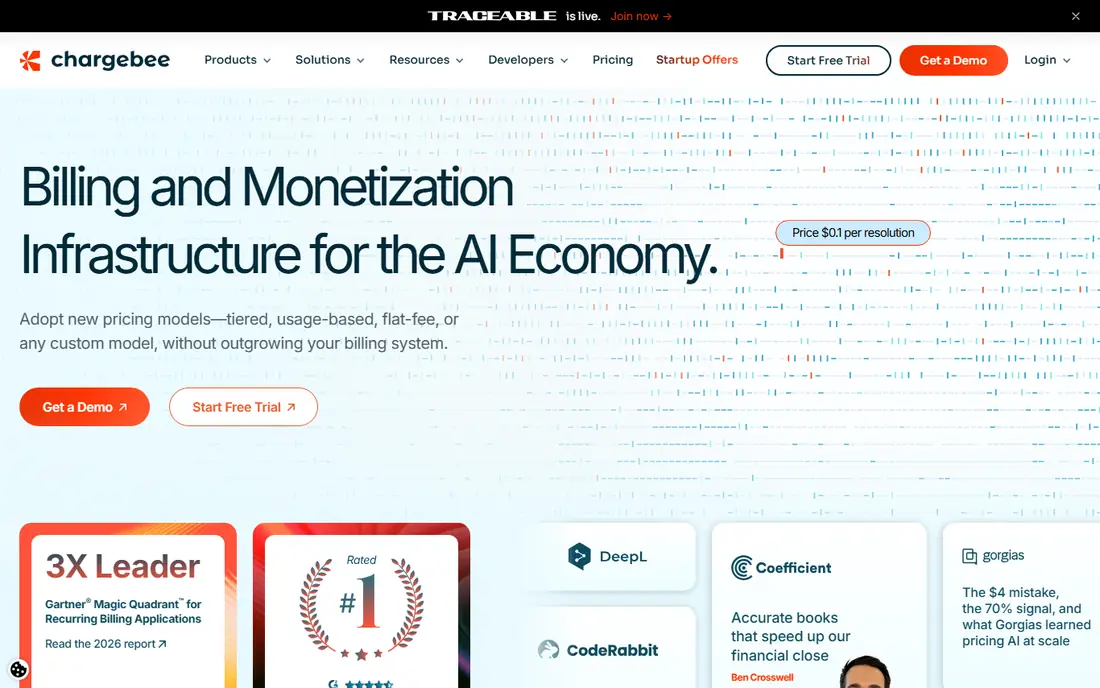
Chargebee is the most direct billing-layer alternative for SaaS teams that want flexibility without being tied to one processor. It supports subscriptions, usage add-ons, coupons, and dunning, and it connects to multiple gateways, so you are not locked to a single payment route. Growth teams that change pricing often tend to value that flexibility most.
The catch is total cost. Chargebee charges its own fee on top of gateway processing fees, so a $99 per month plan plus a percentage of billing volume plus gateway fees adds up. Model a full month of real volume, including failed payments, before comparing it with a merchant of record price.
- Broad subscription and pricing models
- Multi-gateway support
- Dunning and retention tools
- Platform fee sits on top of gateway fees
- Advanced revenue recognition is a separate product

Recurly suits subscription businesses that care most about keeping subscribers and recovering failed payments. Its dunning workflows, retry logic, and analytics focus on involuntary churn, which is often the largest leak in a subscription business. It also supports multiple gateways, so teams can keep payment redundancy.
The trade-off is pricing transparency. Recurly uses quoted pricing for many plans, so budgeting requires a sales conversation about volume and features. Smaller teams should confirm whether the entry plan covers the dunning features they need, since some advanced recovery tools sit on higher tiers.
- Strong dunning and churn recovery
- Multi-gateway support
- Mature subscription analytics
- Pricing is quoted for many plans
- Setup suits mid-market and enterprise teams
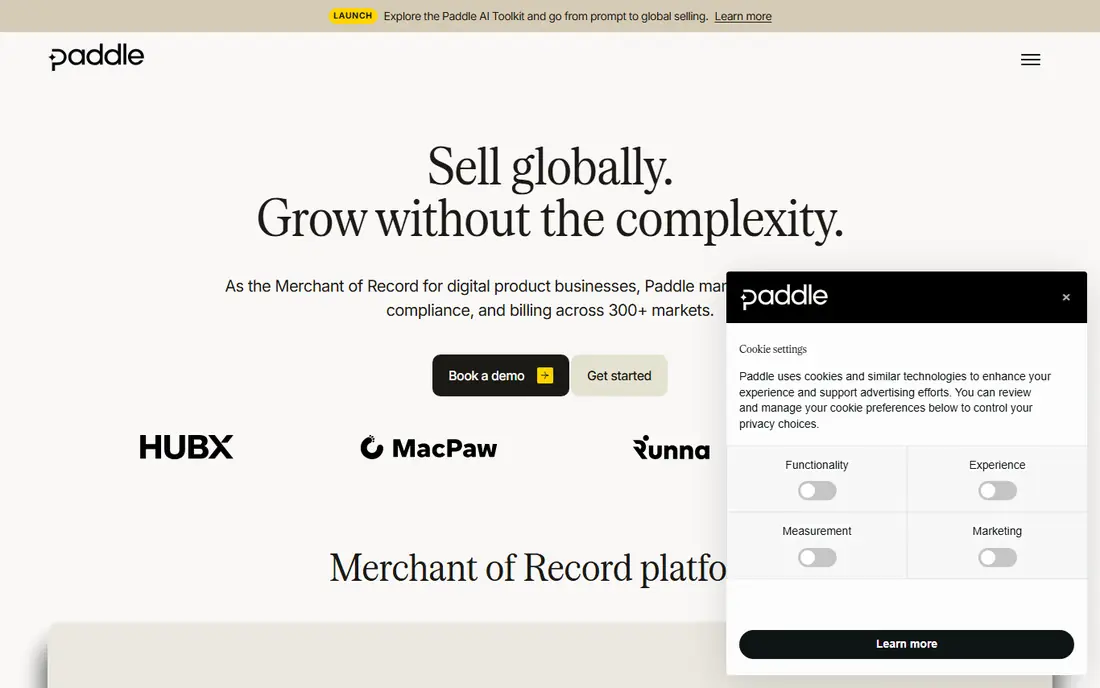
Paddle suits lean SaaS teams selling worldwide that do not want to register for tax in every country they sell into. As merchant of record, Paddle handles payments, global sales tax, and compliance, and its 5% plus $0.50 per transaction fee bundles those services with processing. For a small team, that single fee can be cheaper than hiring tax help.
The catch is control and cost at scale. At high volume, 5% per transaction costs more than a billing layer plus gateway fees, and you give up some control over the checkout and payout process. Larger teams should compare the Paddle fee against the full cost of tax tools, accountants, and gateway fees before deciding.
- Merchant of record handling for global tax
- Single fee covers processing and tax
- Checkout and billing together
- Higher percentage than a billing layer alone
- Less control over payment setup
Zuora is the enterprise heavyweight for companies with complex contracts, multiple entities, and formal revenue recognition needs. It covers quote-to-cash, subscription billing, and revenue management in one platform, which suits public companies and large B2B sellers with finance-led requirements. If your contracts involve negotiated terms, ramps, and renewals, Zuora is built for that complexity.
The barrier is scale. Pricing is quoted, implementation takes time, and the platform rewards teams with dedicated finance and RevOps staff. Smaller SaaS teams will find Chargebee, Recurly, or Zoho Billing faster to launch and far cheaper to run.
- Deep enterprise billing and revenue features
- Multi-entity and complex contract support
- CPQ options
- Quoted enterprise pricing
- Long implementation cycles
Maxio, formed from Chargify and SaaSOptics, suits B2B SaaS teams where finance leads the billing decision. It pairs subscription billing with SaaS metrics and revenue recognition, so finance teams can report on growth, churn, and deferred revenue from the same system. Its Grow plan starts at $599 per month for up to $100,000 in monthly billings.
The honest limit is entry cost. At $599 per month, Maxio is not a starter tool for a pre-revenue product. It earns its price when billing complexity, usage models, and finance reporting would otherwise need several separate tools.
- SaaS metrics and revenue recognition together
- Usage and hybrid billing support
- Quote-to-cash workflows
- Entry price suits funded or growing B2B teams, not early startups
- Advanced features sit on higher tiers
FastSpring suits software companies selling digital goods worldwide, especially those with business buyers who need quotes and invoices. As merchant of record, it handles payments, tax, and compliance, and it supports B2B invoicing alongside self-serve checkout. That combination helps desktop software and SaaS sellers with mixed buyer types.
The catch is pricing opacity. FastSpring sets its revenue share by volume and transaction type through a sales conversation, so you cannot compare it precisely without a quote. Teams with meaningful sales volume get the most from negotiating, while very early sellers may prefer a published-rate tool.
- Merchant of record for software and digital goods
- Global tax handling
- B2B quotes and invoicing
- Revenue share is quoted, not published
- Heavier commercial decision for a first launch
Zoho Billing suits small and mid-size businesses that want solid recurring billing without enterprise cost. Its Standard plan, billed annually, covers subscriptions, invoicing, and customer management at $25 per month per organization, with a Premium plan at $59 per month. Teams already using Zoho CRM, Books, or Desk get extra value from the shared data.
The limit is depth. Zoho Billing does not match Zuora or Maxio on complex contracts and enterprise revenue recognition. For straightforward subscriptions and invoicing, that gap rarely matters, and the price saving is real.
- Low entry price
- Recurring billing and invoicing together
- Integrates with other Zoho apps
- Less depth than enterprise billing tools
- Revenue recognition is limited to higher editions
Lemon Squeezy suits indie sellers, creators, and small software teams that want to start selling without a monthly fee. Its 5% plus $0.50 per transaction rate covers payment processing, global tax as merchant of record, fraud protection, and a storefront, with license key generation for software. Every account gets the full feature set, so there are no tier gates to navigate.
The trade-off is the same as with Paddle: a percentage fee that grows with revenue. At low volume, no monthly fee is a win. At high volume, a billing layer with a flat monthly fee plus lower gateway rates can cost less, so revisit the math as sales grow.
- Simple single rate with no monthly fee
- Merchant of record tax handling
- License keys and storefront included
- Percentage cost grows with sales
- Fewer enterprise billing features than Chargebee or Zuora
Lago suits engineering teams building usage-based products, such as AI or API services billed on consumption. It is open source, meters events, and supports complex usage pricing that flat subscription tools handle poorly. A free self-hosted option lets teams test metering without a vendor contract, with paid cloud tiers for managed use.
The catch is operations. Self-hosting needs engineering time, and Lago focuses on billing, not on full revenue recognition or tax handling. Pair it with accounting and tax tools if your business needs those, and budget engineering time for setup and maintenance.
- Open source usage-based billing
- Event-based metering
- Self-hosted option
- Needs engineering effort to run
- Revenue recognition usually needs a separate tool
How we picked these
We compared official pricing pages and public billing comparisons, and kept only platforms with a live subscription billing product that fits SaaS, software, or recurring sales. We wrote See website where pricing is quoted, and we flagged merchant of record status where it changes who handles tax. We did not list the subject product itself. This article is general information, not financial advice.
What to check before you buy
Decide billing layer or merchant of record first
A billing layer gives you control and often lower fees, but leaves tax registration and filing with you. A merchant of record charges more per transaction but takes on tax and compliance. That single choice narrows the shortlist more than any feature comparison.
Model total cost on real volume
Add platform fees, gateway fees, tax tool costs, and failed payment losses together for a typical month. A tool that looks cheap at $25 per month can cost more than a 5% merchant of record fee if gateway and tax costs are high, and the reverse is true at high volume.
Test dunning and invoicing with real customers
Run failed payment retries, invoice changes, plan upgrades, and refunds through a trial with test customers. Check how customers see invoices, how tax appears, and how support handles billing questions. Billing mistakes damage trust fast, so test the unhappy paths, not just a clean signup.
Frequently asked questions
What is the best Stripe Billing alternative for SaaS?
Chargebee and Recurly are the most common SaaS billing-layer picks, while Maxio suits finance-led B2B teams. Paddle and FastSpring suit global sellers that want tax handled for them. The best pick depends on whether you want control, low fees, or tax offloaded.
Is there a free Stripe Billing alternative?
Lago offers a free self-hosted open source option for usage billing, and Zoho Billing offers a free trial. Lemon Squeezy and Paddle charge no monthly fee, but take a percentage per transaction. Free in this market usually means no monthly fee, not no cost at all.
How much do Stripe Billing alternatives cost?
Entry costs range from free self-hosted use to $25 per month for Zoho Billing, $99 per month for Chargebee, and $599 per month for Maxio, with merchant of record tools at 5% plus $0.50 per transaction. Enterprise tools use quoted pricing. Model gateway and tax costs on top of the platform fee.
Do these tools handle global sales tax?
Paddle, FastSpring, and Lemon Squeezy act as merchant of record and handle global sales tax for transactions they process. Billing layers such as Chargebee, Recurly, and Zuora generally need a separate tax tool or integration. Confirm tax coverage for your exact countries before you launch.
Can I migrate subscriptions from Stripe Billing?
Most vendors offer migration tools or services for subscriptions, customers, and payment methods, but payment method migration often needs cooperation from your current gateway. Ask for a migration plan, a test import, and a timeline for payment method transfer early. Keep the old system running until the first renewal cycle succeeds.
Sources
See where you really rank - block by block
ProMapRanker scans Google Maps across a grid of your service area. Simple monthly plans from $19, white-label on every plan.
Start freeKeep reading
 zscaler alternatives
Best Zscaler Alternatives in 2026
Looking for zscaler alternatives? We compare 9 SASE and zero trust platforms on architecture, data protection, pricing, and fit for your network and team.
Read → zapier alternatives free
Best Zapier Alternatives Free in 2026
Nine automation tools for zapier alternatives free in 2026, all with genuinely free tiers, plus free plan limits, starting prices and upgrade paths explained.
Read → which platform is best for online reputation
Which Platform Is Best for Online Reputation in 2026
Wondering which platform is best for online reputation? We compare 8 review, listing, and response tools for small and multi-location businesses and agencies.
Read →