 ProMapRanker
Streamlit Alternatives in 2026


data teams that need production dashboards · Pricing starts at: Free
Key takeaways
- Dash is the strongest production Python framework, while Gradio is fastest for model demos.
- Panel, Shiny for Python, Taipy, and marimo suit data teams that want reactive, Python-first apps.
- Anvil adds a visual builder and a built-in database for small business apps.
- Retool suits governed internal tools, and Reflex offers a Python-only full-stack path.
- Most open-source options are free to run, with costs coming from hosting and support.
Quick comparison
| Pick | Great for | Pricing starts at | Free tier | |
|---|---|---|---|---|
| Dash by Plotly | data teams that need production dashboards | Free | Yes | Visit |
 Gradio | machine learning demos and prototypes | Free | Yes | Visit |
 Panel | interactive dashboards from Python data tools | Free | Yes | Visit |
 Anvil | custom apps with a built-in database | $15 per month | Yes | Visit |
 Shiny for Python | R and Python teams prototyping web apps | Free | Yes | Visit |
 Taipy | data visualization with scenarios and pipelines | Free | Yes | Visit |
 marimo | reproducible notebooks as apps | Free | Yes | Visit |
 Retool | polished internal business apps with governance | See website | Free trial | Visit |
 Reflex | full-stack web apps in pure Python | Free | Yes | Visit |
The best streamlit alternatives
Streamlit made Python data apps fast to build, but teams often leave it for better production control, a visual builder, a database, or a more polished business app. The alternatives below cover those needs, from open-source frameworks to governed business platforms.
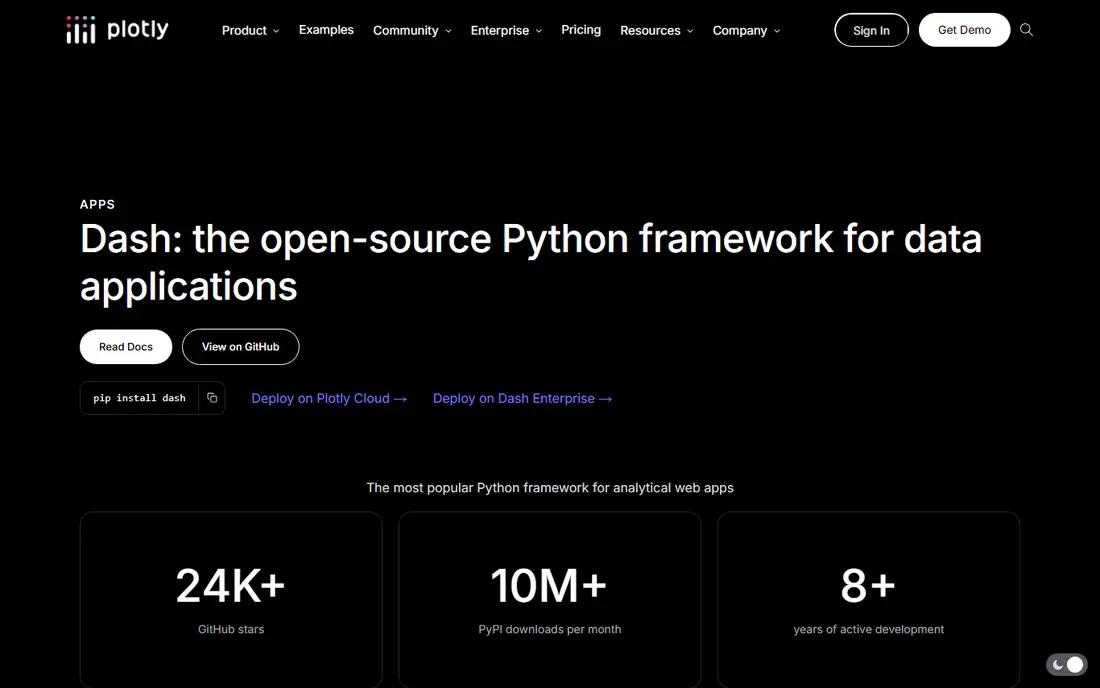
For many readers, this is the first option worth a close look. Dash, from Plotly, is the most production-minded Python alternative here. Its callback graph updates only the parts of a page that changed, which helps when many users interact with different parts of a dashboard at once. Plotly charts are built in, so data teams get polished visuals without adding a separate chart library.
The open-source Dash package is free and fully functional, but hosting, auth, and support sit in Dash Enterprise, which is priced by quote and aimed at larger organizations. Teams that can host Dash themselves get a strong framework for free. Teams that need managed hosting should price Enterprise early.
- Open-source Python framework
- Callback graph updates only changed parts
- Plotly charts
- Production hosting and auth need Dash Enterprise
- Learning curve for callbacks

A different kind of fit shows up here. Gradio is the fastest way to turn a machine learning model into a demo someone else can try. A few lines of Python create inputs, outputs, and a shareable interface, and Hugging Face Spaces offers hosting for demos. That speed makes Gradio the default for model demos, class projects, and quick internal trials.
Complex multi-page apps are not its strength, and design control is more limited than Dash or Retool. If you need a polished business app with many pages and permissions, Gradio will feel thin. If you need a working demo today, Gradio is hard to beat.
- Fastest path to a model demo
- Simple interface components
- Hugging Face hosting option
- Less suited to complex multi-page apps
- Design control is limited
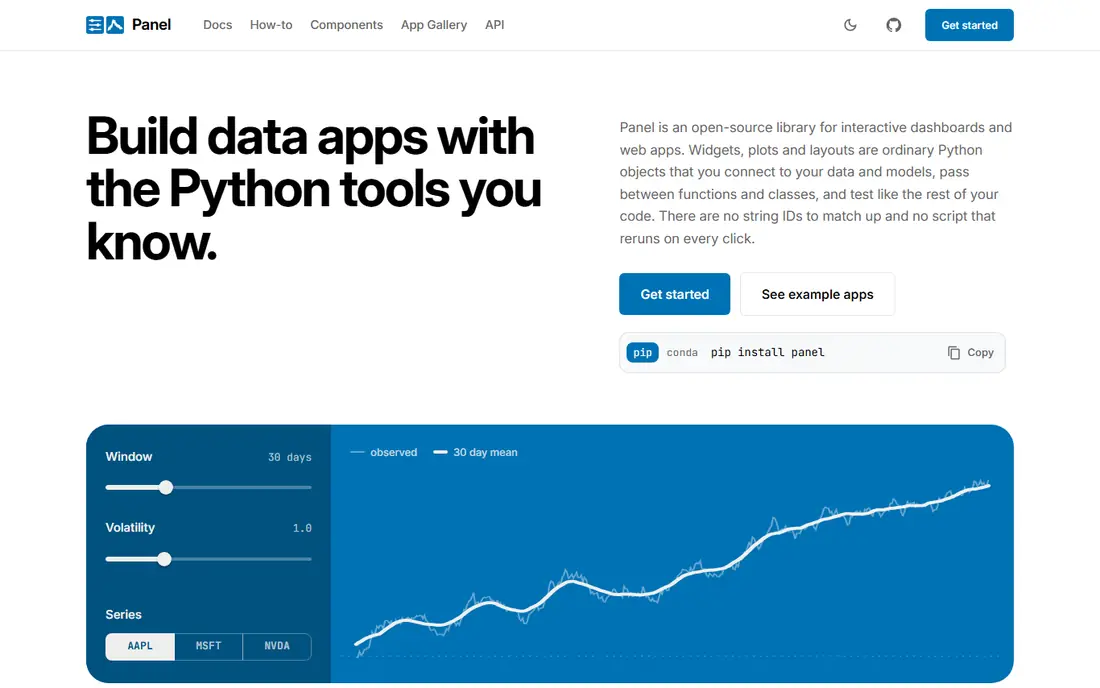
This one earns its place for a clear reason. Panel, from HoloViz, builds interactive dashboards from Python data tools and many plotting libraries. It suits data scientists who already use tools in that ecosystem and want reactive dashboards without leaving Python. The framework is open-source and flexible, with support for notebooks, scripts, and served apps.
Styling and polished layouts need more work than in a drag-and-drop tool, and the docs assume some data science background. Teams that want a business-ready look with little code may prefer Anvil or Retool. Teams that live in Python data tools will find Panel a natural fit.
- Works with many Python plotting libraries
- Reactive dashboards
- Open-source
- Styling needs more work than some rivals
- Docs assume data science background
If the options above feel too narrow, consider this one. Anvil combines a drag-and-drop builder with Python code and a built-in database, so you can design an interface visually and still write logic in Python. You can query, edit, and delete data with Python statements, publish in one click, and host apps in the cloud. That mix suits small business apps that need real data handling, not just charts.
Some components have limits noted by users, and custom features sit behind paid tiers, with Hobby starting at $15 per month. Support can also be uneven for edge cases. If you want a visual builder plus Python and a database, Anvil is a strong Streamlit alternative.
- Drag-and-drop builder plus Python code
- Built-in database
- One-click publishing
- Some components have limits
- Paid tiers needed for custom features
Here is a pick that suits a smaller, specific audience. Shiny for Python brings the reactive model that R users know to Python. When an input changes, dependent outputs update, which makes interactive prototypes feel natural. It is free and open-source, and it fits teams already in the Posit ecosystem or moving from R Shiny to Python.
The Python community is smaller than Streamlit, so examples and third-party components are fewer. Deployment also needs Posit Connect, Posit Connect Cloud, or self-hosting. For prototyping and internal tools, Shiny for Python is a solid, code-first pick.
- Reactive programming model
- Posit ecosystem
- Free and open-source
- Smaller Python community than Streamlit
- Deployment needs Posit or self-hosting
This entry stands out for how it handles the basics. Taipy adds something Streamlit lacks: scenario management for what-if analysis. You can run different versions of a data pipeline, compare outcomes, and build dashboards around those scenarios in Python. That suits planning, forecasting, and operations teams that need to test options, not just show a chart.
The community is smaller than Streamlit, and scenario features take time to learn well. Teams that only need a simple dashboard may find Taipy heavier than needed. Teams that need scenario comparison will find that extra structure valuable.
- Scenario management for what-if analysis
- Python-first
- Open-source core
- Smaller community than Streamlit
- Scenario features need learning time
Another strong choice, with a trade-off worth naming. marimo is a reactive notebook for Python that can also deploy as an app. Run a cell, and dependent cells update or mark themselves stale, which removes hidden state problems that plague classic notebooks. Notebooks are stored as Python files, so they work well with git, and you can share a notebook as an interactive web app.
The ecosystem is newer than Streamlit, so hosted options and third-party components are fewer. Teams that need a managed cloud with one click may need to self-host. For data scientists who want reproducible notebooks that become apps, marimo is a fresh and practical alternative.
- Reactive notebooks stored as Python files
- Git-friendly
- Deploy notebooks as apps
- Newer ecosystem
- Fewer hosted options than Streamlit Cloud
For readers who want a simpler route, this one helps. Retool is for internal business apps that need polish, permissions, and governance. It offers visual components, business system connectors, workflows, mobile support, and audit logs, so a team can build tools that connect to real business systems safely. Developers and less technical builders can work on the same app.
Pricing is often quoted, and Retool is less Python-native than Streamlit, so data science teams may need to adapt their workflow. For business apps that must pass security review, Retool offers controls Streamlit alone does not. For a quick data demo, Streamlit or Gradio remain faster.
- Visual components plus code
- Business system connectors
- Permissions and audit logs
- Pricing needs a quote for many teams
- Less Python-native than Streamlit
The last pick in this list fills a gap the others leave open. Reflex lets you build a full-stack web app in pure Python, covering both front end and back end without writing JavaScript. That appeals to Python teams that want a real web app, not just a dashboard, and want to stay in one language. It is open-source and can be deployed as a standard web app.
The framework is newer than Streamlit, so the component set and community are still growing, and deep front-end customization takes learning. Teams that need a proven, large ecosystem may prefer Dash or Panel. Teams that want a Python-only full-stack path will find Reflex promising.
- Build front end and back end in Python
- Open-source
- Deployable as a web app
- Newer framework
- Front-end customization needs learning
How we picked these
We compared official documentation, pricing pages, and deployment options for each tool, and we noted where pricing is quoted rather than listed. We favored tools that exist and work in October 2026, that build real data or business apps, and that offer a clear advantage over Streamlit for at least one audience. We did not claim hands-on testing we did not do, and we treated managed hosting as a separate cost from the free framework.
How to pick a Streamlit alternative for your next app
Start with the app type. For a model demo, pick Gradio. For a production dashboard, pick Dash. For a business app with a database, pick Anvil. For a governed internal tool, pick Retool. For a reproducible notebook that becomes an app, pick marimo. Next, check deployment. Streamlit Community Cloud only hosts Streamlit, so other frameworks need a container host, a managed platform, or self-hosting. Count users and permissions early, since a tool that is free for one builder can cost more for a team with viewers and admins. Finally, build the same small app in two finalists and compare how long styling, auth, and deployment take. That small build reveals more than a feature list.
Frequently asked questions
What are the best alternatives to Streamlit?
Dash, Gradio, Panel, Anvil, Shiny for Python, Taipy, marimo, Retool, and Reflex are the main options, with Dash best for production dashboards, Gradio best for demos, and Anvil best for database-backed business apps.
Is there a free alternative to Streamlit?
Yes. Dash, Gradio, Panel, Shiny for Python, Taipy, marimo, and Reflex are free and open-source, while Anvil offers a free tier. Costs usually come from hosting, managed services, and support, not from the framework itself.
Which Streamlit alternative is best for data apps?
Dash is the strongest pick for production data dashboards, Panel suits teams in the HoloViz ecosystem, and Taipy suits scenario and what-if analysis. For a quick demo, Gradio is faster than all three.
Can I build apps without code as a Streamlit alternative?
Anvil offers a drag-and-drop builder with Python code behind it, and Retool offers visual components for internal tools. Both suit builders who want less code, though complex logic still benefits from code.
Sources
See where you really rank - block by block
ProMapRanker scans Google Maps across a grid of your service area. Simple monthly plans from $19, white-label on every plan.
Start freeKeep reading
 zscaler alternatives
Best Zscaler Alternatives in 2026
Looking for zscaler alternatives? We compare 9 SASE and zero trust platforms on architecture, data protection, pricing, and fit for your network and team.
Read → zapier alternatives free
Best Zapier Alternatives Free in 2026
Nine automation tools for zapier alternatives free in 2026, all with genuinely free tiers, plus free plan limits, starting prices and upgrade paths explained.
Read → which platform is best for online reputation
Which Platform Is Best for Online Reputation in 2026
Wondering which platform is best for online reputation? We compare 8 review, listing, and response tools for small and multi-location businesses and agencies.
Read →