 ProMapRanker
Best Storylane Alternatives in 2026

Key takeaways
- Screenshot tours, HTML demos, and sandbox demos are different formats, and the right tool depends on which format your buyers need.
- Navattic is the closest HTML first match, while Supademo and Arcade suit teams that want fast, lower cost tours.
- Walnut, Reprise, and Consensus suit enterprise sales teams, but their pricing is quote based and higher.
- Guideflow and HowdyGo offer lower cost routes into interactive demos, with simpler editing and sharing.
- Storylane itself is not listed here, since this article covers alternatives to it.
Quick comparison
| Pick | Great for | Pricing starts at | Free tier | |
|---|---|---|---|---|
 Navattic | HTML product demos | $500 per month | Yes | Visit |
 Supademo | Fast low cost demos | $38 per creator per month | Yes | Visit |
 Arcade | Polished screenshot demos | $32 per user per month | Yes | Visit |
 Walnut | Enterprise sales personalisation | $575 per month | No | Visit |
 Reprise | Cloned product environments | See website | No | Visit |
 HowdyGo | Flat priced HTML demos | See website | Free trial | Visit |
 Guideflow | Low cost guided tours | $35 per month | Yes | Visit |
 Consensus | Video led buyer demos | See website | No | Visit |
The best Storylane alternatives
Storylane builds interactive product demos for marketing and sales, with screenshot tours, HTML demos, and demo hubs. Teams usually look elsewhere because per seat costs rise, because they want a simpler capture workflow, or because they need a full sandbox environment for sales. The tools below cover those reasons in different ways. We compared official pricing pages and recent comparisons, and we did not list Storylane itself.
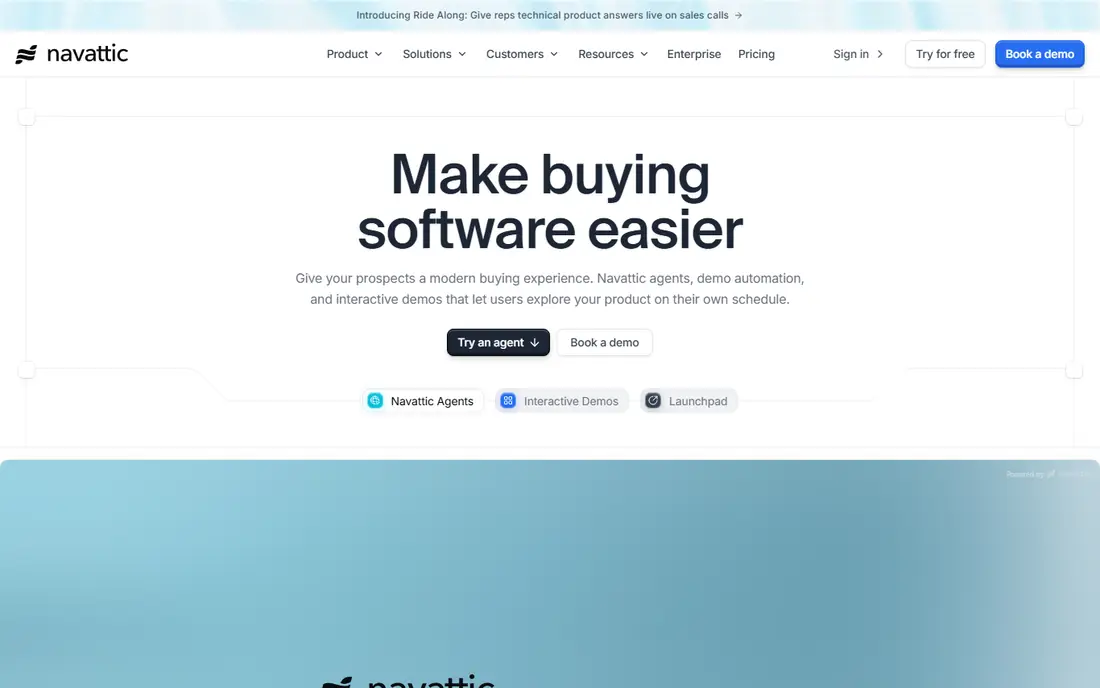
Navattic is the closest match for teams that want HTML demos that behave like the live product. It clones the front end of your app, so hover states, animations, and interactions feel real to a prospect rather than like a slide deck. Analytics and CRM connections help sales and marketing teams see which accounts engage and where they drop off.
The price is the main barrier. The Base plan starts at $500 per month in recent comparisons, which puts Navattic out of reach for a small team that only needs a few tours. Production also takes longer than a screenshot tool, since HTML capture needs more setup and checking. For enterprise marketing teams, that fidelity is worth it, but smaller teams should test a cheaper tool first.
- Full HTML capture
- Strong analytics
- CRM connections
- High entry price
- Slower production than screenshot tools
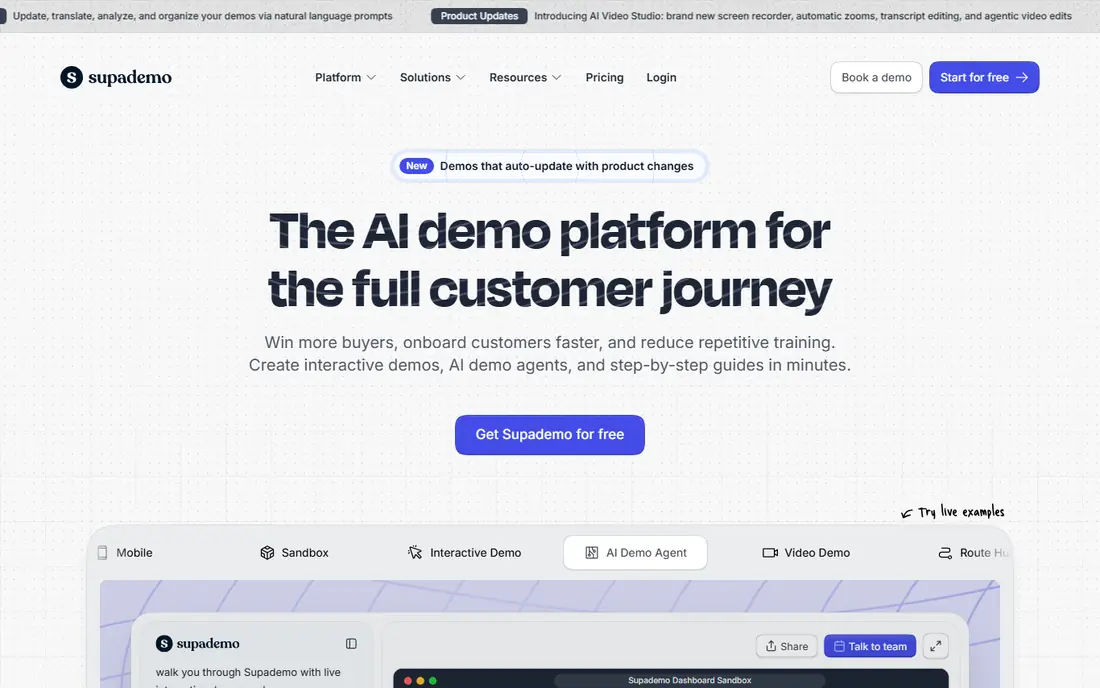
Supademo suits teams that want to publish demos quickly without a sales call. The free plan covers a small set of demos, and the Scale plan at $38 per creator per month billed annually adds more capacity and AI voiceovers. Capture is straightforward, and the same library can serve marketing pages, onboarding, and support articles.
Higher end formats cost more. Guided HTML demos start on the Business tier and sandbox demos on Growth in recent comparisons, so a team that needs HTML as the core format should budget above the entry price. Per creator pricing also grows as more people build demos, so check who actually needs a creator seat before rolling it out widely.
- Free plan
- Fast capture
- Video and HTML formats on higher tiers
- HTML and sandbox features sit on higher tiers
- Per creator pricing adds up
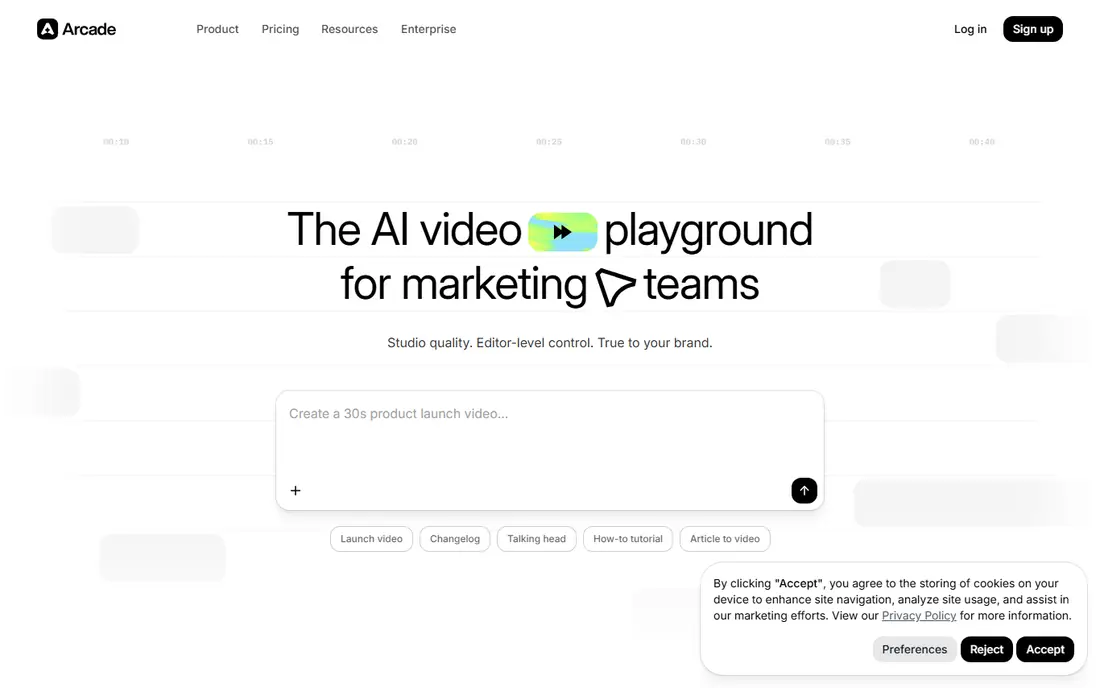
Arcade starts from a screen recording and turns it into an interactive tour, which is why teams describe it as fast to use. Hotspots, chapters, branching, and AI voiceover can be added in the editor, and finished demos export as GIFs or video for social and email use. That multi format output suits product marketing teams that need one recording to work in several channels.
The limit is HTML control. Full HTML capture sits on the Enterprise tier, so teams that need pixel perfect interactive clones should look at Navattic instead. Analytics are useful but less deep than enterprise demo platforms. For marketing led demos where speed and polish matter most, Arcade is a strong first evaluation.
- Fast record first workflow
- GIF and video exports
- Clean design
- HTML capture needs Enterprise
- Analytics depth is lighter than Navattic
Walnut is built for enterprise sales and presales teams that personalise demos for named accounts. It supports cloned front ends, sandbox environments, and digital sales rooms where buyers can explore a tailored demo on their own. That combination suits deal heavy teams that need governance, security review, and consistent branding across a large demo library.
The buying model is the trade off. Walnut starts at $575 per month billed annually in recent comparisons, with sandbox demos on a higher tier, and there is no free plan to test it casually. Smaller teams will find Supademo or Arcade far cheaper, but a sales organisation that lives on personalised demos may find the structure worth the cost.
- Sales personalisation
- Sandbox demos
- Digital sales rooms
- Annual contract
- No free plan
- High entry price
Reprise goes further than a tour by cloning a full product environment that sales teams can tailor for each prospect. That depth matters when a demo needs live data, complex workflows, or multiple modules that a screenshot tour cannot show. Enterprise security and governance features support large sales organisations with strict review processes.
The cost is implementation time and a quote based price. Reprise is not a self serve tool you test in an afternoon, and smaller teams will find the setup heavy for simple marketing tours. If your product is complex and your sales cycle depends on realistic demos, Reprise is worth a demo, but budget for onboarding as well as the subscription.
- Full product clones
- Live data control
- Enterprise security
- Quote based pricing
- Needs implementation time
HowdyGo appeals to teams that dislike per seat pricing. Its model is flat priced, with unlimited users on some plans in recent coverage, which makes budgeting simpler as more people view or build demos. HTML capture gives prospects a realistic product experience, closer to Navattic than to a simple screenshot tour.
Pricing is the point to verify, since published figures for HowdyGo differ across sources, so we list See website rather than a single number. The ecosystem of integrations and templates is also smaller than larger rivals. For a team that wants HTML demos without per seat growth, HowdyGo is worth a trial, with a quote confirmed in writing.
- HTML demos
- Flat pricing model
- Unlimited users on some plans
- Pricing figures conflict across sources
- Smaller ecosystem
Guideflow is the low cost route into interactive demos for small teams and startups. Guided tours are quick to build and share, and the entry price at $35 per month in recent comparisons undercuts most rivals in this list. The free plan lets a team test tour building and embedding before paying anything.
Depth is the limit. Guideflow does not match Walnut or Reprise for enterprise sales personalisation, sandbox environments, or governance. If your main need is a clear product tour on a website or in onboarding, that simplicity is a strength. If you need deep analytics and deal level personalisation, a higher tier tool will fit better.
- Low entry price
- Simple guided tours
- Free plan to test
- Less depth for enterprise sales
- Fewer sandbox options
Consensus takes a different approach by building video led demos for buying groups rather than single viewer tours. Prospects can watch a tailored demo, share it with colleagues, and signal intent, which helps sales teams see which stakeholders are engaged. That buyer group view is useful in complex B2B sales with several decision makers.
The model is also the adjustment. Consensus is not a direct replacement for a screenshot tour builder, and its pricing is quote based, which puts it in the enterprise range. Teams that want simple website tours should pick Supademo, Arcade, or Guideflow instead. Teams that sell to buying committees and need intent data will find Consensus a distinct and useful alternative.
- Buyer group demos
- Intent analytics
- Video led experience
- Quote based pricing
- Different model from screenshot tours
How we picked these
We compared official pricing and feature pages with recent comparisons of demo automation tools, and we kept only tools whose core job is interactive product demos. We excluded Storylane itself, and we marked pricing as See website where figures conflicted across sources or where pricing is quote based. We included a mix of screenshot, HTML, and sandbox tools, since Storylane users leave for different reasons and a single format does not fit every team.
Choosing the right Storylane alternative for your team
Start with the format your buyers need. Website visitors and new users usually do well with screenshot tours from Supademo, Arcade, or Guideflow. Marketing teams that need realistic interactions should test Navattic or HowdyGo for HTML demos. Sales teams that personalise demos for named accounts should evaluate Walnut, Reprise, or Consensus, with a clear view of contract length and implementation time.
Then test with a real demo, not a sample. Build one tour for a feature your buyers actually ask about, embed it where they will see it, and check analytics for completion and drop off. A tool that is fast to build but weak on analytics may suit marketing, while a slower tool with strong CRM data may suit sales. Confirm pricing for your creator count in writing, since per seat and per creator models diverge quickly as teams grow.
Frequently asked questions
Which Storylane alternative is closest to Storylane?
Navattic is the closest HTML first match, since it also captures live apps as editable HTML for marketing and sales demos. Supademo is close for teams that use Storylane across marketing, sales, and onboarding, with a lower entry price. The best match depends on whether HTML fidelity or low cost matters more to your team.
Are there free Storylane alternatives?
Supademo, Arcade, Navattic, and Guideflow each offer a free tier with limits on demo counts, branding, or features. No free tier in this list matches a paid plan for HTML editing, sandbox demos, or advanced analytics. Use a free tier to test capture and sharing, then upgrade for the format and analytics your team needs.
What is the cheapest Storylane alternative for small teams?
Guideflow at $35 per month and Arcade at $32 per user per month are among the lowest entry prices in this list, with Supademo close behind at $38 per creator per month. The cheapest option depends on how many creators you need, since per user pricing grows with team size while flat priced tools such as HowdyGo scale differently.
Do I need HTML demos or are screenshot tours enough?
Screenshot tours are enough for website tours, onboarding, and simple feature walkthroughs, and they are faster to build. HTML demos matter when prospects need to interact with realistic product behaviour, such as hover states, forms, and navigation. If your demo needs to feel like the live product, budget for an HTML tier rather than a screenshot only plan.
Can I migrate demos from Storylane to another tool?
Most tools do not offer a direct import of Storylane demos, so expect to rebuild tours in the new editor. Capture the original product flows again, reuse your scripts and screenshots where possible, and prioritise the demos with the highest traffic first. A rebuild also gives you a chance to shorten tours that had high drop off rates.
Sources
See where you really rank - block by block
ProMapRanker scans Google Maps across a grid of your service area. Simple monthly plans from $19, white-label on every plan.
Start freeKeep reading
 zyte alternatives
Best Zyte Alternatives in 2026
These zyte alternatives cover managed scraping APIs, proxy networks and no code tools for lawful collection from your own or consented sources only in 2026.
Read → zerto alternatives
Best Zerto Alternatives in 2026
Compare the best zerto alternatives for disaster recovery and replication, with recovery targets, cloud options and honest trade-offs for teams in 2026.
Read → zerofox alternatives
Best ZeroFox Alternatives in 2026
We compared 9 zerofox alternatives for brand protection, phishing takedowns, dark web monitoring, and social impersonation, with clear coverage notes.
Read →