 ProMapRanker
Best Spotify Backstage Alternatives in 2026

Key takeaways
- This article covers alternatives to Backstage, the open-source developer portal originally built at Spotify, including managed portals and hosted Backstage options.
- Port and Cortex are our picks for managed portals, with Port offering a flexible data model and Cortex leading on scorecards and engineering standards.
- Atlassian Compass is the cheapest paid route at $7.67 per user per month, and it is the natural pick for teams already running Jira and Bitbucket.
- Roadie suits teams that want Backstage itself without self-hosting it, while Qovery and Humanitec suit teams that also want deployment orchestration.
Quick comparison
| Pick | Great for | Pricing starts at | Free tier | |
|---|---|---|---|---|
 Port | Flexible managed portal | $30 per seat per month | Free trial | Visit |
 Cortex | Scorecards and standards | See website | Free trial | Visit |
 OpsLevel | Service ownership and maturity | See website | Free trial | Visit |
 Roadie | Managed Backstage | $24 per developer per month | No | Visit |
 Atlassian Compass | Jira and Bitbucket shops | $7.67 per user per month | Yes | Visit |
 Harness Internal Developer Portal | Harness platform teams | See website | Free trial | Visit |
 Red Hat Developer Hub | Enterprise Backstage distribution | See website | Free trial | Visit |
 Qovery | Portal plus deployment | See website | Yes | Visit |
 Humanitec | Platform orchestration | See website | No | Visit |
 Mia-Platform Console | Enterprise internal platforms | See website | Free trial | Visit |
The best Spotify Backstage alternatives
Backstage is the open-source framework for building internal developer portals, originally created at Spotify and now a CNCF project. It gives platform teams a service catalog, documentation, software templates and a plugin ecosystem, but self-hosting it takes real engineering effort. The alternatives below split into managed portals that replace Backstage, hosted Backstage services that run it for you, and orchestration platforms that add deployment to the portal idea.
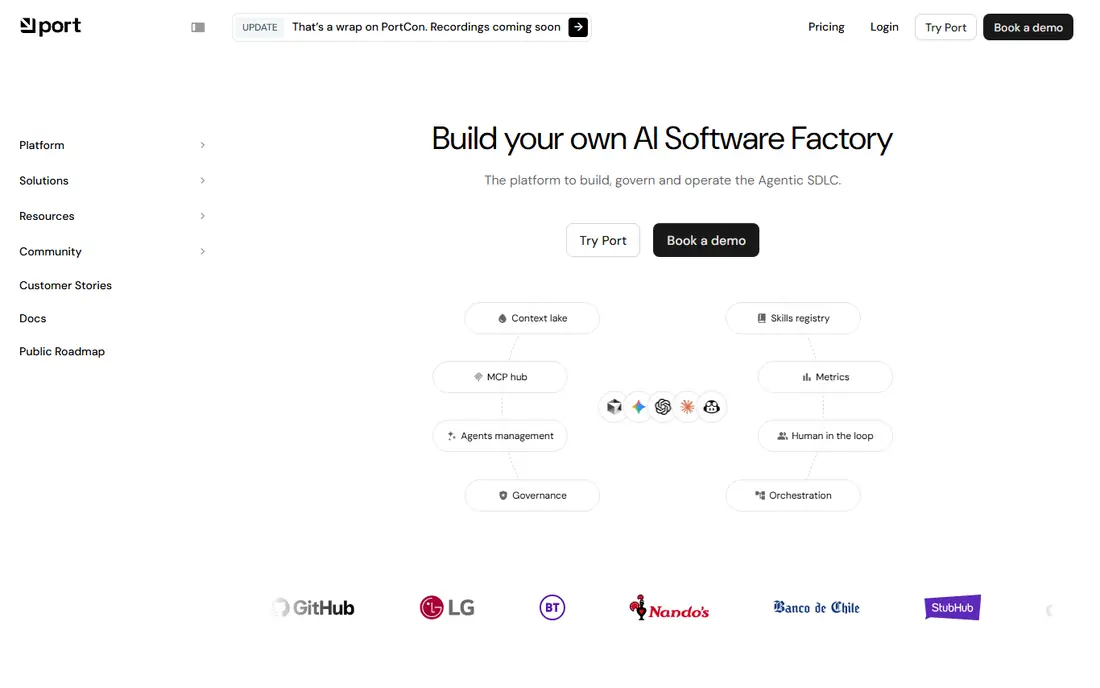
Port is a managed internal developer portal built around a flexible data model. Teams can model services, APIs, environments, cloud resources and any other entity in one catalog, then add scorecards, self-service actions and RBAC on top. The vendor maintains integrations, which removes the plugin upkeep burden that makes self-hosted Backstage expensive.
Pricing starts at $30 per seat per month on Basic, with Standard at $40 per seat per month, so costs scale directly with portal users. For platform teams that want a polished portal without a dedicated team maintaining it, Port is our top managed pick, especially where the data model needs to cover more than just services.
- Flexible data model for any entity
- Catalog plus scorecards
- Vendor maintains integrations
- Per-seat pricing scales fast
- Standard plan costs $40 per seat per month
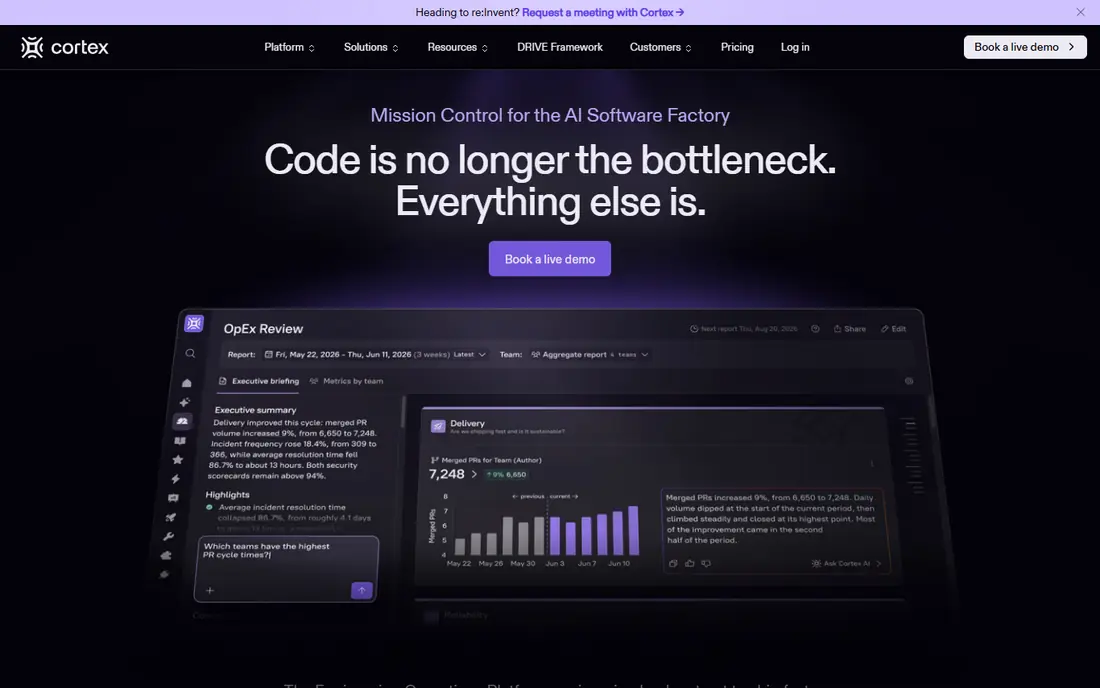
Cortex is a managed portal that leads on engineering standards. Its scorecards track production readiness, security and operational maturity across every service, and initiatives drive migrations and standards adoption with clear ownership and progress tracking. The interface is polished, and the vendor handles integrations and upkeep.
Pricing is quote-based and per seat, with published comparisons noting enterprise-scale costs, so small teams should get a quote early. For organisations whose main problem is inconsistent standards across hundreds of services, Cortex is the best scorecard-driven alternative to Backstage.
- Strongest scorecards and initiatives
- Service ownership clarity
- Polished interface
- Quote-based pricing
- Per-seat cost scales at enterprise size
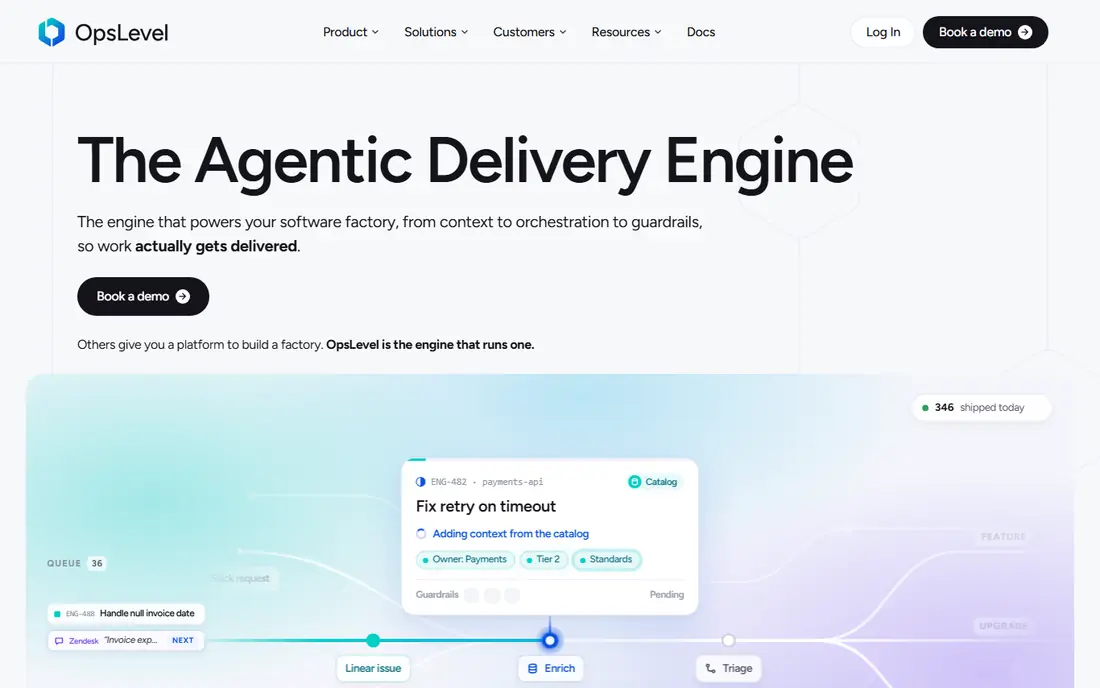
OpsLevel is the fastest route to a working service catalog on this list. It automates catalog creation and maintenance, tracks service ownership and maturity, and adds automation and workflows for standards enforcement and migrations. AI-powered insights help leaders see where services fall short.
Pricing is quote-based and per developer using the portal, with volume discounts reported. Its data model is less flexible than Port, and it is less template-focused than Backstage itself. For teams that need ownership and maturity visibility quickly, OpsLevel is a strong, pragmatic choice.
- Fast catalog setup
- Clear service ownership and maturity tracking
- Automation and workflows
- Quote-based pricing
- Less flexible data model than Port
Roadie is a hosted Backstage service: you get the real Backstage catalog, software templates, documentation and plugin ecosystem, without running the infrastructure yourself. Managed upgrades, RBAC and support remove the maintenance tax that drives teams away from self-hosted Backstage, and optional Tech Insights scorecards add maturity tracking.
Pricing is published per developer, with recent figures around $24 per developer per month on Teams tiers, though exact tiers vary. Deep customisation still follows the Backstage plugin model and can need React skills. For teams that want Backstage itself but not the hosting burden, Roadie is the natural pick.
- Real Backstage with managed upgrades
- Plugin ecosystem
- Optional scorecards
- Deep customisation still needs React skills
- Pricing varies by tier
Atlassian Compass is a developer experience platform that tracks services, systems and software health with scorecards, ownership and DORA metrics. A free tier exists, and paid plans start at $7.67 per user per month on Standard, rising to $23.96 on Premium, making it the cheapest paid portal here.
The catch is ecosystem fit: Compass shines for teams already running Jira and Bitbucket, and is thinner for teams on other tooling. Note also that Compass scaffolding and templates were deprecated on 1 December 2025, so teams that need golden-path templates should check current capabilities. For Atlassian shops, Compass is excellent value.
- Free tier available
- Cheapest paid plan here
- Deep Jira and Bitbucket integration
- Weaker outside the Atlassian world
- Software templates were deprecated in late 2025
Harness Internal Developer Portal is a Backstage-compatible portal sold as a module of the Harness platform rather than a standalone product. It provides a service catalog, templates and scorecards, and ties into Harness CI, CD, feature flags and cloud cost tools, which suits teams already standardising on Harness.
There is no standalone list price: it is licensed per developer with portal access inside Harness Enterprise plans, with newer Flex pricing metering it in Harness Subscription Units. Teams that do not use Harness elsewhere will find the bundle hard to justify. For Harness customers, it is a convenient, integrated portal option.
- Backstage-compatible portal inside Harness
- Ties into CI, CD and feature flags
- Enterprise governance
- No standalone list price
- Sold as part of Harness platform plans
Red Hat Developer Hub is a supported, enterprise distribution of Backstage, giving organisations the open-source portal with Red Hat support, lifecycle management and OpenShift integration. It suits enterprises that want Backstage with a vendor standing behind it, rather than a community-only deployment.
Pricing is not published and the sales process is enterprise-grade. Compared with Roadie, Red Hat Developer Hub fits organisations already running Red Hat platforms and wanting support contracts. For teams that want open-source Backstage with enterprise backing, it is a credible, heavyweight option.
- Supported enterprise Backstage distribution
- Red Hat support and lifecycle
- OpenShift integration
- Pricing not published
- Enterprise sales process
Qovery combines a developer portal with deployment orchestration. Its blueprint catalog lets developers self-serve environments and deployments in your own cloud, which goes beyond what a pure catalog portal does. A free plan is available, and the vendor maintains integrations.
Pure portal features such as scorecards and maturity tracking are thinner than Port or Cortex, and higher-tier pricing is enterprise-grade. For platform teams whose main gap is deployment self-service rather than catalog polish, Qovery covers both needs in one product.
- Blueprint catalog plus self-service deploys
- Runs in your own cloud
- Free plan available
- Portal depth is thinner than pure portals
- Higher-tier pricing is enterprise-grade
Humanitec is a platform orchestrator with a score-based catalog, designed to manage workloads and environments across clouds. It works alongside Backstage or other portals rather than replacing them outright, and its Score specification gives platform teams a standard way to define workloads.
Pricing differs structurally from per-seat portals: flat tiers price by environment capacity, with published comparisons noting Pro tiers around $5,499 per month for 50 users, and Enterprise by quote. There is no free plan. For teams building an internal platform around orchestration, Humanitec is a strong complement to a portal.
- Score-based orchestration
- Works with Backstage and other portals
- Environment management
- Quote-based pricing
- Flat tiers price by environment capacity, not headcount
Mia-Platform Console is an enterprise internal developer platform that combines a service catalog with compliance scorecards, microservices lifecycle management and deployment tooling. It suits regulated enterprises and large organisations building a full platform, not just a catalog.
Pricing is not published, and implementation is a project rather than a signup. Smaller teams will move faster with Compass or Roadie. For enterprises that need a governed, full-lifecycle platform with compliance tracking, Mia-Platform is a serious Backstage alternative.
- Full internal platform console
- Compliance scorecards
- Microservices lifecycle support
- Pricing not published
- Enterprise focus and implementation effort
How we picked these
We compared official product pages, pricing pages and platform documentation for internal developer portals and platforms that cover the same ground as Backstage: service catalogs, documentation, software templates, scorecards and self-service actions. We included managed portals, hosted Backstage distributions and orchestration platforms, and we favoured tools that are live and supported in October 2026. Where a vendor does not publish a price, we wrote See website rather than guess.
What to check before you switch
Start with the gap that hurts most. If developers cannot find services or owners, a catalog-first portal such as Port or OpsLevel helps fastest. If standards and production readiness are the problem, Cortex or Compass scorecards matter more. If golden-path templates are essential, confirm template support carefully, since Compass deprecated scaffolding in late 2025 and pure portals vary in template depth.
Count the real cost
Per-seat pricing means your bill is headcount times price times years, so model the cost at your developer count in two years. Managed portals save platform engineering time, which is the hidden cost of self-hosted Backstage: several engineers maintaining plugins and upgrades. Compare the vendor price with that staffing cost, not with zero, since Backstage itself is free but running it is not.
Pick by team shape
Small Atlassian teams should start with Compass free or Standard. Teams that want Backstage without hosting should pick Roadie or Red Hat Developer Hub. Managed portal buyers should compare Port and Cortex first, with OpsLevel for fast ownership tracking. Harness customers should evaluate the Harness portal, and orchestration-focused teams should look at Qovery and Humanitec.
Frequently asked questions
What is Backstage, and who built it?
Backstage is an open-source framework for building internal developer portals, originally built at Spotify. It provides a service catalog, documentation, software templates and a plugin ecosystem, and it is now a CNCF project used by many large engineering organisations.
Is Backstage free?
Yes, Backstage itself is open-source and free to use, but self-hosting it takes engineering time for setup, upgrades, plugins and maintenance. Managed options such as Roadie and Red Hat Developer Hub charge for running it for you, while managed portals such as Port and Cortex replace it with a vendor-run service.
What is the cheapest Backstage alternative?
Atlassian Compass is the cheapest paid option here, with a free tier and paid plans from $7.67 per user per month. Roadie and Port cost more per developer, but they include managed hosting or a fuller portal, so compare features as well as price.
Do I need a portal if my team is small?
Probably not. Teams under about 20 engineers can usually manage with a wiki, a repository list and good documentation. A portal earns its cost when service counts, ownership questions and onboarding time grow beyond what manual tracking handles.
Can I keep Backstage and add a portal tool?
Yes. Some teams run Backstage for catalog and templates while adding Cortex scorecards or Humanitec orchestration alongside it. Check integration support before buying, since overlap between tools can confuse developers if ownership of the catalog is unclear.
Sources
- https://www.port.io
- https://www.cortex.io
- https://www.opslevel.com
- https://roadie.io
- https://www.atlassian.com/software/compass
- https://www.harness.io
- https://developers.redhat.com/products/red-hat-developer-hub
- https://www.qovery.com
- https://humanitec.com
- https://mia-platform.eu
- https://platform-monkey.com/guides/backstage-alternatives
- https://www.qovery.com/blog/backstage-alternatives-developer-portals-buyers-guide
See where you really rank - block by block
ProMapRanker scans Google Maps across a grid of your service area. Simple monthly plans from $19, white-label on every plan.
Start freeKeep reading
 zoro.to alternatives
Best Zoro.to Alternatives in 2026
We compare the best zoro.to alternatives in 2026, listing only legal licensed anime streaming services, from Crunchyroll to free options for fans today.
Read → zip alternatives
Best Zip Alternatives in 2026
We compare the best zip alternatives for buy now, pay later in 2026, covering pay-in-4 plans, fees, spending limits, and credit reporting options today.
Read → yesware alternatives
Best Yesware Alternatives in 2026
Compare the best yesware alternatives for sales email tracking, templates, and sequences, with current pricing and honest tradeoffs for small sales teams.
Read →