 ProMapRanker
Best Alternatives to Contentful in 2026

Key takeaways
- Strapi is our pick for teams that want full control and free self-hosting, while Sanity suits teams that treat content as structured data.
- Storyblok is the strongest choice for marketing teams that want a visual editor, and Hygraph suits projects built around GraphQL.
- Contentful charges a steep jump from its free tier to paid plans, so several options here cost less at small and mid scale.
- Self-hosted tools save licence fees but add hosting and maintenance work, so count developer time, not only the subscription price.
Quick comparison
| Pick | Great for | Pricing starts at | Free tier | |
|---|---|---|---|---|
 Strapi | Self-hosted control | Free | Yes | Visit |
 Sanity | Structured content teams | Free | Yes | Visit |
 Storyblok | Visual page building | Free | Yes | Visit |
 Hygraph | GraphQL-first projects | Free | Yes | Visit |
 Contentstack | Enterprise governance | See website | No | Visit |
 Directus | Content over existing data | Free | Yes | Visit |
 Prismic | Marketing landing pages | Free | Yes | Visit |
 Payload | Code-first TypeScript teams | Free | Yes | Visit |
 DatoCMS | Media and GraphQL projects | Free | Yes | Visit |
The best alternatives to Contentful
Contentful is a capable enterprise headless CMS, but its pricing jump and its developer-first editing experience push many teams to look elsewhere. The platforms below all separate content from presentation, so your site, app or storefront can pull the same content through an API.
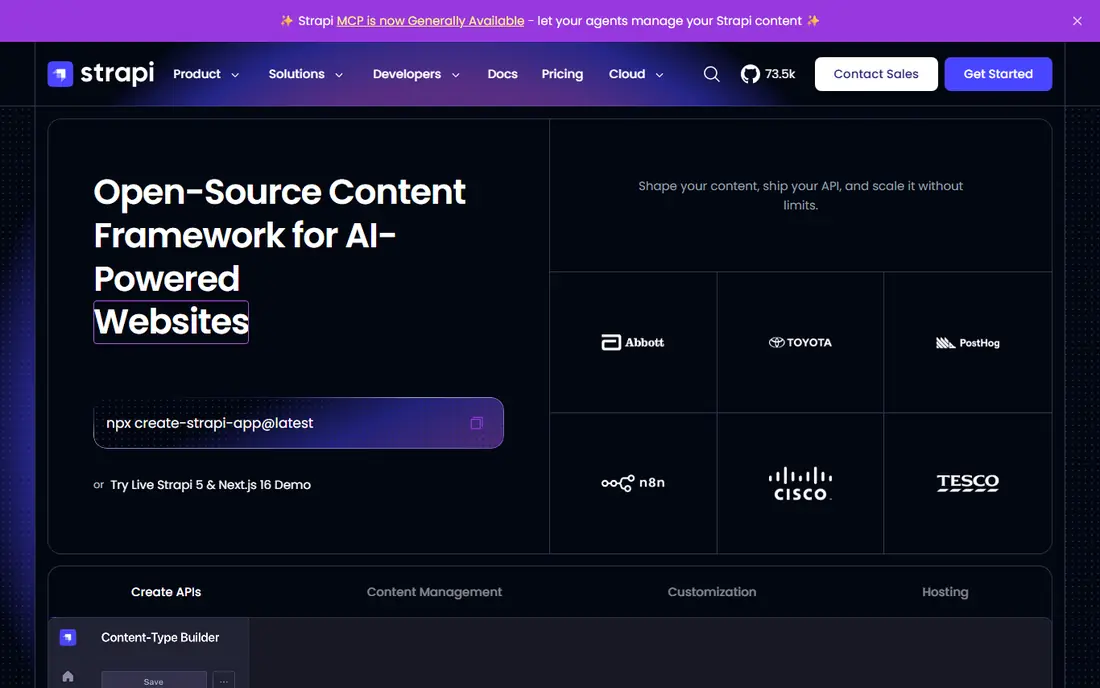
Strapi is the open source answer for teams that do not want their content locked inside a vendor cloud. You install it on your own server, shape content types in code or through its admin panel, and expose the result through REST or GraphQL. That control appeals to developers and to organisations with strict data rules.
The price of control is maintenance. Hosting, backups, upgrades and security patches become your job, and a small team without developer time can find that burden heavier than a monthly fee. Strapi also offers paid cloud hosting from $15 per month for teams that want a managed middle ground.
- Free open source self-hosting
- Full code and database control
- REST and GraphQL APIs
- You handle hosting, updates and security
- Editor experience is plainer than visual-first rivals

Sanity treats content as data first and pages second, which suits teams that reuse the same material across a website, an app and a help centre. Editors work in a customisable studio, developers query content with GROQ or GraphQL, and changes appear in real time for collaborators. That model scales well once the schema is settled.
The early setup is the hurdle. Sanity expects a developer to shape the studio and the content model, so a marketing team working alone may find the first weeks slow. Once that work is done, though, editors get a clean, fast tool that bends to their content instead of forcing content into fixed page templates.
- Flexible structured content model
- Real-time collaboration
- Strong query language in GROQ
- Needs developer setup before editors feel at home
- Pricing is per seat on paid plans
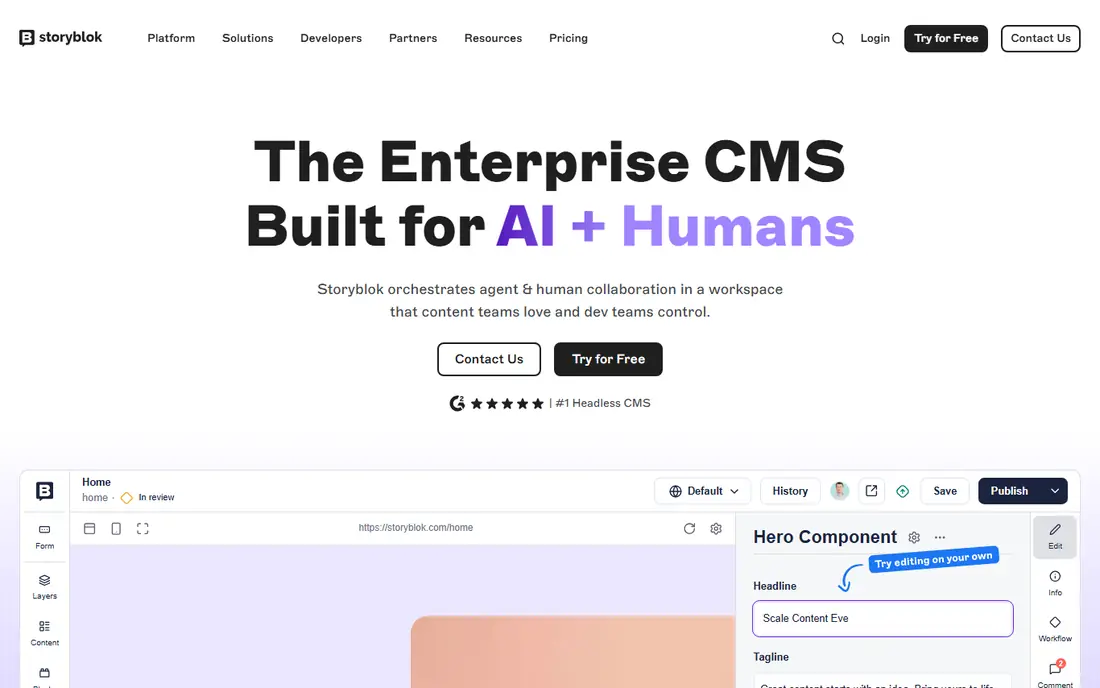
Storyblok is the pick when marketers, not developers, build most pages. Its visual editor lets editors assemble pages from components and see the result as they work, which cuts the back-and-forth that slows many headless projects. For agencies and brand sites, that speed is the main selling point.
Paid plans start at around $99 per month, which is more than a small hobby project may want to spend. Storyblok also fits page-shaped content better than deep, structured data projects. If your content is mostly pages and sections, it shines; if it is a web of linked records, Sanity or Hygraph may fit better.
- True visual editor for marketers
- Component-based pages
- Good collaboration tools
- Paid plans start higher than some rivals
- Weaker for content that is not page-shaped
Hygraph, formerly GraphCMS, is built around GraphQL from the ground up. Developers get a single API for content, and the platform can also pull in data from other sources, which suits projects that combine a CMS with product data or external records. Content modelling is clear, and the hosted service removes the maintenance work of self-hosting.
The community is smaller than the biggest names here, so you may find fewer tutorials and plugins for edge cases. Pricing also needs watching as traffic grows, because usage-based costs can climb. For a GraphQL team that wants a hosted, API-first CMS, Hygraph is still a strong, focused choice.
- Native GraphQL API
- Federated content from multiple sources
- Clean content modelling
- Smaller community than Strapi or Sanity
- Pricing rises with usage at scale
Contentstack is the enterprise-grade alternative, built for organisations with complex approval workflows, many brands and strict compliance needs. Roles and permissions are granular, localisation is handled well, and the platform is designed to keep large content operations orderly rather than merely fast.
That focus comes with enterprise pricing and a sales-led buying process, so small teams should look elsewhere. Contentstack makes sense when governance, audit trails and multi-region publishing matter more than a low monthly fee, and when a dedicated content team will use the workflow tools every day.
- Strong workflows and permissions
- Good localisation
- Built for large, multi-brand teams
- Enterprise pricing with no public entry tier
- Overkill for small sites
Directus takes a different approach from most headless CMS tools: instead of asking you to move content into its own store, it wraps your existing SQL database with a friendly admin app and APIs. That makes it a smart pick for projects that already have a database, or for teams that want to keep full ownership of their data.
The admin experience is more database-shaped than page-shaped, so marketers who want a visual page builder may prefer Storyblok or Prismic. Directus also offers managed cloud hosting for teams that want the tool without running servers, at a price that reflects the managed service.
- Free open source core
- Wraps any SQL database with an API
- No forced content migration
- Self-hosting takes effort
- Managed cloud starts around $99 per month
- Interface is data-focused
Prismic is built for marketing teams that ship landing pages and campaign sites often. Its Slice system lets editors reuse blocks such as hero sections, testimonials and pricing tables, so a new page can be assembled in minutes rather than built from scratch. Setup is fast, and the editor experience is one of the friendliest here.
The limit is depth. Prismic handles marketing content beautifully, but a project with deeply linked, structured data may outgrow it sooner than Sanity or Directus. Pricing is also worth checking carefully, because paid plans are priced per repository and can add up across many sites.
- Slice-based reusable blocks
- Quick setup
- Friendly editor experience for marketers
- Paid plans are per repository
- Less suited to very complex structured data
Payload is a code-first CMS for teams that already build in TypeScript and Next.js. Content models, access rules and hooks live in code, which gives developers precise control and keeps content logic in the same repository as the rest of the app. For a team that thinks in code, that unity is a real advantage.
Non-developers will feel the difference. Payload expects technical setup, and its ecosystem is smaller than Strapi's, so some features need hand-building. It also offers paid cloud hosting for teams that want management handled for them. Choose Payload when your stack is TypeScript and your team is comfortable owning the code.
- Free open source core
- TypeScript-first and code-driven
- Strong access control
- Developer-heavy setup
- Smaller plugin ecosystem than Strapi
- Managed cloud is paid
DatoCMS is a hosted headless CMS with a GraphQL API and particularly good handling of images and video. Editors get a clean modelling interface, developers get a predictable API, and media-heavy sites benefit from built-in image optimisation and transformations. For editorial sites with rich media, that combination is appealing.
The free tier is modest, and paid plans start above the cheapest options here, so small projects should compare total cost at their expected traffic. DatoCMS also has a smaller community than the largest platforms, which can mean fewer ready-made answers for unusual setups.
- GraphQL API
- Strong media handling
- Clean modelling for editorial teams
- Free tier is limited
- Paid plans start higher than some rivals
- Smaller community
How we picked these
We compared official pricing pages, documentation and public comparisons, and we chose platforms that are live, actively maintained and genuinely headless, meaning content is delivered through an API to any front end. Where pricing varies by seats, usage or edition, we used the free tier or the published entry price, and we wrote See website for enterprise tools that do not publish a price.
How to choose a headless CMS without regret
Start with who edits content most. If marketers build pages, weight the editor experience heavily and shortlist Storyblok and Prismic. If developers shape the content model, weight the API, the query language and the code experience, and shortlist Sanity, Strapi and Payload. A tool your editors avoid will fail no matter how good its API looks on paper.
Next, model the total cost at your real scale. Count seats, locales, API calls and hosting time, not only the headline monthly price. A free self-hosted tool can cost more in developer hours than a hosted plan, while a cheap hosted plan can grow expensive as traffic rises. Finally, build a small pilot with your actual content types, migrate a handful of pages, and let editors and developers use it for a week before you commit the whole site.
Frequently asked questions
Is a headless CMS better than WordPress?
It depends on the project. A headless CMS suits teams that publish the same content to a website, an app and other channels, and that have developers to build the front end. WordPress suits teams that want a complete site, themes and plugins out of the box with less custom code.
Do I need developers to use these tools?
Most headless CMS tools need some developer setup, even the friendliest ones. Storyblok and Prismic need the least ongoing developer help for editors, while Strapi, Directus and Payload expect a developer to own hosting, modelling or code.
Which alternative is cheapest to start?
Strapi, Sanity, Directus and Payload all offer free self-hosted or free-tier starts, so the cheapest licence cost is zero. The cheapest total cost depends on whether you pay for hosting and developer time, or choose a managed plan instead.
Can I migrate content from Contentful to another CMS?
Yes, in most cases, because Contentful content can be exported through its API and reshaped into a new schema. Migration still takes planning: content models differ, rich text handling varies, and media assets need to move with their metadata intact. Test with a small content set first.
What is the difference between headless and traditional CMS?
A traditional CMS stores content and renders the website in one system. A headless CMS stores content and delivers it through an API, while a separate front end renders it. That split gives more freedom over design and channels, at the cost of more building work.
Which CMS is best for a small marketing team?
Storyblok or Prismic are the most natural fits for a small marketing team, because their editors are visual and friendly. If the team also has a developer and expects to grow into apps or multiple channels, Sanity is a strong longer-term choice.
Sources
See where you really rank - block by block
ProMapRanker scans Google Maps across a grid of your service area. Simple monthly plans from $19, white-label on every plan.
Start freeKeep reading
 zscaler alternatives
Best Zscaler Alternatives in 2026
Looking for zscaler alternatives? We compare 9 SASE and zero trust platforms on architecture, data protection, pricing, and fit for your network and team.
Read → zapier alternatives free
Best Zapier Alternatives Free in 2026
Nine automation tools for zapier alternatives free in 2026, all with genuinely free tiers, plus free plan limits, starting prices and upgrade paths explained.
Read → which platform is best for online reputation
Which Platform Is Best for Online Reputation in 2026
Wondering which platform is best for online reputation? We compare 8 review, listing, and response tools for small and multi-location businesses and agencies.
Read →