 ProMapRanker
Best Solr Alternatives in 2026

Key takeaways
- Elasticsearch and OpenSearch suit large, complex search and analytics workloads, with the deepest feature sets here.
- Meilisearch and Typesense suit product and site search where speed and simple setup matter most.
- Algolia suits teams that want managed search with merchandising and analytics, without running servers.
- Vespa and Manticore Search suit specialised workloads, from large-scale ranking to database-style full-text search.
Quick comparison
| Pick | Great for | Pricing starts at | Free tier | |
|---|---|---|---|---|
 Elasticsearch | Large search and analytics | See website | Free trial | Visit |
 OpenSearch | Open-source search and analytics | Free | Yes | Visit |
 Meilisearch | Fast product and site search | $20 per month | Free trial | Visit |
 Algolia | Managed search with merchandising | Free | Yes | Visit |
 Typesense | Typo-tolerant search without per-query fees | Free | Yes | Visit |
 Vespa | Large-scale ranking and recommendations | See website | Free trial | Visit |
 Manticore Search | Database-style full-text search | Free | Yes | Visit |
 Azure AI Search | Search inside Microsoft Azure | See website | Free trial | Visit |
The best Solr alternatives
Apache Solr is a long-running open-source search platform built on Lucene, used for site search, enterprise search and large document collections. The alternatives below cover the same ground with different trade-offs, from managed services that remove server work to open-source engines you run yourself. Solr itself is not listed here, since this article covers alternatives to it.
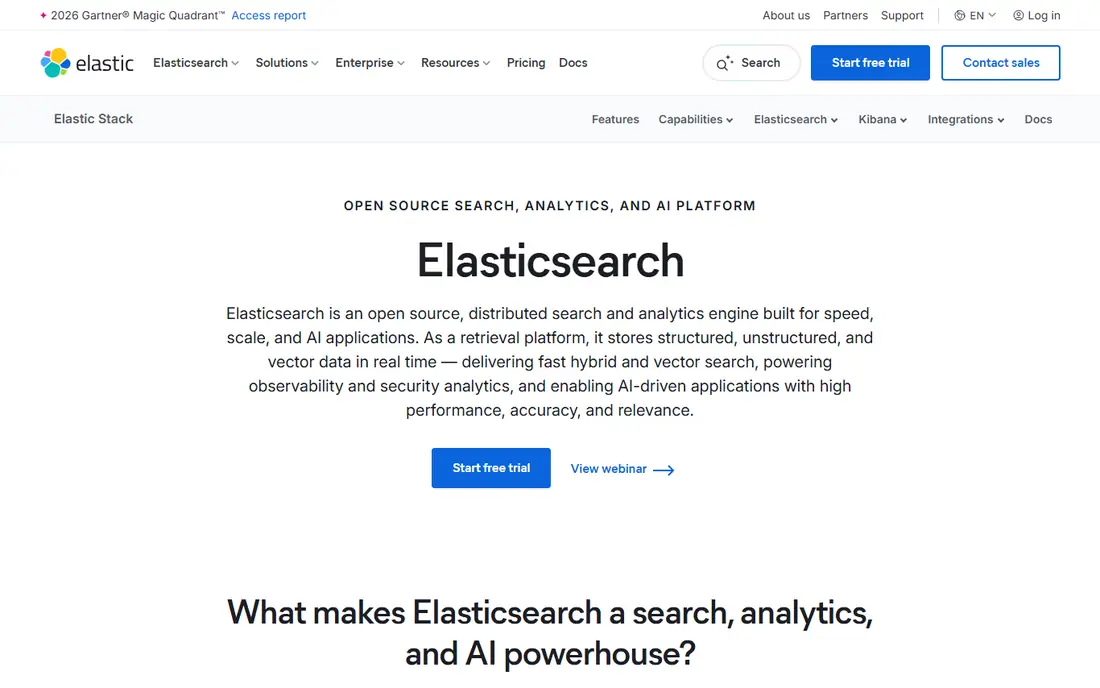
Elasticsearch is the most common Solr replacement for large workloads, covering full-text search, vector search, observability and analytics from one engine. Its ecosystem includes Kibana for visualisation, Logstash and Beats for data intake, and a large library of clients and integrations. That breadth suits companies that need search plus log and analytics work in one stack.
The cost is complexity and price at scale. A production cluster needs planning for nodes, memory, storage and upgrades, and Elastic Cloud pricing is usage-based, so bills grow with ingest, search and retention. Teams without search expertise should start with managed Elastic Cloud or a simpler engine, and only self-host when they have the skills to run it.
- Deepest feature set here
- Vector search and analytics
- Huge ecosystem and integrations
- Complex to run at scale
- Managed pricing grows with data and use
- Needs search expertise
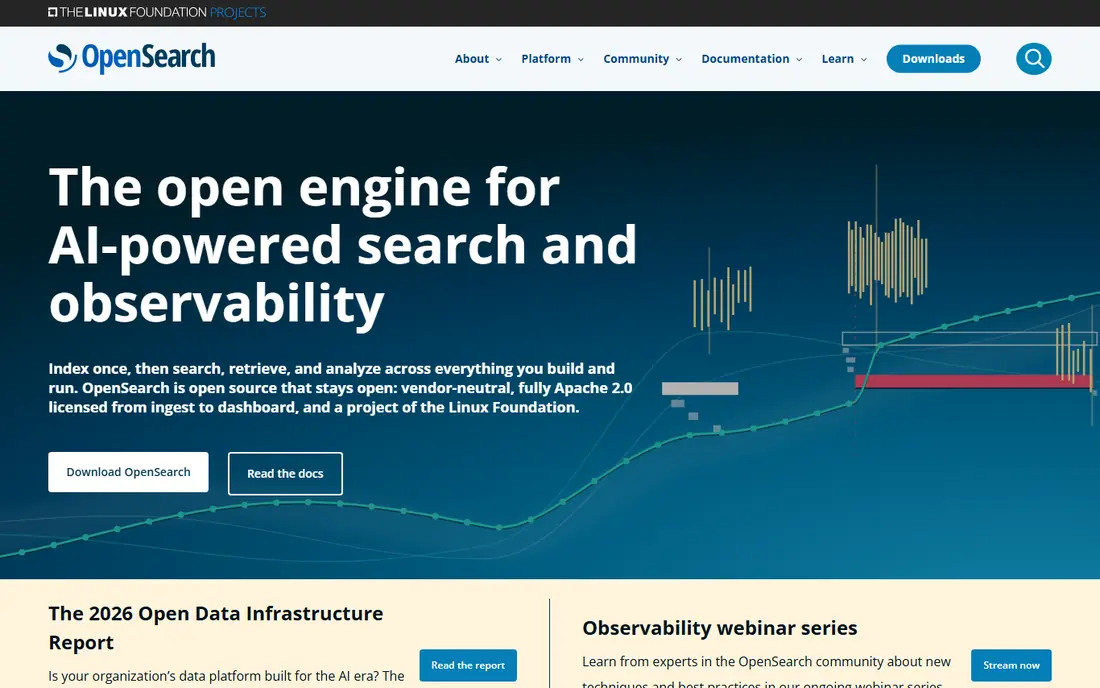
OpenSearch began as a fork of Elasticsearch and has grown into its own open-source search and analytics suite, with dashboards, security, alerting and machine learning features. It suits teams that want an Apache-licensed engine they can run themselves without licence fees, and it covers much of the same ground as Elasticsearch for search and log analytics.
Running it yourself still needs server and upgrade work, and managed pricing depends on the provider, with AWS OpenSearch Service metering compute and storage separately. The ecosystem is smaller than Elasticsearch, so check plugins and clients for your stack. For open-source teams that want control, OpenSearch is the most direct Solr successor.
- Free and open source
- Search, analytics and observability in one
- No per-query licence fees
- Managed service pricing varies by provider
- Ecosystem is smaller than Elasticsearch
- Upgrades need care
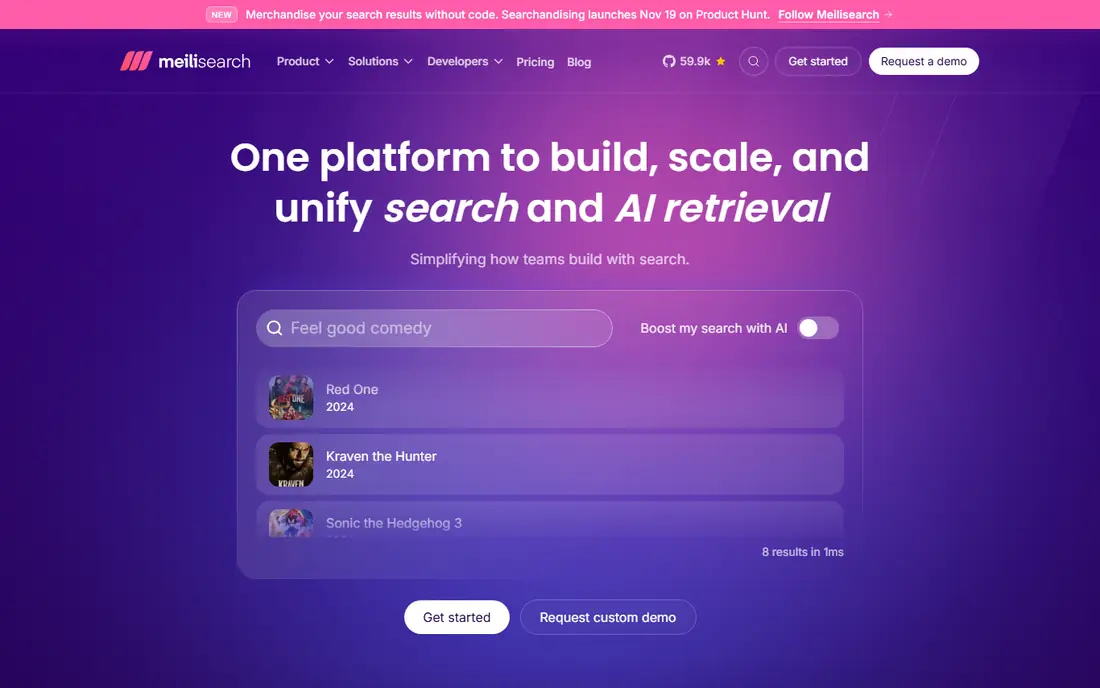
Meilisearch is built for the search box on a website or app, where relevance, speed and typo tolerance matter more than complex analytics. Setup is fast, indexing is simple, and features such as faceting, filtering and typo tolerance work with little configuration. Meilisearch Cloud starts at $20 per month on recent listings, with a trial route, while the open-source edition is free to self-host.
It is not a direct replacement for Solr in huge analytics or log workloads, where Elasticsearch and OpenSearch are stronger. For product catalogs, docs sites and app search, Meilisearch gives a better experience with far less tuning, which is why many teams switch to it from heavier engines.
- Very fast setup
- Typo tolerance out of the box
- Hybrid and vector search options
- Less suited to huge analytics workloads
- Managed pricing rises with instance size
Algolia is a managed search service, so your team builds the front end and Algolia handles indexing, ranking and delivery. It suits ecommerce and content sites that need merchandising rules, personalisation, A/B testing and search analytics without running an engine. A free Build plan covers small projects, with Grow and higher tiers priced by records and requests.
Usage pricing is the warning. Costs rise with indexed records and search requests, and AI features add higher per-request charges on some tiers, so forecast traffic before committing. Teams with very high query volume may find self-hosted Meilisearch or Typesense cheaper, while teams that want a managed service with merchandising will find Algolia hard to beat.
- Managed service with no servers to run
- Merchandising and analytics
- Fast global search
- Usage-based pricing can rise fast with traffic
- Records and request limits need watching
Typesense is an open-source search engine focused on fast, typo-tolerant search for products, docs and sites. It is easy to set up, handles faceting, filtering and grouping well, and its cloud pricing is resource-based, so you pay for memory and CPU rather than per search. That model suits catalogs with high query volume but moderate data size.
The feature set is narrower than Elasticsearch, with less depth for analytics and complex aggregations, and very large datasets need memory planning since Typesense keeps much of its index in memory. For site and product search, that trade is usually worth it, and many teams pair Typesense with a separate analytics tool when needed.
- Free open-source core
- Typo tolerance and faceting
- Resource-based cloud pricing, not per query
- Smaller feature set than Elasticsearch
- Very large datasets need careful memory planning
Vespa, from Vespa.ai, is built for serving search, recommendations and AI retrieval at very large scale, with real-time updates and ranking models that combine text, structured data and vectors. It suits companies running recommendation feeds, large marketplaces or AI search where ranking quality and latency matter at scale. The open-source edition can be self-hosted, with a managed cloud option.
Vespa is overkill for a simple site search box, and operating it needs real engineering investment. Teams that need Solr-style document search for a website should start with Meilisearch or Typesense. Teams building a ranking system that must serve millions of queries should evaluate Vespa seriously.
- Built for large-scale serving
- Ranking, recommendations and AI retrieval in one
- Open source
- Complex to operate
- Overkill for simple site search
- Needs engineering investment
Manticore Search is an open-source search engine with a database-like feel, offering SQL-style queries alongside full-text and vector search. It suits teams that think in tables and queries, or that need to replace a database full-text setup with a dedicated engine without learning a new query language from scratch. It scales across nodes and handles large document sets well.
The ecosystem is smaller than Elasticsearch, with fewer managed providers and thinner dashboard tooling, so teams should expect more hands-on setup. For developers who like SQL and want a free, fast engine, Manticore is a strong and often overlooked Solr alternative.
- Free and open source
- SQL-like querying
- Fast full-text and vector search
- Smaller ecosystem than Elasticsearch
- Fewer managed options
- Interface tooling is thinner
Azure AI Search is Microsoft managed search service for teams already running on Azure. It offers full-text, semantic and vector search, with built-in AI enrichment that can extract text, entities and captions from documents. Integration with Azure storage, databases and AI services makes it a natural pick for Azure-based apps.
It is Azure-only, so teams that need portability across clouds should prefer an open-source engine. Pricing is by tier, with a free tier for testing and paid tiers priced by search units and storage. For Azure teams that want managed search without running servers, it is the most direct Solr replacement in that cloud.
- Managed service inside Azure
- Semantic and vector search
- Integrates with Azure data and AI services
- Azure-only
- Pricing by tier and scale
- Less portable than open-source engines
How we picked these
We compared official product pages, pricing pages and documentation for search engines that are live and maintained in October 2026 and that genuinely replace Solr work, whether for site search, product search, enterprise search or large-scale ranking. We included managed services and open-source engines, and we left out Solr itself. Where a vendor does not publish a simple price, we mark it as See website rather than guessing.
Choosing by workload, not by brand
Start with the workload, not the logo. Site and product search with a few million documents suits Meilisearch, Typesense or Algolia, depending on whether you want to self-host or pay for managed search. Large analytics, log and multi-use workloads suit Elasticsearch or OpenSearch, with OpenSearch winning on licence cost and Elasticsearch winning on ecosystem depth.
Specialised workloads need specialised picks. Large-scale ranking and recommendations point to Vespa, database-style querying points to Manticore Search, and Azure-native apps point to Azure AI Search. Test relevance with your real documents and queries before choosing, since a fast engine with poor relevance for your data is worse than a slower engine that returns the right results.
Frequently asked questions
What are the best Apache Solr alternatives for site search?
Meilisearch and Typesense are the best starting points for site search, because both offer fast setup, typo tolerance and simple APIs. Algolia suits teams that want managed search with merchandising. Elasticsearch and OpenSearch suit larger sites that also need analytics.
Is Elasticsearch a good replacement for Solr?
Yes, for large and complex workloads. Elasticsearch covers full-text, vector and analytics search with a huge ecosystem, and it is the most common Solr replacement at scale. It is more complex and costlier to run than Meilisearch or Typesense, so it suits teams with search expertise or a managed cloud budget.
Which Solr alternative is free and open source?
OpenSearch, Meilisearch, Typesense, Vespa and Manticore Search all offer free open-source editions you can self-host. Licence fees are zero, but hosting, storage and upkeep still cost money, and managed cloud versions of the same engines are paid.
Can I migrate an index from Solr to another engine?
In most cases, yes, but it is rarely automatic. Document fields, analysers, ranking rules and query logic usually need remapping, and tools such as search UI adapters help for Meilisearch and Typesense. Run a pilot with a sample of documents and real queries before migrating a full index.
Which Solr alternative is best for ecommerce search?
Algolia suits ecommerce teams that want merchandising, personalisation and analytics without running servers. Meilisearch and Typesense suit teams that want fast, typo-tolerant product search with predictable costs. Test merchandising rules and faceting with your real catalog before choosing.
Sources
See where you really rank - block by block
ProMapRanker scans Google Maps across a grid of your service area. Simple monthly plans from $19, white-label on every plan.
Start freeKeep reading
 zscaler alternatives
Best Zscaler Alternatives in 2026
Looking for zscaler alternatives? We compare 9 SASE and zero trust platforms on architecture, data protection, pricing, and fit for your network and team.
Read → zapier alternatives free
Best Zapier Alternatives Free in 2026
Nine automation tools for zapier alternatives free in 2026, all with genuinely free tiers, plus free plan limits, starting prices and upgrade paths explained.
Read → which platform is best for online reputation
Which Platform Is Best for Online Reputation in 2026
Wondering which platform is best for online reputation? We compare 8 review, listing, and response tools for small and multi-location businesses and agencies.
Read →