 ProMapRanker
Best SillyTavern Alternatives in 2026

Key takeaways
- SillyTavern is an open-source AI chat frontend, so these alternatives are frontends and local chat tools, not the language models themselves.
- Agnai suits shared servers and multi-user use, RisuAI suits a quick desktop and mobile start, and TavernAI suits a simpler classic setup.
- Most frontends here are free, but the model backend may still cost money, whether local hardware, a cloud API, or a hosted plan.
- These tools are for adults, for fictional characters only, and companion apps are not therapy or a substitute for professional support.
Quick comparison
| Pick | Great for | Pricing starts at | Free tier | |
|---|---|---|---|---|
 Agnai | Shared servers and multi-user chat | Free | Yes | Visit |
 RisuAI | Quick desktop and mobile setup | Free | Yes | Visit |
 TavernAI | Simple classic character chat | Free | Yes | Visit |
 KoboldCpp | Local model running with a chat interface | Free | Yes | Visit |
 Text Generation WebUI | Power users wanting deep model control | Free | Yes | Visit |
 Open WebUI | General local chat with tools and files | Free | Yes | Visit |
 LibreChat | Teams wanting a clean multi-model chat UI | Free | Yes | Visit |
 LM Studio | Easy local model download and chat | Free | Yes | Visit |
 Backyard AI | Beginner-friendly local and cloud character chat | Free | Yes | Visit |
The best sillytavern alternatives
SillyTavern is a free, open-source frontend that connects to language models through local runtimes or APIs, letting users chat with fictional characters, use lore books, and run group chats. The alternatives below are similar frontends and local chat tools, not character platforms that sell their own models. Users must be 18 or older for adult-oriented character chat, should keep characters fictional, and should not use these tools to create non-consensual imagery or to impersonate real people.
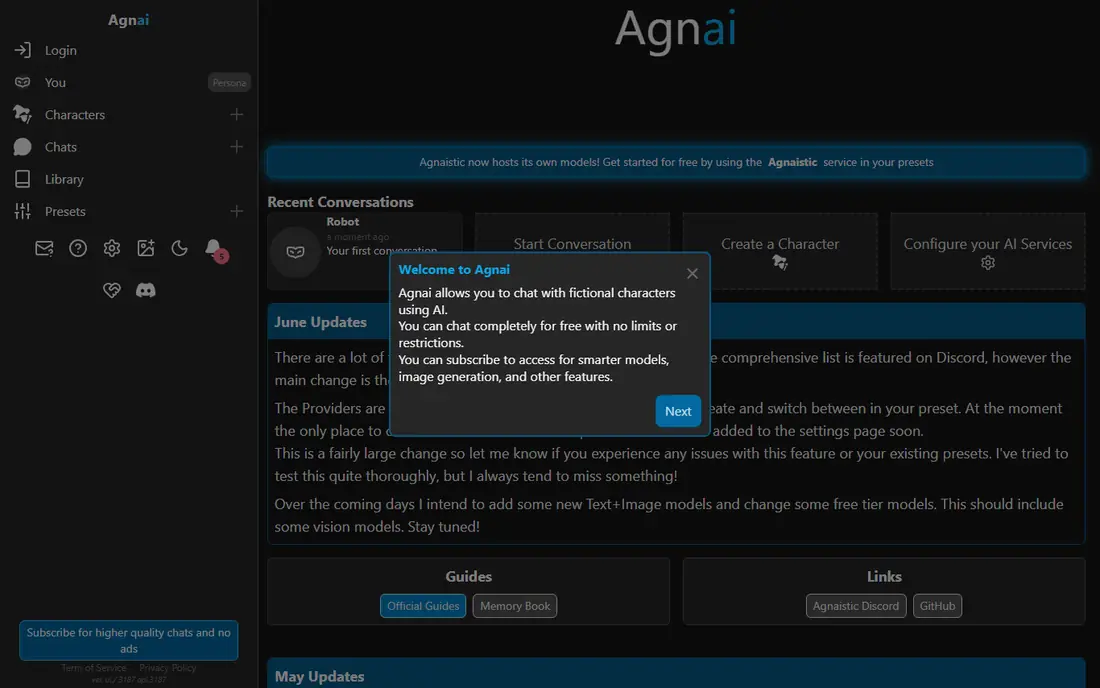
Agnai is the closest SillyTavern alternative for people who want to share a server. It runs as a local Node.js app in a browser, or as a shared server for multiple users, with character cards, personas, group chats, and lore books. That multi-user design is its main difference from SillyTavern, which is built for a single user. A group of friends or a small community can use one Agnai server without each person running a separate install.
Agnai lore books and extensions are simpler than SillyTavern, so power users who rely on deep recursive scanning and a large extension library may miss that depth. Server setup also takes longer than a single-user desktop app. If shared use matters most, Agnai is the pick. If solo depth matters most, SillyTavern itself remains hard to beat, but Agnai is the best shared alternative.
- Multi-user and shared server support
- Tavern v2 character cards
- Group chat and lore books
- Lore book scanning is simpler than SillyTavern
- Server setup takes more time
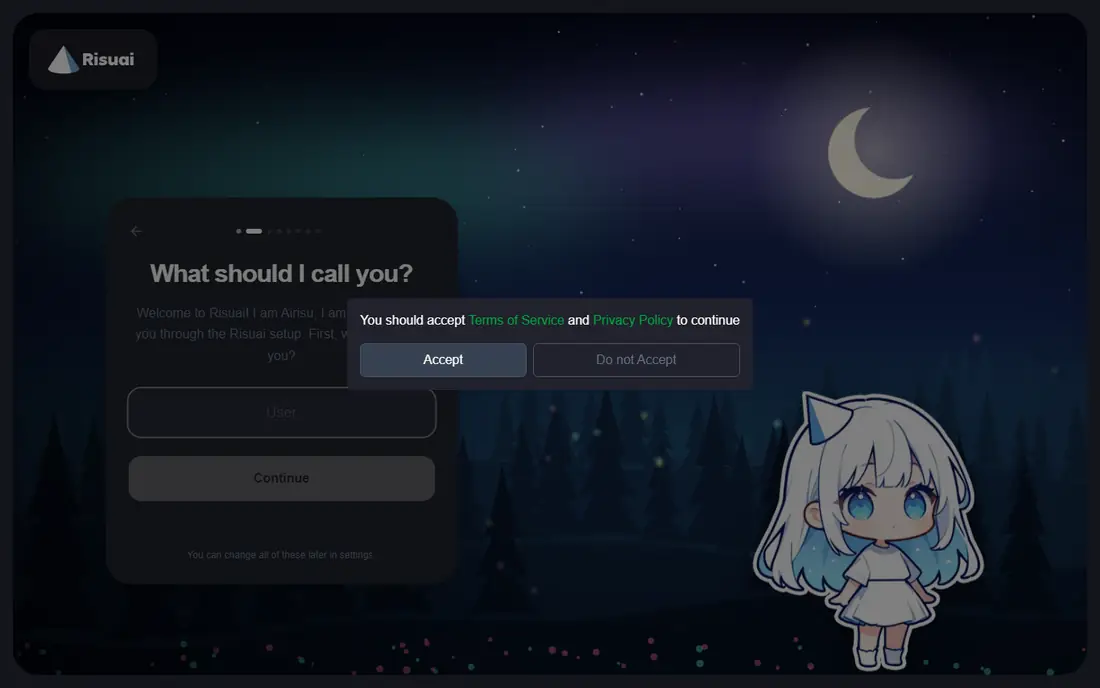
RisuAI is a cross-platform character chat app built with Tauri and Electron, with desktop and mobile builds that make it easy to start quickly. It supports Tavern v2 character cards plus its own formats, expression packs, prompt templates, and regex functions for output control. Users who want a portable app rather than a browser server setup will find RisuAI the fastest route to a working chat.
RisuAI does not include free hosted models, so you must connect your own local model or API key, and that backend may cost money or need hardware. Documentation and community help can also be uneven for new users. Still, for portability and a quick start, RisuAI is one of the strongest SillyTavern alternatives here.
- Fast desktop and mobile setup
- Tavern v2 and own formats
- Regex and script controls
- No free hosted models included
- Documentation can be uneven
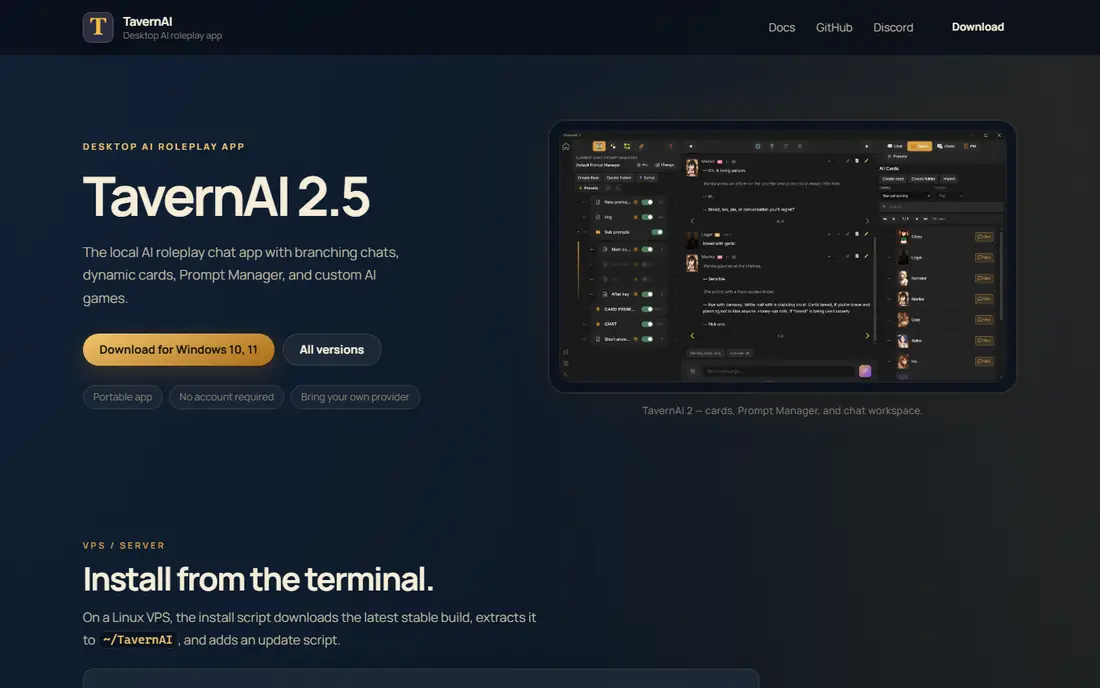
TavernAI is the classic frontend that SillyTavern itself began as a fork of, and it remains a simple choice for character chat. It offers character cards, chat history, and connections to local and API backends without the extension complexity of SillyTavern. Users who want a straightforward chat surface, rather than a deep customisation system, will appreciate that restraint.
TavernAI is less feature-rich than Agnai or RisuAI, with fewer modern controls for lore, group chat, and scripting. Development activity is also lower than the most active rivals, so new model backends may arrive later. Choose TavernAI when simplicity matters more than depth, and when you already know the classic Tavern workflow.
- Classic, simple character chat workflow
- Character card support
- Local and API backends
- Smaller feature set than modern frontends
- Development is less active than rivals
KoboldCpp is a local model runtime with a built-in chat interface, designed to run large language models on your own computer. It handles model loading, sampling, and API serving, so it can act as the backend for frontends like SillyTavern or as a standalone chat tool. Users who want privacy and no cloud API bills will value local running, especially on a capable machine.
KoboldCpp setup is more technical than a hosted chat app, since you must download models, choose quantisation, and tune sampling settings. Its built-in interface is also plainer than a dedicated character frontend, with fewer character, lore, and group features. Use KoboldCpp as the engine for local chat, and pair it with a richer frontend when character features matter.
- Runs local models efficiently
- Built-in chat interface
- Works with SillyTavern-style frontends
- More technical setup
- Interface is plainer than dedicated frontends
Text Generation WebUI, often called oobabooga, is a local chat interface for power users who want full control over models, sampling, and extensions. It supports many local backends, character cards, and chat modes, and its extension system lets advanced users add features for research, coding, and creative writing as well as character chat. For users who want to tune every generation setting, it offers more control than most character frontends.
That control comes with complexity. New users can feel overwhelmed by settings, model formats, and extension choices, and character-specific features are less polished than in Agnai or RisuAI. Text Generation WebUI suits users who enjoy tuning models and who want one interface for general local chat as well as character work.
- Deep model and sampling controls
- Extensions
- Supports many local backends
- Steeper learning curve
- Interface can feel overwhelming for beginners
Open WebUI is a clean, self-hosted chat interface that works well with Ollama and other local or API backends. It supports multiple models, file uploads, tools, and chat organisation, which suits users who split time between general chat, research, and creative work. The interface is modern and easy to learn, and self-hosting keeps chats on your own server where you control retention.
Open WebUI is not a dedicated character frontend, so lore books, character cards, and group chat features are thinner than in SillyTavern, Agnai, or RisuAI. Users who want deep character workflows should pair it with a character tool, or choose a character-first frontend instead. For general local chat with a polished interface, Open WebUI is an excellent choice.
- Clean chat interface
- File, tool, and multi-model support
- Ollama integration
- Character and lore features are thinner
- Best for general chat, not deep roleplay
LibreChat is an open-source, self-hosted chat interface that supports many model providers and local backends in one clean UI. It suits small teams and individuals who want to switch models without switching apps, with chat organisation, presets, and multi-user options for shared deployments. Its interface feels closer to a commercial chat product than many local tools, which helps new users.
LibreChat character features are limited compared with dedicated character frontends, so it is better for general and team chat than for deep lore and group roleplay. Server setup also needs some comfort with self-hosting, though documentation helps. Choose LibreChat when multi-model flexibility and a clean team UI matter more than character-specific depth.
- Clean multi-model interface
- Self-hosted
- Supports many providers and local models
- Character features are limited
- Setup needs server comfort
LM Studio makes local models approachable, with model discovery, download, chat, and a local API server in one desktop app. Beginners can download a small model, chat in minutes, and later connect LM Studio as a backend for SillyTavern-style frontends. That path suits users who want to try local AI without learning command-line model management first.
LM Studio built-in chat is basic for character work, with fewer lore, persona, and group features than dedicated frontends. Larger models also need strong hardware, so small laptops should stick to smaller models. Use LM Studio as the easy on-ramp to local models, and add a character frontend when you want deeper character control.
- Easy model discovery and download
- Built-in chat
- Local API server for frontends
- Character features are basic
- Needs local hardware for larger models
Backyard AI is a privacy-focused character platform with a desktop app that runs locally, so chats can stay on your own computer rather than going to an external server. It offers a character hub, text and voice chat, and mobile tethering to local models, which helps beginners who want character chat without server setup. A free tier covers smaller models, while paid cloud plans open up larger models and longer context.
The free tier is limited to smaller models, so users who want the largest models will need a paid plan or a local model with capable hardware. Backyard AI is also less customisable than SillyTavern for power users who want deep lore and extension control. For a beginner-friendly start with local privacy, it is a welcoming alternative.
- Beginner-friendly desktop app
- Local privacy focus
- Character hub and mobile tethering
- Paid cloud plans needed for larger models
- Free tier limited to smaller models
How we picked these
We compared official project pages, documentation, and independent frontend comparisons published in 2026. We kept only frontends and local chat tools that connect to language models, support character or general chat, and are actively maintained or available today. We left out SillyTavern itself, since this list is about alternatives to it, and we left out platforms whose main product is selling access to their own proprietary characters, since they do not match the frontend model.
What to check before you pick a frontend
Start with your backend, not the interface. Decide whether you will run models locally, use a cloud API, or use a hosted plan, since that choice sets hardware, cost, and privacy. Local models keep chats private but need disk space and GPU power, while cloud APIs are easier but send prompts to a provider and bill per use. Test your chosen backend with the frontend you like, since sampling and context handling can differ between combinations.
Next, check character compatibility and safety. Confirm that the frontend loads the character card format you use, that lore books and group chats work as you expect, and that you understand content controls and data retention. Keep characters fictional, do not impersonate real people, do not create non-consensual imagery, and remember that companion apps are not therapy. If a chat starts to feel like a substitute for professional support, seek a qualified professional instead.
Frequently asked questions
What is SillyTavern?
SillyTavern is a free, open-source AI chat frontend that runs locally and connects to language models through local runtimes or APIs. It supports fictional character chats, lore books, group chats, and extensions for customisation.
Do SillyTavern alternatives include free models?
Most frontends here are free, but they do not include a free model by default. You supply a local model or an API key, and that backend may cost money or need capable hardware, except for limited free tiers on some hosted options.
Which SillyTavern alternative is easiest for beginners?
RisuAI offers a quick desktop and mobile start, while LM Studio offers the easiest local model download and chat. Backyard AI is also beginner-friendly, with a desktop app and character hub for new users.
Can I use my SillyTavern character cards elsewhere?
Many frontends here support Tavern v2 character cards, including Agnai and RisuAI, so cards often transfer. Check each frontend for card, lore book, and group chat compatibility, since support depth varies.
Are AI companion apps safe for teenagers?
These tools are intended for adults, especially for adult-oriented character chat, and companion apps are not therapy. Keep use to fictional adult characters, follow platform age rules, and seek professional support for mental health needs rather than relying on a chatbot.
Sources
See where you really rank - block by block
ProMapRanker scans Google Maps across a grid of your service area. Simple monthly plans from $19, white-label on every plan.
Start freeKeep reading
 zyte alternatives
Best Zyte Alternatives in 2026
These zyte alternatives cover managed scraping APIs, proxy networks and no code tools for lawful collection from your own or consented sources only in 2026.
Read → zerto alternatives
Best Zerto Alternatives in 2026
Compare the best zerto alternatives for disaster recovery and replication, with recovery targets, cloud options and honest trade-offs for teams in 2026.
Read → zerofox alternatives
Best ZeroFox Alternatives in 2026
We compared 9 zerofox alternatives for brand protection, phishing takedowns, dark web monitoring, and social impersonation, with clear coverage notes.
Read →