 ProMapRanker
Best SIEM Alternatives in 2026


Microsoft 365 and Azure estates · Pricing starts at: See website
Key takeaways
- Microsoft Sentinel and Google Security Operations suit cloud-heavy teams, with consumption pricing that follows log volume.
- Splunk, Elastic Security and QRadar suit mature SOC teams that want deep search, custom detections and long retention.
- Graylog and Wazuh give smaller teams a lower cost start, with free self-hosted editions and paid security tiers.
- CrowdStrike and Exabeam suit teams that want endpoint or behaviour context close to the SIEM, rather than a standalone log platform.
Quick comparison
| Pick | Great for | Pricing starts at | Free tier | |
|---|---|---|---|---|
| Microsoft Sentinel | Microsoft 365 and Azure estates | See website | Free trial | Visit |
 Splunk Enterprise Security | Deep search for large SOCs | See website | Free trial | Visit |
 Elastic Security | Search-led teams with engineering skill | See website | Free trial | Visit |
 IBM QRadar | Regulated on-premises estates | See website | Free trial | Visit |
 Google Security Operations | Fast search and long retention | See website | Free trial | Visit |
 CrowdStrike Falcon Next-Gen SIEM | CrowdStrike endpoint estates | See website | Free trial | Visit |
 Exabeam | Behaviour and identity-led detection | See website | Free trial | Visit |
 Graylog Security | Value SIEM for midsize teams | $1,250 per month | Yes | Visit |
 Wazuh | Free open-source SIEM start | Free | Yes | Visit |
The best SIEM alternatives
A SIEM collects logs, correlates events and helps analysts detect and investigate threats. The right choice depends less on a feature list and more on log volume, team skill and the cloud or on-premises estate you already run. These nine platforms cover enterprise, cloud-native and open-source options.
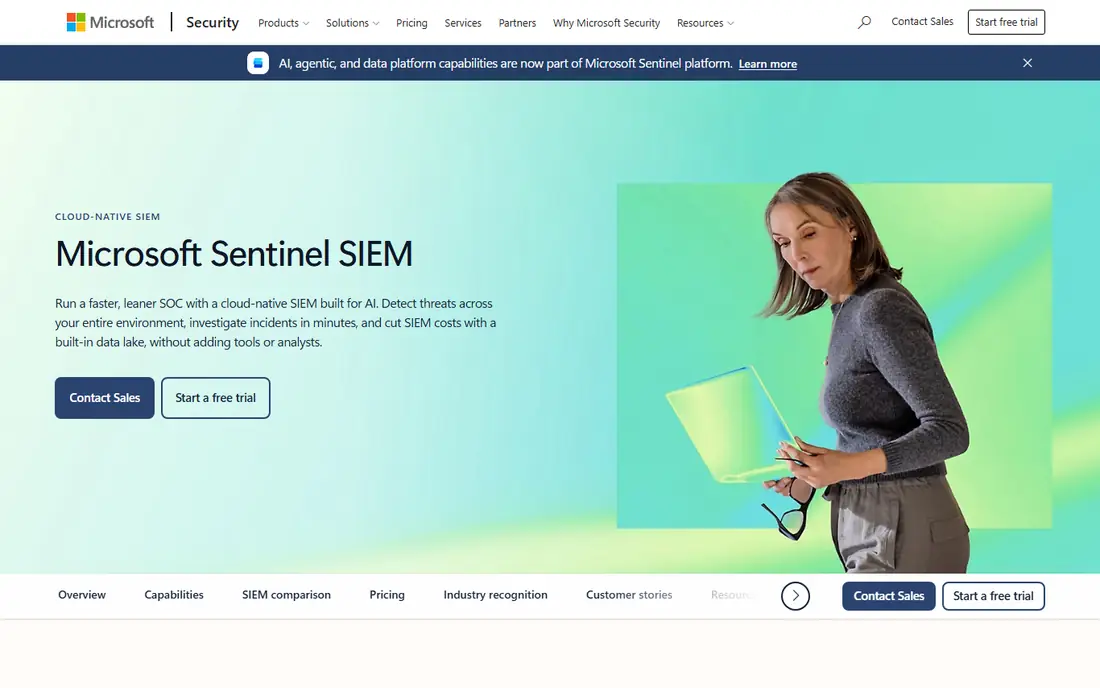
Microsoft Sentinel is the natural SIEM for a team already running Microsoft 365 and Azure. Microsoft source data integrates closely, and built-in analytics, workbooks and automation help a small SOC start quickly without building parsers from scratch. Pay-as-you-go ingestion and commitment tiers let a team scale price with volume rather than buying a fixed appliance.
The bill is the main risk: log volume drives cost, and a noisy estate can grow the monthly charge fast. Teams should model 30 days of real volume by source before signing, and set retention and filtering rules early. For a Microsoft-centred estate, Sentinel's integration advantage is hard to match with a standalone SIEM.
- Strong Microsoft data integration
- Pay-as-you-go ingestion
- Built-in analytics and automation
- Costs follow log volume closely
- Azure skill needed
- Non-Microsoft data needs tuning
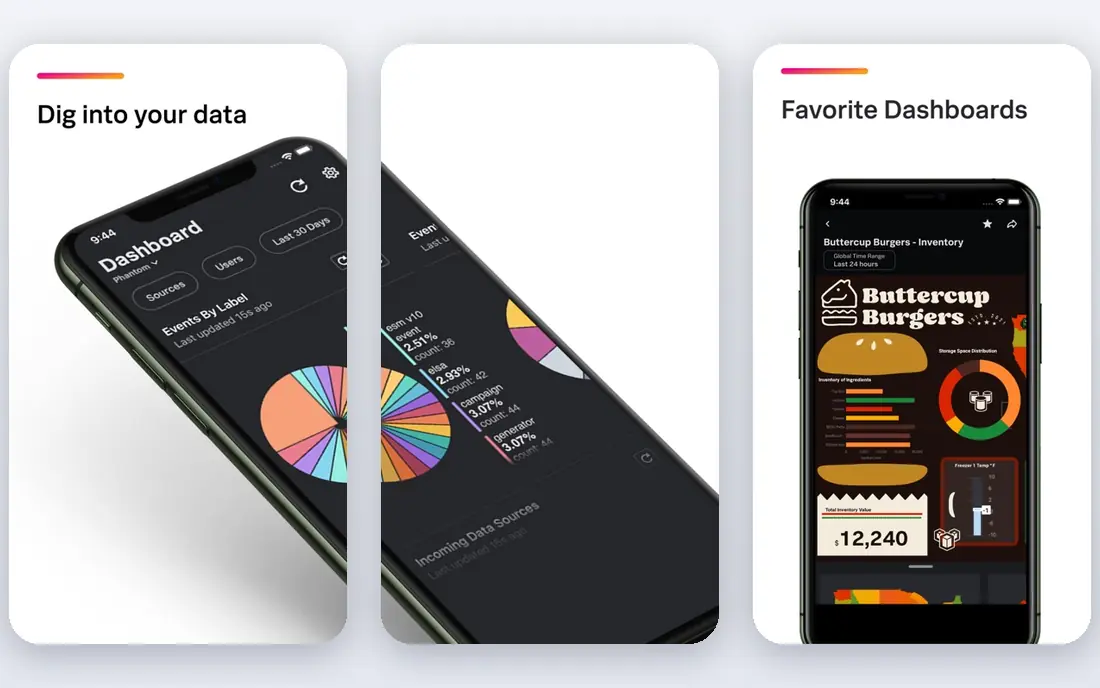
Splunk Enterprise Security remains the reference SIEM for large, mature SOC teams. Its search language, correlation engine and app ecosystem support complex investigations and custom detections that simpler tools cannot match. Teams with Splunk skills can build dashboards, risk scoring and investigation workflows to a depth few rivals offer.
Cost and complexity are the barriers. Pricing is quoted by ingestion or workload, and enterprise volumes can reach six figures a year, with skilled staff needed to tune and maintain the platform. For a small team, that depth is often more than needed. For a large SOC with complex estates, Splunk's analytical ceiling still justifies its place on the shortlist.
- Powerful search language
- Huge app ecosystem
- Deep correlation and investigation
- Quote-based pricing
- Expensive at scale
- Needs skilled administration
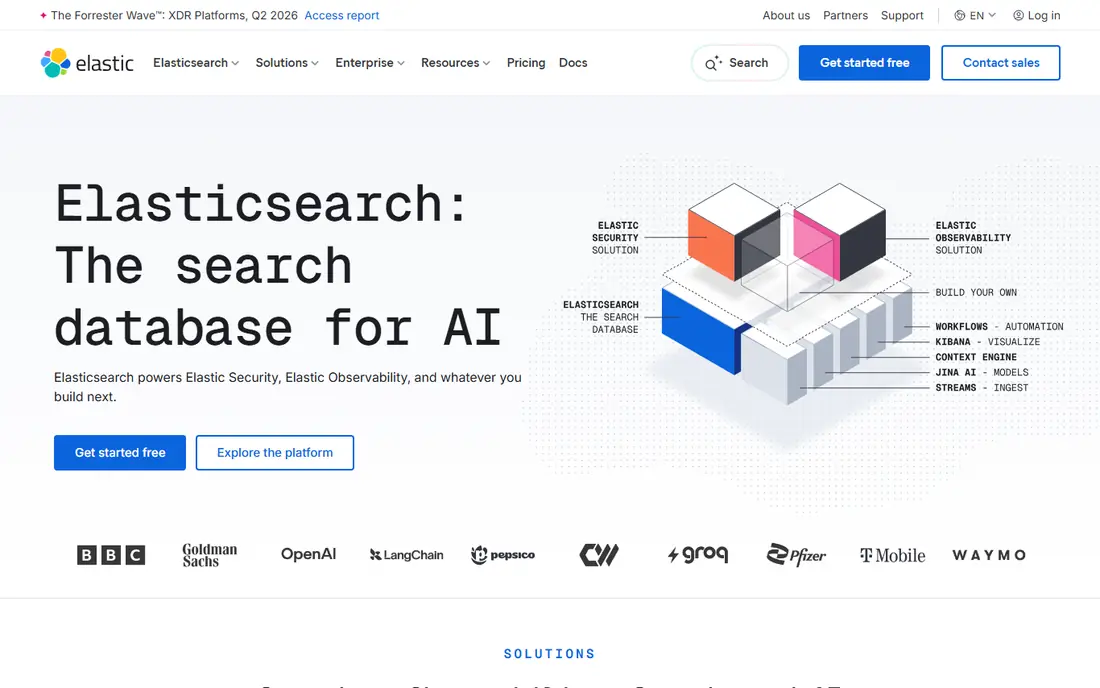
Elastic Security suits engineering-led security teams that want to build detections as code and control their search platform. Rules can be versioned and reviewed like software, dashboards are flexible, and deployment spans managed cloud and self-hosted options. Teams already running Elastic for search or observability get a natural extension into security monitoring.
Out-of-the-box alert quality needs tuning, and teams without Elastic expertise can spend more time running the platform than investigating alerts. Total cost also includes compute and storage, not just a licence figure, so model infrastructure alongside ingestion. For a team with engineering depth, Elastic offers control and flexibility at a lower licence cost than Splunk.
- Open rules as code
- Flexible search and dashboards
- Cloud or self-hosted deployment
- Needs Elastic expertise
- Alert tuning takes work
- Total cost includes infrastructure
IBM QRadar suits regulated organisations with on-premises estates that need offense-based correlation, where related events are grouped into a single investigation. Its history in finance, healthcare and government estates means compliance reporting and on-premises deployment are well covered. For a team that cannot move logs fully to the cloud, that fit matters.
Buyers should check the current product direction and support model, since QRadar's roadmap has changed hands in recent years and packaging varies. Pricing by events per second or managed server count also needs careful sizing against real log rates. For a regulated, on-premises SOC, QRadar remains a credible and proven choice.
- Offense-based correlation
- Strong on-premises fit
- Regulated industry history
- Quote-based pricing
- Product direction needs checking
- Event-based pricing complexity
Google Security Operations, formerly Chronicle, suits hunt-heavy teams that need fast search over a year or more of telemetry. Its search speed over long retention helps analysts trace an incident back through months of data without waiting for slow queries. AI-assisted summaries also help triage, though analysts should still verify findings against raw logs.
Pricing is packaged by ingestion and needs a sales conversation, so small teams should confirm entry cost early. The platform also fits best inside Google Cloud estates, and moving from another SIEM takes planning for parsers and detections. For a cloud-heavy, hunt-led SOC, its search performance is a clear advantage.
- Very fast search over long retention
- Gemini-assisted summaries
- Google Cloud fit
- Quote-based packages
- Google Cloud gravity
- Migration effort for non-Google estates
CrowdStrike Falcon Next-Gen SIEM suits teams already running CrowdStrike endpoints who want security monitoring in the same console. Falcon endpoint data is included for existing customers, which can lower the effective cost, and third-party logs can be added for a fuller picture. That consolidation cuts console switching during an investigation.
Outside a CrowdStrike estate, the advantage shrinks and third-party data pricing becomes the main cost driver. Teams should model third-party volume separately from Falcon data before comparing with Sentinel or Elastic. For a CrowdStrike shop that wants one console for endpoint and log investigations, this SIEM is a strong fit.
- Single console with endpoint data
- Falcon data included for customers
- Fast ingestion model
- Quote-based pricing
- Strongest inside CrowdStrike estates
- Third-party data pricing varies
Exabeam suits SOC teams that prioritise behaviour and identity risk over simple log correlation. Its timelines show how a user or entity behaved over time, which helps spot insider threats, compromised accounts and lateral movement that rule-based alerts miss. Cloud and self-hosted deployment options also suit teams with mixed estates.
Pricing is quote-only, and buyers should confirm the current platform direction, since Exabeam combined with LogRhythm in recent years. Behaviour baselines also need tuning time before alerts become reliable. For a team focused on identity risk and insider threats, Exabeam's behaviour-first approach is a distinct advantage.
- Behaviour timelines
- Identity and insider risk focus
- Cloud or self-hosted options
- Quote-only pricing
- Platform direction needs checking
- Needs tuning for behaviour baselines
Graylog Security is our value pick for midsize teams that want a real SIEM without enterprise pricing. Graylog Open is free and source-available for log collection, search, dashboards and alerting, while paid Enterprise and Security licences add features and support by daily volume. Unlimited users on paid editions also helps a growing SOC avoid per-analyst charges.
The paid licence carries an annual minimum, so a very small team should start with the open edition and confirm volume before buying. Graylog also lacks some of Splunk's deepest analytics and ecosystem breadth. For a midsize team that needs solid log security at a predictable price, Graylog is a strong and honest choice.
- Free open edition
- Predictable annual licence
- Unlimited users on paid editions
- Annual minimum commitment
- Less breadth than Splunk
- Security tier costs more than base
Wazuh is the best free start for a team willing to run its own SIEM infrastructure. The open-source platform combines intrusion detection, log analysis, vulnerability detection and compliance monitoring, with no licence cost for self-hosted use. A managed Wazuh Cloud option exists for teams that prefer not to run servers, priced by active agents.
Self-hosting means your team owns sizing, patching and tuning, and that time is the real cost. For a small team or a lab, that trade is often worth it, and Wazuh can grow into a serious SOC platform with care. For a team with no infrastructure time, Graylog Cloud or a managed SIEM may fit better.
- No licence cost for self-hosted use
- Intrusion detection and compliance features
- Active community
- You run the infrastructure
- Tuning and sizing take time
- Managed cloud costs extra
How we picked these
We compared official product pages and public 2026 SIEM comparisons covering pricing models, deployment options and detection approaches. We kept only platforms that are live in October 2026 and that offer correlation, detection and investigation, not just log storage. Prices are starting prices where a vendor publishes them, and we wrote See website where pricing is quoted by volume, events or package. We did not claim hands-on testing; our view comes from comparing public documentation, pricing models and SOC fit.
What to check before you switch
Price your logs before you price a platform. Collect 30 days of real volume by source, growth rate and required retention, then model that volume against each pricing model. The same estate can cost several times more on a per-gigabyte model than on a per-device or per-asset model, so a headline price alone tells you little.
Test the analyst workflow, not just the demo. Take one real past incident and two noisy alert types into a trial, and time how long a mid-level analyst takes to reach a clear narrative. Check detection language, export options and parser maintenance, since those decide whether the SIEM stays useful after the first month. A SIEM your team can run at 3 a.m. is worth more than a richer platform your team avoids.
Frequently asked questions
What is a SIEM?
A SIEM collects logs and security events from systems, networks and cloud services, correlates related events, and helps analysts detect, investigate and respond to threats. It is the central console for a security operations team.
What is the best SIEM for small businesses?
Graylog and Wazuh are the best small business starts, with free self-hosted editions and paid tiers for growth. Microsoft Sentinel also suits a small Microsoft-centred team, though costs follow log volume.
What is the best SIEM for large enterprises?
Splunk Enterprise Security, Microsoft Sentinel and Google Security Operations lead for large enterprises, depending on estate gravity. Splunk suits deep search, Sentinel suits Microsoft estates, and Google suits hunt-heavy cloud teams.
How much does a SIEM cost?
Costs vary widely by pricing model. Graylog Security starts around $1,250 per month, Wazuh self-hosted software is free, and enterprise platforms such as Splunk, Sentinel and QRadar are quote-based and can reach six figures a year at high volumes.
Can I switch SIEM without losing detections?
Yes, but plan for it. Export rules and detections where possible, rebuild the most important detections in the new platform's language, and run both systems in parallel for a trial period before you cut over.
Sources
- https://www.microsoft.com
- https://www.splunk.com
- https://www.elastic.co
- https://www.ibm.com
- https://cloud.google.com
- https://www.crowdstrike.com
- https://www.exabeam.com
- https://graylog.org
- https://wazuh.com
- https://underdefense.com/blog/siem-solutions-comparison/
- https://theknowledgeengineers.com/software-advice/siem-software
See where you really rank - block by block
ProMapRanker scans Google Maps across a grid of your service area. Simple monthly plans from $19, white-label on every plan.
Start freeKeep reading
 zoro.to alternatives
Best Zoro.to Alternatives in 2026
We compare the best zoro.to alternatives in 2026, listing only legal licensed anime streaming services, from Crunchyroll to free options for fans today.
Read → zip alternatives
Best Zip Alternatives in 2026
We compare the best zip alternatives for buy now, pay later in 2026, covering pay-in-4 plans, fees, spending limits, and credit reporting options today.
Read → yesware alternatives
Best Yesware Alternatives in 2026
Compare the best yesware alternatives for sales email tracking, templates, and sequences, with current pricing and honest tradeoffs for small sales teams.
Read →