 ProMapRanker
Best Screaming Frog Alternatives in 2026

Key takeaways
- Sitebulb and Netpeak Spider are the closest desktop-style replacements for guided and low-cost crawling.
- Ahrefs and Semrush suit teams that want a site audit inside a wider SEO suite.
- Lumar, JetOctopus and OnCrawl suit large sites where cloud scale and log analysis matter.
- A free crawl limit is fine for a small site, but scheduled cloud crawls pay off once audits become routine.
Quick comparison
| Pick | Great for | Pricing starts at | Free tier | |
|---|---|---|---|---|
 Sitebulb | Guided desktop audits | $18 per month | Free trial | Visit |
 Ahrefs | Audit inside a link suite | $29 per month | Free trial | Visit |
 Semrush | Audit inside an all-in-one suite | $139.95 per month | Free trial | Visit |
 Lumar | Enterprise cloud crawling | See website | No | Visit |
 JetOctopus | Large sites and log files | $349 per month | Free trial | Visit |
 OnCrawl | Data-led enterprise audits | See website | No | Visit |
 Netpeak Spider | Low-cost desktop crawling | $20 per month | Free trial | Visit |
 SEO PowerSuite Website Auditor | Desktop audits on a budget | See website | Free trial | Visit |
 Sitechecker | Cloud audits for small teams | See website | Free trial | Visit |
The best screaming frog alternatives
We compared these tools on crawl scale, JavaScript rendering, reporting, scheduling, log analysis and price. Our pick for most solo SEOs is Sitebulb for guided audits, and Netpeak Spider when budget is the main constraint. Large sites should start with a cloud crawler instead of a desktop tool.
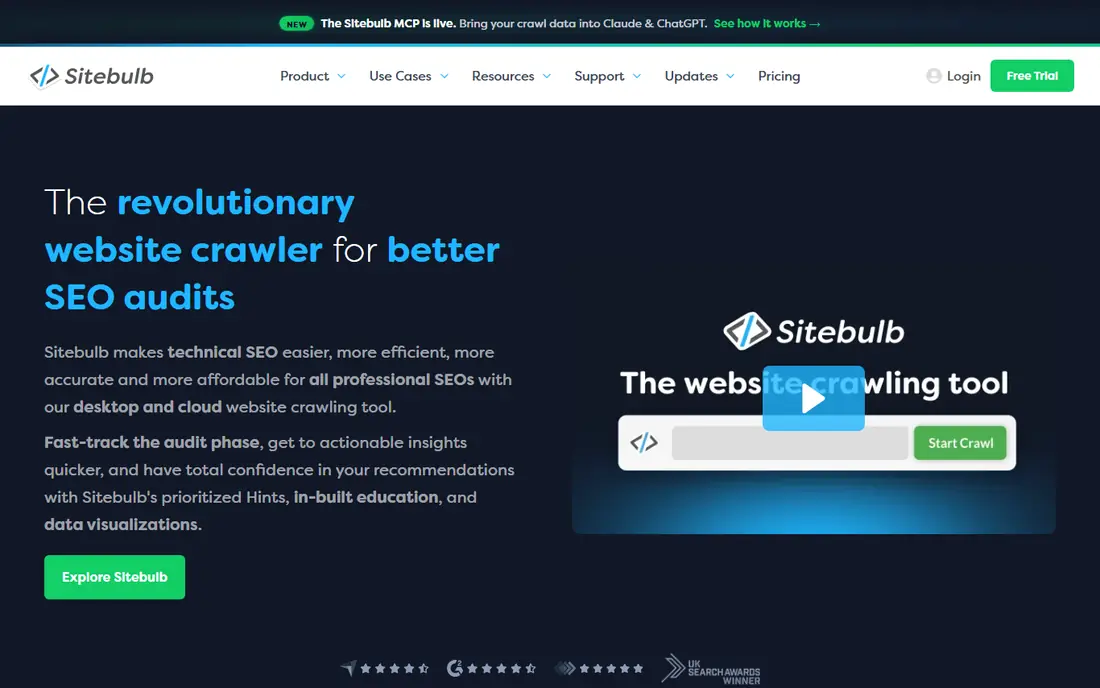
Sitebulb turns a crawl into a prioritized list of hints, with an explanation of why each issue matters and how to fix it. That guidance helps a freelancer or a junior team member act without a senior translating raw crawl data. Crawl maps show site structure at a glance, and PDF reports are ready to share with a client.
The Lite plan starts at 18 dollars per month and covers 10,000 URLs per audit, which handles most small and mid-size sites. Larger sites need Pro or Cloud, and Cloud pricing is much higher. Sitebulb is best when reporting time costs more than raw crawl depth, and when the audit audience includes non-technical clients.
- Prioritized hints with plain explanations
- Crawl maps
- Client-ready reports
- Lite caps URLs per audit
- Cloud tier is a large step up in price

Ahrefs Site Audit runs in the cloud and groups technical issues by type, with a health score that makes progress easy to track over time. Because it sits inside Ahrefs, a team can move from a crawl issue to backlink and content research without exporting data to another tool. Scheduled crawls also help teams that audit the same sites each month.
The drawback is tiering. The Starter plan starts at 29 dollars per month but is limited, and the main Lite plan is higher. A team that only needs a crawler may pay for research tools it rarely uses. Ahrefs is a good pick when link research and audits share the same budget.
- Strong backlink data
- Scheduled cloud audits
- Health score and issue grouping
- Full audit depth sits in higher tiers
- Starter plan is limited

Semrush Site Audit covers crawl errors, internal linking, HTTPS, performance and markup issues, and it schedules audits so a team can track fixes over time. Its value grows when a team also uses keyword research, rank tracking and backlink tools in the same account. Reports are organized by theme, which helps a team split fixes by owner.
The entry price is the main barrier. Pro starts at 139.95 dollars per month, and limits on projects and crawled pages can push larger teams to a higher tier. Semrush fits agencies and in-house teams that will use several modules, not a solo user who only needs an occasional crawl.
- Broad SEO toolkit
- Scheduled audits
- Thematic issue reports
- High entry price
- Project and crawl limits on the base plan
Lumar, formerly Deepcrawl, is a cloud crawler built for enterprise sites with millions of pages. It offers JavaScript rendering, log-file analysis and reporting that can handle large, complex estates. Cloud deployment means crawls run on schedule without tying up a local machine, and teams can share results without passing files around.
The trade-off is cost and complexity. Pricing is quote-based, and setup needs more planning than a desktop tool. Small sites will not use the scale on offer. Lumar is the right shortlist entry when a site is large, changes often and needs both crawl and log data in one place.
- Cloud scale for very large sites
- Rendering and log analysis
- Enterprise reporting
- Quote-only pricing
- Heavier setup than a desktop crawler
JetOctopus pairs a cloud crawler with log-file analysis, so a team can compare what the crawler finds with what search bots actually request. That pairing is valuable for crawl budget work on large sites, where wasted bot visits on parameters and errors can hide real problems. JavaScript rendering is included, which matters for modern templates.
The entry price starts around 349 dollars per month on annual billing in recent listings, so it is not a casual purchase. Volume limits also need sizing against the real URL count. JetOctopus fits large in-house and agency teams that already treat log analysis as part of the audit, not an extra.
- Cloud crawling at scale
- Log-file analysis
- JavaScript rendering
- High entry price
- Volume-based plans need careful sizing
OnCrawl is a cloud SEO platform for large sites, with crawling, log analysis and data exploration in one workspace. Its log analysis avoids sampling, which helps teams trust the numbers when they study bot behavior at scale. Segmentation and custom analysis also suit teams that want to slice crawl data by template, section or traffic.
The drawback is that OnCrawl is quote-based and aimed at technical teams. A small site will find it too much, and a non-technical user may need help to build useful segments. It is best for enterprises and agencies that already work with large crawl and log datasets and want to query them directly.
- Large-scale cloud crawling
- Log analysis without sampling
- Data exploration tools
- Quote-only pricing
- Needs technical skill to get full value
Netpeak Spider is a desktop crawler priced at 20 dollars per month in current listings, with a short free trial. It covers common audit checks, internal linking, status codes and scraping, and it integrates with Google Analytics and Search Console data. For a solo SEO who wants a desktop tool without a high annual fee, it is a practical replacement.
The interface is denser than Sitebulb, and it does not guide a beginner through fixes in the same way. Desktop limits also apply to very large sites, since the local machine does the work. Netpeak Spider is best when budget matters and the user already knows what crawl data means.
- Low monthly price
- Desktop control
- Scraping and audit checks
- Interface is denser than Sitebulb
- Desktop limits apply to very large sites
Website Auditor is part of SEO PowerSuite and runs on desktop, covering technical and on-page checks, site structure and content optimization. It suits users who prefer a desktop tool and a suite that also covers rank tracking and link building. A free version with limits lets a user test the workflow before paying.
The catch is edition pricing, which varies and should be checked on the vendor site before purchase. The interface is also more traditional than Sitebulb or a cloud dashboard. Website Auditor fits users who want a desktop suite and are comfortable with a denser tool.
- Desktop audit tool
- Content and technical checks
- One-time license options in past plans
- Pricing varies by edition
- Interface feels dated to some users
Sitechecker is a cloud SEO platform with site audits, monitoring, rank tracking and backlink checks. It suits small teams that want scheduled audits and simple reports without installing desktop software. The audit groups issues and tracks changes over time, which helps a team show progress to a client.
The limitation is depth. Sitechecker does not match Lumar, JetOctopus or OnCrawl for very large sites or advanced log work. It is a good middle option for small and mid-size sites that want a cloud audit plus basic rank and link tools in one subscription.
- Cloud audits and monitoring
- Simple reports
- Rank and backlink tools
- Less crawl depth than enterprise tools
- Pricing should be confirmed on the vendor site
How we picked these
We compared official product and pricing pages with recent comparison guides, and we favored tools that are still sold and supported in October 2026. We mixed desktop and cloud tools because the original tool is desktop-based, while many teams now need scheduled cloud crawls. Where pricing conflicted across sources, we wrote See website rather than repeating a figure we could not confirm. We did not claim hands-on testing.
What to check before you switch
Match the tool to site size first. A desktop crawler is fine for a few thousand pages, but a site with hundreds of thousands of URLs needs cloud scale and scheduling. Test JavaScript rendering on a real template, since a raw HTML crawl can miss content that only appears after rendering. Also test how the tool handles staging, login areas and crawl limits.
Check reporting needs before you buy. If clients receive the audit, Sitebulb and cloud dashboards save time. If the audit stays internal, a denser desktop tool may be enough. Finally, check whether log analysis is included or needs a separate tool, since crawl data alone does not show what search bots actually did.
Frequently asked questions
What are the best alternatives to Screaming Frog?
Sitebulb is the closest guided desktop alternative, Netpeak Spider is a low-cost desktop option, and Ahrefs or Semrush suit teams that want audits inside a wider suite. Large sites should consider Lumar, JetOctopus or OnCrawl for cloud scale and log analysis.
Is there a free alternative to Screaming Frog?
Several tools offer free trials or limited free tiers, but a full free desktop crawler with no URL cap is rare in this list. Netpeak Spider and Sitebulb offer trials, while Ahrefs and Semrush offer limited free access through webmaster tools or trials. Check the current limits before you rely on a free tier.
Which alternative is best for large sites?
Lumar, JetOctopus and OnCrawl are built for large sites, with cloud crawling and log analysis. Desktop tools can handle large crawls, but they depend on local memory and disk, and they do not run on schedule while a laptop is off.
Do I need log file analysis?
Log analysis helps when crawl budget matters, since it shows what bots actually requested rather than what a crawler found. It is most valuable for large sites with many parameters, errors or low-value pages. Small sites can often fix issues from a crawl alone.
Can I use these tools for JavaScript sites?
Yes, most tools in this list support JavaScript rendering, including Sitebulb, Lumar, JetOctopus and OnCrawl. Test rendering on a real page template, and compare raw and rendered output before you trust the results.
Sources
See where you really rank - block by block
ProMapRanker scans Google Maps across a grid of your service area. Simple monthly plans from $19, white-label on every plan.
Start freeKeep reading
 zscaler alternatives
Best Zscaler Alternatives in 2026
Looking for zscaler alternatives? We compare 9 SASE and zero trust platforms on architecture, data protection, pricing, and fit for your network and team.
Read → zapier alternatives free
Best Zapier Alternatives Free in 2026
Nine automation tools for zapier alternatives free in 2026, all with genuinely free tiers, plus free plan limits, starting prices and upgrade paths explained.
Read → which platform is best for online reputation
Which Platform Is Best for Online Reputation in 2026
Wondering which platform is best for online reputation? We compare 8 review, listing, and response tools for small and multi-location businesses and agencies.
Read →