 ProMapRanker
How to Scale Rank Tracking Across Dozens of Local Clients

Scaling local SEO rank tracking across dozens of local clients demands a strategic shift from manual, time-consuming processes to automated, data-driven systems. Agencies must leverage robust geo-grid rank trackers, standardized Google Business Profile (GBP) audit tools, and white-label reporting solutions to efficiently monitor performance, identify growth opportunities, and communicate value. By automating data collection and analysis, agencies can expand their client base without disproportionately increasing operational overhead, ensuring consistent, high-quality service delivery for every local business they serve.
As the founder of ProMapRanker, I've seen firsthand how agencies struggle to maintain accurate, timely rank tracking for a growing client roster. The key isn't just working harder, but smarter, by implementing systems that provide deep insights at scale.
Why is scaling local rank tracking a significant challenge for agencies?
Scaling local rank tracking becomes challenging for agencies due to the sheer volume of data points, the dynamic nature of local search results, and the geographical specificity required for accurate reporting. Manual tracking is inefficient and prone to error, making it impossible to consistently monitor hundreds of keywords across multiple locations for dozens of clients without advanced automation.
Traditional rank trackers often focus on single-point keyword rankings, which are insufficient for local SEO. A business's visibility can vary dramatically even within a few blocks. Manually checking these variations for multiple keywords, across many clients, quickly becomes a full-time job for several team members. Moreover, Google's local search algorithm is highly personalized and fluid, influenced by factors like user location, device, and search history, making static rank checks unreliable. Agencies need a solution that captures this nuance systematically.
What foundational elements are essential for scaling local rank tracking efficiently?
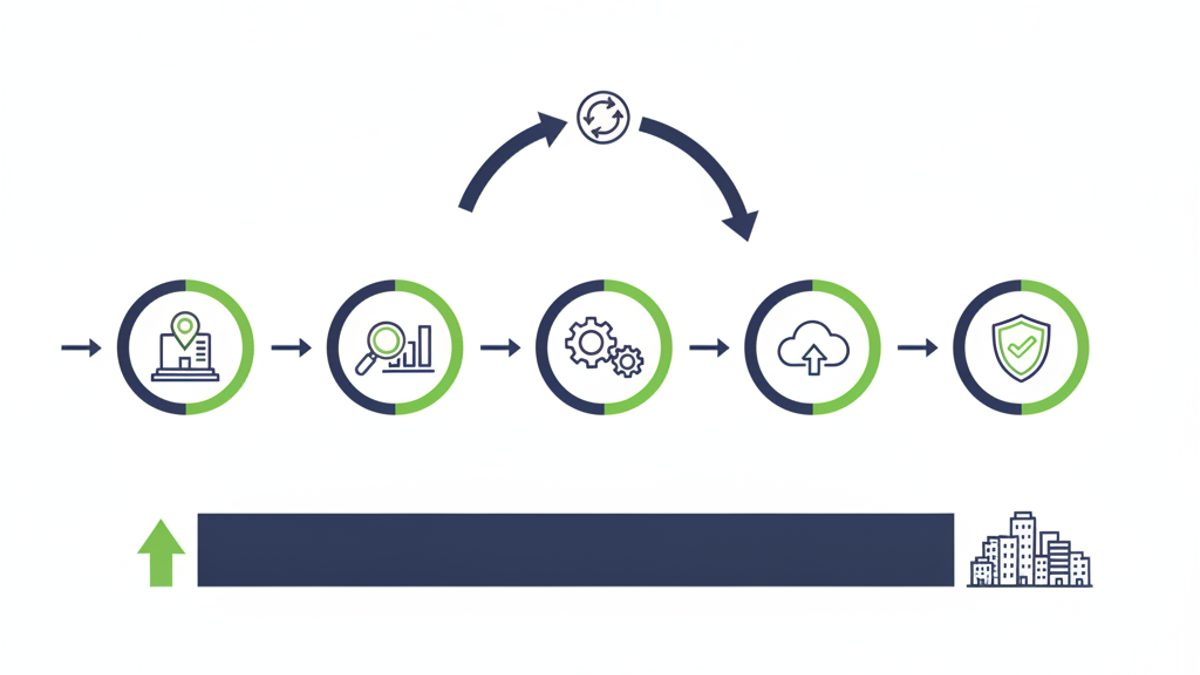
Efficiently scaling local rank tracking requires three foundational elements: standardized client onboarding processes, automated geo-grid rank tracking software, and integrated Google Business Profile (GBP) audit tools. These components work together to ensure consistent data collection, streamlined analysis, and actionable insights across an expanding client portfolio.
Standardization begins with consistent keyword research and selection for each client, ensuring relevant terms are tracked from the outset. Automated geo-grid rank trackers, such as ProMapRanker, then take over the arduous task of daily or weekly data collection, mapping local search performance across specific geographical areas. Finally, an integrated GBP audit tool helps identify common optimization gaps that impact local rankings, allowing agencies to address critical issues systematically. This three-pronged approach allows agencies to onboard new clients rapidly while maintaining high standards of data accuracy and reporting.
How do geo-grid rank trackers enable efficient scaling for local SEO agencies?
Geo-grid rank trackers enable efficient scaling by automating the process of mapping a business's local search visibility across a defined geographical area, eliminating the need for manual, location-specific rank checks. This automation provides a comprehensive, unbiased view of local performance, allowing agencies to monitor hundreds of locations and keywords simultaneously with minimal effort.
Instead of just reporting a single ranking for a keyword, a geo-grid scan generates a visual map (e.g., a 7x7 grid with 1-mile intervals) showing how a client ranks from various points within their service area. This level of detail is crucial because local rankings can fluctuate significantly even within a short distance. For agencies managing dozens of clients, running weekly or even daily geo-grid scans across all locations drastically reduces manual labor while providing superior insights into hyper-local performance. This allows teams to quickly identify areas of strength and weakness, pinpointing where optimization efforts are most needed. Learn more about their value in our geo-grid rank tracker explained article.
What role does white-label reporting play in scaling client communication and retention?
White-label reporting is crucial for scaling client communication because it allows agencies to present comprehensive rank tracking data under their own brand, enhancing professionalism and client trust without requiring significant time investments. By automating report generation, agencies can deliver consistent, branded updates to dozens of clients simultaneously, freeing up valuable staff time.
Clients appreciate professional, easy-to-understand reports that clearly demonstrate the value of their SEO investment. White-label solutions integrate seamlessly with agency branding, making the performance data appear as a direct output of the agency's expertise. This consistency across all client communications builds a stronger brand identity for the agency and reinforces their perceived value. For instance, ProMapRanker offers white-label local SEO reporting, allowing agencies to customize reports with their logo, colors, and commentary, turning complex data into actionable insights for clients without the manual design work.
How can agencies automate Google Business Profile audits for multiple locations?
Agencies can automate Google Business Profile (GBP) audits for multiple locations by utilizing specialized tools that systematically analyze key profile attributes against best practices and ranking factors. This automation streamlines the identification of optimization opportunities, ensuring consistency and accuracy across a large client base without manual review of each profile.
Manually auditing dozens of GBP profiles for completeness, consistency, review management, photo optimization, and service area accuracy is incredibly time-consuming. Automated GBP audit tools, like those offered by ProMapRanker, can scan profiles for missing information, inconsistent NAP (Name, Address, Phone) data, unresponded reviews, low-quality images, and other critical elements that impact local visibility. For example, the tool can flag profiles with fewer than 20 high-quality photos or an average review rating below 4.0 stars, providing a clear checklist for improvement. This allows agencies to efficiently prioritize fixes and ensure every client's GBP is optimized for maximum impact. Consider a free GBP audit to see this in action.
What advanced rank tracking features support multi-location local SEO strategies?
Advanced rank tracking features such as Share of Local Voice (SoLV), AI Rank Potential (ARP), and competitive geo-grid analysis are essential for supporting multi-location local SEO strategies. These features move beyond basic keyword rankings to provide deeper, actionable insights into overall market dominance, AI impact, and competitive positioning across numerous locations.
SoLV (Share of Local Voice) quantifies a business's overall visibility within a local market relative to its competitors, providing a single metric to gauge market share. ARP (AI Rank Potential) analyzes how well a business is optimized for AI-driven search results, which are increasingly influencing local visibility. For example, ProMapRanker includes features to track maps and AI rank on the same grid, giving a holistic view. Combined with competitive geo-grid analysis, which allows agencies to overlay competitor rankings on the same map, these features enable a sophisticated, data-driven approach to multi-location SEO. Agencies can identify specific geographical areas where a client is underperforming against a competitor, or where their AI optimization needs improvement, allowing for targeted strategy adjustments.
Step-by-Step: Implementing a Scalable Local Rank Tracking System for Agencies
Implementing a scalable local rank tracking system requires a structured approach, leveraging automation and standardized processes to efficiently manage multiple clients. Here's a practical checklist:
-
Select a Robust Local Rank Tracker for Agencies:
Choose a platform built for agencies, offering geo-grid capabilities, white-label reporting, and multi-client management. Look for features like daily/weekly scans, comprehensive reporting, and API access for integration. ProMapRanker, for example, provides these core functionalities and more, designed specifically for agency needs. Make sure the tool can handle a "5x5 grid at 1-mile intervals" as a minimum for granular local tracking.
-
Standardize Keyword Research and Tracking:
Develop a standardized process for identifying primary, secondary, and long-tail keywords for each client. Use a consistent keyword set across similar business types to streamline setup. Aim for 10-20 core keywords per client location to track effectively, including branded and non-branded terms. Ensure keywords are specific enough to capture local intent.
-
Automate Geo-Grid Scans:
Set up automated geo-grid scans for all client locations. Configure grid density (e.g., 7x7 or 9x9 grid) and radius (e.g., 1-mile or 3-mile intervals) based on the client's service area and competition. Schedule these scans weekly or bi-weekly to capture rank fluctuations and identify trends. This moves beyond single-point tracking to truly understand local visibility.
-
Integrate Automated Google Business Profile Audits:
Utilize your chosen rank tracker's integrated GBP audit features, or a dedicated tool, to regularly scan client profiles. Automate checks for NAP consistency, review sentiment, photo quantity and quality (e.g., at least 20 high-resolution photos), category accuracy, and service area clarity. This ensures foundational elements are always optimized, linking directly to Google Business Profile optimization best practices.
-
Implement White-Label Reporting:
Configure white-label reports with your agency's branding, including logos, colors, and custom introductory/concluding remarks. Schedule automated delivery of these reports to clients (e.g., monthly), ensuring they receive consistent, professional updates on their local SEO performance without manual assembly. This is key for efficient client communication.
-
Leverage Advanced Analytics (SoLV, ARP, Competitive Grids):
Train your team to utilize advanced features like Share of Local Voice (SoLV) to track market share, AI Rank Potential (ARP) to understand AI search visibility, and competitive geo-grids to benchmark against rivals. These insights help develop more sophisticated strategies and explain complex performance metrics to clients. For example, use competitive grids to show why a client's "geo-grid is mostly red" in certain areas compared to a competitor.
-
Streamline Internal Workflows:
Integrate your rank tracking data with project management tools or CRM systems. Establish clear protocols for interpreting data, assigning tasks based on audit findings, and communicating with clients about performance and strategic adjustments. This ensures that insights from the tracking system translate directly into actionable steps for your team.
Comparison: Manual vs. Automated Local Rank Tracking
Here's a quick comparison highlighting the efficiency gains of automated systems for agencies:
| Feature | Manual Local Rank Tracking | Automated Geo-Grid Local Rank Tracking |
|---|---|---|
| Time Investment Per Client | Hours per week (e.g., 3-5 hours for 10 keywords across 3 locations) | Minutes per week (setup time + review of automated reports) |
| Geographical Granularity | Limited to a few specific check points, highly biased by user location | High, detailed maps (e.g., 9x9 grid, 1-mile intervals) showing true local reach |
| Accuracy & Consistency | Prone to human error, inconsistencies across checks | High, consistent data from unbiased IP locations |
| Scalability for Agencies | Very low; linear increase in time/cost with each new client | High; enables exponential growth with minimal increase in operational overhead |
| Competitive Analysis | Difficult and time-consuming to compare against rivals point-by-point | Easy; overlay competitor data on geo-grids for direct comparison |
| Reporting | Manual report generation, inconsistent branding | Automated, white-label, branded reports delivered on schedule |
| Insights Provided | Basic keyword positions | Geo-grid maps, SoLV, ARP, local pack visibility, competitive landscapes |
The data clearly shows that agencies aiming for growth must transition to automated solutions to remain competitive and profitable. ProMapRanker is engineered to be a comprehensive BrightLocal alternative, offering superior geo-grid depth and advanced AI-driven insights.
Frequently asked questions
How do you scale local SEO services across multiple clients?
Scaling local SEO services involves standardizing processes, automating data collection with tools like geo-grid rank trackers and GBP audit software, and leveraging white-label reporting. This allows agencies to efficiently manage keyword tracking, profile optimization, and client communication for a large number of businesses without a proportional increase in manual effort.
What is an agency-level local SEO strategy?
An agency-level local SEO strategy focuses on delivering consistent, high-impact results across many clients by using robust tools and repeatable workflows. It emphasizes automated rank tracking (especially geo-grids), comprehensive Google Business Profile optimization, strategic review management, and efficient, branded client reporting to drive measurable local visibility and growth.
What are the essential tools for scaling local SEO for agencies?
Essential tools for scaling local SEO for agencies include a powerful geo-grid local rank tracker (like ProMapRanker), a Google Business Profile audit tool, a review management platform, a citation building service, and a white-label reporting solution. These tools automate tedious tasks, provide deep insights, and streamline client communication, enabling efficient growth.
How can local SEO agencies improve client retention?
Local SEO agencies can improve client retention by consistently demonstrating value through transparent, data-driven reporting, proactive communication, and measurable results. Utilizing white-label reports that clearly show ranking improvements and ROI, coupled with regular strategic updates based on geo-grid data and GBP audits, helps build trust and long-term partnerships.
Ready to supercharge your agency's local SEO efforts and scale effortlessly? Register for ProMapRanker today and experience the power of advanced geo-grid tracking and AI-driven insights.
See where you really rank - block by block
ProMapRanker scans Google Maps across a grid of your service area. Simple monthly plans from $19, white-label on every plan.
Start free