 ProMapRanker
Best Rutter Alternatives in 2026


Broad B2B integrations across categories · Pricing starts at: $650 per month
Key takeaways
- Rutter focuses on commerce, accounting, payments, and ads, so replacements range from commerce specialists to broad unified APIs.
- Merge and Apideck suit teams that need many categories behind one API, while Unified.to suits real-time use cases.
- Pricing models differ sharply, from per-connection and per-consumer to per-call and usage-based models.
- Data freshness matters: some platforms sync and store data, while others pass requests through in real time.
Quick comparison
| Pick | Great for | Pricing starts at | Free tier | |
|---|---|---|---|---|
| Merge | Broad B2B integrations across categories | $650 per month | Free trial | Visit |
 Apideck | Real-time unified APIs with published pricing | $599 per month | No | Visit |
 Unified.to | Usage-based APIs for AI and real-time apps | $750 per month | No | Visit |
 Codat | Accounting and financial data for fintech | See website | No | Visit |
 Nango | Code-first teams that want control | $50 per month | Yes | Visit |
 Kombo | HR and payroll integrations with European focus | See website | No | Visit |
 Paragon | Embedded integrations inside a SaaS product | See website | No | Visit |
 Knit | Pass-through integrations at a lower entry price | $499 per month | No | Visit |
The best rutter alternatives
Rutter is a unified API for commerce, accounting, payments, ads, and bank feeds, built for products that read orders, payouts, and sales data from platforms such as Shopify, Amazon, Stripe, and PayPal. The options below are unified commerce APIs and broader unified APIs that can serve similar products, and we note where a platform covers more than commerce.
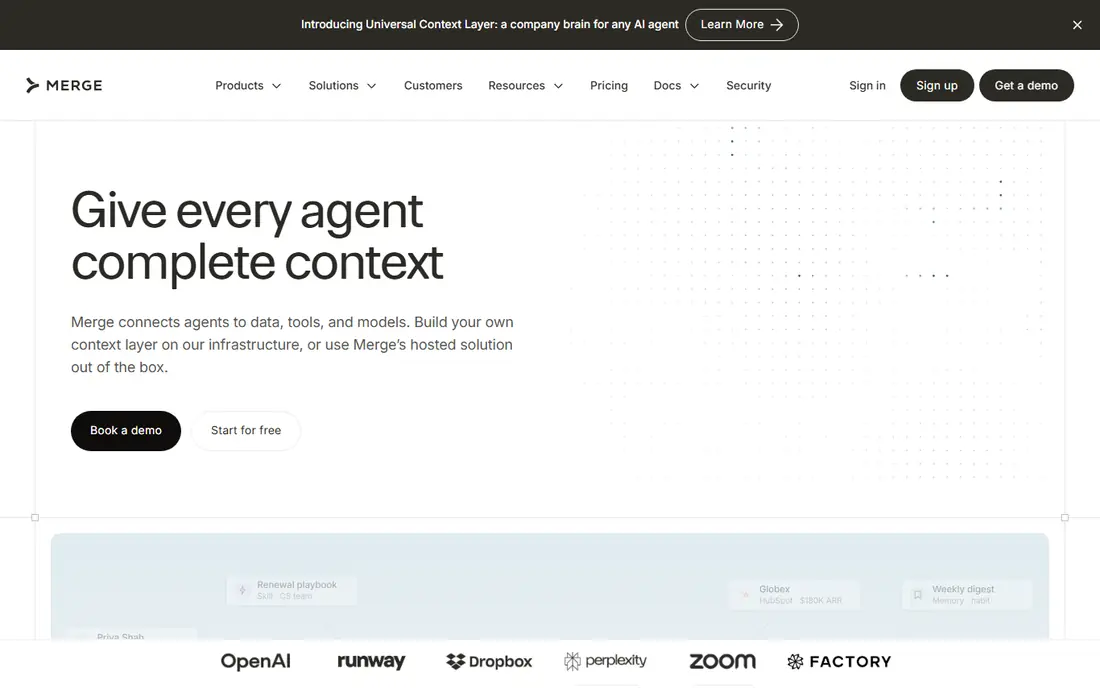
Merge is the broadest replacement for a team whose roadmap goes beyond commerce. It normalizes data across human resources, applicant tracking, customer management, accounting, ticketing, and file storage, so one integration layer can serve many product areas. Its observability tools, logs, and issue detection also help a team support customer connections in production.
The cost model needs care. The launch plan starts at $650 per month for up to ten production linked accounts, with the first three included free, and extra accounts add $65 each. A product with many small customers can see costs rise quickly, so model pricing on expected linked accounts, not just on the starting plan.
- Normalized APIs across HRIS, ATS, CRM, accounting, and ticketing
- Strong observability tools
- Wide provider coverage
- Per-linked-account pricing scales fast
- Commerce depth is part of a broader platform, not the sole focus
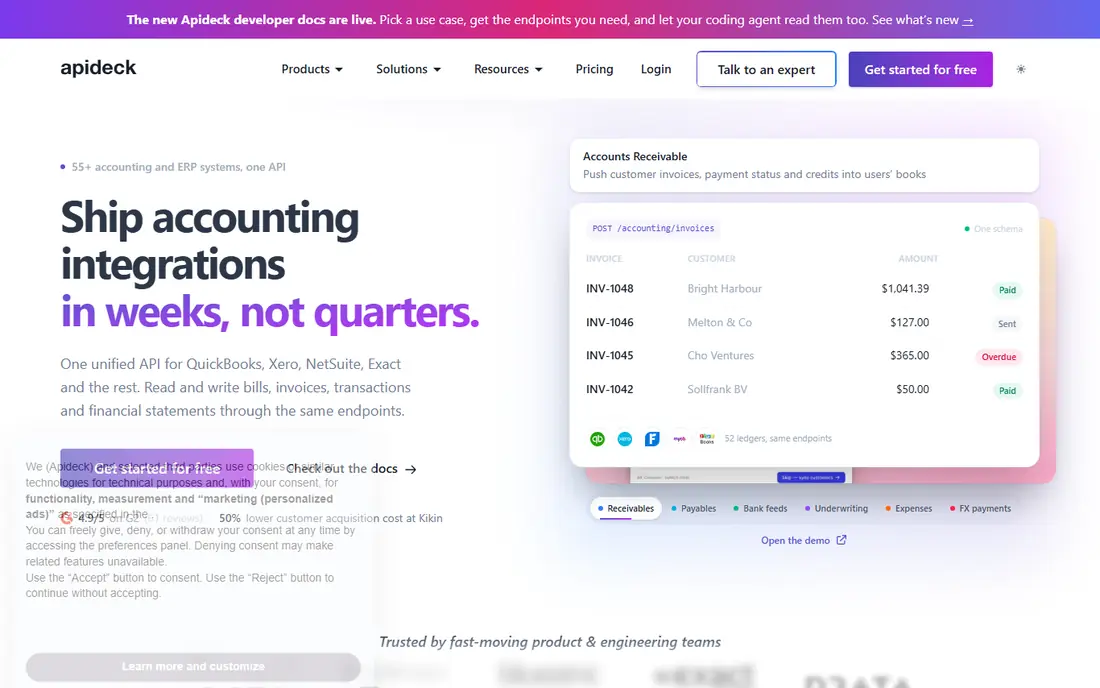
Apideck suits teams that need fresh data on every request. It calls the source system in real time and does not persist third-party data, which helps with data residency and compliance questions, and it avoids the staleness of a scheduled sync. Its published pricing, starting at $599 per month for 25 consumers, also makes early cost modelling easier than a quote-only platform.
The trade-off is scope and price structure. Apideck covers many categories beyond commerce, so a commerce-only product may pay for breadth it does not need. Per-consumer pricing also rises with customer count, though tiered plans lower the per-consumer cost at higher volumes, which rewards a team that scales steadily.
- Real-time pass-through with no stored third-party data
- Published pricing
- Covers commerce, CRM, HRIS, and more
- Per-consumer pricing can grow with customer count
- Smaller commerce-only teams may pay for categories they do not use
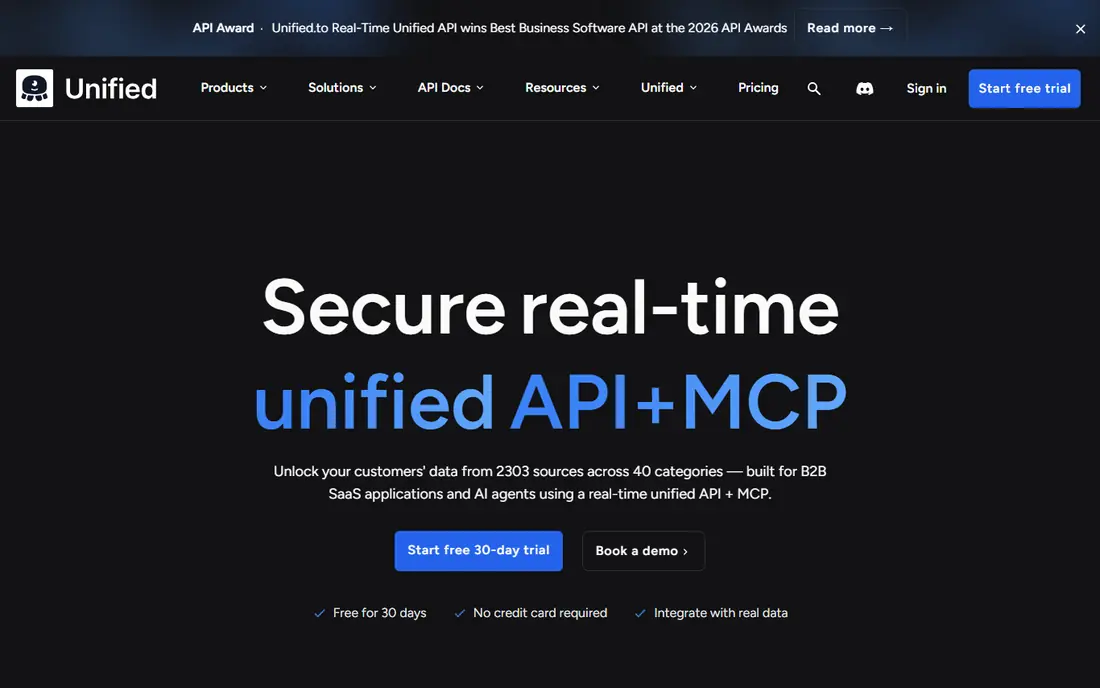
Unified.to fits products where fresh data is a feature, such as real-time dashboards, AI agents, and operational workflows. Its live pass-through model calls source systems on demand, and it covers many categories, which suits a team building AI features that need current data rather than a synced copy. Pricing starts at $750 per month for a set request allowance with unlimited customer connections.
Usage billing is the watch point. Webhook events count toward the monthly request limit, so a noisy integration can use allowance faster than expected. Teams should estimate requests from real customer behaviour, including webhooks, before choosing a usage-based model over a per-connection model.
- Live pass-through across many categories
- Usage-based pricing
- Webhook support for change events
- Usage-based billing needs careful forecasting
- Webhook events count toward request limits
Codat is the pick for fintech products that need accounting and financial data more than storefront orders. Lenders, underwriters, and business finance tools use it to read standardized financial data from accounting and banking systems, which supports credit decisions and cash flow analysis. That focus gives it depth in financial data that broader platforms may not match.
Commerce teams should check coverage carefully. Codat is less focused on marketplace orders, ad performance, and payout data than Rutter, so a product built on ecommerce sales may find gaps. Pricing is also quote-based, so a team must go through sales to model cost, which slows early comparison.
- Deep accounting and financial data focus
- Suits lending and underwriting
- Strong data standardization
- Quote-based pricing
- Narrower commerce and ads coverage than Rutter
Nango suits engineering-led teams that want to define their own sync logic and keep control over integrations. Its free tier covers a small number of connections, and pay-as-you-go pricing starts at $50 per month including credits, which makes it the cheapest entry point on this list. A self-hosted option also appeals to teams with strict hosting needs.
The cost is engineering time. Nango gives developers more control, but it also asks them to build and maintain more of the integration logic than a fully managed platform would. A small team without integration experience may move faster with Merge or Apideck, while a team with strong engineers may prefer Nango's flexibility and price.
- Low entry price with a free tier
- Self-hosting option
- Custom sync logic for developers
- More engineering work than a managed platform
- Smaller managed connector library for some categories
Kombo is a specialist replacement for teams that need human resources, applicant tracking, and payroll data, especially from European providers. Its integration count in those categories is high, and its sync options support products that need current employee and candidate data. That depth suits HR tools, payroll products, and workforce platforms.
Commerce-first teams should treat Kombo as a partial fit. It is not built as a direct Rutter replacement for Shopify, Amazon, or ad platform data, so a product that needs both commerce and HR data may need Kombo alongside a commerce API. Pricing is also quote-based, with an annual platform fee plus a per-customer fee.
- Strong HR, ATS, and payroll coverage
- Real-time sync options
- European provider depth
- Quote-based pricing
- HR focus means commerce coverage is not the main strength
Paragon fits SaaS products that want customers to connect their own tools inside the product, through a white-labelled portal. That embedded experience matters for a B2B tool where integrations are a selling point, not just a back-end data feed. Managed sync and action tools help teams offer write access as well as reads.
The limit is fit and price. Paragon is aimed at embedded integrations, so a team that only needs to pull commerce data for underwriting may find it heavier than needed. Pricing is quote-based, so early cost comparison is harder than with Nango, Apideck, or Unified.to, where entry prices are published.
- White-labelled connect portal for end users
- Managed sync
- Low-code and code options
- Quote-based pricing
- Aimed at embedded use cases rather than data extraction alone
Knit offers a middle path between cheap code-first tools and large managed platforms. Its pass-through model with webhook push gives fresher data than a scheduled sync, and its start-up plan at $499 per month undercuts Merge and Apideck for teams that need a managed option without enterprise pricing. Category coverage spans HR, accounting, CRM, and more.
The watch point is scaling terms. Connected accounts on higher plans are contract-based, so a team should confirm how account growth affects price before building a large customer base on Knit. Its smaller presence also means fewer public case studies to check, so a trial with real customer systems matters more here.
- Pass-through model with webhook push
- Lower entry price than Merge or Apideck
- Broad category coverage
- Connected accounts are contract-based on higher plans
- Smaller brand presence than larger rivals
How we picked these
We compared official pricing pages, product documentation, and recent comparison research for unified APIs operating in October 2026. We kept only platforms with a real, current API product, and we wrote See website where pricing is quote-based. Where pricing differed across sources, we used the published vendor figure where available and noted the pricing model, since the model often matters more than the starting figure.
We also weighed data freshness and coverage, not just price. A sync-based platform stores a copy of customer data and refreshes it on a schedule, while a pass-through platform calls the source on each request. Both approaches work, but they suit different products, and a team should choose based on how fresh its data must be.
How to choose a unified API without locking in the wrong model
Start with the exact systems your customers use. List the top ten platforms your first fifty customers will connect, then check each vendor catalog for those names, not for total connector counts. A vendor with two hundred connectors is poor value if it lacks the three systems your customers actually use, while a smaller vendor that covers those three may be the better pick.
Next, model cost on realistic growth. A per-connection model scales with customer count even if usage stays low, a per-consumer model behaves similarly, and a usage-based model scales with requests and webhooks. Run all three models on a forecast of customers, requests, and webhook volume for twelve months, and ask each vendor to confirm the forecast in writing before signing.
Finally, test data freshness and writes. Connect a test account, change a record in the source system, and time how long the change takes to appear through the API. Test a write operation as well, since some platforms read well but write poorly. Those two tests reveal more about fit than a feature page, and they should happen before a migration or a launch commitment.
Frequently asked questions
Is Rutter only for commerce data?
Rutter focuses on commerce, accounting, payments, ads, and bank feeds, which suits ecommerce and lending products built on sales data. Broader unified APIs such as Merge and Apideck cover those areas plus CRM, HRIS, and other categories. A commerce-only product may not need that breadth, while a multi-category product will.
What is the difference between sync and pass-through APIs?
A sync platform copies customer data on a schedule and serves reads from that copy, which is fast but only as fresh as the last sync. A pass-through platform calls the source system on each request, which gives fresher data but depends on source system speed and limits. Choose sync for reporting and pass-through for real-time dashboards and AI features.
How much do unified APIs cost at scale?
Costs vary widely by model. Nango starts at $50 per month, Knit at $499 per month, Apideck at $599 per month, Merge at $650 per month, and Unified.to at $750 per month, while Codat, Kombo, and Paragon use quote-based pricing. At scale, per-connection and per-consumer costs often dominate, so model growth before choosing.
Can I migrate customer connections from Rutter?
Migration depends on the vendors involved and on token transfer support. Apideck, for example, offers token migration for some moves, while other vendors need customers to reconnect. Ask both vendors about token migration, downtime, and customer communication before starting, since reconnecting many customers is a major project.
Do unified APIs handle writes as well as reads?
Most platforms in this list support writes for at least some categories, but write coverage varies by provider and object. Rutter returns write results in the same request by default in its sync mode, while other platforms vary. Test writes on the exact objects your product needs, rather than assuming full write support across all categories.
Should a small team build integrations directly instead?
Direct integrations can work for one or two systems, but they become costly as provider count grows, since each API needs auth, mapping, error handling, and upkeep. A unified API pays off once a product needs several systems or expects provider APIs to change often. Start direct only if the roadmap stays at one or two stable systems.
Sources
See where you really rank - block by block
ProMapRanker scans Google Maps across a grid of your service area. Simple monthly plans from $19, white-label on every plan.
Start freeKeep reading
 zoro.to alternatives
Best Zoro.to Alternatives in 2026
We compare the best zoro.to alternatives in 2026, listing only legal licensed anime streaming services, from Crunchyroll to free options for fans today.
Read → zip alternatives
Best Zip Alternatives in 2026
We compare the best zip alternatives for buy now, pay later in 2026, covering pay-in-4 plans, fees, spending limits, and credit reporting options today.
Read → yesware alternatives
Best Yesware Alternatives in 2026
Compare the best yesware alternatives for sales email tracking, templates, and sequences, with current pricing and honest tradeoffs for small sales teams.
Read →