 ProMapRanker
Best REST API Alternatives in 2026

Front ends needing exactly the fields they ask for · Pricing starts at: Free
Key takeaways
- This article covers alternatives to REST APIs as API styles and protocols, not rival products, so each entry is judged on fit, not a vendor plan.
- GraphQL suits front ends that need flexible, client-shaped data, while gRPC suits fast service-to-service calls inside a backend.
- WebSocket and Server-Sent Events are not general REST replacements; they suit live updates, chat, and dashboards where the server must push data.
- SOAP, JSON-RPC, OData, Falcor, and Connect each fit a narrower case, from formal enterprise contracts to typed web clients.
Quick comparison
| Pick | Great for | Pricing starts at | Free tier | |
|---|---|---|---|---|
| GraphQL | Front ends needing exactly the fields they ask for | Free | Yes | Visit |
 gRPC | High-performance service-to-service calls | Free | Yes | Visit |
 tRPC | Full-stack TypeScript teams wanting end-to-end types | Free | Yes | Visit |
 SOAP | Regulated and enterprise partner integrations | Free | Yes | Visit |
 WebSocket | Chat, live dashboards, and collaborative editing | Free | Yes | Visit |
 JSON-RPC | Simple action-based calls over JSON | Free | Yes | Visit |
 OData | Queryable data APIs for business applications | Free | Yes | Visit |
 Falcor | Front ends fetching data through one JSON graph | Free | Yes | Visit |
 Connect | Typed RPC that works well on the web | Free | Yes | Visit |
The best rest api alternatives
A plain note on the angle first: REST is an architectural style, so its alternatives are other styles and protocols for moving data between systems, not a list of competing apps. Each entry below is an open specification or open-source project, free to use, with costs limited to implementation and hosting. We compared official specifications, documentation, and public comparisons to judge where each style earns its place.
GraphQL is the most popular REST alternative for front-end teams, and for good reason. Instead of calling several REST endpoints and stitching the results together, a client sends one query describing the exact shape it needs, and the server returns that shape. That design cuts over-fetching and under-fetching, which matters most on mobile apps and complex dashboards built from many data sources.
The cost is server-side discipline. A single endpoint that can serve many shapes needs query depth limits, complexity limits, and caching strategies that REST gets almost for free through URLs and HTTP verbs. Teams with simple CRUD APIs may not need GraphQL at all. Teams whose screens change often, and whose clients need different field sets, will find it a genuine improvement.
- Clients request only the fields they need in one query
- Typed schema supports tooling and validation
- Single endpoint reduces endpoint sprawl
- Caching by URL is harder than with REST
- Deeply nested queries can strain servers without limits
- Auth and rate limits need care on a single endpoint
gRPC is the standard choice when services inside one backend need to talk fast. It uses Protocol Buffers for compact binary payloads, HTTP/2 for multiplexed streaming, and generated clients in many languages, so a service call feels like a typed function call rather than a hand-built HTTP request. That combination suits microservices, real-time backends, and polyglot systems where performance and type safety matter.
The limit is the public edge. Browsers do not speak gRPC natively, and external partners usually prefer JSON over HTTP, so most teams put a REST or Connect gateway in front of gRPC services for outside callers. Inside the backend, though, gRPC is hard to beat. If your pain is service-to-service speed and contract rigor, start here.
- Binary Protocol Buffers payloads are compact and fast
- HTTP/2 streaming supports long-lived calls
- Generated clients enforce typed contracts
- Poor fit as a public browser API without a gateway
- Debugging binary payloads is harder than reading JSON
- Schema changes need version care
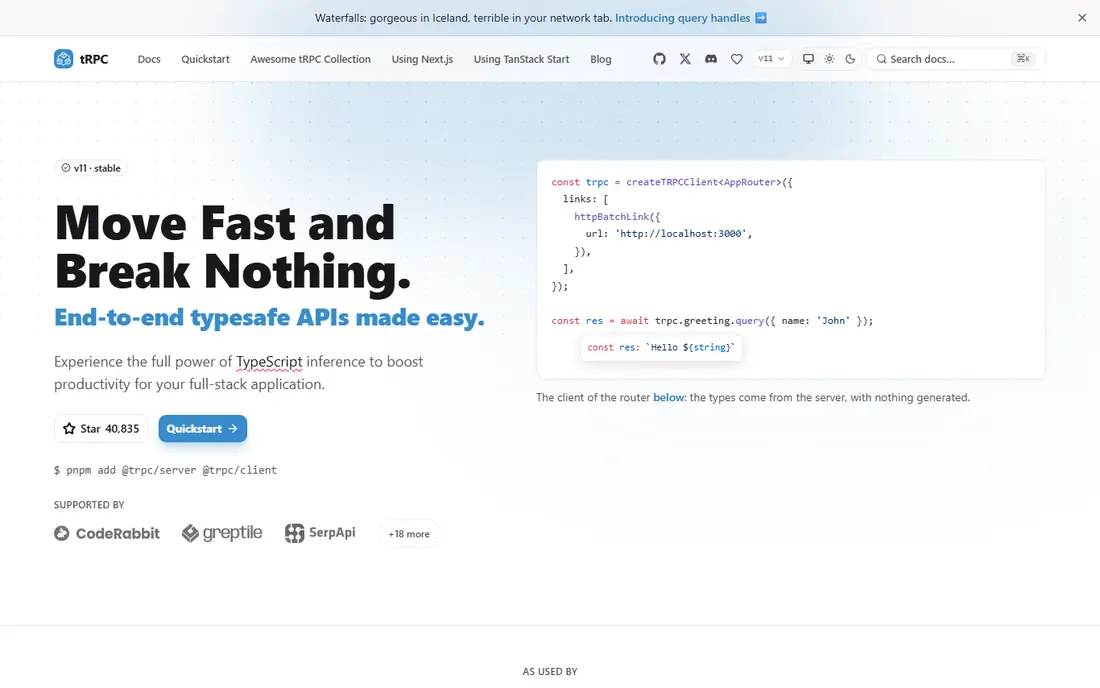
tRPC removes a whole layer of API busywork for TypeScript teams. Instead of defining REST endpoints, writing OpenAPI specs, and generating clients, you define procedures on the server and call them from the client with full type safety, including inputs, outputs, and errors. Refactors propagate through types, which catches mismatches at build time rather than in production.
The boundary is language. tRPC is a TypeScript solution, so teams with Python, Go, or Java services will not get the same benefit, and public APIs for outside partners still call for REST or GraphQL. For a TypeScript team building its own web app, tRPC is often the fastest and safest REST alternative available.
- Types flow from server to client with no schema file to maintain
- Procedures replace REST endpoint boilerplate
- Excellent fit for TypeScript monorepos
- TypeScript-only, so mixed-language teams gain less
- No public API standard for outside partners
- Router design needs care as the API grows
SOAP is not fashionable, and that is not the point. It remains the required choice when a bank, insurer, health system, or government partner hands you a WSDL file and expects a formal contract with strict typing, security standards, and reliable messaging. In those integrations, SOAP's rigor is a feature, not a flaw, and its standards cover cases that REST leaves to convention.
For a new API you control, SOAP is rarely the right pick in 2026. JSON APIs are easier to build, test, and consume, and mobile clients handle them far better. Treat SOAP as a compatibility tool: use it where a partner or regulator requires it, and choose a modern style for everything you build fresh.
- Strict WSDL contracts define operations precisely
- WS-Security standards cover signing and encryption
- Long track record in banking, health, and government
- XML payloads are verbose and slower to parse
- Tooling feels dated next to JSON APIs
- Poor fit for new public or mobile APIs
WebSocket
Great for: Chat, live dashboards, and collaborative editing
WebSocket solves a problem REST handles badly: the server pushing data to the client without polling. A persistent connection lets chat messages, live scores, dashboard updates, and collaborative edits arrive the moment they change, with far less overhead than repeated REST requests. That is why chat apps, trading screens, and multiplayer tools rely on it.
It is not a general REST replacement. WebSocket carries messages, but it does not define resources, queries, or caching, so most apps pair it with REST or GraphQL for data fetching and use WebSocket only for live updates. Teams that need one-way server push, rather than two-way chat, should also consider Server-Sent Events, which are simpler over plain HTTP. Use WebSocket where liveness is the product.
- Persistent two-way channel with low latency
- Server can push updates the moment they happen
- Efficient for frequent small messages
- Not a query API, so it does not replace CRUD endpoints
- Connection management and scaling take work
- No HTTP caching for live messages
JSON-RPC is the simplest alternative on this list, and sometimes simplicity is enough. A client sends a JSON object naming a method and its parameters, and the server returns a result or an error. That action-oriented shape fits internal tools, device control, and command-style APIs far better than forcing every action into REST resource verbs.
The weakness is the lack of a standard contract. Without a schema, discovery, or code generation story, large JSON-RPC APIs can drift into a tangle of undocumented methods. Small, internal, action-heavy APIs are the sweet spot. Larger public APIs should pick GraphQL, gRPC with a gateway, or REST with OpenAPI instead.
- Tiny specification that is easy to implement
- Method names map cleanly to actions
- Works over HTTP, WebSocket, or other transports
- No standard discovery or schema story
- Clients and servers can drift without contract tooling
- Less suited to resource-shaped public APIs
OData adds a standard query language on top of HTTP data services. Clients can filter, sort, page, and expand related data through URL conventions, rather than waiting for a vendor to build a custom endpoint for each query. That design suits business applications, reporting tools, and data platforms where consumers need flexible access to structured data.
The cost is complexity. The full OData specification is large, and complete implementations take real effort, which is why its strongest ecosystem sits around Microsoft platforms. Teams that need only a few fixed queries should stay with REST. Teams exposing business data to many consumers, including Excel and business intelligence tools, will find OData's query standard worth the investment.
- Standard query language for filtering, sorting, and paging over HTTP
- Metadata documents describe the data model
- Strong fit for enterprise data services
- Full specification is large and complex to implement
- Client support varies outside Microsoft ecosystems
- Simpler APIs may not need its query power
Falcor, created at Netflix, treats all remote data as one JSON graph. A client requests paths through that graph, and the server resolves them, batching and caching the underlying data fetches. Like GraphQL, it lets a front end ask for exactly the nested data a screen needs in one round trip, without a proliferation of endpoints.
The reason GraphQL usually wins today is ecosystem. Falcor's community, tooling, and hiring pool are smaller, so most teams will find GraphQL easier to staff and support. Falcor remains a valid choice for teams that already use it, or that prefer its JSON graph model to GraphQL's schema language. New projects should compare both before committing.
- Single data model lets clients request nested data in one call
- Server can batch and cache underlying fetches
- Proven at scale in its original use case
- Smaller community and ecosystem than GraphQL
- Server implementation work falls on the adopter
- Documentation and tooling are thinner today
Connect, from the ConnectRPC project, answers the main complaint about gRPC: that it does not work well on the web. It keeps Protocol Buffers and typed contracts, but serves them over plain HTTP with JSON support, so browsers and standard HTTP tooling work without a translation proxy. It can also interoperate with gRPC services, which lets a team adopt it at the edge while keeping gRPC inside the backend.
The trade-off is youth. Connect is newer than gRPC and REST, so its ecosystem and production history are smaller, though growing. For a team that wants gRPC-style typing with web-friendly transport, Connect is the most practical bridge available. For a purely internal backend, plain gRPC remains the simpler choice.
- Uses Protocol Buffers with plain HTTP and JSON support
- Works in browsers without special proxies
- Compatible with gRPC services and tooling
- Newer ecosystem than gRPC itself
- Fewer production stories than plain REST
- Teams must still manage schema versioning
How we picked these
We compared official specifications, documentation, and public comparisons for styles and protocols that can carry API traffic in place of REST. We kept only styles that are live, documented, and usable in October 2026, and we left REST itself off the list, since this article is about alternatives to it. Prices are Free throughout because these are open specifications and open-source projects, not vendor products; implementation and hosting costs still apply.
What to check before you switch
Start with the consumer, not the protocol. Public APIs for outside partners favor REST or GraphQL, because partners already know them and have tooling for them. Internal service calls favor gRPC or Connect, because type safety and speed matter more there. Live updates favor WebSocket, and formal partner contracts may force SOAP whether you like it or not. A single system often uses two or three styles at once, and that mix is normal.
Also check caching, auth, and versioning before you commit. REST gives you URL caching and HTTP status codes for free, while GraphQL, gRPC, and WebSocket each need explicit answers for those concerns. Prototype the hardest query, the hardest live update, and the hardest version change, then judge the style on those three cases. A style that handles your hardest cases well is a better pick than one that only handles the easy ones.
Frequently asked questions
What is the best alternative to REST API?
GraphQL is the best general alternative for front ends that need flexible data, while gRPC is the best alternative for internal microservices. There is no single winner, because REST covers public APIs, simple CRUD, and caching better than most rivals. Pick by consumer: front end, internal service, partner, or live client.
Is GraphQL better than REST?
GraphQL is better when clients need different field sets, nested data, or fewer round trips, and when screens change often. REST is better for simple CRUD, public APIs, and anything that benefits from HTTP caching by URL. Many teams run both, with GraphQL for the front end and REST for partner APIs.
When should I use gRPC instead of REST?
Use gRPC for service-to-service calls inside your own backend, where speed, streaming, and typed contracts matter and where you control both sides. Avoid exposing raw gRPC as a public browser API, since browsers do not speak it natively. Put a REST or Connect gateway in front of gRPC services for outside callers.
Is SOAP still used in 2026?
Yes, mainly in banking, insurance, healthcare, and government integrations where a formal WSDL contract and WS-Security standards are required. SOAP is rarely chosen for a new public or mobile API today. Use it where a partner or regulator requires it, and choose a modern style for new work.
What is the difference between WebSocket and REST?
REST follows a request and response pattern, where the client asks and the server answers, which suits data fetching and CRUD. WebSocket keeps a persistent two-way connection open, so the server can push updates the moment they happen, which suits chat, live dashboards, and collaboration. Most live apps use both styles together.
Sources
See where you really rank - block by block
ProMapRanker scans Google Maps across a grid of your service area. Simple monthly plans from $19, white-label on every plan.
Start freeKeep reading
 zscaler alternatives
Best Zscaler Alternatives in 2026
Looking for zscaler alternatives? We compare 9 SASE and zero trust platforms on architecture, data protection, pricing, and fit for your network and team.
Read → zapier alternatives free
Best Zapier Alternatives Free in 2026
Nine automation tools for zapier alternatives free in 2026, all with genuinely free tiers, plus free plan limits, starting prices and upgrade paths explained.
Read → which platform is best for online reputation
Which Platform Is Best for Online Reputation in 2026
Wondering which platform is best for online reputation? We compare 8 review, listing, and response tools for small and multi-location businesses and agencies.
Read →