 ProMapRanker
REST Alternatives in 2026

Key takeaways
- This guide treats REST alternatives as API approaches and tools, not as single products: GraphQL, gRPC, tRPC, SOAP, WebSockets, and similar styles.
- GraphQL is our pick when one front end needs flexible, nested data from many sources, while gRPC fits fast service-to-service calls inside a backend.
- REST remains the right default for simple public APIs, because it is easy to learn, easy to cache, and every language speaks HTTP.
- No alternative wins on every measure. Pick by the constraint that matters most: flexible reads, speed, strict contracts, or real-time updates.
Quick comparison
| Pick | Great for | Pricing starts at | Free tier | |
|---|---|---|---|---|
 GraphQL | Flexible client-driven reads | Free | Yes | Visit |
 gRPC | Fast internal services | Free | Yes | Visit |
 tRPC | Type-safe TypeScript APIs | Free | Yes | Visit |
 SOAP | Strict enterprise contracts | Free | Yes | Visit |
 WebSockets | Real-time bidirectional updates | Free | Yes | Visit |
 Server-Sent Events | One-way server push | Free | Yes | Visit |
 Connect | Typed APIs for web and mobile | Free | Yes | Visit |
 OData | Queryable data APIs | Free | Yes | Visit |
 JSON-RPC | Simple remote method calls | Free | Yes | Visit |
The best REST API alternatives
Here are the REST alternatives we shortlisted for teams that hit a real limit with REST, such as over-fetching, chatty mobile calls, strict partner contracts, or live updates.
GraphQL is our pick when a front end needs flexible, nested data. Instead of many fixed REST endpoints, a client sends one query to one endpoint describing exactly the data it wants, and the response matches that shape. That solves over-fetching, where REST returns fields a screen never uses, and under-fetching, where a screen needs several REST calls to build one view.
The costs are caching and query safety. REST caches easily by URL, while GraphQL usually posts queries to one URL, so caching needs extra tooling. A deeply nested query can trigger many database calls unless the server batches them, and one endpoint doing many jobs needs careful auth checks. Use GraphQL when screens change often and data comes from many sources, and stay with REST for simple CRUD and public APIs.
- Clients request exactly the fields they need
- One endpoint for many resources
- Typed schema clients can inspect
- Caching needs extra work
- Deeply nested queries can strain a server
- Auth on one endpoint needs care
gRPC fits fast service-to-service calls inside your own backend. It uses binary Protocol Buffers over HTTP/2, with typed contracts defined in proto files and clients generated from those files. Streaming in both directions suits services that exchange a steady flow of messages, and the binary format keeps payloads small and fast.
The limit is public use. Browsers do not speak gRPC natively, and partners who expect JSON over HTTP will find a binary API awkward, so a public mobile API usually needs a gateway in front of gRPC. Debugging also takes tooling, since you cannot read a binary payload in a browser tab. Use gRPC between services you control, and keep REST or GraphQL at the public edge.
- Binary Protocol Buffers over HTTP/2
- Typed generated clients
- Streaming in both directions
- Not browser-friendly without a gateway
- Binary payloads are hard to inspect by hand
- Setup is heavier than REST
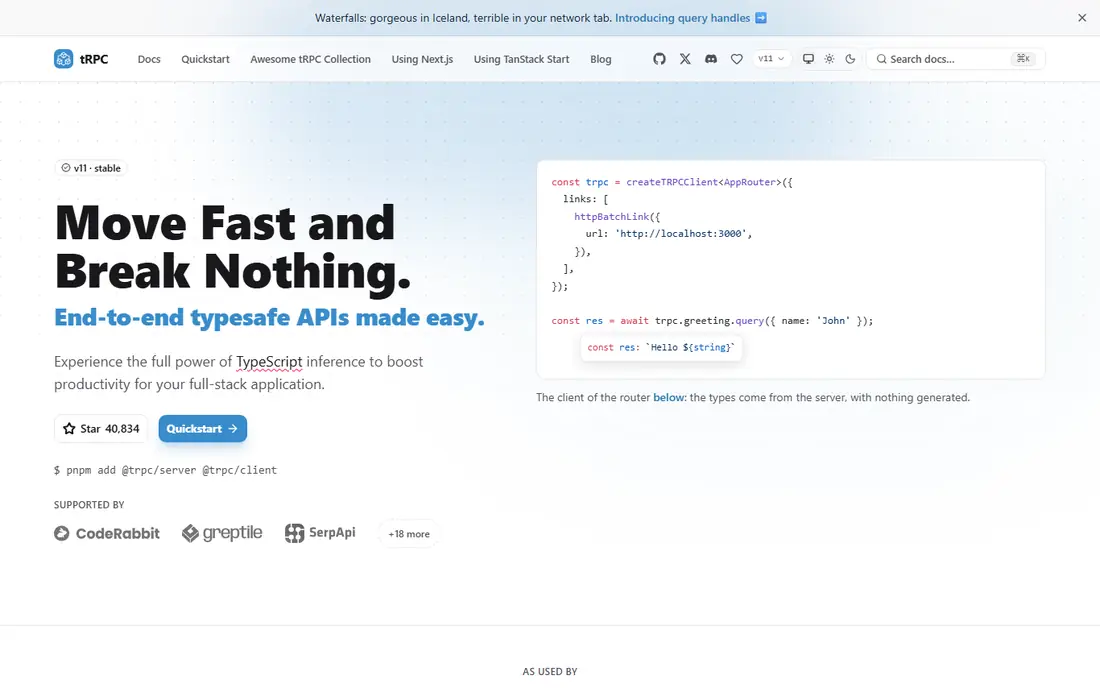
tRPC suits a full-stack TypeScript team that wants type safety without a separate schema layer. Procedures defined on the server carry types straight through to the client, so a renamed field or a changed return type shows up as a compile error, not a runtime surprise. That tight loop speeds up a small team building a web app with one codebase.
The scope is narrow by design. tRPC is TypeScript-only, and it fits best when one team owns both server and client. A public API for third parties in many languages needs a language-neutral contract, such as REST with OpenAPI, GraphQL, or gRPC. Use tRPC for an internal full-stack app, and pick a neutral style for a public API.
- End-to-end type safety for TypeScript teams
- No separate schema file
- Fast to build for full-stack apps
- TypeScript-only
- Less suited to public third-party APIs
- Server and client must share types
SOAP fits a narrow but real job: integrating with an organization that already requires a strict contract. It exchanges XML messages under a WSDL contract, with WS standards for security, transactions, and reliable messaging. Banks, government agencies, and older health systems still use SOAP, and when a partner hands you a WSDL file, SOAP is the correct answer, not a debate.
Do not start a new consumer API in SOAP in 2026 if you control both sides. XML payloads are verbose, tooling is heavy, and mobile developers will prefer JSON. SOAP earns its place as a compatibility choice for regulated partner integrations, where a formal contract matters more than payload size or developer fashion.
- Strict WSDL contracts
- Built-in standards for security, transactions, and reliable messaging
- Long enterprise history
- Verbose XML payloads
- Heavy tooling
- Poor fit for new public web and mobile APIs
WebSockets suit live features where the server must push updates the moment they happen. A single persistent connection carries messages in both directions, which fits chat, live dashboards, collaborative editing, and multiplayer features. Polling a REST endpoint every few seconds wastes requests and still lags, while a WebSocket delivers the update at once.
The cost is connection management. Each client holds an open connection, which needs scaling, reconnection, and auth handling that REST does not. WebSockets also do not replace CRUD: use REST or GraphQL for reads and writes, and add WebSockets only for the live feed. A hybrid design, with REST for data and WebSockets for updates, is the usual sensible shape.
- Persistent two-way connection
- Server can push updates at once
- Low latency for chat and live dashboards
- Needs an open connection per client
- Harder to scale and cache than REST
- Not a CRUD replacement
Server-Sent Events, often called SSE, suit one-way push over plain HTTP. The server streams text events to the browser, which reconnects automatically if the connection drops. That simplicity fits live news feeds, build logs, progress updates, and notifications where the client never needs to send messages back over the same channel.
The limit is direction. SSE cannot carry client-to-server messages, so a chat app or collaborative editor still needs WebSockets or a separate REST call for input. SSE also streams text, not binary, and it fits browsers best. Use SSE when the flow is one-way and simple, and use WebSockets when both sides must talk in real time.
- Simple one-way streaming over HTTP
- Automatic reconnection in browsers
- No extra protocol to learn
- Server to client only
- Limited to text events
- Fewer features than a full bidirectional socket
Connect, from the ConnectRPC project, bridges the gap between gRPC and the web. It offers typed contracts with generated clients, like gRPC, but it works over plain HTTP with protocols browsers and mobile clients can use, including JSON. That makes it a practical choice for a team that wants gRPC-style typing without forcing every client through a binary-only gateway.
The ecosystem is newer than REST or GraphQL, so expect fewer tutorials, fewer third-party tools, and more learning time for a new team. Protocol choices also need a decision upfront, since Connect supports more than one wire format. Shortlist Connect when you want typed service APIs that reach web and mobile clients directly, and compare it with gRPC plus a gateway before committing.
- Typed contracts like gRPC with browser-friendly protocols
- Works over plain HTTP
- Supports JSON and binary
- Newer ecosystem than REST or GraphQL
- Teams must learn its protocol options
- Gateway needs vary by client
OData suits a data-heavy API where clients need to filter, sort, page, and select fields without a new endpoint for each query. It builds on REST and HTTP, adds a standard query language in the URL, and publishes metadata so clients can discover entities and fields. Business and reporting tools that already speak OData can consume such an API with little custom code.
The risk is query cost. A flexible query language lets a client ask for an expensive join or a huge page, so the server needs paging limits, query validation, and auth checks on every field. Implementation depth also varies across libraries, so test your stack's OData support before promising it. Use OData for queryable business data, and use plain REST when a fixed set of endpoints covers the job.
- Standard query options for filtering, sorting, and paging
- Metadata documents clients can read
- Suits data-heavy APIs
- Query flexibility can strain a server
- Implementation depth varies
- Overkill for simple CRUD
JSON-RPC suits action-oriented APIs where the job is to call a method, not to manage a resource. The client sends a JSON object naming a method and its parameters, and the server returns a JSON result or error. That model is easy to implement in any language, and it fits internal tools, scripts, and services that invoke commands rather than browse data.
The weakness is discipline. Without a resource model or a schema standard, a JSON-RPC API can grow into a long list of ad hoc methods that are hard to document, cache, or discover. Keep method names consistent, version them, and document every method and error. Use JSON-RPC for a small internal service, and use REST, GraphQL, or gRPC when the API must scale to many clients.
- Very simple method-call model
- JSON over HTTP
- Easy to implement in any language
- No standard resource model
- Easy to grow into messy method soup
- Caching and discovery are weak
How we picked these
We compared API documentation, protocol specifications, and recent 2026 guides, and we kept only approaches that are live, documented, and used in production in October 2026. We favored a mix that covers the main reasons teams leave REST: flexible reads, speed, type safety, strict contracts, real-time push, and simple method calls. We did not invent products for this list, since these entries are protocols and open tools, and their websites are the official specification or project pages.
What to check before you buy
Name the REST limit you actually hit before switching. If screens need many calls, GraphQL or OData may help. If internal services are slow, gRPC may help. If a partner demands a contract, SOAP may be required. If updates must arrive live, WebSockets or Server-Sent Events may help. If none of those limits apply, staying with REST is the cheapest and simplest choice.
Prototype the hard case, not the happy path
Build the hardest screen, the slowest service call, or the strictest partner message in the new style before migrating. Check caching, auth, error handling, and client support in that prototype, since those concerns decide real cost. A demo that fetches one simple object hides the caching and auth work that dominates a production API.
Mix styles where it helps
Most real systems mix styles: REST for public CRUD, GraphQL for a complex front end, gRPC between internal services, and WebSockets for a live feed. That mix is normal, and it beats forcing one style onto every job. Document which style owns each boundary, so new team members do not guess.
Frequently asked questions
What are REST API alternatives?
GraphQL, gRPC, tRPC, SOAP, WebSockets, Server-Sent Events, Connect, OData, and JSON-RPC. Each solves a different limit of REST, from flexible reads to real-time push, and none replaces REST for every job.
When should I use GraphQL instead of REST?
When one front end needs flexible, nested data from many sources and screens change often. GraphQL lets the client request exactly the fields it needs in one query, which cuts over-fetching and chatty REST calls.
Is gRPC better than REST?
For fast service-to-service calls inside a backend, yes, thanks to binary payloads and HTTP/2 streaming. For public web and mobile APIs, REST is usually better, because browsers and third parties speak JSON over HTTP easily.
What is the best REST alternative for real-time apps?
WebSockets for two-way live features such as chat and collaborative editing, and Server-Sent Events for one-way push such as feeds and progress updates. Both pair well with REST for normal reads and writes.
Should a new API start with REST or an alternative?
Start with REST unless you have a clear reason not to. REST is easy to learn, easy to cache, and easy for third parties to use. Switch to an alternative when a specific limit, such as flexible reads, speed, contracts, or live updates, forces the change.
Are REST alternatives free?
The protocols and open tools in this guide are free to use, with costs coming from your own hosting, engineering time, and any managed gateway or platform you add. Check the project page for license and hosting terms before building on it.
Sources
See where you really rank - block by block
ProMapRanker scans Google Maps across a grid of your service area. Simple monthly plans from $19, white-label on every plan.
Start freeKeep reading
 zscaler alternatives
Best Zscaler Alternatives in 2026
Looking for zscaler alternatives? We compare 9 SASE and zero trust platforms on architecture, data protection, pricing, and fit for your network and team.
Read → zapier alternatives free
Best Zapier Alternatives Free in 2026
Nine automation tools for zapier alternatives free in 2026, all with genuinely free tiers, plus free plan limits, starting prices and upgrade paths explained.
Read → which platform is best for online reputation
Which Platform Is Best for Online Reputation in 2026
Wondering which platform is best for online reputation? We compare 8 review, listing, and response tools for small and multi-location businesses and agencies.
Read →