 ProMapRanker
Redis Alternatives in 2026

Key takeaways
- Valkey is the closest community-led drop-in path for teams that want Redis-style commands without a new license model.
- Dragonfly and KeyDB focus on higher throughput and multi-threaded use, which helps on busy single instances.
- Memcached stays the simplest choice when you only need a fast cache and nothing else.
- Hazelcast, Aerospike, Apache Ignite, Tarantool, and NCache suit larger distributed jobs where caching is only part of the workload.
Quick comparison
| Pick | Great for | Pricing starts at | Free tier | |
|---|---|---|---|---|
 Valkey | Closest Redis-style replacement | Free | Yes | Visit |
 Dragonfly | High throughput caching | Free | Yes | Visit |
 KeyDB | Multi-threaded Redis workloads | Free | Yes | Visit |
 Memcached | Simple, fast caching | Free | Yes | Visit |
 Hazelcast | Distributed in-memory computing | Free | Yes | Visit |
 Aerospike | Large real-time data workloads | See website | Free trial | Visit |
 Apache Ignite | In-memory database and compute | Free | Yes | Visit |
 Tarantool | Application data plus logic in one store | Free | Yes | Visit |
 NCache | .NET distributed caching | See website | Free trial | Visit |
The best redis alternatives
These nine options cover the main reasons teams move away from Redis: licensing, cost at scale, simpler caching, or a wider distributed feature set. We compared official feature pages, licensing, pricing pages, and documentation for each one.
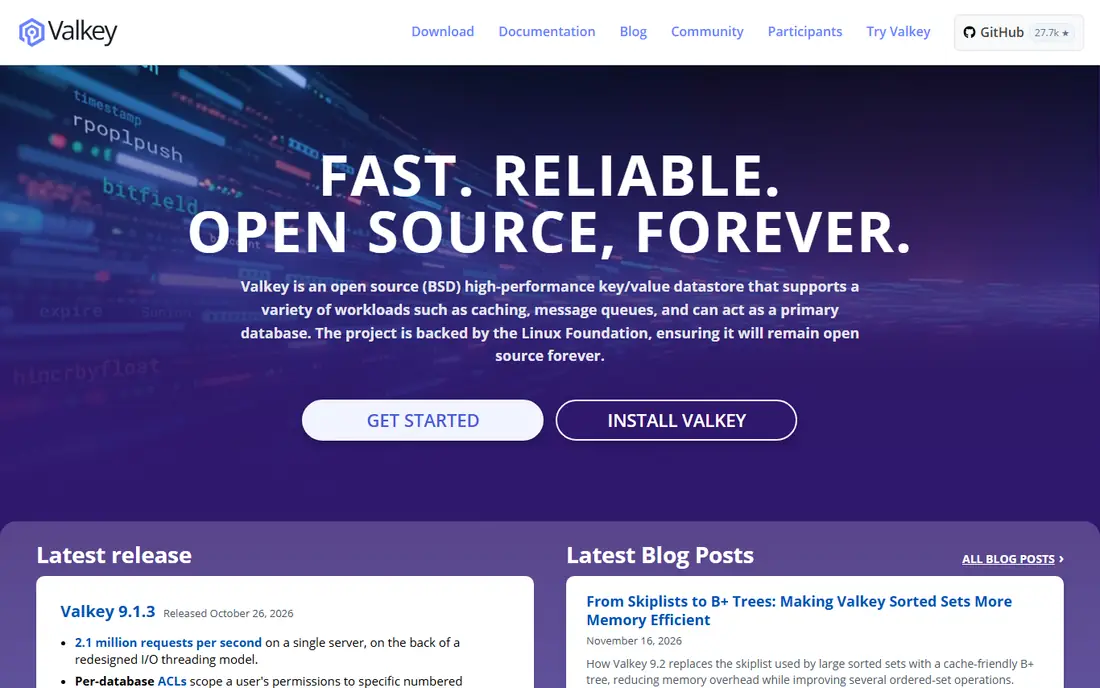
Valkey grew out of the Redis codebase as a community fork, and that history is its main draw. Teams can often keep familiar commands, data types, and client libraries while moving to a project with a clear open source home. It supports strings, hashes, lists, sets, sorted sets, and other types used for caching, queues, and leaderboards.
The catch is maturity in the wider ecosystem. Valkey itself is actively developed, but third party guides, managed services, and plugins do not yet match the depth built up around Redis over many years. If your stack relies on a niche module, check Valkey support for it before you commit.
- Redis-compatible commands
- Open source under the Linux Foundation
- Clustering and replication support
- Newer ecosystem than Redis
- Some client tooling still catching up
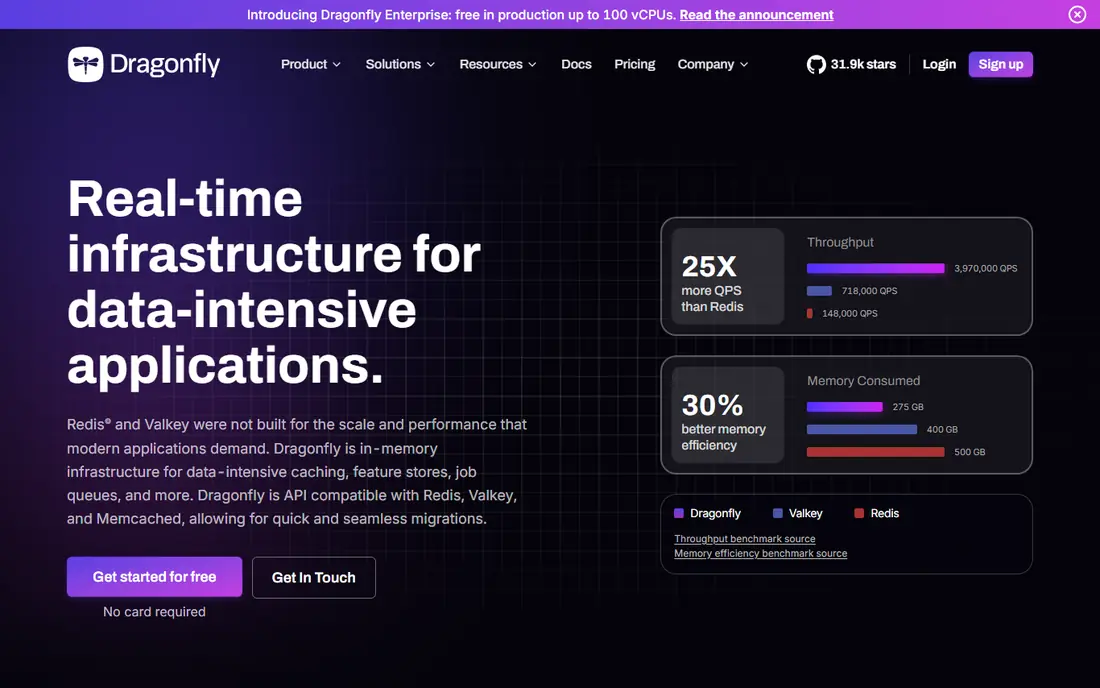
Dragonfly was built from scratch with a multi-threaded core, so a single instance can use modern multi-core servers more fully than a single-threaded design. For read-heavy caches and session stores, that can mean fewer instances for the same load. Its API aims for Redis compatibility, which keeps migration work modest for common commands.
Where it fits less well is at the edges of the Redis module world. If you depend on specific search, JSON, or time series modules, test those workloads early. Dragonfly is strongest as a fast cache and data store, not as a one-for-one copy of every Redis extension.
- Multi-threaded design
- Redis-compatible API
- Lower memory use in many cache workloads
- Smaller feature set for some advanced Redis modules
- Managed options vary by provider
KeyDB keeps Redis compatibility while adding multi-threading and replication features that help teams scale a single logical store. It is a sensible pick when your bottleneck is CPU on one instance rather than memory or network. Flash storage support also gives teams a way to hold larger data sets at lower cost than pure memory.
The trade-off is that KeyDB is not the default choice in most managed cloud catalogs, so you may run it yourself or rely on a vendor build. That is fine for teams with operations skill, but it adds work for small teams that want a fully managed service.
- Multi-threaded execution
- Redis-compatible
- Active-active replication options
- Project pace and support depend on community and vendors
- Some newer Redis features lag
Memcached does one job and does it well: it stores key and value pairs in memory for fast retrieval. There are no data structures, no persistence, and no query language to learn. For page caching, session caching, and fragment caching, that simplicity is a real advantage, since there is less to misconfigure.
Do not pick Memcached if you need it to act as a primary database. A restart clears the cache, and you cannot run set operations or sorted lists inside it. Teams that only need speed in front of a database will like it. Teams that need durability should look elsewhere on this list.
- Very simple to run
- Proven at large scale
- Low overhead
- No persistence or rich data types
- No built-in clustering in the core design
Hazelcast is a distributed platform rather than a single cache server. It offers distributed maps, queues, topics, and stream processing, so teams can run compute close to the data instead of pulling everything back to an application server. That design suits microservices that share state across many instances.
The price of that breadth is complexity. A small team that only needs caching will find Hazelcast heavier to set up and tune than Memcached or Valkey. It earns its place when you need distributed state, failover across nodes, and processing in the same platform.
- Distributed maps, queues, and compute
- Strong Java and .NET support
- Managed cloud option
- More moving parts than a simple cache
- Paid features matter at larger scale
Aerospike targets real-time workloads such as fraud checks, personalization, and ad serving, where low latency must hold under very high request rates. Its hybrid memory design uses fast flash storage alongside memory, which can cut hardware cost for large data sets compared with memory-only stores. Strong consistency options and cross-datacenter replication suit global services.
For a small cache, Aerospike is more than you need, and its commercial pricing requires a conversation for production scale. It fits best when latency, throughput, and scale are the deciding factors and the team can invest in learning its model.
- Very high throughput at scale
- Hybrid memory and flash storage
- Strong uptime design
- Pricing is quote-based for larger use
- Learning curve for its data model
Apache Ignite works as an in-memory database, a cache, and a compute grid in one system. Teams can run SQL queries against cached data, join it with data from other stores, and run distributed processing without moving large data sets around. Persistence options let it act as a system of record for some workloads, not just a temporary cache.
That breadth makes Ignite a poor fit for a quick cache drop-in. Configuration, cluster tuning, and client setup take real effort. It is a strong choice for data-heavy platforms that already think in terms of distributed systems and SQL access.
- SQL queries over in-memory data
- Distributed compute
- Persistence options
- Heavier setup than a cache
- Java-centered ecosystem
Tarantool combines an in-memory database with an application server, so you can run Lua code close to the data. That design cuts round trips for logic such as filtering, aggregation, and request handling. It supports replication, sharding, and persistence, and it has been used for high-load services including telecom and gaming back ends.
The main limit is familiarity. Fewer developers know Tarantool than Redis or Memcached, and Lua is less common in many web teams. If your team is comfortable with that stack, it is a capable and fast option. If not, the learning cost may outweigh the latency gain.
- In-memory storage with Lua application logic
- Replication and sharding
- Low latency
- Smaller community than mainstream caches
- Lua skill needed for full use
NCache is aimed squarely at .NET teams that need a distributed cache for web applications, session state, and data sharing across servers. It offers cache topologies for replication and partitioning, along with ASP.NET session and output caching support. That focus makes integration smoother than adapting a generic cache to a .NET stack.
Outside .NET, its advantage fades, and other options on this list have broader client support. Licensing is also a factor, since production use is paid, with a trial for evaluation. For a .NET shop, though, it is one of the most direct fits here.
- Built for .NET and ASP.NET
- Distributed cache topologies
- Rich client features
- Less common outside .NET shops
- Paid licensing for production editions
How we picked these
We compared official documentation, licensing, pricing pages, and feature lists for in-memory stores that are actively maintained in October 2026. We kept only products that exist as working software today and that cover caching, fast data access, or distributed in-memory work. We left out Flowise, which reached end of life on 31 August 2026, and any product we could not confirm as a live, fitting option.
What to check before you switch
Start with compatibility, not speed claims. List the commands, data types, and modules your application actually uses, then test that exact set against a candidate. A store that passes a simple string cache test can still fail on pub/sub, streams, or transactions.
Next, check persistence and failure behavior. Ask what happens on restart, on node loss, and during a network split. A cache can lose data safely if the database behind it remains the source of truth. A primary store cannot. Match the durability setting to the job, and test failover before launch, not after an outage.
Finally, price the whole setup, including memory, replication, backups, and operations time. Open source software is free to download, but managed hosting, monitoring, and on-call work are not. A simple cache that your team already understands often beats a faster system that nobody on call can debug at 2 a.m.
Frequently asked questions
What is the best Redis alternative for most teams?
Valkey is our pick for most teams because it keeps Redis-style commands and data types while sitting under a community open source home. Test your exact workload first, since module support can differ.
Are Redis alternatives free?
Many are free as open source software, including Valkey, Dragonfly, KeyDB, Memcached, and Apache Ignite. Managed hosting, support, and some enterprise features are paid, so check the full cost before you choose.
Can I replace Redis with Memcached?
Yes, if you only use it as a cache. Memcached handles simple key and value caching well, but it lacks persistence, rich data types, and pub/sub, so it cannot replace every Redis use case.
Which Redis alternative is fastest?
That depends on your workload, data size, and hardware. Dragonfly and KeyDB aim for high throughput on multi-core servers, while Aerospike targets very large real-time workloads. Benchmark with your own traffic rather than trusting vendor charts alone.
Do these alternatives support clustering?
Valkey, Hazelcast, Aerospike, Apache Ignite, Tarantool, and NCache all support distributed or clustered deployment in some form. Memcached relies on client-side sharding, so plan for that difference if you need built-in failover.
Is Valkey a drop-in replacement for Redis?
For many common commands and clients, yes. Some modules and newer features may differ, so run your test suite and check client compatibility before a full migration.
Sources
See where you really rank - block by block
ProMapRanker scans Google Maps across a grid of your service area. Simple monthly plans from $19, white-label on every plan.
Start freeKeep reading
 zoho inventory alternatives
6 Alternatives to Zoho Inventory, Compared on Price and Fit
Zoho Inventory alternatives: 6 tools compared on price, free plans and fit. Katana leads the list for manufacturers. Fit and flaws are laid out for each entry.
Read → zoho crm alternatives
Best Zoho CRM Alternatives (2026)
Need Zoho CRM alternatives? We compare 7 tools on cost, free access and who each suits. Every pick gets a straight assessment. Built for quick decisions.
Read → zelle alternatives
Best Zelle Alternatives in 2026
Compare the best Zelle alternatives for sending money to friends, paying sellers and moving funds abroad, with honest notes on fees, speed and safety in 2026.
Read →