 ProMapRanker
Best RabbitMQ Alternatives in 2026

Key takeaways
- RabbitMQ is a work queue broker first, so the best replacement depends on whether you need queues, replayable streams, or a managed service.
- Apache Kafka and Redpanda suit durable event streams and replay, while NATS and ActiveMQ are closer fits for lighter queue and messaging work.
- Managed options such as Amazon SQS, Google Cloud Pub/Sub and Azure Service Bus remove server care, but their usage pricing needs a real traffic estimate.
- Self hosted open source brokers cost less in licence fees and more in operating time, so team skill matters as much as the feature list.
Quick comparison
| Pick | Great for | Pricing starts at | Free tier | |
|---|---|---|---|---|
 Apache Kafka | Durable event streams | Free | Yes | Visit |
 NATS | Lightweight cloud messaging | Free | Yes | Visit |
 Apache Pulsar | Queues and streams in one system | Free | Yes | Visit |
 Amazon SQS | Managed queues on AWS | See website | Free trial | Visit |
 Google Cloud Pub/Sub | Managed messaging on Google Cloud | See website | Free trial | Visit |
 Azure Service Bus | Enterprise messaging on Azure | See website | Free trial | Visit |
 Apache ActiveMQ | Multi protocol messaging | Free | Yes | Visit |
 Redpanda | Kafka compatible streaming | Free | Yes | Visit |
The best rabbitmq alternatives
We compared official feature pages, pricing pages and public documentation for brokers that cover queues, pub/sub and event streaming. RabbitMQ itself is not listed, since this guide is about replacements.

Kafka stores events in a durable log that consumers can replay, which is a different shape from a classic queue where a message is deleted after acknowledgement. That replay ability helps analytics, audit trails and services that need to rebuild state from past events. The ecosystem is a real strength, with connectors for databases, object storage and stream processing tools that many teams already use.
The catch is operational weight. A production cluster needs planning around partitions, replication, retention and consumer groups, and simple job dispatch can feel heavy here. Teams with high throughput or a clear need for replay will get value from that weight. Teams that only need background jobs should test whether a lighter broker does the job first.
- Replayable log based streams
- Very large ecosystem of connectors and tools
- Strong fit for many independent consumers
- More to operate than a simple queue
- Queue style work needs extra care around partitions
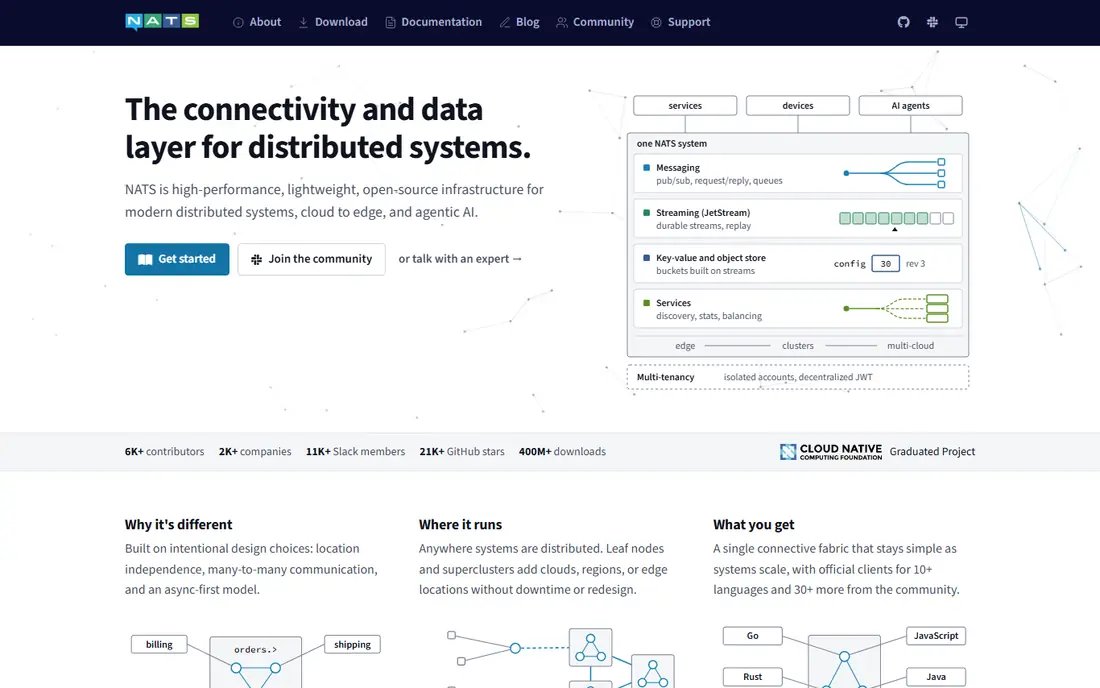
NATS starts from the opposite end from Kafka, with a small server that is easy to deploy and quick to connect. Core NATS covers pub/sub and request reply, while JetStream adds persisted streams, acknowledgement and queue style consumers for work that must survive a restart. That combination suits microservices, edge sites and teams that want messaging without a large cluster.
The trade-off is depth of surrounding tooling. Kafka has more managed connectors and stream processing options, and NATS teams may build more of that themselves. Throughput at very large scale also needs testing on your own workload. For moderate streams and service to service messages, the simplicity is often worth it.
- Small and fast to run
- Core pub/sub plus JetStream persistence
- Good fit for edge and microservices
- Smaller tooling ecosystem than Kafka
- JetStream retention and tuning still need design
Pulsar separates serving brokers from BookKeeper storage, and it supports several subscription types on the same topic. That means one topic can feed a log style consumer and a shared queue style consumer, which is useful when different services need the same events in different ways. Multi tenancy and tiered storage also help teams that host many tenants or keep data for long periods.
The price for that flexibility is a larger deployment. Brokers, bookies and ZooKeeper or its successor components all need care, so Pulsar suits teams with platform experience. If you only need one pattern, a simpler broker will be easier to live with. If you need both patterns plus tenant isolation, Pulsar earns its place on the shortlist.
- Queue and stream consumption from the same topics
- Multi tenancy built in
- Tiered storage options
- More components to run than NATS
- Smaller community than Kafka
SQS is the simplest choice for teams already on AWS. You create a queue, send messages and let consumers pull them, without patching brokers or sizing clusters. Standard queues give at least once delivery, while FIFO queues add ordering within a message group and deduplication for work where order matters. It pairs naturally with Lambda, SNS and EventBridge for fan out and serverless jobs.
The limit is that SQS is a queue, not a log. Once a message is deleted, it cannot be replayed to a new consumer, so it is a poor fit for event sourcing or analytics replay. Pricing is usage based, so a traffic estimate matters before you commit. For background jobs and decoupling services on AWS, it is hard to beat for low effort.
- No servers to run
- Standard and FIFO queue options
- Pairs well with other AWS services
- No replay after a message is deleted
- Costs depend on request volume
Pub/Sub gives Google Cloud teams a managed path to durable messaging without running brokers. Publishers send to a topic, and each subscription tracks its own acknowledgement, so different services can consume at their own pace. Ordering keys help when a subset of messages must stay in order, and the service scales without broker sizing work.
It is not a direct copy of a Kafka log. Replay through seek is available in a limited way, and long term retention is not the same as keeping an event history for years. Teams outside Google Cloud can still use it, but the value is highest inside that cloud. For event driven apps on Google Cloud, it removes a whole layer of operations.
- Fully managed durable pub/sub
- Per subscription acknowledgement
- Ordering keys available
- Tied to Google Cloud for the best experience
- Seek based replay is limited compared with a full log
Service Bus is aimed at enterprise messaging on Azure, with queues for point to point work and topics with subscriptions for pub/sub. Sessions, scheduled messages and dead letter queues help with ordered workflows, retries and poison messages, which matter in order processing and line of business systems. Integration with Azure Functions, Logic Apps and other Azure services keeps the plumbing short.
The main caution is tier choice. Basic, Standard and Premium tiers differ in features such as sessions and scale, so the cheapest tier may not cover the workflow you planned. Teams outside Azure will find less reason to choose it over a portable broker. Inside Azure, it is a solid, well documented replacement for classic queue workloads.
- Queues, topics and subscriptions in one service
- Sessions and dead lettering for complex workflows
- Strong Azure integration
- Pricing tiers need careful reading
- Best value stays inside Azure
ActiveMQ has been around long enough to support a wide range of protocols and client libraries, which helps teams with mixed stacks or older Java systems. It covers queues and topics, and its Artemis broker is the newer codebase most new projects should look at first. For a team that needs protocol breadth more than streaming scale, that breadth is a practical strength.
The weakness is modern polish. Admin tooling and documentation can feel older than Kafka or NATS, and high throughput designs need more manual work. It is not the first pick for event streaming at scale. It is a sensible pick when protocol support and a familiar queue model matter more than the newest streaming features.
- Supports several messaging protocols
- Long track record in Java shops
- ActiveMQ Artemis for newer deployments
- Interface and tooling feel dated next to newer brokers
- Scaling design needs care
Redpanda speaks the Kafka protocol, so many Kafka clients, connectors and tools work against it without a rewrite. Its single binary design removes the separate coordination service that Kafka used to require, which makes local testing and smaller clusters simpler to run. Teams that like the Kafka model but want less operational work often test Redpanda early.
Compatibility still needs checking feature by feature, since newer Kafka features may arrive at different times. Paid tiers add governance and support features that self hosted users do not get. For a Kafka style log with a smaller operations footprint, Redpanda is a credible alternative to both Kafka and RabbitMQ for stream heavy work.
- Works with Kafka clients and tools
- Single binary deployment
- Lower operational overhead than Kafka for many teams
- Kafka compatibility is not a full copy of every Kafka feature
- Enterprise features are paid
How we picked these
We compared official feature pages, pricing pages and public documentation, and we favoured products that are still offered and maintained in October 2026. We looked for a mix of open source brokers, Kafka compatible systems and fully managed cloud queues, so readers can match the list to queue work, streaming work, or a no server approach. We did not claim hands-on testing, and we left prices as See website where a vendor prices by usage or by quote.
What to check before you switch
Start with the pattern, not the brand. Queue work needs acknowledgement, retries and dead letter handling. Stream work needs retention, replay and many consumers. Managed work needs a cost model based on your real message count, message size and retention, not a marketing example.
Test the failure cases before you migrate. Send a poison message, stop a consumer, restart a broker and check what happens to ordering and duplicates. Check client library support for your languages, and check how monitoring, alerts and backups work in the new system. A short pilot on a non critical workload will reveal more than a feature table, and it keeps the migration reversible if the fit is wrong.
Frequently asked questions
Is Apache Kafka a direct replacement for RabbitMQ?
Not always. Kafka is a log based streaming platform, while RabbitMQ is a queue broker with flexible routing. Kafka fits replay and many consumers, while RabbitMQ fits competing consumers and complex routing. Choose by pattern, and pilot both on your workload if you are unsure.
What is the simplest RabbitMQ alternative for a small team?
NATS or a managed queue such as Amazon SQS or Google Cloud Pub/Sub is usually simplest. NATS keeps a small self hosted footprint, while managed queues remove server care entirely. The right pick depends on which cloud you already use and whether you need replay.
Do these alternatives support AMQP?
Some do, and some do not. Apache ActiveMQ supports several protocols, while Kafka, NATS and Pulsar use their own protocols and clients. Check the client libraries for your stack before you assume an existing AMQP client will work unchanged.
Can I keep RabbitMQ and add Kafka or NATS beside it?
Yes, and many teams do. A common split is RabbitMQ or SQS for job queues and Kafka or Pulsar for event streams. Running two systems adds operations work, so keep the split only where each pattern clearly earns its place.
How should I estimate managed queue costs?
Count messages per month, average message size, retention and requests from consumers, then run those numbers through the vendor pricing page. Usage based pricing can stay cheap at low volume and grow fast with polling or fan out, so test with real traffic patterns.
Sources
See where you really rank - block by block
ProMapRanker scans Google Maps across a grid of your service area. Simple monthly plans from $19, white-label on every plan.
Start freeKeep reading
 zyte alternatives
Best Zyte Alternatives in 2026
These zyte alternatives cover managed scraping APIs, proxy networks and no code tools for lawful collection from your own or consented sources only in 2026.
Read → zerto alternatives
Best Zerto Alternatives in 2026
Compare the best zerto alternatives for disaster recovery and replication, with recovery targets, cloud options and honest trade-offs for teams in 2026.
Read → zerofox alternatives
Best ZeroFox Alternatives in 2026
We compared 9 zerofox alternatives for brand protection, phishing takedowns, dark web monitoring, and social impersonation, with clear coverage notes.
Read →