 ProMapRanker
Best PractiTest Alternatives in 2026

Key takeaways
- TestRail and Zephyr are the most established test management replacements for structured QA teams.
- Xray suits Jira-native teams that want test management inside Jira itself.
- Testmo, Qase, and Testpad cover unified, modern, and checklist-style testing respectively.
- Kualitee, SpiraTest, and QMetry suit budget, traceability, and agile reporting needs.
Quick comparison
| Pick | Great for | Pricing starts at | Free tier | |
|---|---|---|---|---|
 TestRail | Structured QA reporting | $22 per user per month | Free trial | Visit |
 Zephyr | Jira-native test management | $10 per user per month | Free trial | Visit |
 Xray | Tests inside Jira | See website | Free trial | Visit |
 Testmo | Unified manual and automated tests | $99 per month | Free trial | Visit |
 Qase | Modern test case management | $20 per month | Yes | Visit |
 Testpad | Checklist-style manual testing | $49 per month | Free trial | Visit |
 Kualitee | Budget test management | $12 per user per month | Yes | Visit |
 SpiraTest | Requirements and defect traceability | See website | Free trial | Visit |
 QMetry Test Management | Agile test reporting | See website | Free trial | Visit |
The best PractiTest alternatives
We compared test management tools on test case organisation, test runs, defect links, automation integration, reporting, and price. Test management is the system that holds test cases, plans runs, records results, and links failures to defects. It is distinct from test automation itself, though most tools here integrate with automation frameworks.

TestRail is the classic structured alternative to PractiTest. Test cases, suites, plans, and runs follow a clear hierarchy, and reports show coverage and progress without custom setup. QA leads who need audit-ready results often prefer this order.
Pricing starts at $22 per seat per month with annual billing for Essentials, rising to $37 for Professional. Self-hosted options need larger seat counts and longer terms. For teams that value reporting depth over novelty, TestRail remains a safe, well understood choice.
- Clear test case, run, and report structure
- Strong integrations with Jira, GitHub, and automation tools
- Cloud and self-hosted options on higher plans
- Essentials plan is cloud only and limited to small teams
- Enterprise features need higher tiers
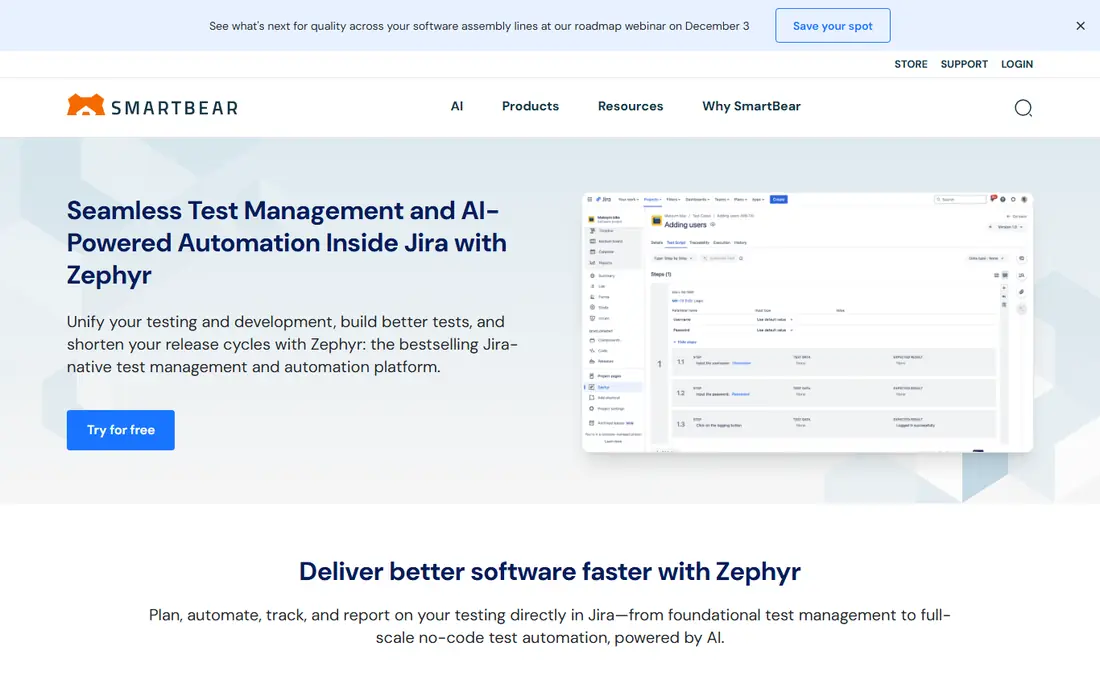
Zephyr, from SmartBear, suits teams that already plan work in Jira. Test cases, executions, and defects sit close to Jira issues, which reduces context switching for developers and testers. Agile teams can link tests to stories and releases in the same workflow.
Check which Zephyr version you need. The Jira-native and standalone products differ in features and pricing, and the $10 per user per month starting point covers the entry Squad tier. For Jira shops, the closeness to development work is the main draw.
- Native Jira integration for teams already in Jira
- Standalone version also available
- Traceability and dashboards for agile teams
- Feature depth varies between Jira and standalone versions
- Advanced plans cost more

Xray goes further than a Jira integration by making test management part of Jira itself. Test cases are Jira issue types, executions link to requirements, and traceability reports show coverage from requirement to result. Teams that live in Jira often find this model natural.
The catch is Jira itself. If your Jira setup is already complex, Xray inherits that complexity. Pricing is also tied to your Jira tier, so get a quote based on real user counts rather than assuming a flat per-tester price.
- Test management built as a Jira app
- Manual and automated testing with traceability reports
- DevOps and CI integration
- Pricing depends on Jira user count and hosting
- Jira complexity carries over into test setup
Testmo brings manual testing, exploratory sessions, and automation results into one place. Testers can log exploratory notes with time tracking, while automation results feed the same reports. That unified view helps teams that mix manual and automated work in each release.
The $99 per month starting point covers a team bundle rather than a single seat, which changes the value calculation. Small teams should compare total team cost, not just headline price. For mixed manual and automation teams, the unified reporting is a real advantage.
- Unified manual, exploratory, and automated testing
- CI integration and session notes
- Real-time and historical reporting
- Starting price is a team price, so solo users may find it high
- Smaller ecosystem than TestRail
Qase is a modern, approachable test management tool. It covers test cases, runs, defects, and automation results with a clean interface that new testers learn quickly. A free plan helps small teams start without a purchase approval cycle.
Larger organisations should test reporting and permission depth before committing. Qase covers core needs well, but enterprise QA programs with complex hierarchies may need its higher tiers. For small and mid-sized teams, it balances price and usability well.
- Free plan for small teams
- Modern interface for manual and automated cases
- CI integration and reporting built in
- Enterprise features need custom pricing
- Very large QA orgs may need deeper customisation
Testpad suits teams that find full test management tools too heavy. Test plans look like checklists, testers tick passes and fails, and notes capture what happened. Exploratory and acceptance testing feel natural in this format.
Structured QA teams may miss strict test case versioning and traceability. Testpad trades that depth for speed and adoption, which is the right trade for many product and support teams. For formal, regulated testing, a structured tool above fits better.
- Spreadsheet-like checklists that non-technical testers grasp fast
- Simple collaboration and reporting
- Low training burden
- Less structure for large automated suites
- Not ideal for teams needing deep traceability matrices
Kualitee is the budget-friendly option that still covers core test management. Test cases, executions, defects, and reports sit in one system, with AI features to assist test creation and defect handling. The free plan lets teams evaluate real work before paying.
Buyers should check which AI and reporting features sit in each tier, since Kualitee packages them by plan. For cost-conscious teams that need a full test tool rather than a checklist, Kualitee offers strong value.
- Free plan available
- AI-assisted test and defect management features
- Broad integrations for small and mid-sized teams
- Interface and reporting depth vary by plan
- Enterprise support needs higher tiers
SpiraTest from Inflectra suits teams that need traceability from requirement to defect. Requirements, tests, and incidents share one database, so coverage gaps and defect links are easy to audit. That structure helps regulated teams and larger programs.
The interface is more traditional than Qase or Testmo, and pricing requires a quote. Teams that prioritise audit trails over modern design will accept that trade. Teams that prioritise speed and simplicity may prefer a newer tool.
- Links requirements, test cases, and defects in one system
- Customisable reports and dashboards
- On-premises and cloud options
- Pricing is quote based for current plans
- Interface feels more traditional than newer rivals
QMetry Test Management focuses on agile QA teams that need clear reporting across sprints. Test cases, executions, and requirements link together, and reports show progress by release and cycle. Jira integration keeps development and testing aligned.
Pricing opacity is the main drawback, so request a quote for your tester count and required modules. For agile teams that found PractiTest pricing or workflow a poor fit, QMetry offers a comparable, reporting-led alternative.
- Agile-friendly test case and execution management
- Requirement tracking and reporting
- Jira integration for agile teams
- Pricing is quote based
- Advanced automation features need the wider QMetry platform
How we picked these
We compared official feature pages, pricing pages, and public documentation for test management tools live in October 2026. We looked for test case management, run tracking, defect integration, automation links, and reporting. We did not claim hands-on testing, and we used See website where a vendor does not publish a starting price.
How to choose a test management tool
Start with where your work already lives. Jira-native teams gain most from Zephyr or Xray. Teams outside Jira gain most from a standalone tool such as TestRail, Testmo, or Qase. Forcing a Jira tool into a non-Jira team, or vice versa, creates friction every day.
Next, check migration. Export a sample of test cases, runs, and defects from PractiTest, import them into each shortlisted tool, and verify that steps, attachments, and links survive. A tool that imports cleanly saves weeks of manual rebuilding.
Finally, trial reporting with a real release. Create a test plan, run it, log defects, and produce the report your stakeholders actually read. The tool that produces that report with least manual work is usually the right pick, even if its feature list looks shorter.
Frequently asked questions
What is the best PractiTest alternative?
TestRail is the most established structured replacement, while Zephyr and Xray suit Jira-native teams. Qase and Testmo suit modern and unified teams. The best pick depends on whether you work in Jira, how much automation you run, and how formal your reporting must be.
Can I migrate test cases from PractiTest?
Yes, most tools accept CSV or API imports, and several publish migration guides. Export a sample first, test the import, and check steps, custom fields, and attachments. Keep PractiTest live until the imported data checks out.
Do these tools run automated tests?
They manage and report automated results, but most do not replace automation frameworks themselves. They integrate with tools such as Selenium, Playwright, Jenkins, and CI pipelines. Check the integration list for your exact framework before buying.
Which test management tool is free?
Qase and Kualitee both offer free plans, with limits on users and features. Testpad, TestRail, and others offer free trials rather than permanent free tiers. Free plans suit small teams, while larger teams should budget for paid seats.
Do I need test management if I already use Jira?
Jira tracks issues and stories, but it does not manage test cases, runs, and coverage well on its own. A test management tool adds that structure, whether inside Jira through Xray or Zephyr, or as a connected standalone tool. Teams with formal QA needs usually benefit from one.
Sources
See where you really rank - block by block
ProMapRanker scans Google Maps across a grid of your service area. Simple monthly plans from $19, white-label on every plan.
Start freeKeep reading
 zyte alternatives
Best Zyte Alternatives in 2026
These zyte alternatives cover managed scraping APIs, proxy networks and no code tools for lawful collection from your own or consented sources only in 2026.
Read → zerto alternatives
Best Zerto Alternatives in 2026
Compare the best zerto alternatives for disaster recovery and replication, with recovery targets, cloud options and honest trade-offs for teams in 2026.
Read → zerofox alternatives
Best ZeroFox Alternatives in 2026
We compared 9 zerofox alternatives for brand protection, phishing takedowns, dark web monitoring, and social impersonation, with clear coverage notes.
Read →