 ProMapRanker
Best PostHog Alternatives in 2026

Key takeaways
- Mixpanel and Amplitude are the closest full product analytics replacements for PostHog, with funnels, retention, cohorts, and experimentation.
- Heap suits teams that want automatic event capture without instrumenting every action in advance.
- Matomo is the pick for data ownership and self-hosting, while Plausible suits simple, privacy-focused website reporting.
- FullStory and Microsoft Clarity cover the session replay and heatmap side of PostHog, with Clarity free for unlimited traffic.
Quick comparison
| Pick | Great for | Pricing starts at | Free tier | |
|---|---|---|---|---|
 Mixpanel | Funnels and retention | Free | Yes | Visit |
 Amplitude | Behavioral analytics at scale | Free | Yes | Visit |
 Heap | Automatic event capture | Free | Yes | Visit |
 Matomo | Self-hosted data ownership | Free | Yes | Visit |
 Plausible | Simple privacy-first stats | $9 per month | No | Visit |
 FullStory | Replay-led behavior analysis | See website | Yes | Visit |
 LogRocket | Frontend debugging plus analytics | See website | No | Visit |
 Microsoft Clarity | Free replay and heatmaps | Free | Yes | Visit |
The best PostHog alternatives
PostHog bundles product analytics, session replay, feature flags, surveys, and experiments in one open-source-friendly platform, which is why teams like it. No single alternative replaces every part of that bundle equally, so the list below is grouped by strength: deep product analytics first, then automatic capture, data ownership, simple reporting, and replay-led tools. Pick based on which PostHog feature your team uses most.
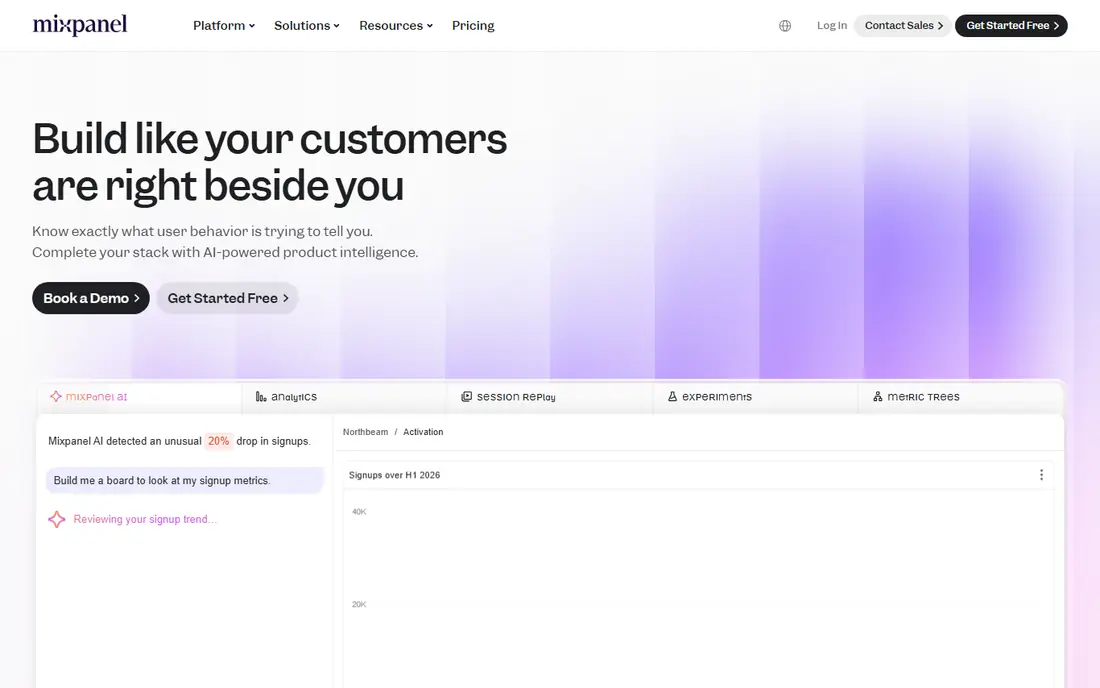
Mixpanel is the most direct product analytics alternative to PostHog. It tracks events, builds funnels and retention views, segments users into cohorts, and supports experimentation and lifecycle analysis for product and growth teams. Its free tier lets small teams start without a contract, and paid pricing scales with event volume.
The main cost watch point is event volume. Teams that track many events per user can see bills rise quickly, so event naming and volume discipline matter from the start. Mixpanel also needs manual instrumentation for custom events, unlike Heap's automatic capture. For teams that want deep behavioral analysis with a familiar analytics model, Mixpanel is a strong first shortlist pick.
- Strong funnels, retention, and cohorts
- Free tier for starting
- Session replay and experimentation options
- Event-based pricing can grow fast
- Manual instrumentation needed for custom events
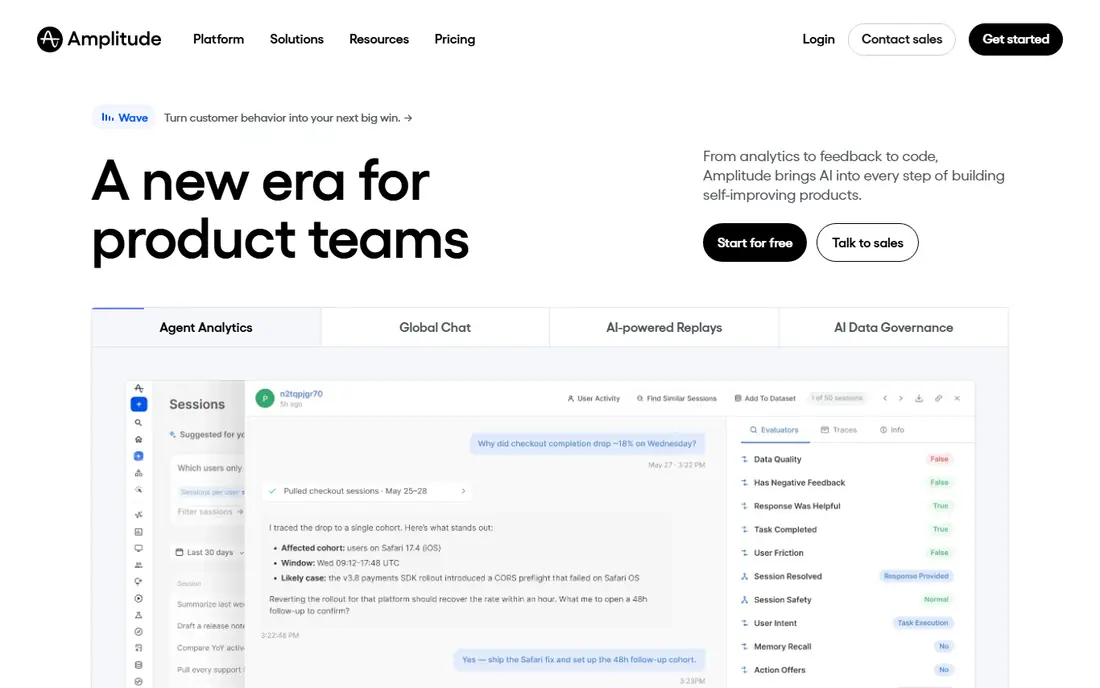
Amplitude competes directly with Mixpanel for product analytics at scale, with strong behavioral analysis, journey views, cohorts, and experimentation. It also offers session replay and activation features on higher tiers, which brings it closer to PostHog's bundle than a pure analytics tool. Its free tier covers starting teams, with paid pricing based on monthly tracked users and features.
Amplitude's depth is also its complexity. New teams may need time to learn its analysis model and to set up events, properties, and cohorts well. Paid costs can also rise at scale, so teams should forecast tracked users carefully. For larger product teams that need advanced analysis and experimentation, Amplitude is a leading choice.
- Deep behavioral analytics and cohorts
- Experimentation and activation features
- Free tier for starting
- Paid plans can be costly at scale
- Learning curve for advanced analysis
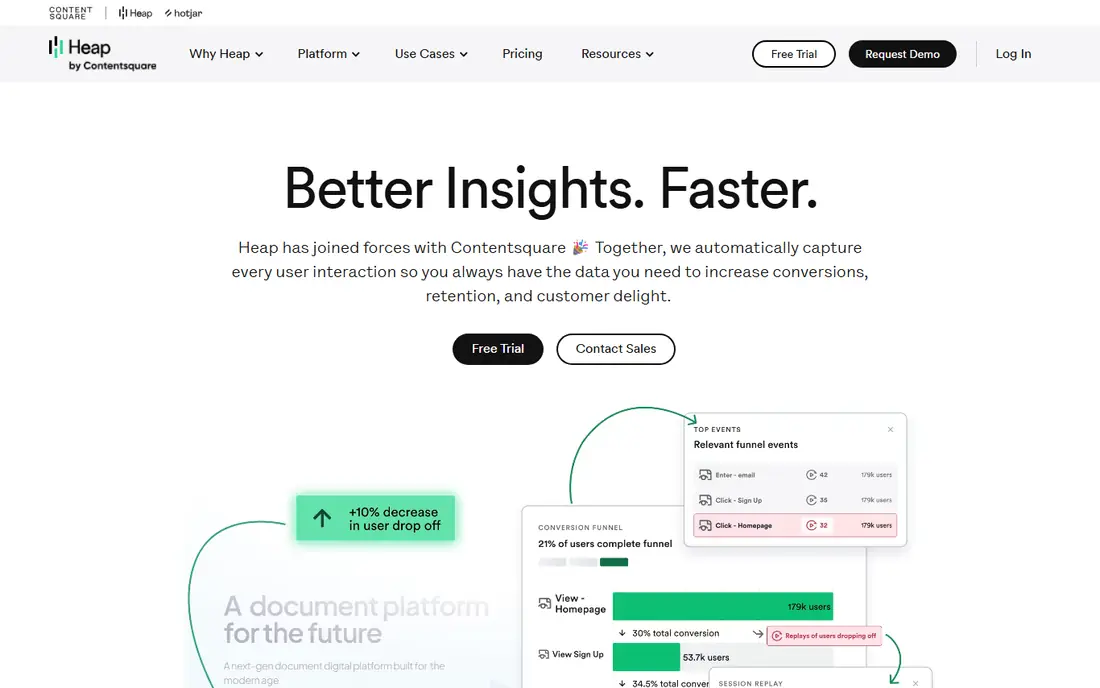
Heap removes the hardest part of product analytics: deciding every event in advance. It automatically captures user interactions, then lets teams define events retroactively and explore journeys, funnels, and retention from data already collected. That suits teams that move fast and do not want analytics work to block product releases.
Paid pricing is less transparent than Mixpanel's, with many teams moving to quote-based plans after the free tier, so budget planning needs a sales conversation. Heap's analysis is also strong for exploration but less specialized than Amplitude for advanced experimentation. For teams that hate instrumentation work, Heap's automatic capture is a clear advantage.
- Automatic capture of clicks, taps, and page views
- Retroactive analysis without pre-instrumentation
- Free tier for starting
- Paid pricing is quote-based for many teams
- Analysis depth differs from Mixpanel and Amplitude
Matomo is the data ownership pick. Teams can self-host Matomo for free and keep analytics data on their own servers, which suits privacy-sensitive organizations and regulated industries. Its cloud plans start from a paid tier based on traffic, and paid features add heatmaps, session recordings, and testing. Matomo also offers familiar web analytics reports alongside product-style analysis.
Self-hosting is the trade-off: the team owns updates, backups, and scaling, which takes engineering time. The interface is also more traditional than Mixpanel or PostHog, which may slow adoption for teams used to modern dashboards. For organizations where data control matters most, Matomo is the most credible open alternative.
- Self-hosted option is free
- Full data ownership
- Heatmaps, replay, and testing on paid features
- Self-hosting needs maintenance
- Interface feels less modern than newer rivals
Plausible is the simplicity pick. It gives website owners clean traffic stats, goals, and basic funnel reporting without cookies or heavy tracking scripts, and its entry plan starts at $9 per month for 10,000 pageviews. A 30-day trial lets teams test it, and a community edition can be self-hosted by technical teams.
Plausible does not replace PostHog's product analytics depth or session replay, so teams that need funnels, cohorts, and replay should look elsewhere. For blogs, marketing sites, and small products that need trustworthy traffic numbers without complexity, Plausible is one of the easiest tools to adopt and explain to privacy-conscious visitors.
- Lightweight and privacy-focused
- Simple dashboard
- Self-hosted community edition available
- No session replay
- Funnels only on paid plans
FullStory focuses on what users actually do in a product, through session replay, heatmaps, and journey analysis that surface frustration signals such as rage clicks and dead clicks. Its free tier covers a set number of sessions per month, which lets UX and product teams test replay workflows before paying. Paid plans are quote-based and scale with session volume.
FullStory is not a full replacement for PostHog's analytics, flags, and experiments, since its strength is behavioral observation rather than deep event analysis. Teams that pair FullStory with Mixpanel or Amplitude get both sides: replay for why users struggle, and analytics for how many users follow each path. For UX-led teams, FullStory alone may be enough.
- Strong session replay and heatmaps
- Free tier for starting
- Useful frustration and journey signals
- Paid pricing is quote-based
- Product analytics is lighter than Mixpanel
LogRocket pairs session replay with frontend technical data, including console logs, network requests, and error traces, so engineers can see exactly what happened before a bug. That makes it a strong debugging companion to product analytics, and product teams can also use its analytics views to understand user paths. A trial lets teams test replay quality on their own app.
LogRocket is best seen as a debugging and experience tool rather than a full analytics platform. Teams that need funnels, cohorts, and experimentation at scale will still need Mixpanel, Amplitude, or a similar tool alongside it. For frontend teams whose main PostHog use was replay and error context, LogRocket is a focused replacement.
- Session replay tied to console and network data
- Strong frontend error tracking
- Useful for debugging production issues
- Pricing is quote-based for most teams
- More debugging tool than general analytics
Microsoft Clarity is the free replay option that surprises many teams. It offers session recordings, heatmaps, and insight dashboards at no cost, with no stated traffic limit, which makes it an easy add-on for any website. Setup is a simple script, and data can be viewed alongside other Microsoft tools for teams already in that ecosystem.
Clarity does not offer PostHog's product analytics, feature flags, surveys, or experiments, so it cannot replace the full bundle alone. It is best used as a free replay and heatmap layer, paired with Plausible for traffic or Mixpanel for product analytics. For teams on a zero budget, Clarity covers the replay side better than any other free tool.
- Free with unlimited traffic
- Session replay and heatmaps
- Simple setup for websites
- No deep product analytics
- Limited to web, not full product analytics
How we picked these
We compared official product and pricing pages for product analytics, web analytics, and session replay tools that cover part or all of PostHog's bundle, and we kept only products live in October 2026. We mixed deep analytics platforms, automatic capture, self-hosted options, simple privacy tools, and replay-led tools, so buyers can match the list to their main use. Where pricing is quote-based, we wrote See website rather than repeating an estimate.
What to check before you buy
Start with the PostHog feature you use most. If it is funnels and retention, shortlist Mixpanel and Amplitude. If it is replay and heatmaps, shortlist FullStory, LogRocket, and Clarity. If it is data ownership, shortlist Matomo. If it is simple traffic stats, shortlist Plausible. A tool that excels at one job may be weak at another, so do not expect a single tool to match the whole PostHog bundle at the same price.
Next, forecast volume honestly: events, monthly tracked users, sessions, or pageviews, depending on the vendor's model. Free tiers are generous for starting teams but can end quickly at product scale, and quote-based plans need a scoped conversation. Check data retention, privacy controls, and regional hosting, especially for teams in regulated industries.
Finally, test with a real product flow. Instrument a key journey, check that funnels and replay match real user behavior, and confirm that exports, integrations, and team permissions meet your needs. A trial that only checks the dashboard will hide instrumentation effort and volume costs that appear later.
Frequently asked questions
What is the closest PostHog alternative?
Mixpanel and Amplitude are the closest full product analytics alternatives, with funnels, retention, cohorts, and experimentation. Neither includes PostHog's full bundle of flags and surveys at the same level, so teams using those features may need a second tool.
Is there a free PostHog alternative?
Yes. Mixpanel, Amplitude, Heap, and Matomo offer free tiers or free self-hosting, and Microsoft Clarity is free for session replay and heatmaps. Free tiers have volume limits, so check event, session, or tracked-user caps against your real traffic.
Which PostHog alternative is best for privacy?
Matomo is best for data ownership, since teams can self-host it and keep data on their own servers. Plausible is best for simple, cookie-free website stats, with a clean privacy story for visitors.
Do I need session replay and product analytics together?
Many teams benefit from both: analytics shows how many users follow each path, while replay shows why individual users struggle on that path. Pairing Mixpanel or Amplitude with FullStory or Clarity covers both sides, while PostHog bundles them in one tool.
Can I self-host a PostHog alternative?
Yes. Matomo offers a free self-hosted version, and Plausible offers a self-hosted community edition. Mixpanel, Amplitude, Heap, FullStory, LogRocket, and Clarity are cloud-only, so teams that need self-hosting should shortlist Matomo or Plausible.
Sources
See where you really rank - block by block
ProMapRanker scans Google Maps across a grid of your service area. Simple monthly plans from $19, white-label on every plan.
Start freeKeep reading
 zoro.to alternatives
Best Zoro.to Alternatives in 2026
We compare the best zoro.to alternatives in 2026, listing only legal licensed anime streaming services, from Crunchyroll to free options for fans today.
Read → zip alternatives
Best Zip Alternatives in 2026
We compare the best zip alternatives for buy now, pay later in 2026, covering pay-in-4 plans, fees, spending limits, and credit reporting options today.
Read → yesware alternatives
Best Yesware Alternatives in 2026
Compare the best yesware alternatives for sales email tracking, templates, and sequences, with current pricing and honest tradeoffs for small sales teams.
Read →