 ProMapRanker
Best Plaid Alternatives in 2026

Key takeaways
- MX and Finicity through Mastercard Open Finance are the closest US matches for broad bank coverage and lending use cases.
- Envestnet Yodlee suits wealth and long history aggregation, while Akoya suits teams that want API only bank connections.
- Tink and TrueLayer lead for Europe and the UK, with payments as well as account data in their strongest markets.
- Salt Edge and Teller suit global or developer led projects that need clear API access and broad institution lists.
- Stripe Financial Connections fits teams already on Stripe that mainly need account verification and balance checks.
- This is not financial advice. Pricing for most providers is negotiated, so request a quote based on your volume and use case.
Quick comparison
| Pick | Great for | Pricing starts at | Free tier | |
|---|---|---|---|---|
 MX | US banks and clean data | See website | Yes | Visit |
 Mastercard Open Finance | US lending and verification | See website | No | Visit |
 Envestnet Yodlee | Wealth and long history data | See website | No | Visit |
 Akoya | API only bank connections | See website | Yes | Visit |
 Tink | European open banking | See website | No | Visit |
 TrueLayer | UK and EU payments and data | See website | No | Visit |
 Salt Edge | Global open banking APIs | See website | Free trial | Visit |
 Stripe Financial Connections | Stripe teams and verification | See website | No | Visit |
 Teller | Developer led US bank data | See website | Yes | Visit |
The best plaid alternatives
These nine providers connect apps to bank accounts with user permission, for balances, transactions, verification, and in some markets payments. We compared official product pages and public documentation, and we note where pricing is negotiated rather than published.
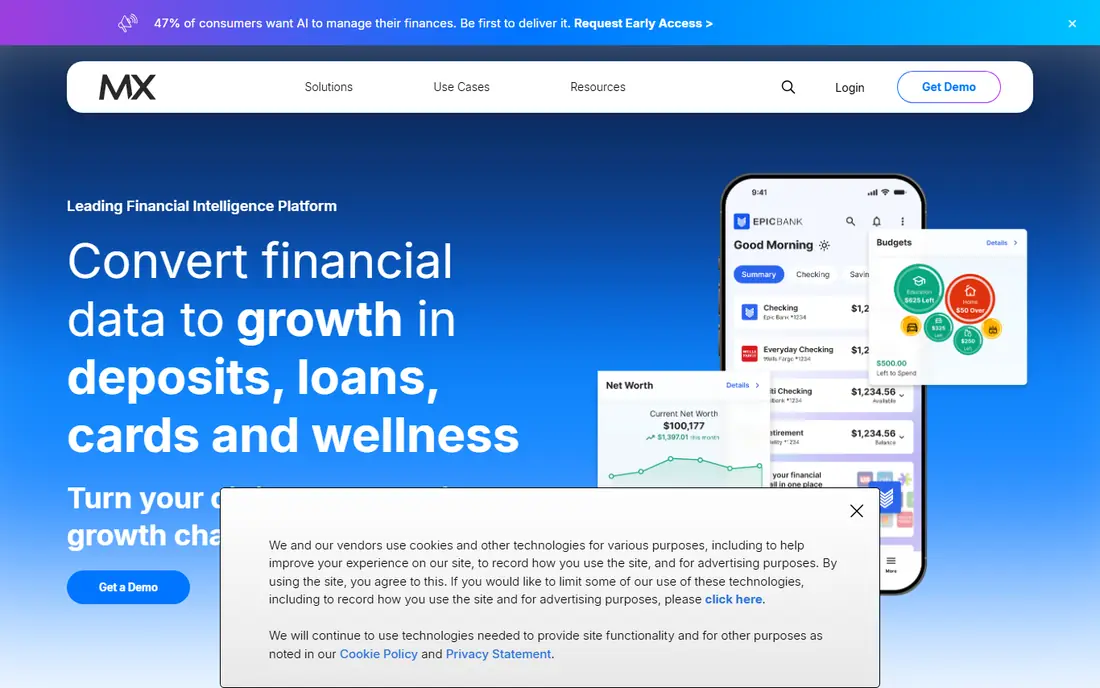
MX is the alternative most US teams mention first, and data quality is the reason. Its aggregation feeds into cleansing and categorization tools that help budgeting apps, banks, and credit unions present transactions in a readable form. Instant verification and investment data sit alongside core account data for teams that need more than balances.
A free developer tier helps teams test connections before a sales conversation, but production pricing is negotiated, so budget planning needs a quote based on volume. Coverage and connection quality still vary by institution, as with every aggregator. For US products where clean data matters more than the widest global list, MX is a strong first call.
- Strong transaction cleansing and categorization
- US bank and credit union focus
- Developer tier for testing
- Enterprise pricing is negotiated
- Coverage varies by institution
Mastercard Open Finance builds on Finicity, which Mastercard acquired, and it is shaped for lending, mortgage, and account verification work. Account ownership, balances, transactions, income, and employment data can feed underwriting and onboarding flows. Payroll and small business data add depth for cash flow checks.
The trade is complexity. The offering spans several products and reports, so buyers need to map which service produces each output before signing. Pricing is negotiated and depends on volume and product mix. For US lenders that need verified income and asset data, this is one of the most direct options in the list.
- Finicity infrastructure
- Income, employment, and cash flow reports
- Strong lender use cases
- Product structure spans several services
- Pricing is negotiated
Yodlee has one of the longest histories in aggregation, and that shows in wealth management use. Banking, cards, loans, investments, and insurance data can feed personal finance and advisor tools, with enrichment and verification alongside raw transactions. FastLink gives a hosted way for users to connect accounts without building the whole flow.
Breadth has a cost. Different institutions connect through different methods, so refresh behavior and data quality can vary. Pricing is enterprise and negotiated, which puts Yodlee out of reach for many early startups. For wealth platforms and established finance apps, the depth is the appeal.
- Very broad data source list
- Deep wealth and investment data
- Hosted FastLink onboarding
- Connection methods vary by institution
- Enterprise pricing only
Akoya takes a different stance from hybrid aggregators. It connects through bank APIs with consumer permission, rather than asking users to share bank credentials with a third party. That model appeals to banks and fintechs that want a cleaner security story and a standard consent flow.
The limit is coverage. Where a bank has not joined the network, Akoya cannot offer the same fallback that a hybrid aggregator might. A free sandbox helps developers test the API before production talks. For teams that put API only access and bank partnerships first, Akoya is worth evaluating early.
- Bank API connections without credential sharing
- OAuth based consent
- Clear network model
- Coverage depends on bank participation
- Less fallback than hybrid aggregators
Tink, owned by Visa, is a leading choice for Europe, with account aggregation, verification, and payment initiation across many European banks. It suits budgeting apps, lending checks, and pay by bank flows in markets where open banking rules support direct bank connections. The API is built for regulated data access with user consent at the center.
US teams should not assume the same depth across the Atlantic, since Tink's strength is European coverage. Pricing is custom and depends on volume and products. For a product launching in Europe first, Tink belongs on the shortlist alongside TrueLayer.
- Broad European bank coverage
- Account data and payments
- Visa backing
- US coverage is not the focus
- Pricing is negotiated
TrueLayer is known in the UK and Europe for pay by bank payments as well as account data. Merchants and fintechs use it for instant payments, verification, and data enrichment, with a focus on regulated open banking connections. That payments strength sets it apart from data only aggregators.
Teams building mainly for the US will find coverage thinner than US focused providers. Pricing is negotiated by volume and use case. For UK and EU products where payments matter as much as data, TrueLayer is a leading option to compare with Tink.
- Strong UK and EU payments
- Account data and verification
- Growing coverage
- US coverage is limited
- Pricing is negotiated
Salt Edge covers banks in more than 50 countries, which helps products that serve users across borders. Its APIs support account information and payment initiation where local rules allow, with compliance tooling for European open banking. Developer docs and a trial help teams test connections before committing.
Global breadth means local depth varies. A market with strong bank API support will feel smoother than one that relies on other connection methods. Pricing is custom, so request a quote for your main markets. For global products that cannot rely on one region, Salt Edge is a practical candidate.
- Coverage across many countries
- PSD2 compliance tooling
- API first docs
- Pricing is custom
- Data quality varies by market
Stripe Financial Connections lets Stripe users verify bank accounts and pull balances without adding a separate aggregator contract. That simplicity matters for onboarding, payouts, and payment verification inside a product that already uses Stripe for payments. Billing and support stay in the Stripe account teams already know.
The scope is narrower than a full aggregation platform. It is not a replacement for deep transaction enrichment or wealth data across many institutions. For Stripe teams whose main need is verification and balance checks, it is the lowest friction option here.
- Simple fit for Stripe users
- Account verification and balances
- Familiar Stripe dashboard
- Narrower than full aggregators
- Pricing is per use in Stripe billing
Teller stands out for publishing a rate card, which is rare in this category. Developers can see per account, per API call, and per enrollment pricing before a sales call, which makes early budgeting far easier. The API is built for US bank data, account verification, and transactions with a clear developer workflow.
The institution list is smaller than the largest US aggregators, so teams should check coverage for their users' banks early. A free tier or sandbox helps with that check. For developer led teams that value transparent pricing and a clean API over the widest possible list, Teller is a refreshing option.
- Published rate card
- Developer friendly API
- US bank focus
- Smaller institution list than the largest aggregators
- Enterprise features need sales talks
How we picked these
We compared official product pages, developer docs, and public coverage descriptions, and we kept only providers that are live in October 2026. We looked for permissioned bank connections, account data or verification, and a clear API for developers. Where pricing is not published, we say so rather than guessing a figure, since most enterprise deals in this category are negotiated.
What to check before you choose
Start with your users' banks and your markets. A provider with strong US coverage may be weak in Europe, and the reverse is true for European leaders. Test the top banks your users actually hold accounts at, not just the headline institution count.
Next, define the data you need. Balances and verification are simpler than income reports, investment holdings, or payment initiation, and each product maps to different pricing. Ask about refresh rates, consent expiry, and how the provider handles banks that change their login or API. A clean demo can hide slow refreshes that frustrate users later.
Finally, plan for compliance and security review. Check SOC reports, data handling, and how user consent is recorded and revoked. Get pricing in writing for your expected volume, including per account and per call charges, before you build a business model around one provider.
Frequently asked questions
What are alternatives to plaid?
The main alternatives are MX, Mastercard Open Finance, Envestnet Yodlee, Akoya, Tink, TrueLayer, Salt Edge, Stripe Financial Connections, and Teller. US teams usually start with MX or Mastercard Open Finance, while European teams start with Tink or TrueLayer. The right choice depends on your markets and the data you need.
Is there a free plaid alternative?
Some providers offer a free developer tier or sandbox, including MX and Teller, and Salt Edge offers a trial. Production use is almost always paid and often negotiated. Free tiers are for testing connections and data shape, not for serving large numbers of users at no cost.
Which plaid alternative is best for US fintechs?
MX and Mastercard Open Finance are the closest US matches for broad coverage and lending work. Akoya suits teams that want API only bank connections, while Stripe Financial Connections suits Stripe teams that mainly need verification. Check coverage for your users' specific banks before deciding.
Do these APIs store my bank password?
Reputable providers use permissioned connections and, where available, bank APIs with OAuth style consent, so users approve access through their bank. Hybrid aggregators may still use other methods for banks without APIs. Ask each provider how credentials are handled for your target banks, and read its security documentation.
How much do open banking APIs cost?
Most providers do not publish production prices, and costs depend on volume, products, and markets. Teller is an exception with a published rate card. Expect per account, per connection, or per call models, and request a written quote based on your expected usage before you commit.
Can I switch providers later?
Yes, but it takes work. Users usually need to reconnect their accounts, and transaction history and categorization may not transfer cleanly. Design your data model to store provider neutral account and transaction records where possible, so a future switch is a reconnection project rather than a rebuild.
Sources
See where you really rank - block by block
ProMapRanker scans Google Maps across a grid of your service area. Simple monthly plans from $19, white-label on every plan.
Start freeKeep reading
 zscaler alternatives
Best Zscaler Alternatives in 2026
Looking for zscaler alternatives? We compare 9 SASE and zero trust platforms on architecture, data protection, pricing, and fit for your network and team.
Read → zapier alternatives free
Best Zapier Alternatives Free in 2026
Nine automation tools for zapier alternatives free in 2026, all with genuinely free tiers, plus free plan limits, starting prices and upgrade paths explained.
Read → which platform is best for online reputation
Which Platform Is Best for Online Reputation in 2026
Wondering which platform is best for online reputation? We compare 8 review, listing, and response tools for small and multi-location businesses and agencies.
Read →