 ProMapRanker
Best Pinecone Alternatives in 2026


Hybrid search and managed open source · Pricing starts at: $45 per month
Key takeaways
- Qdrant and Weaviate are the strongest open source managed options, with Qdrant leading on price performance and Weaviate on native hybrid search.
- pgvector suits teams already on Postgres, since it adds vector search without a second database or a new billing envelope.
- Milvus and Zilliz Cloud suit very large collections, with distributed scale that smaller tools do not aim to match.
- Chroma suits prototypes and small apps, with the simplest developer experience and a free local mode.
- Managed pricing is usage based in most cases, so test with your real dimensions, filters and query rate before committing to a tier.
Quick comparison
| Pick | Great for | Pricing starts at | Free tier | |
|---|---|---|---|---|
| Weaviate | Hybrid search and managed open source | $45 per month | Yes | Visit |
 Qdrant | Fast open source vector search | See website | Yes | Visit |
 Milvus | Very large distributed collections | Free | Yes | Visit |
 Chroma | Prototypes and small apps | Free | Yes | Visit |
 pgvector | Postgres teams adding vectors | Free | Yes | Visit |
 Zilliz Cloud | Managed Milvus at scale | Free | Yes | Visit |
 MongoDB Atlas Vector Search | MongoDB teams adding search | See website | Yes | Visit |
 Elasticsearch | Search teams adding vectors | See website | Free trial | Visit |
 Vespa | Large real time retrieval | Free | Yes | Visit |
 FAISS | Custom research pipelines | Free | Yes | Visit |
The best pinecone alternatives
Pinecone is a fully managed vector database built for serverless AI search. The tools below replace it in different ways: open source engines you can host, managed clouds, a Postgres extension, and a library for custom pipelines. Match the tool to your scale, your existing database and how much operations work you want to carry.

Weaviate is an open source vector database with built in hybrid search, which combines keyword matching and vector similarity in one query. That matters for retrieval apps where a user query contains a name, a product code or a rare term that pure vector search can miss. Weaviate also supports multi modal data, filters and modules for vectorisation.
You can self host for free on your own infrastructure, or use Weaviate Cloud with a Flex plan starting at 45 dollars a month. Self hosting gives control over data and cost, while the cloud removes operations work. If hybrid search is a core requirement, Weaviate is our first pick among open source options.
- Native hybrid search combining keyword and vector
- GraphQL and REST APIs
- Self host or managed cloud options
- Managed entry price is higher than some rivals
- Self hosting needs operations skill
- Large scale tuning takes effort
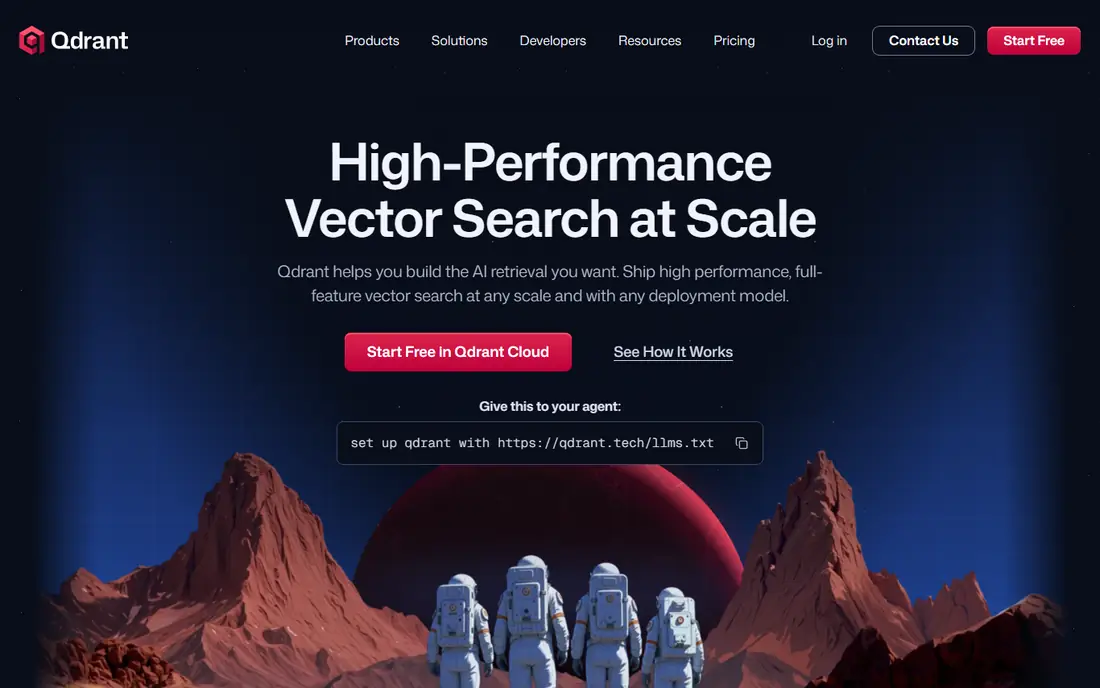
Qdrant is an open source vector database written in Rust, known for fast search and strong payload filtering. You can filter by metadata, combine filters with vector search, and store payloads alongside vectors without a second store. That makes it a strong pick for product search, recommendation and retrieval apps with strict filters.
Self hosting is free, and Qdrant Cloud offers a free tier for small clusters. Production cost depends on memory, storage and query rate, so test with your real data size before choosing a tier. For teams that want open source control with production performance, Qdrant is our price performance pick.
- Fast filtered search with payload indexes
- Rust based engine
- Free self hosting and a cloud free tier
- Managed pricing is usage based and needs careful estimating
- Smaller ecosystem than Postgres tools
- Advanced tuning needs reading
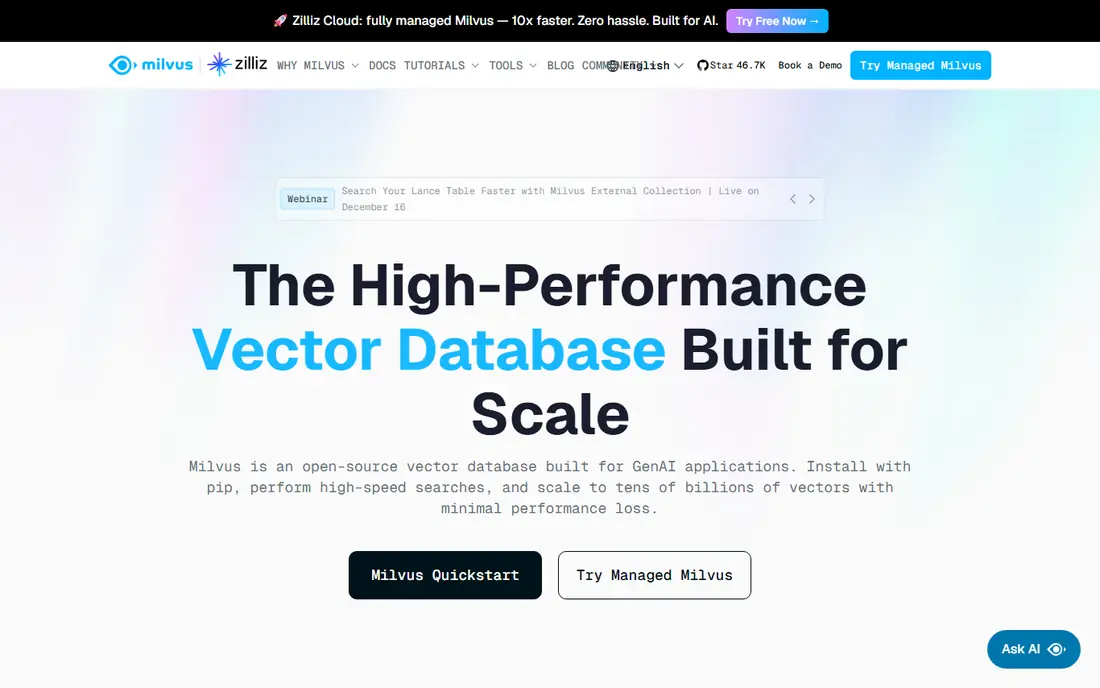
Milvus is an open source vector database built for very large, distributed deployments. It separates storage, indexing and query work, which helps it scale to billions of vectors across many nodes. It supports many index types, scalar filtering and GPU acceleration, making it a fit for large retrieval, recommendation and search systems.
That scale comes with complexity. A small prototype does not need Milvus, and a team without DevOps experience may find setup and tuning heavy. Use Milvus when you have genuinely outgrown a simpler engine, or when you know your collection will reach hundreds of millions of vectors. For managed Milvus, see Zilliz Cloud below.
- Distributed design for billions of vectors
- Many index types
- GPU acceleration options
- Setup is heavier than Qdrant or Chroma
- Needs more infrastructure at scale
- Operations skill required
Chroma is the easiest vector store to start with. You can run it embedded in a Python app, store embeddings locally, and query them with a few lines of code. Integrations with LangChain, LlamaIndex and other AI frameworks are well documented, which helps teams build a retrieval prototype in a day.
Production limits appear at scale. Chroma suits small to medium collections, internal tools and prototypes, while larger systems usually move to Qdrant, Weaviate or Milvus. Chroma Cloud adds a managed option for teams that outgrow local mode. If you are building your first retrieval app, start here, then migrate only if you hit a real limit.
- Simplest setup for Python developers
- Local embedded mode with no server
- Strong LangChain and LlamaIndex integrations
- Less suited to very large production collections
- Write heavy workloads can strain it
- Cloud pricing is usage based
pgvector is an extension that adds vector storage and search to PostgreSQL. It supports HNSW and IVFFlat indexes, so you can store embeddings, metadata and business data in one database, and query them with SQL. That simplicity is powerful: no sync job, no second billing system, and familiar backup and access controls.
Scale is the limit. pgvector works well for millions of vectors, but very large collections or heavy vector load may need a dedicated engine. Managed Postgres services, including Supabase, offer pgvector with their own pricing. If your data already lives in Postgres, try pgvector first, and move only when a benchmark shows a real bottleneck.
- Vector columns and indexes inside Postgres
- No new database to operate
- SQL joins, filters and transactions together
- Less suited to hundreds of millions of vectors
- Vector queries can compete with transactional load
- Needs Postgres tuning
Zilliz Cloud is the managed version of Milvus, built by the team behind Milvus. It removes the operations burden of running a distributed vector database, while keeping Milvus scale and index options. A free tier lets you test small workloads, and serverless options suit variable query rates.
Cost at production scale depends on storage, compute and query volume, so estimate with your real dimensions and traffic. For teams that want Milvus scale without a DevOps team, Zilliz Cloud is the natural managed path. For teams that want full control and lower infrastructure cost, self hosted Milvus may be cheaper.
- Managed Milvus with no operations work
- Free tier for small use
- Scale to billions of vectors
- Pricing is usage based and varies by region
- Less control than self hosting
- Enterprise features need higher tiers
MongoDB Atlas Vector Search adds vector search to Atlas, so teams already using MongoDB do not need a second database. You can store documents, metadata and embeddings together, run vector queries with filters, and avoid sync lag between systems. A free M0 tier and a Flex tier with a monthly cap make testing cheap.
Pure vector engines may outperform Atlas at very large scale or for specialised hybrid search. For most MongoDB teams building retrieval, recommendations or semantic search on existing data, the simplicity of one database outweighs that edge. Check index limits and dimension support for your embedding model before you commit.
- Vectors, documents and metadata in one collection
- Free M0 tier
- Familiar MongoDB query language
- Less specialised than a pure vector engine at very large scale
- Flex tier caps apply
- Migration from another vector store takes work
Elasticsearch is a mature search engine that now supports dense vector search alongside keyword search, filters and aggregations. Teams already running Elasticsearch for logs, product search or site search can add semantic search without a new database. Hybrid search, combining keyword and vector results, fits naturally here.
Operating a cluster is heavier than using a managed vector cloud, and pricing depends on deployment size and cloud provider. Elastic Cloud offers managed options with a trial. If your team already runs Elasticsearch, adding vectors there is efficient. If you need only vector search, a dedicated engine such as Qdrant or Weaviate is simpler.
- Mature search, filtering and analytics
- Dense vector and hybrid search support
- Large ecosystem and tooling
- Running a cluster takes operations skill
- Pricing varies by deployment
- Vector use is one part of a larger system
Vespa, from Yahoo, is an open source engine for large scale search, recommendation and retrieval. It combines vector search, keyword search, filtering and real time ranking in one system, with support for machine learning models in ranking. That makes it a fit for large recommendation and search systems that need custom ranking logic.
The learning curve is steeper than Chroma or Qdrant, and configuration files are more involved. Vespa Cloud offers a managed path, while self hosting is free. If you need custom ranking at scale, Vespa is worth the effort. If you need simple retrieval, a smaller engine will get you live faster.
- Real time ranking with machine learning features
- Hybrid search and filtering
- Open source with cloud options
- Steeper learning curve
- Configuration is more involved
- Smaller community than Postgres or MongoDB tools
FAISS, from Meta, is a library for efficient similarity search, not a full database. Researchers and engineers use it to build custom pipelines, test index types and run GPU accelerated search at large scale. It is free, fast and widely used in research and production prototypes.
Because it is a library, you must build persistence, filtering, serving and scaling yourself. That is a feature for research teams who want full control, and a burden for product teams who want a managed service. Use FAISS when you are building a custom retrieval system or benchmarking indexes. Use a database from this list when you want a ready to run service.
- Very fast similarity search library
- GPU support
- Many index types for research
- A library, not a database, so no built in persistence or API
- Needs engineering to build a service
- No managed cloud
How we picked these
We compared official documentation, pricing pages and public benchmarks for vector systems that are live in October 2026 and that can replace Pinecone for retrieval, search or recommendation work. We excluded Pinecone itself, since this list is about alternatives, and we excluded tools that only store embeddings without search. We weighted hosting options, hybrid search, filtering, scale and whether a free tier allows real testing.
How to choose a Pinecone alternative
Start with your existing stack. If you use Postgres, try pgvector. If you use MongoDB, try Atlas Vector Search. If you use Elasticsearch, add vectors there. Only add a dedicated vector database when your current stack cannot meet a clear benchmark for scale, latency or hybrid search.
Next, test with real data. Use your actual embedding dimensions, filter patterns and query rate, not a toy dataset. Measure latency at your target recall, test filtered queries that match production, and check how updates and deletes behave. A tool that is fast on unfiltered queries can slow down sharply with complex filters.
Finally, model cost at production scale, not just on the free tier. Managed vector pricing is usage based, so storage, memory, query volume and dimension size all matter. Compare a managed tier with self hosting on your own infrastructure, including engineer time for operations. The cheapest free tier is not always the cheapest production choice.
Frequently asked questions
What is the best alternative to Pinecone?
Qdrant is our pick for most teams that want open source control with strong performance, Weaviate is the best pick for native hybrid search, and pgvector is the best pick for teams already on Postgres. The right pick depends on scale, filters and how much operations work you accept.
Is there a free Pinecone alternative?
Yes. Qdrant, Weaviate, Milvus, Chroma, pgvector, Vespa and FAISS are all free to self host or run locally, and several offer managed free tiers. Managed production tiers are paid, but free tiers are enough to build and test a prototype.
Can pgvector replace Pinecone?
Yes, for many teams, especially when collections are in the millions and data already lives in Postgres. pgvector adds vector search without a second database. For hundreds of millions of vectors or very high query rates, a dedicated engine such as Qdrant or Milvus may perform better.
Which Pinecone alternative is best for hybrid search?
Weaviate offers native hybrid search that combines keyword and vector results in one query. Elasticsearch and Vespa also support hybrid search well, especially for teams already using those systems for keyword search.
Do I need a separate vector database for retrieval?
Not always. If your collection is small, or your data already lives in Postgres or MongoDB, adding vector search there is simpler and cheaper. A separate vector database earns its place when scale, latency, filtering or hybrid search exceed what your current database handles well.
Sources
See where you really rank - block by block
ProMapRanker scans Google Maps across a grid of your service area. Simple monthly plans from $19, white-label on every plan.
Start freeKeep reading
 zscaler alternatives
Best Zscaler Alternatives in 2026
Looking for zscaler alternatives? We compare 9 SASE and zero trust platforms on architecture, data protection, pricing, and fit for your network and team.
Read → zapier alternatives free
Best Zapier Alternatives Free in 2026
Nine automation tools for zapier alternatives free in 2026, all with genuinely free tiers, plus free plan limits, starting prices and upgrade paths explained.
Read → which platform is best for online reputation
Which Platform Is Best for Online Reputation in 2026
Wondering which platform is best for online reputation? We compare 8 review, listing, and response tools for small and multi-location businesses and agencies.
Read →