 ProMapRanker
Perdoo Alternatives in 2026: 9 Tools Compared


Simple weekly OKR check-ins · Pricing starts at: $6 per user per month
Key takeaways
- Tability, Weekdone, and Mooncamp suit teams that want a dedicated OKR tool without a large performance suite.
- Lattice, 15Five, and Betterworks suit teams that want OKRs inside reviews, feedback, and engagement work.
- Profit.co, WorkBoard, and Leapsome suit larger or more structured teams that need strategy links and reporting depth.
- Free plans exist at the small end, but most serious OKR use needs a paid plan with enough seats.
- The best tool is the one managers actually update weekly, so check-in habits matter more than feature counts.
Quick comparison
| Pick | Great for | Pricing starts at | Free tier | |
|---|---|---|---|---|
| Tability | Simple weekly OKR check-ins | $6 per user per month | Free trial | Visit |
 Weekdone | Weekly reports for small teams | See website | Yes | Visit |
 Mooncamp | Clean dedicated OKR tracking | See website | Free trial | Visit |
 Lattice | OKRs inside performance management | $8 per user per month | No | Visit |
 15Five | OKRs with check-ins and reviews | $11 per user per month | Free trial | Visit |
 Betterworks | Enterprise OKRs and calibration | See website | No | Visit |
 Profit.co | OKRs with tasks and strategy links | See website | Free trial | Visit |
 WorkBoard | Enterprise strategy and OKR execution | See website | No | Visit |
 Leapsome | OKRs with reviews and development | See website | Free trial | Visit |
The best perdoo alternatives
Perdoo is a dedicated OKR tool with strategy maps, KPI tracking, and a free plan for up to five users. The alternatives below cover the same ground in different ways, from light weekly check-in tools to full performance platforms. Teams should choose by how much structure they need, and by whether OKRs must connect to reviews.
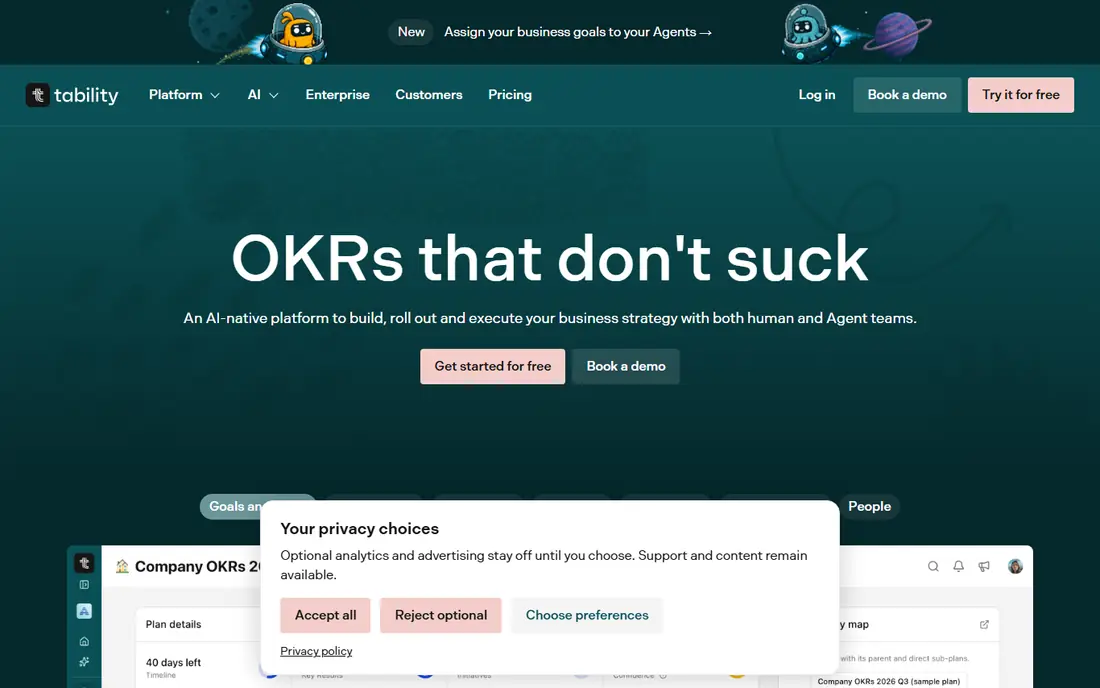
Tability centers on one habit: a short weekly update for each goal owner. Owners enter a number, pick a confidence level, and add a note, which keeps OKRs visible without long meetings. AI suggestions and scheduled reports help managers spot stalled goals early.
The limit is scope. Tability does not try to run reviews, compensation, or engagement surveys, so teams that want one people platform will need another tool. It is best for small and mid-sized teams that want OKRs to stay alive between quarterly reviews.
- Weekly update habit is built in
- Confidence levels and notes keep progress visible
- Simple setup
- No permanent free plan
- Less performance-suite depth than Lattice or 15Five
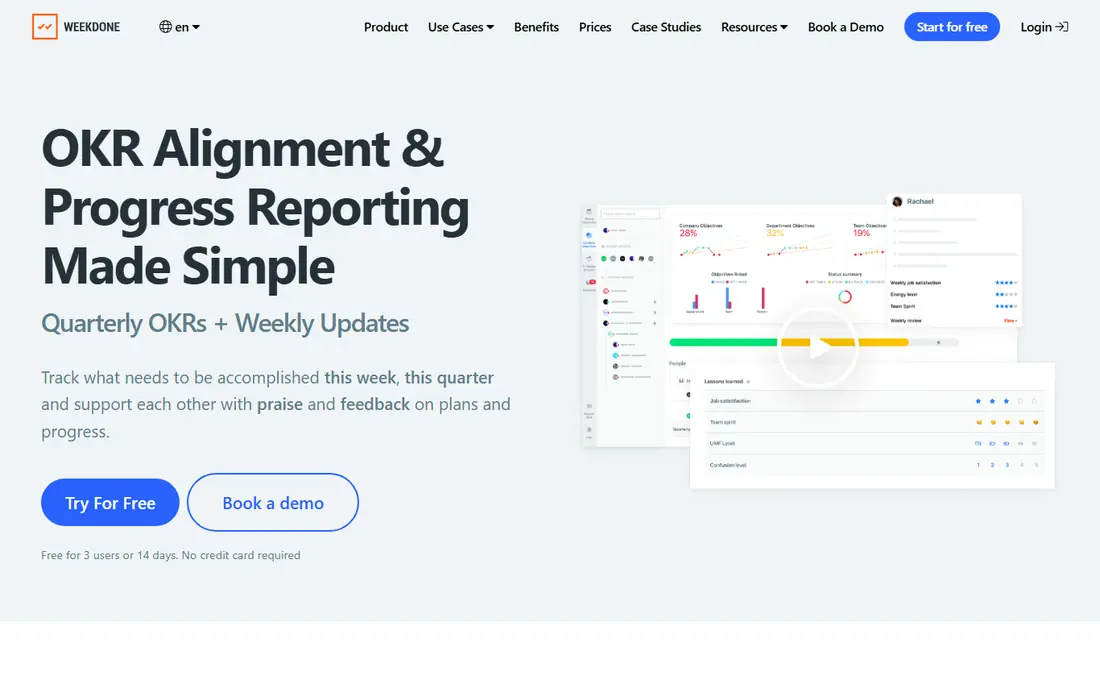
Weekdone helps teams set quarterly objectives and report progress each week. The weekly report format suits managers who want a regular, readable update without chasing spreadsheets. A free plan for up to three users makes it easy for a tiny team to test the method before paying.
Larger teams may find Weekdone light on integrations, strategy mapping, and advanced reporting. It is a good starting point for a first OKR cycle, and a weaker pick for a company that needs OKRs tied to many systems and departments.
- Free plan for up to three users
- Weekly planning and reporting
- Simple OKR structure
- Smaller feature set than enterprise tools
- Reporting depth is limited at scale
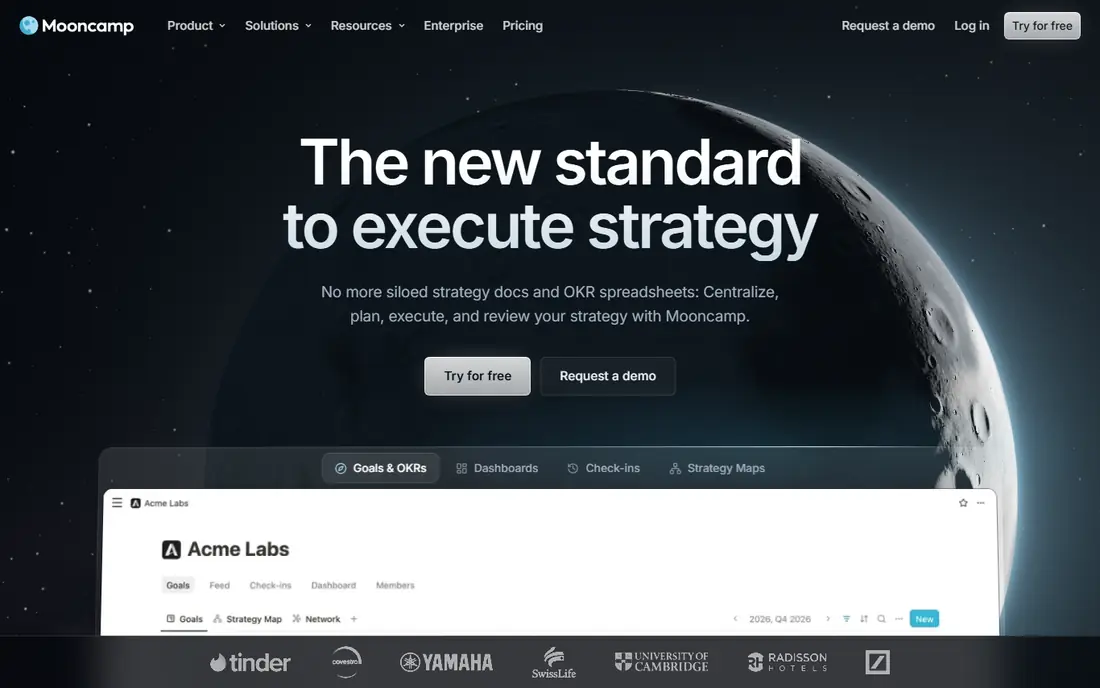
Mooncamp is a dedicated OKR tool with a clean interface for objectives, key results, and check-ins. Teams can align company, team, and individual goals, then track progress in one view. The focused design helps teams that found larger suites too busy or too slow to adopt.
The trade-off is ecosystem size. Integrations and add-on modules are fewer than on Lattice or WorkBoard, so teams with complex HR or project stacks should check connections first. Mooncamp fits teams that want OKRs done well, without buying a whole performance suite.
- Focused OKR and check-in workflow
- Clean interface
- Goal alignment views
- Smaller ecosystem than large platforms
- Minimum seat rules on some plans
Lattice combines goals and OKRs with performance reviews, feedback, engagement surveys, and career growth tools. That combination helps HR-led teams connect goal progress to review conversations and development plans. Published goals pricing starts at $8 per seat per month, with an annual minimum that buyers should confirm.
For a team that only needs OKRs, Lattice can cost more than Tability or Weekdone. It earns its price when reviews, feedback, and goals must live in one system, with one set of user records and permissions.
- Goals and OKRs alongside reviews, feedback, and engagement
- Strong HR integrations
- Clear manager tools
- Annual minimum spend applies
- Goals alone may cost more than a dedicated tool
15Five pairs OKRs with weekly check-ins, pulse surveys, and performance reviews. Managers get a regular view of progress, blockers, and morale, rather than a quarterly OKR snapshot. That rhythm suits remote and hybrid teams that need frequent, light-touch management.
Pricing is the caution. OKRs sit in the Perform plan at $11 per user per month, not in the cheaper engagement-only plan. Teams should confirm which plan covers goals before budgeting, and test whether weekly check-ins fit their management style.
- Weekly check-ins and OKRs in one flow
- Manager coaching tools
- Engagement and review modules
- OKRs sit in a higher-priced plan
- Smaller teams may pay for features they do not use
Betterworks serves enterprises that need structured goals, calibration, and continuous feedback across distributed teams. It connects OKRs to review cycles and HR systems such as Workday, which helps large companies keep goal data consistent. Reporting and alignment views support strategy reviews at scale.
Small teams will find Betterworks heavy in both price and process. It is built for companies with formal review cycles and dedicated people teams, not for a startup running its first OKR quarter. Enterprise buyers should plan onboarding time and change management.
- Structured enterprise OKRs
- Calibration and continuous feedback
- Strong HR system integrations
- Enterprise pricing and setup
- Interface and process can feel heavy for small teams
Profit.co combines OKR tracking with task management, KPI tracking, and strategy views. Teams can link a key result to the tasks that move it, which helps managers see why a goal is stuck. Integrations with Slack, Microsoft Teams, and Jira keep updates close to daily work.
Pricing has moved toward quote-based enterprise plans in recent listings, so small teams should request a current quote rather than assuming a low entry price. The interface also packs a lot into each screen, so a short pilot helps teams judge adoption before a full rollout.
- OKRs linked to tasks and KPIs
- Strategy and execution views
- Broad integrations
- Quote-based enterprise pricing in recent listings
- Interface can feel busy at first
WorkBoard focuses on turning strategy into measurable results, with OKRs, business reviews, and execution reporting for large companies. It suits organizations that run formal operating rhythms and need leaders to review progress on a shared cadence. Coaching and review features help managers act on stalled results.
The platform is enterprise-grade in price and setup, and it works best with executive sponsorship. A small team without a formal strategy process will find it heavy. WorkBoard fits when alignment across many teams, not just goal tracking, is the main problem.
- Strategy-to-execution alignment
- Strong enterprise reporting
- Results coaching features
- Enterprise price and complexity
- Overkill for small teams
- Needs executive sponsorship
Leapsome combines OKRs with performance reviews, feedback, engagement, and learning tools. Mid-market teams, especially in technology, use it to connect goal progress with skill development and review cycles. The interface is modern and approachable for managers and employees alike.
Buyers should confirm current pricing, since Leapsome is sales-led and goals sit inside a wider suite. Teams that only want OKRs may find a dedicated tool cheaper. Leapsome is strongest when reviews, feedback, and goals must share one people platform.
- OKRs alongside reviews, feedback, and learning
- Modern interface
- Good for mid-market tech teams
- Pricing is sales-led
- Goals are part of a wider suite, so standalone OKR cost is unclear
How we picked these
We compared official feature pages, pricing pages, public documentation, and public reviews for dedicated OKR tools and performance platforms with OKR modules. We kept only tools that operate in October 2026 and that support real OKR work, such as objectives, key results, check-ins, and alignment. We excluded the named product itself and generic project tools where goal tracking is only a minor feature.
What to check before you choose
First, decide how often the team will update goals. A tool with a strong weekly check-in habit beats a feature-rich tool that no one opens. Ask managers to trial the check-in flow for two weeks before committing to a year-long plan.
Second, check how goals connect to reviews, if at all. Some teams want that link, while others prefer to keep OKRs separate from performance ratings. That choice alone splits the list between dedicated tools and performance platforms.
Finally, confirm seat minimums, free-plan limits, and annual minimums in writing. Several vendors require a minimum seat count or annual spend, which changes the real cost for a small team. A clear quote avoids a surprise after the trial ends.
Frequently asked questions
What is the best Perdoo alternative for a small team?
Tability and Weekdone are strong small-team picks, with Weekdone offering a free plan for up to three users. Mooncamp also suits small teams that want a clean dedicated OKR tool. Lattice and 15Five cost more but add reviews and check-ins.
Can I use Lattice or 15Five just for OKRs?
Yes, but the price reflects a wider platform. Lattice goals start at $8 per seat per month with an annual minimum, and 15Five OKRs sit in the $11 Perform plan. A dedicated tool is usually cheaper if reviews are not needed.
Do OKR tools offer free plans?
Yes, at the small end. Weekdone offers a free plan for up to three users, and Perdoo itself offers one for up to five. Most other tools here offer trials instead, so check current limits on the vendor site.
How are OKRs different from KPIs?
OKRs set a bold objective and measurable key results for a period, usually a quarter. KPIs track ongoing health metrics, such as revenue or churn. Many tools here, including Perdoo and Profit.co, track both, but the two should not be confused in goal reviews.
How often should teams update OKRs?
Weekly updates work best for most teams, with a short confidence note on each key result. Quarterly reviews alone let goals drift, while daily updates create busywork. A weekly rhythm keeps progress visible without overloading managers.
Sources
See where you really rank - block by block
ProMapRanker scans Google Maps across a grid of your service area. Simple monthly plans from $19, white-label on every plan.
Start freeKeep reading
 zyte alternatives
Best Zyte Alternatives in 2026
These zyte alternatives cover managed scraping APIs, proxy networks and no code tools for lawful collection from your own or consented sources only in 2026.
Read → zerto alternatives
Best Zerto Alternatives in 2026
Compare the best zerto alternatives for disaster recovery and replication, with recovery targets, cloud options and honest trade-offs for teams in 2026.
Read → zerofox alternatives
Best ZeroFox Alternatives in 2026
We compared 9 zerofox alternatives for brand protection, phishing takedowns, dark web monitoring, and social impersonation, with clear coverage notes.
Read →