 ProMapRanker
Best Pendo Alternatives in 2026

Key takeaways
- No single tool copies the full Pendo bundle, so pick the half you actually use: analytics or in-app guidance.
- Mixpanel and Amplitude give the deepest event analytics, while Userpilot and Appcues focus on tours, checklists, and onboarding inside the product.
- Heap and Fullstory help teams that want to see what happened without heavy setup or manual event planning.
- Hotjar suits teams that want heatmaps and recordings beside analytics, and Gainsight PX fits customer success teams that track product health.
Quick comparison
| Pick | Great for | Pricing starts at | Free tier | |
|---|---|---|---|---|
 Mixpanel | Event analytics for product teams | Free | Yes | Visit |
 Amplitude | Deep behavioural analytics | Free | Yes | Visit |
 Heap | Automatic event capture | Free | Yes | Visit |
 Fullstory | Session replay and experience analytics | Free | Yes | Visit |
 Hotjar | Heatmaps and recordings | See website | Yes | Visit |
 Userpilot | In-app onboarding and adoption | $299 per month | Free trial | Visit |
 Appcues | No-code in-product experiences | See website | No | Visit |
 Gainsight PX | Customer success and product health | See website | No | Visit |
The best Pendo alternatives
Pendo bundles product analytics, in-app guides, surveys, and roadmaps, so the right replacement depends on which part your team misses most. The tools below cover both sides of that bundle, and we note where a tool only replaces one half.
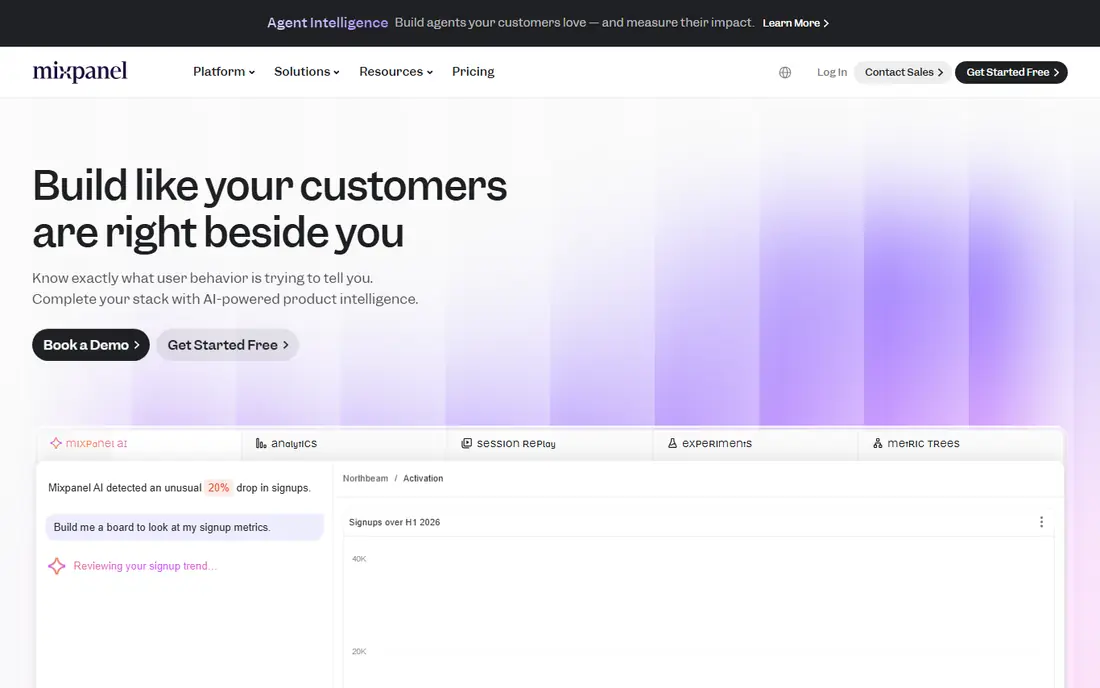
Mixpanel is the most direct analytics replacement for teams that lived in Pendo dashboards. You define events, then build funnels, retention curves, and breakdowns without waiting on an analyst for every question. That self-serve style suits product managers and growth teams that check usage daily and want answers in minutes rather than in a weekly report.
The trade-off is scope. Mixpanel does not try to be an onboarding tool, so teams that also need tours and checklists will pair it with a guidance tool or pick a different option below. Watch event volume too, since a chatty product can push a free or low-cost plan into paid usage faster than expected. If analytics is the priority and guides are a nice extra, Mixpanel is a strong starting point.
- Fast self-serve funnels and retention reports
- Free plan with a large monthly event allowance
- Works for web and mobile products
- Paid pricing is usage based and can climb with event volume
- In-app guides are not its focus
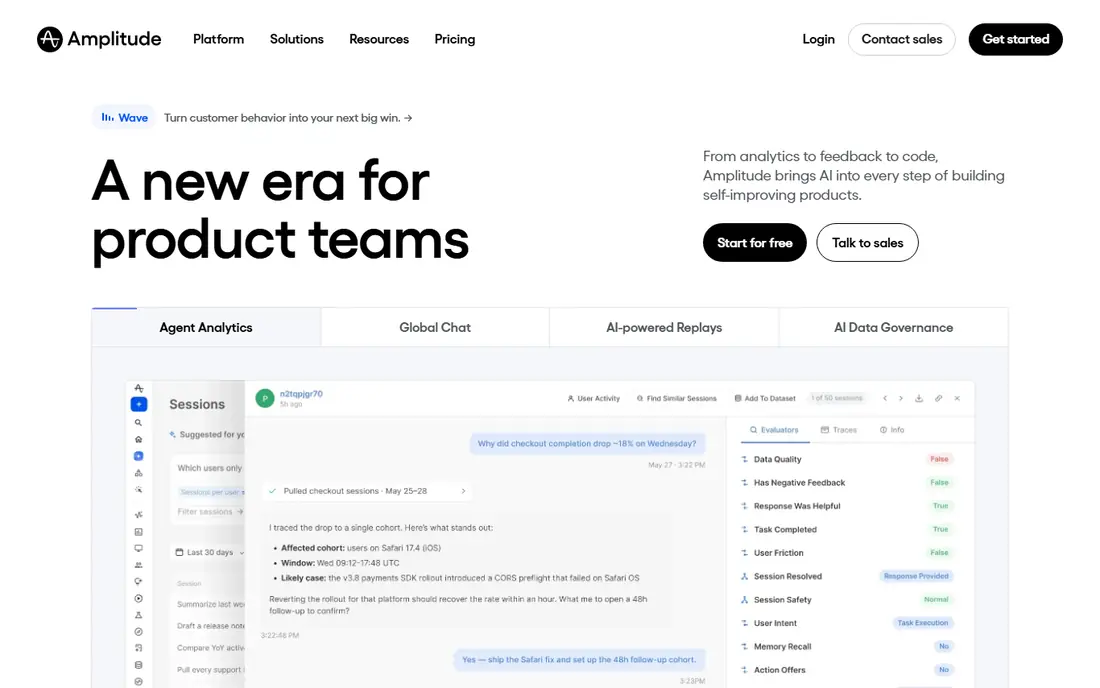
Amplitude suits teams that want to go deeper than page views and simple funnels. Cohorts, retention analysis, and journey views help product teams see which behaviours predict long-term use, and which onboarding steps actually lead to paying customers. The free plan gives smaller teams room to learn the tool before committing to a paid tier.
That depth comes with setup cost. Amplitude rewards teams that plan their events and naming carefully, and it can feel heavy for a small team that just wants a quick dashboard. Paid pricing also moves to quotes as usage grows, so larger teams should budget time for a sales conversation. For serious product analytics, though, Amplitude remains one of the most capable options on this list.
- Generous free plan for smaller products
- Strong cohort and retention analysis
- Experimentation and data tools in the same platform
- Paid plans are quote based at higher tiers
- Setup and taxonomy work take real effort
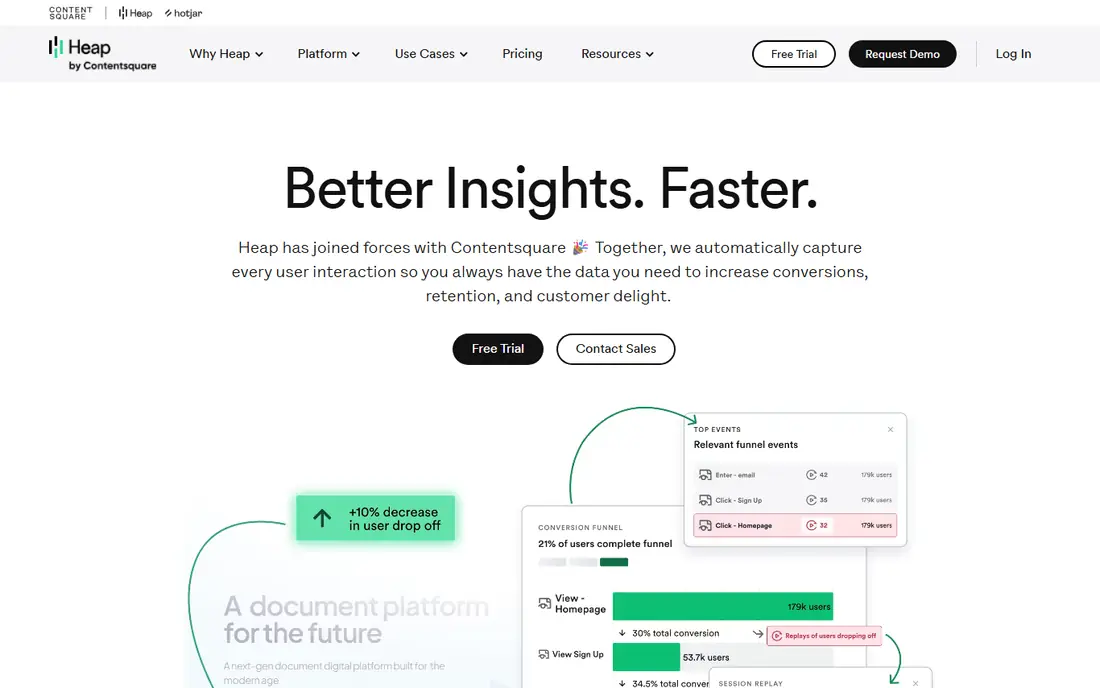
Heap is built for teams that never quite finished their tracking plan. It captures interactions automatically, so you can go back later and define an event for something users did last month, without a new release. That retroactive view is genuinely useful when a question comes up after a launch and nobody instrumented the exact button in advance.
The catch is that automatic capture is not the same as automatic insight. You still need to decide which events matter, clean up noisy data, and build the reports your team will actually read. Paid plans are also quote based, which makes budgeting less transparent than a published price list. If your team keeps missing tracking for new features, Heap removes that excuse.
- Captures clicks, taps, and page views automatically
- Lets teams define events after the fact
- Session replay on paid plans
- Paid pricing is quote based beyond the free tier
- Analysis can feel less guided than Mixpanel or Amplitude
Fullstory answers a different question from the analytics tools above: not just how many users dropped off, but what they saw and did before they left. Session replay, heatmaps, and frustration signals help designers and support teams spot confusing layouts, broken forms, and rage clicks that aggregate charts tend to hide. The free plan gives small teams a real way to try replay before paying.
Fullstory is less useful as a standalone funnel and retention engine, and its paid pricing is not published beyond the free tier. Teams that need both deep analytics and replay often pair Fullstory with Mixpanel or Amplitude. If your main problem is understanding why a flow fails, start with Fullstory and let the replays guide the fix.
- Free plan with a monthly session allowance
- Replay shows exactly where users struggle
- Frustration signals point to broken flows
- Paid plans are quote based
- Mobile analytics and guides sit in higher tiers or add-ons
Hotjar is the lightest option here, and that is its appeal. Heatmaps show where visitors click and scroll, recordings show real sessions, and short surveys collect feedback in context. For marketing sites and simpler web products, that combination often explains a drop-off faster than a dashboard full of events.
Hotjar does not replace Pendo analytics for a complex SaaS product. It is session and response based rather than event based, and its pricing now runs through Contentsquare, so check the current product page before budgeting. Still, for teams that mainly want to see how people use pages and forms, Hotjar is quick to set up and easy for non-technical teammates to read.
- Simple heatmaps, recordings, and surveys
- Easy to set up on a website
- Free plan for small sites
- Pricing now sits under Contentsquare product lines, which can confuse comparisons
- Not a full product analytics platform
Userpilot is the closest match for teams that used Pendo mainly for guides and onboarding. You can build product tours, checklists, tooltips, and announcements without code, then target them at new users, specific plans, or users who have not tried a feature yet. Built-in analytics and surveys mean you can measure whether a tour actually changed behaviour, not just whether it was shown.
The price is the honest barrier. At $299 per month for the Starter plan, Userpilot is a serious purchase for a small startup, and costs rise with monthly active users. Smaller teams may prefer UserGuiding or a simpler tour tool, but for SaaS teams that treat onboarding as a core job, Userpilot covers analytics and guidance in one place.
- No-code tours, checklists, and modals
- Analytics and engagement in one tool
- Targeting by user behaviour and segment
- Entry price is high for small teams
- Pricing scales with monthly active users
Appcues focuses on the in-product experience itself: the tour a new user sees, the checklist that guides activation, the announcement for a new feature. Its builder is polished, and behavioural targeting keeps guidance relevant instead of showing every user the same sequence. Recent AI features help draft campaigns and explain drop-offs, which saves time for small product teams.
Pricing is the main drawback. Appcues does not publish list prices for its main plans, and there is no free plan, so you need a sales conversation to get a firm number. A smaller Spark plan exists for very small teams, but check its user limits before assuming it fits. If polished onboarding matters more than published pricing, Appcues deserves a demo.
- Strong flow builder for tours, modals, and checklists
- Behavioural targeting
- Product analytics and AI-assisted creation
- Main plans are not published as list prices
- No free plan
- Costs rise with users and published experiences
Gainsight PX makes sense when the buyer is a customer success team rather than a lone product manager. It connects product usage to account health, so success managers can see which accounts are adopting, which are stuck, and where an in-app guide or outreach could help before renewal. That account-level view is something pure analytics tools do not offer on their own.
The trade-off is weight. Gainsight PX is quote based, setup takes coordination with customer success workflows, and small teams will find it more tool than they need. For B2B SaaS companies with named accounts and renewal risk, though, that combination of usage data and success tooling is exactly why teams move to it from a general product analytics tool.
- Product usage tied to customer health and success workflows
- In-app engagements for adoption
- Strong for B2B SaaS teams
- Quote based pricing
- Heavier setup than a simple tour tool
- Overkill for small consumer products
How we picked these
We compared official feature pages, pricing pages, and app store listings, plus public reviews, and we kept only tools that are live in October 2026 and clearly replace at least one major part of Pendo. We excluded tools that are closed, retired, or only loosely related to product analytics and in-app guidance. Where pricing was quote based or conflicting across sources, we wrote See website rather than guessing a number.
What to check before you switch
Start by listing what your team actually used in Pendo in the last month. If the answer is dashboards and funnels, an analytics tool like Mixpanel or Amplitude is the safer move. If the answer is tours, checklists, and NPS surveys, Userpilot or Appcues will feel closer to home. Teams that used both should expect either a bundle compromise or two tools, and should price that pair honestly.
Check the billing unit before you compare prices. Analytics tools often charge by events or sessions, while guidance tools charge by monthly active users, so the cheapest headline price can become the most expensive bill at your volume. Run a trial on a real feature launch, not a demo account, and confirm that guides, surveys, and analytics all work in your actual product stack. Finally, confirm data privacy terms and retention limits, since replay and analytics tools store detailed user behaviour.
Frequently asked questions
What is the best Pendo alternative for product analytics?
Mixpanel and Amplitude are the strongest analytics replacements, with Mixpanel favouring fast self-serve reports and Amplitude favouring deeper cohort and retention work. Heap is a good pick when your team has not fully instrumented events, since it captures interactions automatically. Pick based on how your team asks questions, not just on the free plan.
What is the best Pendo alternative for in-app guides and onboarding?
Userpilot and Appcues are the closest matches for tours, checklists, tooltips, and announcements built without code. Userpilot pairs guidance with analytics in one tool, while Appcues leans harder on polished in-product experiences. Both charge by monthly active users, so model your real user count before choosing.
Is there a free Pendo alternative?
Mixpanel, Amplitude, Heap, Fullstory, and Hotjar all offer free plans, but each free plan has limits on events, sessions, or users. They work well for small products and trials, and they let you test the core workflow before paying. Guidance tools are harder to get for free, since Userpilot offers only a trial and Appcues has no free plan.
Can one tool replace everything Pendo does?
Rarely, and that is the main lesson from comparing these tools. Analytics leaders do not offer the same depth of guides, and guide leaders do not offer the same depth of analytics. Many teams end up with one tool for each job, or accept a weaker half in a single platform. Decide which half drives revenue or retention, and protect that one first.
How much do Pendo alternatives cost?
Costs range from free plans for small products to $299 per month for Userpilot Starter and quote based enterprise pricing for Amplitude, Heap, Fullstory, Appcues, and Gainsight PX. Usage based billing means your event or user volume matters more than the headline price. Always trial with real traffic and check overage terms before signing an annual plan.
Sources
See where you really rank - block by block
ProMapRanker scans Google Maps across a grid of your service area. Simple monthly plans from $19, white-label on every plan.
Start freeKeep reading
 zoho inventory alternatives
6 Alternatives to Zoho Inventory, Compared on Price and Fit
Zoho Inventory alternatives: 6 tools compared on price, free plans and fit. Katana leads the list for manufacturers. Fit and flaws are laid out for each entry.
Read → zoho crm alternatives
Best Zoho CRM Alternatives (2026)
Need Zoho CRM alternatives? We compare 7 tools on cost, free access and who each suits. Every pick gets a straight assessment. Built for quick decisions.
Read → zelle alternatives
Best Zelle Alternatives in 2026
Compare the best Zelle alternatives for sending money to friends, paying sellers and moving funds abroad, with honest notes on fees, speed and safety in 2026.
Read →