 ProMapRanker
9 Paylocity Alternatives in 2026


Small businesses and simple payroll · Pricing starts at: $49 per month plus $6 per employee
Key takeaways
- Gusto and OnPay suit small businesses that want simple, flat-rate payroll with clear pricing.
- Rippling and BambooHR suit growing teams that need HR, payroll, and integrations in one system.
- Paychex, ADP, and Paycor suit larger or more complex employers that want service depth and compliance support.
- Deel and Justworks suit teams with global staff, contractors, or PEO needs.
- Paylocity pricing is quote-based, so alternatives with published starting prices can make budgeting easier.
Quick comparison
| Pick | Great for | Pricing starts at | Free tier | |
|---|---|---|---|---|
| Gusto | Small businesses and simple payroll | $49 per month plus $6 per employee | Free trial | Visit |
 OnPay | Flat-rate small business payroll | $49 per month plus $6 per employee | Free trial | Visit |
 Rippling | HR, IT, and payroll in one system | $8 per user per month | No | Visit |
 BambooHR | HR-first small to mid-size teams | See website | Free trial | Visit |
 Paychex | Established and scaling employers | See website | No | Visit |
 ADP | Large and multi-entity employers | See website | No | Visit |
 Paycor | Payroll and compliance for mid-size teams | See website | No | Visit |
 Deel | Global payroll and contractors | $29 per employee per month | No | Visit |
 Justworks | PEO benefits for remote teams | $8 per employee per month | No | Visit |
The best paylocity alternatives
Paylocity is a strong mid-market HR and payroll platform, but its quote-based pricing and breadth can be more than a smaller team needs. The alternatives below cover the same core jobs, payroll, benefits, time tracking, and HR records, with different strengths on price transparency, simplicity, and scale. We compared official feature pages, pricing pages, and plan descriptions to build this list, and we did not include Paylocity itself.
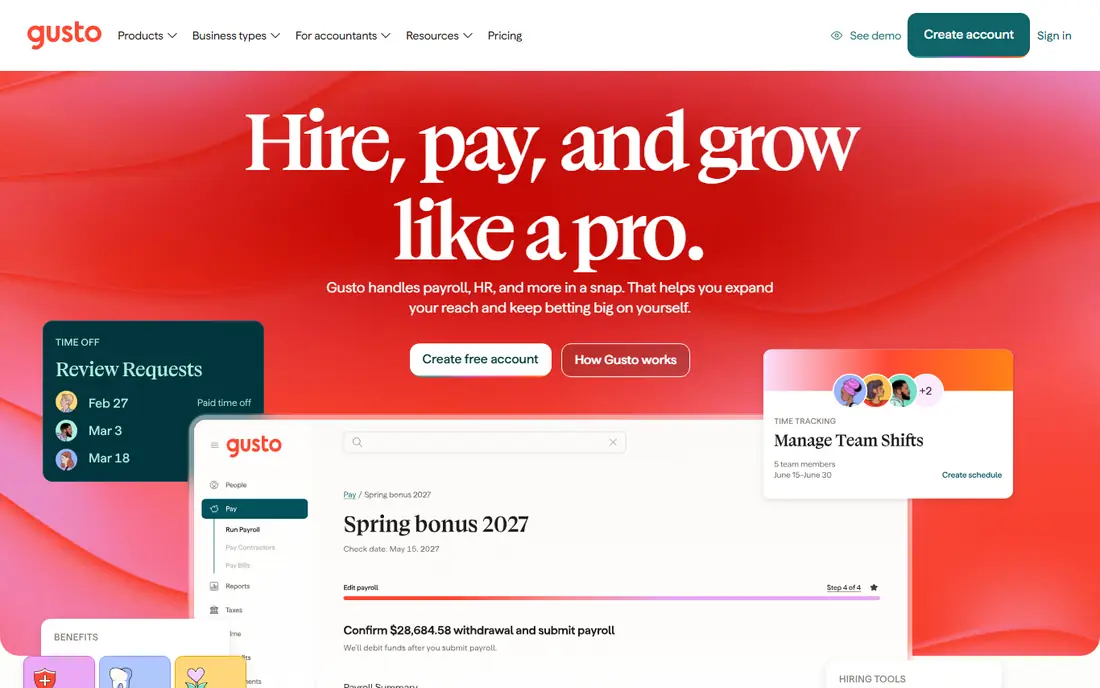
Gusto is the simplest switch for a small business that finds Paylocity too large. Its pricing is published plainly, payroll runs are unlimited on its plans, and setup is designed for owners without a dedicated HR team. Onboarding, direct deposit, tax filings, and benefits administration are built in, which keeps routine payroll work in one place.
The limit is scale and complexity. Larger employers with multi-entity payroll, advanced talent tools, or global staff will likely need a broader platform. Gusto also charges per employee on top of the base fee, so costs rise with headcount. For teams under about 50 people who want payroll done cleanly, Gusto is a strong and friendly alternative.
- Clear published pricing
- Unlimited payroll runs on plans
- Onboarding, benefits, and time tools included on higher tiers
- More complex HR needs may require higher tiers
- International payroll is limited
- Some features are add-ons
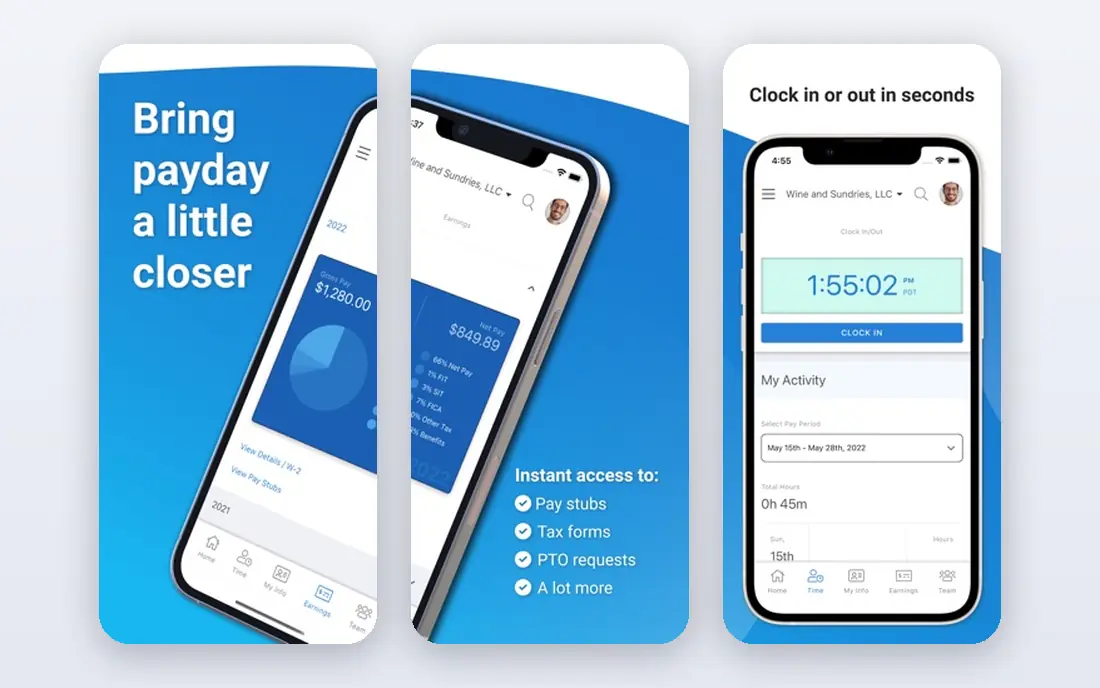
OnPay appeals to owners who want one price and no module maze. It covers payroll, tax filings, direct deposit, and contractor payments in a single plan structure, with multi-state support for growing teams. The interface is plain and task-focused, which suits businesses that run payroll themselves without an HR department.
The trade-off is HR depth. OnPay does not try to match Paylocity on talent, engagement, or advanced reporting, and time tracking is more basic than dedicated tools. If payroll accuracy and simple pricing matter more than a full HR suite, OnPay is a practical choice. If you need deep HR workflows, pair it with a separate HR tool or choose a broader platform below.
- Single flat pricing model
- Multi-state payroll
- Unlimited payroll runs
- Straightforward interface
- HR features are lighter than full HCM platforms
- Time tracking is limited
- Fewer advanced talent tools
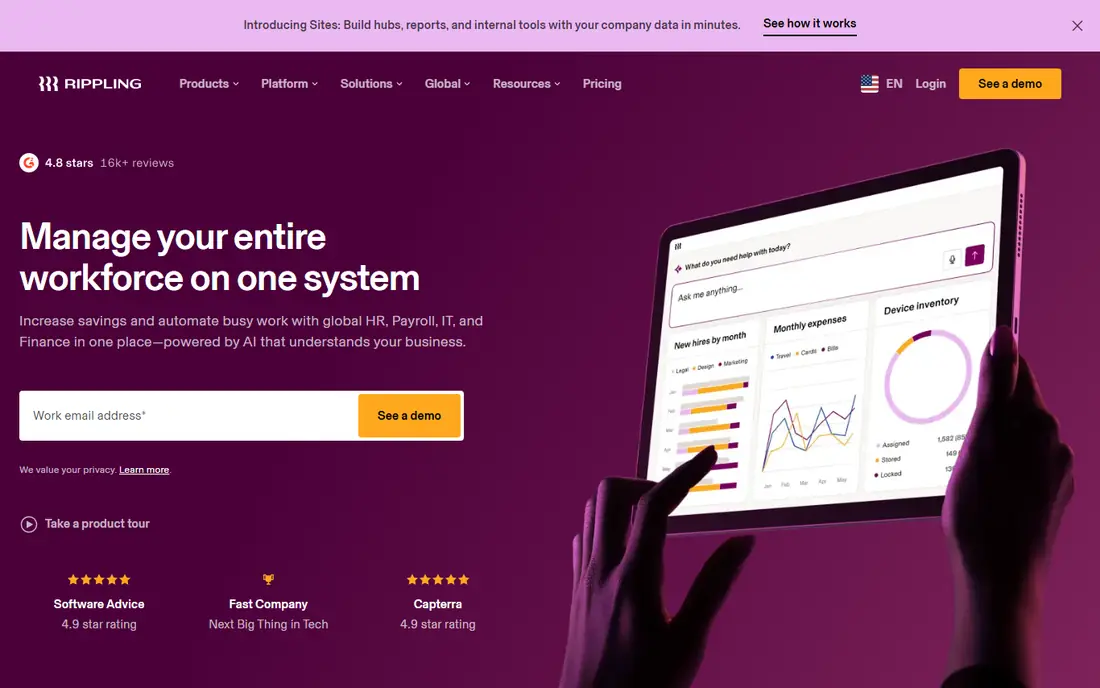
Rippling is the pick for tech-forward teams that want HR, IT, and payroll connected. It can provision accounts and devices when someone joins, remove access when someone leaves, and automate approvals across HR and finance. That automation saves time for distributed teams and reduces the manual work that comes with separate systems.
Pricing starts low per user, but modules add cost, so the final bill depends on which products you enable. Small teams that only need payroll may find Rippling more complex than Gusto or OnPay. For scaling companies that want one system for people, devices, and pay, Rippling is one of the strongest Paylocity alternatives.
- Combines HR, payroll, IT, and finance workflows
- Strong automation and integrations
- Global payroll options
- Modular pricing can rise as you add products
- Setup can be complex
- Smaller teams may not need IT features
BambooHR puts HR records first. Employee profiles, time off, onboarding, and reporting are clean and easy for managers to use, which helps teams that have outgrown spreadsheets but do not want a heavy enterprise system. Payroll is available as an add-on in the US, so a team can keep HR and payroll linked without switching vendors.
The catch is that payroll is not the core strength in the same way as Gusto or OnPay, and pricing requires a quote for many plans. Teams with complex payroll, multi-state tax needs, or global staff should test payroll carefully during a trial. For HR-led teams that want a friendly system of record, BambooHR is a solid alternative.
- Clear employee records and reporting
- Onboarding and time-off tools
- Easy to use for non-HR staff
- Payroll is an add-on in the US
- Pricing is quote-based on higher tiers
- Advanced payroll complexity may need another tool
Paychex suits established businesses that want a service partner, not just software. It offers payroll, HR services, benefits, and a PEO option, with support for multi-state and growing employers. That service depth helps companies that prefer to hand compliance questions to a provider rather than solve them in software alone.
The downside is transparency and feel. Pricing is quote-based, so budgeting requires a sales conversation, and the product can feel more traditional than newer platforms. For a 50-plus employee company that values support and a PEO path, Paychex is a dependable Paylocity alternative. For a five-person startup, it may be more than needed.
- Long track record in payroll and HR services
- PEO option
- Dedicated support and compliance help
- Pricing is quote-based
- Interface can feel traditional
- Smaller teams may find it heavier than Gusto
ADP is the large-employer counterpart to Paylocity. It covers payroll, HR, time, talent, benefits, and global payroll across a wide range of company sizes, including multi-entity and international operations. Its compliance tools and benefits brokerage are strengths for companies with complex workforces.
The complexity is the trade-off. ADP sells many products under one brand, so choosing the right package takes guidance, and pricing is quote-based. Implementation for a large setup can also take longer than a small-business tool. If your company is growing past mid-market size, or you operate in many states or countries, ADP is a serious alternative to consider.
- Scales from small business to global enterprise
- Strong compliance and benefits tools
- PEO and global payroll options
- Pricing is quote-based
- Product range can be confusing
- Implementation can take time for larger setups
Paycor targets mid-size employers that need payroll accuracy plus HR tools, without moving to a full enterprise HCM. Its compliance alerts, time management, and reporting help HR teams stay ahead of payroll errors and labor rules. Recruiting and onboarding tools add value for companies that hire regularly.
Pricing is quote-based, which makes direct comparison harder than with Gusto or OnPay. Paycor is also a better fit for teams with dedicated HR staff than for a solo owner running payroll alone. For a mid-size company that wants a Paylocity-style platform with strong payroll and compliance focus, Paycor belongs on the shortlist.
- Payroll with compliance alerts
- Time and attendance tools
- Reporting for HR leaders
- Recruiting and onboarding options
- Pricing is quote-based
- Some advanced features sit on higher tiers
- Smaller teams may prefer simpler pricing
Deel is the pick when your workforce is global. It handles payroll, contractor payments, and employer-of-record services across many countries, with local compliance handled by Deel or its partners. That is a different job from US-only payroll, and it matters for remote-first companies hiring across borders.
The limit is focus. A purely US team with simple payroll will likely find Gusto or OnPay cheaper and simpler. Deel pricing also varies by service, with employer-of-record plans costing far more than standard global payroll. If you hire internationally, or you manage many contractors abroad, Deel is a strong Paylocity alternative for that specific need.
- Global payroll and employer-of-record services
- Contractor management
- Compliance support across many countries
- US-only small business payroll is not its main strength
- Employer-of-record pricing is much higher
- Costs vary by country
Justworks offers a PEO model, which means it co-employs your team for benefits, payroll taxes, and compliance purposes, while you keep day-to-day management. That model can give small teams access to health benefits and HR support that would be hard to get alone. Payroll, onboarding, and compliance are handled in one platform, which suits remote teams.
The PEO model is not for everyone. Some companies prefer to keep full employer control and use standalone payroll software instead. Pricing also depends on the plan and benefits chosen. If benefits access and compliance support matter more than standalone software control, Justworks is a practical alternative to Paylocity.
- PEO model with access to large-group benefits
- Automated payroll and compliance
- Simple pricing structure for PEO plans
- PEO model means shared employer responsibilities
- Not ideal for teams that want standalone payroll only
- Pricing varies by plan
How we picked these
We compared official feature pages, pricing pages, and plan descriptions for HR and payroll platforms live in October 2026. We favored tools that cover US payroll, benefits, or global employment, that state their starting price or pricing model clearly, and that represent different company sizes. We excluded niche scheduling-only tools and tools that do not offer payroll, because they do not replace the core Paylocity job.
What to check before you switch
Start with payroll complexity. Count your states, pay types, and worker types, including contractors and part-time staff, because multi-state and contractor handling changes the right choice. Next, check benefits and time tools. A cheap payroll tool can become costly if you need separate systems for benefits, time tracking, and onboarding.
Also test the migration path. Ask how employee data, pay history, and tax records move over, and what support is included during the first payroll run. Finally, compare total cost at your headcount, not just the base fee. Per-employee charges, module fees, and PEO costs can change the ranking quickly, so model the price for your actual team size before signing.
Frequently asked questions
What is the best Paylocity alternative for small businesses?
Gusto and OnPay are the best small-business alternatives, because they offer clear flat-rate pricing and simple payroll. Gusto adds more benefits and onboarding depth, while OnPay keeps pricing and payroll especially straightforward.
Which Paylocity alternative has the most transparent pricing?
Gusto and OnPay publish starting prices plainly, which makes budgeting easier. Rippling publishes a low starting per-user price, but module costs add up, while Paychex, ADP, Paycor, and BambooHR often require a quote for full pricing.
Is Rippling better than Paylocity?
Rippling is better for teams that want HR, IT, and finance workflows in one system, especially for distributed companies. Paylocity is stronger for mid-market HR and engagement features in a single HCM. The better choice depends on whether IT automation or HR depth matters more to your team.
Which alternative is best for global teams?
Deel is the best global alternative here, because it covers global payroll, contractor management, and employer-of-record services across many countries. Rippling and ADP also offer global options, but Deel is built around international employment as its core job.
Can I switch from Paylocity mid-year?
Yes, but plan the timing around payroll tax filings and year-end reporting. Ask the new provider about data migration, parallel payroll runs, and tax history transfer, and avoid switching during a complex pay period if you can schedule the move in a quieter window.
What is a PEO, and do I need one?
A PEO, or professional employer organization, co-employs your staff for benefits, payroll taxes, and compliance, while you manage daily work. It can help small teams access better benefits and HR support, but it involves shared employer responsibilities. If you only need payroll software, a non-PEO tool like Gusto or OnPay is simpler.
Sources
See where you really rank - block by block
ProMapRanker scans Google Maps across a grid of your service area. Simple monthly plans from $19, white-label on every plan.
Start freeKeep reading
 zoro.to alternatives
Best Zoro.to Alternatives in 2026
We compare the best zoro.to alternatives in 2026, listing only legal licensed anime streaming services, from Crunchyroll to free options for fans today.
Read → zip alternatives
Best Zip Alternatives in 2026
We compare the best zip alternatives for buy now, pay later in 2026, covering pay-in-4 plans, fees, spending limits, and credit reporting options today.
Read → yesware alternatives
Best Yesware Alternatives in 2026
Compare the best yesware alternatives for sales email tracking, templates, and sequences, with current pricing and honest tradeoffs for small sales teams.
Read →