 ProMapRanker
Best Onfleet Alternatives in 2026


Flexible delivery management for local teams · Pricing starts at: See website
Key takeaways
- Tookan and Track-POD are the closest all-round replacements for Onfleet-style dispatch, tracking and proof of delivery.
- Routific and OptimoRoute suit smaller teams that mainly need route planning, while Bringg and Shipsy fit larger, more complex networks.
- Pricing models differ sharply, with per-driver, per-order and per-task models, so compare costs at your real monthly volume.
- Proof of delivery depth, offline driver apps and customer notifications separate good tools from pretty maps.
- Trial the driver app with your own drivers before signing, since field usability decides whether a rollout sticks.
Quick comparison
| Pick | Great for | Pricing starts at | Free tier | |
|---|---|---|---|---|
| Tookan | Flexible delivery management for local teams | See website | Free trial | Visit |
 Track-POD | Route execution and proof of delivery | See website | Free trial | Visit |
 Routific | Simple route planning for small teams | See website | Yes | Visit |
 OptimoRoute | Route planning per driver | See website | Free trial | Visit |
 Detrack | Low-cost dispatch for courier teams | See website | Free trial | Visit |
 Bringg | Delivery orchestration at scale | See website | No | Visit |
 Shipsy | End-to-end logistics for larger networks | See website | No | Visit |
 eLogii | Route planning and delivery management | See website | Free trial | Visit |
 Circuit | Simple multi-stop routes for small teams | See website | Free trial | Visit |
The best Onfleet alternatives
Onfleet covers dispatch, driver tracking, customer notifications and proof of delivery for local delivery teams. The tools below cover the same job, with different strengths in routing, pricing, fleet features and scale. Compare them at your actual order volume, since a cheap per-driver plan can still cost more than a per-order plan at high volume.
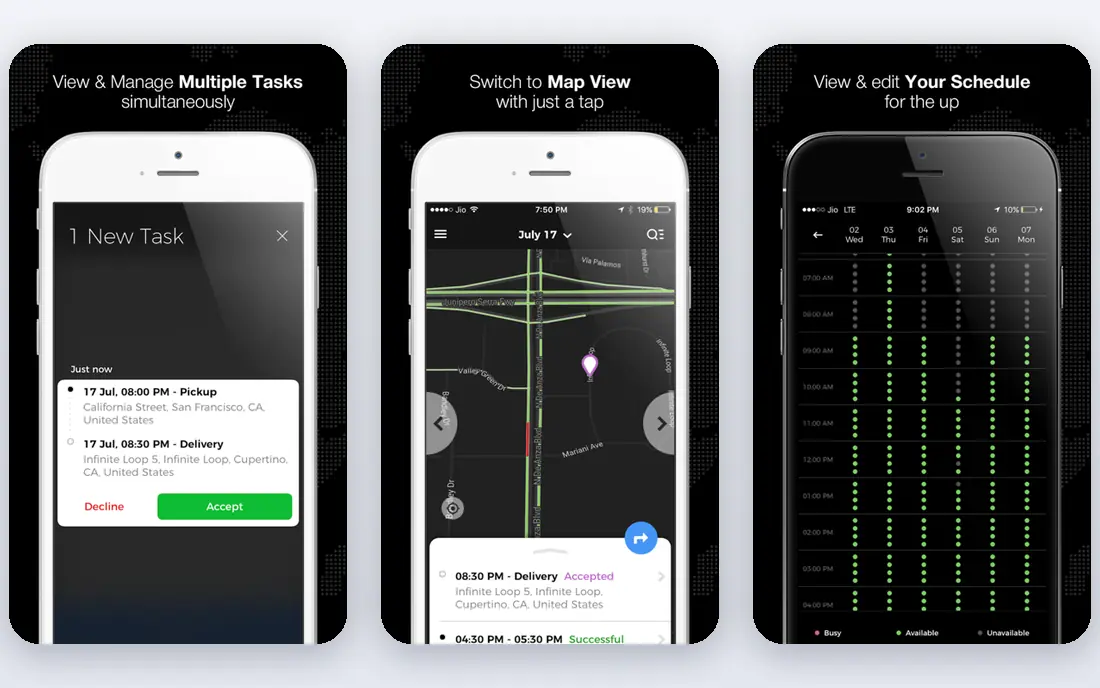
Tookan is the most frequently named Onfleet rival in reviewer comparisons, and the reason is breadth. It covers dispatch, live tracking, driver apps, customer notifications and proof of delivery, with workflow options that suit food, grocery, pharmacy and courier teams. Setup is self-serve for smaller teams, and the interface is easy for dispatchers to learn.
Pricing is the catch. Tookan's plans depend on agents, tasks and add-ons, so a small team should get a written quote at its real volume rather than budgeting from a headline figure. For teams that want flexibility without an enterprise project, Tookan is still the first trial on our list.
- Real-time tracking and dispatch
- Customisable workflows
- Broad app marketplace integrations
- Pricing is not published as a single simple tier
- Larger fleets need a sales conversation
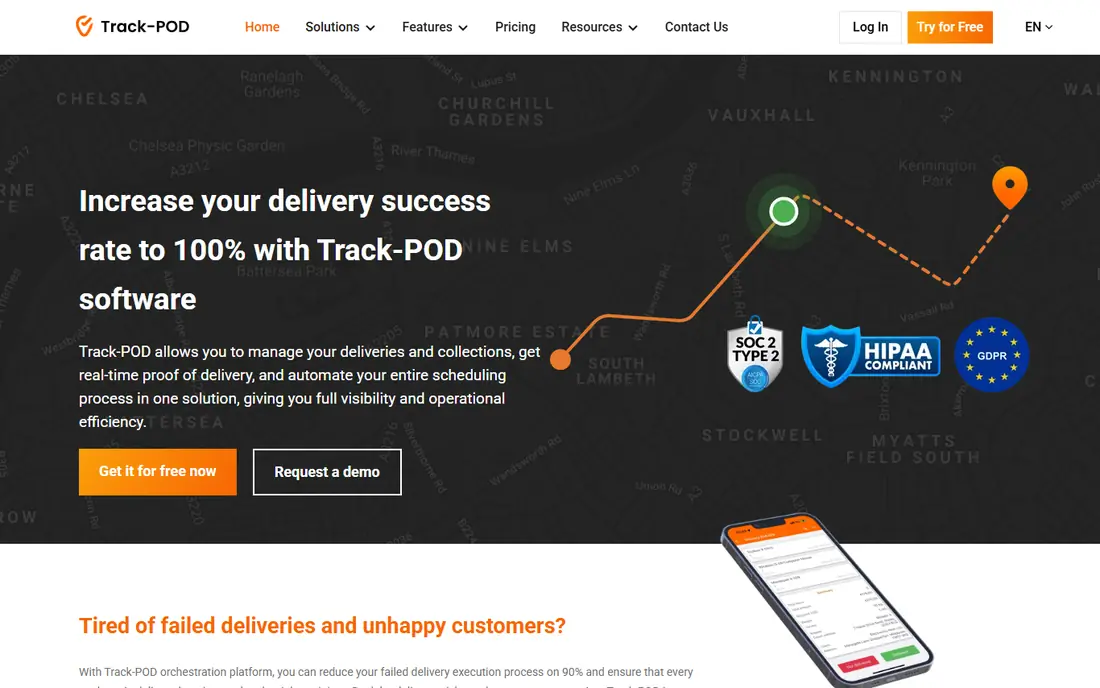
Track-POD focuses on the moment a delivery happens. Its proof of delivery covers signatures, photos, barcodes and custom forms, and its driver app works through route execution with live tracking for dispatchers. Teams that dispute deliveries or need audit-ready records will value that depth over a prettier map screen.
Integration depth is the question to settle early. Track-POD connects with common commerce and fleet tools, but the exact fit depends on your stack, so test the integration you actually need during a trial. Pricing also varies between driver-based and order-based plans, so compare both at your volume.
- Strong electronic proof of delivery
- Route planning and driver app
- Offline-capable capture
- Deeper integrations need checking against your stack
- Pricing varies by plan type
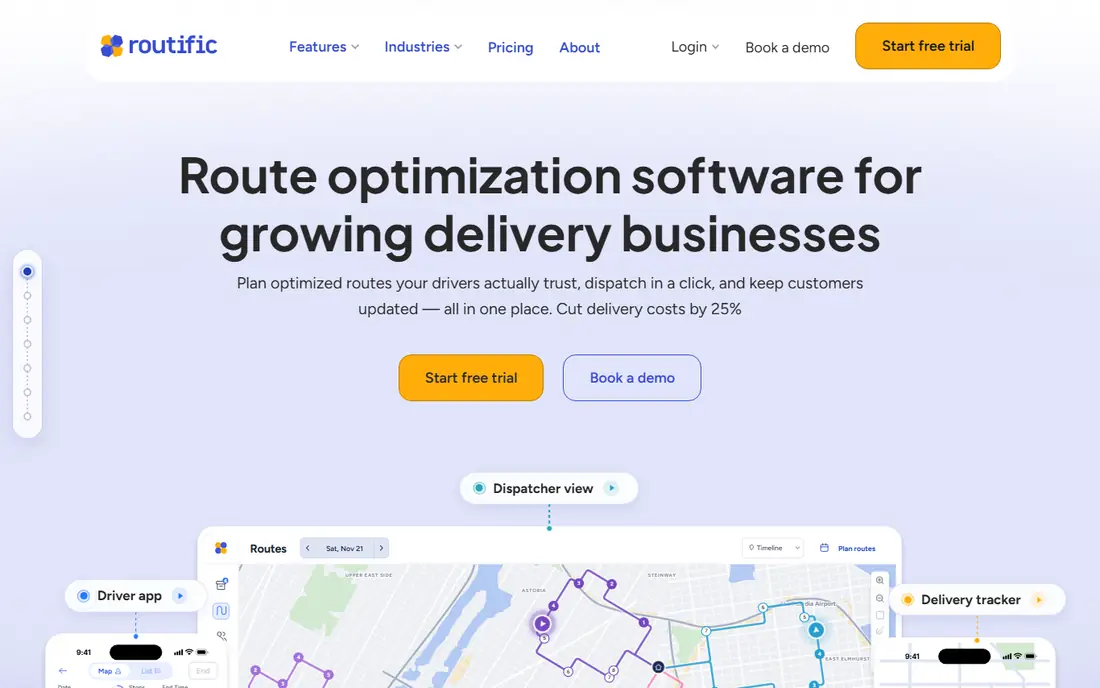
Routific is the low-friction starting point for a team moving off spreadsheets. It optimises multi-stop routes quickly, offers a free tier for low order volumes, and keeps the driver experience simple. Proof of delivery covers signatures and photos on all plans, which is generous for a budget tool.
The limits show at scale. There is no client portal, only recipient tracking, and SMS costs sit outside the headline plan. For a small local team, those limits rarely matter, but a team serving business clients with portal needs should look at Tookan or Track-POD instead.
- Free tier for low volumes
- Fast route optimisation
- Simple driver app
- No client portal
- SMS notifications are quoted separately
OptimoRoute charges per driver, which makes budgeting simple for teams with a stable driver count. Its route optimisation handles time windows, vehicle capacity and service times well, and dispatchers can drag stops to re-optimise routes during the day. That planning strength suits field service and delivery teams alike.
Proof of delivery depth is tiered, with signature, photo and barcode capture on higher plans, and there is no client portal. If your customers mainly need a tracking link and your drivers need strong routes, OptimoRoute is a strong, predictable pick.
- Strong route optimisation
- Weekly planning on higher plans
- Clear per-driver pricing
- Proof of delivery extras sit on higher plans
- No client portal
Detrack suits small courier teams moving from paper to digital. Per-driver pricing stays low, proof of delivery covers signatures, photos, location and timestamps on all plans, and recipients get tracking links without extra portal work. The dispatcher view stays simple, which helps teams with high driver turnover.
Advanced routing is a paid tier, so teams with complex multi-stop optimisation needs should test that tier rather than the base plan. For straightforward courier runs, Detrack delivers the core Onfleet job at a lower monthly cost.
- Low per-driver pricing
- Signature, photo and geotag proof of delivery
- Live tracking links
- Advanced routing sits on a higher tier
- No client portal
Bringg fits delivery networks that juggle in-house drivers, third-party fleets and carriers in one operation. Its orchestration layer plans, dispatches and tracks across those modes, with customer experience tools for branded tracking and notifications. Large retailers and logistics operators use it to unify fragmented delivery operations.
That power comes with enterprise cost and implementation effort. A single local fleet will find Bringg heavier than it needs, and pricing requires a sales conversation. For a network with real complexity, though, Bringg solves problems that simpler dispatch tools cannot.
- Orchestration across fleets and carriers
- Customer experience workflows
- Enterprise integrations
- Enterprise pricing and implementation
- Overkill for a single small fleet
Shipsy covers more of the logistics chain than a pure last-mile tool, including first-mile, line-haul and last-mile stages, with automation, tracking and analytics across them. Reviewers name it as a common Onfleet alternative for larger operations, and its carrier management helps teams that mix owned fleets with partners.
Scope is also the weakness for small teams. Shipsy is an enterprise platform with implementation time to match, so a local delivery team should not pick it for dispatch alone. For a growing logistics operation, its breadth becomes an advantage as volume and network complexity rise.
- Broad logistics coverage from first to last mile
- Automation and analytics
- Carrier management
- Enterprise scope and pricing
- Setup takes longer than a small dispatch tool
eLogii combines route planning, live driver tracking, proof of delivery and customer notifications in one platform, with options that suit courier, field service and retail delivery teams. Its planning tools handle constraints like time windows and vehicle capacity, and dispatchers can adjust routes during the day.
Pricing is largely quote-based, so small teams should ask for a written figure at their volume before comparing it with per-driver tools. The platform is still a solid middle ground between a simple route planner and an enterprise orchestration suite.
- Route optimisation with live tracking
- Proof of delivery and notifications
- Customer portal options
- Pricing is quote-based for most teams
- Feature depth varies by plan
Circuit, known for its route planner, suits small teams that mainly need optimised multi-stop routes and a simple driver app. Setup takes minutes, routes optimise quickly, and drivers get a clear stop list with navigation. For a team of a few drivers, that simplicity beats a full dispatch suite.
Depth is the limit. Circuit does not match Tookan or Bringg on dispatch automation, customer portals or complex fleet workflows, so growing teams may outgrow it. As a first step off manual planning, though, it is one of the easiest tools to adopt.
- Very simple route planning
- Driver app with proof of delivery
- Fast setup
- Less dispatch depth than Onfleet rivals
- Limited enterprise workflow options
How we picked these
We compared official feature pages, pricing models, proof of delivery options, driver app capabilities and public reviewer comparisons for each tool. We favoured tools that are actively sold in 2026 and cover dispatch, tracking or routing for last-mile work, not general fleet telematics alone. Where pricing is quote-based, we say so rather than guessing a figure.
How to choose a last-mile delivery tool
Start with your delivery model, not with a feature list. A single fleet with simple routes needs a different tool than a network mixing owned drivers and third-party carriers, and a pharmacy team needs different proof of delivery than a food team. List your must-haves: proof of delivery types, offline driver support, customer notifications, integrations and reporting.
Run a real trial with your own drivers on real routes, and check the dispatcher view during a busy shift. Watch for missed stops, failed proof captures and notification gaps, since those show up only under load. Compare total cost at your monthly order and driver counts, including SMS fees and add-ons, before signing an annual plan.
Frequently asked questions
What is the cheapest Onfleet alternative?
Routific and Detrack are the cheapest starting points in this list for small teams, thanks to a free tier and low per-driver pricing respectively. Total cost still depends on order volume, SMS use and plan tier, so compare at your real numbers.
Do these tools offer proof of delivery?
Yes. All the tools in this list offer some form of proof of delivery, usually signatures and photos, with Track-POD and Tookan offering the deepest options including barcodes and custom forms.
Can I track drivers in real time?
Yes. Live GPS tracking for dispatchers is standard across this list, and most tools also send customers a tracking link with an estimated arrival time.
Do I need route optimisation or just dispatch?
Route optimisation matters most when drivers make many stops per route or face tight time windows. For a handful of stops per driver, a simple dispatch and tracking tool may be enough, and a route planner like Circuit or Routific may be cheaper.
How long does setup take?
Small tools like Routific, Circuit and Detrack can be live in days, while enterprise platforms like Bringg and Shipsy need longer implementation. Trial the driver app first, since field adoption is the part most teams underestimate.
Sources
See where you really rank - block by block
ProMapRanker scans Google Maps across a grid of your service area. Simple monthly plans from $19, white-label on every plan.
Start freeKeep reading
 zyte alternatives
Best Zyte Alternatives in 2026
These zyte alternatives cover managed scraping APIs, proxy networks and no code tools for lawful collection from your own or consented sources only in 2026.
Read → zerto alternatives
Best Zerto Alternatives in 2026
Compare the best zerto alternatives for disaster recovery and replication, with recovery targets, cloud options and honest trade-offs for teams in 2026.
Read → zerofox alternatives
Best ZeroFox Alternatives in 2026
We compared 9 zerofox alternatives for brand protection, phishing takedowns, dark web monitoring, and social impersonation, with clear coverage notes.
Read →