 ProMapRanker
Best OneTrust Alternatives in 2026


Regulated teams that want advisory support · Pricing starts at: See website
Key takeaways
- OneTrust covers a very wide privacy program, so most teams switch to get a simpler tool, a lower starting price, or deeper automation in one area.
- Cookie consent alone does not need a full platform: CookieYes, Termly and Usercentrics cover banners and records for far smaller sites.
- Data request automation is where DataGrail, Transcend and Securiti differ most, so check which of your systems each one connects to before you buy.
- Most enterprise tools in this list are quote based, while Osano and Ketch publish entry prices you can check before a sales call.
Quick comparison
| Pick | Great for | Pricing starts at | Free tier | |
|---|---|---|---|---|
| TrustArc | Regulated teams that want advisory support | See website | No | Visit |
 Osano | Growing companies that want a clear starting price | Free | Yes | Visit |
 DataGrail | Mid-market data request automation | See website | No | Visit |
 Securiti | Teams that want discovery plus privacy in one place | See website | No | Visit |
 Transcend | Engineering-led privacy teams | See website | No | Visit |
 BigID | Data discovery across many systems | See website | No | Visit |
 Ketch | Programmatic consent and preferences | Free | Yes | Visit |
 CookieYes | Small sites that need cookie consent fast | Free | Yes | Visit |
 Termly | Small sites that need consent plus policies | Free | Yes | Visit |
 Usercentrics | Consent for websites and apps | Free | Yes | Visit |
The best onetrust alternatives
We compared these tools on consent management, data subject requests, data discovery, integrations, and published pricing, using vendor documentation and pricing pages.

TrustArc suits teams that want help, not just software. Its platform covers consent, assessments, data subject requests and vendor risk, and its advisory background shows in the regulatory content that sits behind those workflows. A team in a heavily regulated sector may value that guidance when rules change in several regions at once.
The trade-off is scope and price opacity. You will need a sales conversation to learn what a given bundle costs, and smaller teams may find parts of the suite unused. TrustArc makes most sense when compliance work is ongoing and you want a vendor that can advise as well as automate.
- Long track record in privacy
- Regulatory intelligence and assessments
- Managed services available
- Pricing is quote based
- The suite can feel large for a small team
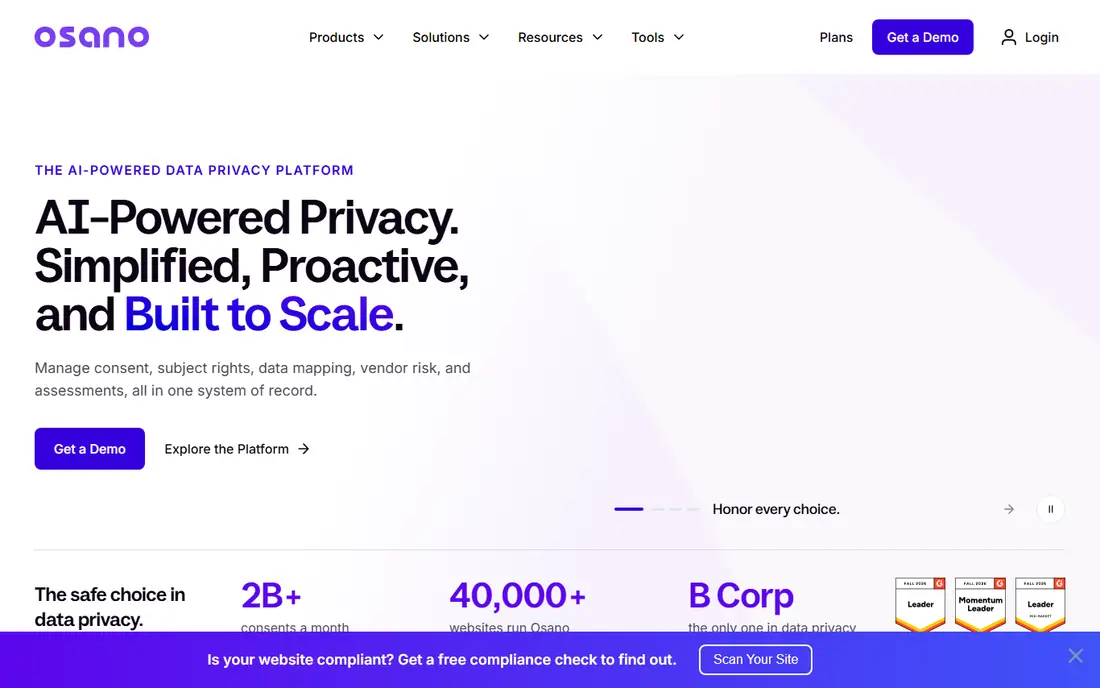
Osano is a friendlier step down from a full enterprise suite. It pairs a cookie banner with consent records, data subject request handling and monitoring of privacy law changes, so a small privacy team can cover the basics without stitching several tools together. The free tier works for a single small site.
The honest catch is the jump to paid plans. Published pricing starts at 199 dollars per month for the Plus tier, which is a real commitment for a one or two person business. If you can start free and grow into paid, Osano is a clear, well documented option.
- Free tier for one site
- Published paid pricing
- Privacy law monitoring included
- Paid step from free is steep for very small sites
- Costs rise with visitors and domains

DataGrail focuses on the work that eats privacy team time: finding personal data across software tools and answering access and deletion requests. Its connector library covers many common SaaS tools, which is why mid-market teams often pick it when their data lives mostly in cloud apps rather than on-premise systems.
It is not a cheap impulse buy, since pricing is set by quote, and the value depends on how many of your systems are already supported. Check your top ten systems against its integration list first. If they are covered, DataGrail can cut request handling from days of manual searching to a managed workflow.
- Large integration library
- Clean request workflows
- Faster setup than many enterprise suites
- Pricing is quote based
- Discovery depends on connected systems
Securiti aims to join two jobs that are often bought separately: finding where personal data lives and then acting on it for consent, requests and governance. That combination appeals to teams with heavy AI use, since the same discovery work feeds AI governance as well as privacy compliance.
The platform is enterprise grade, so expect a sales-led purchase and an implementation effort to match. Smaller teams that only need a banner or a simple request form will find it oversized. For larger teams, the single discovery layer is the main reason to choose it over a consent-only tool.
- Data discovery built in
- Request automation
- AI governance features
- Pricing is quote based
- The platform can be more than a small team needs
Transcend treats privacy as infrastructure. Engineers define how data flows, how consent signals travel, and how deletion requests propagate, using code and APIs rather than ticket queues. That approach suits companies where engineering owns data systems and privacy staff want automation they can verify.
The flip side is that a team without engineering time will struggle to get full value. Transcend is a strong pick when your privacy program is run with developers in the room, and a weaker pick when the buyer is a lone compliance officer with no technical support.
- Code-first approach to requests and consent
- Strong automation
- Built for developers
- Pricing is quote based
- Less friendly for non-technical privacy teams
BigID starts from a different question than most tools here: what data do you actually hold, and where is it? Its discovery and classification engine scans structured databases and unstructured files, which helps teams that cannot answer a request until they know where sensitive data sits. That strength also supports AI governance work.
BigID is not the simplest consent banner tool, and teams that need only consent should look elsewhere. Choose it when discovery is the blocker, then pair it with consent and request workflows, or use its wider platform where those features fit your needs.
- Strong discovery across structured and unstructured data
- Classification
- AI governance use
- Pricing is quote based
- Consent and request features are not its main strength
Ketch builds consent as infrastructure that developers and marketers can both use. Consent and preference signals are captured once and sent to downstream systems, which matters when a recorded choice must reach analytics, advertising and data tools rather than stopping at the banner. Published pricing starts with a free tier and a Starter plan at 150 dollars per month.
The catch is that consent pricing and full program pricing are not the same thing. Data request and mapping features are priced in other tiers, so model the whole program before comparing Ketch with a suite price. For consent-led teams, the transparency is still a welcome change.
- Free tier published
- Programmatic consent controls
- Clear starting prices
- Full privacy program features are priced separately
- Smaller teams may need guidance
CookieYes does one job well: it scans a site, builds a cookie banner, and keeps a record of visitor consent. Setup is quick, the free tier covers a small site, and the banner can be shaped to match the site design. For a blog, a small store, or a brochure site, that is often all that is needed.
Do not expect data request automation or data mapping here. CookieYes is a consent specialist, and a growing company will eventually pair it with request handling or move to a platform. As a first step away from OneTrust for a small site, it is a practical, low cost choice.
- Quick setup
- Free tier
- Consent records and banner customization
- Not a full privacy platform
- Larger programs need a second tool
Termly bundles a consent banner with generators for privacy policies, terms and cookie policies, which suits small site owners who need several legal basics at once. The free tier lets a small site start without a purchase, and the setup steps are plain enough for a non-technical owner.
The limit is depth. Generated policies are templates, so they still need a careful read against what your site actually does with data, and Termly is not a tool for large, multi-system request programs. Within its lane, though, it saves small teams from buying a suite for a banner and a policy page.
- Consent banner plus policy generators
- Free tier
- Simple setup
- Policy templates need review for your business
- Not built for enterprise programs
Usercentrics focuses on consent management for websites and apps, with banner and preference tools that cover major privacy regulations. App publishers like the mobile SDK option, since consent in an app needs different handling than consent on a web page. A free tier covers small use.
Pricing beyond the free tier requires checking the vendor site for your volume and features, so budget with a quote in hand. For teams whose main problem is consent across web and app properties, Usercentrics is a focused alternative to a full OneTrust deployment.
- Consent for web and mobile apps
- Free tier
- Broad regulation coverage
- Paid pricing is not fully transparent
- Full platform needs a quote
How we picked these
We compared official feature pages, pricing pages and public documentation for each vendor, and we checked which products are live and supported in October 2026. We favored tools that cover a clear part of a privacy program, from consent to requests to discovery, and we left out OneTrust itself, since this list is about alternatives. Where pricing is not published, we say so rather than repeating third party estimates as fact.
What to check before you switch
Start with the job you actually need done. If consent is the whole job, a specialist banner tool will be cheaper and faster than a platform. If requests are the pain, list your systems and ask each vendor which ones it automates, since a tool that covers only half your stack leaves manual work in place.
Next, check how consent signals travel downstream. A banner that records a choice but never updates your analytics or marketing tools leaves a gap that auditors and users both notice. Ask for a clear answer on downstream sync before you sign.
Finally, compare total cost, not the headline price. Modules for requests, mapping, assessments and vendor risk are often priced separately, and visitor or domain limits can push a small site into a higher tier. A short trial on your real site, with your real systems, tells you more than a demo on a sample site.
Frequently asked questions
What are the best OneTrust alternatives?
The best choice depends on the job. TrustArc, DataGrail, Securiti and Transcend suit larger programs, while Osano, Ketch, CookieYes, Termly and Usercentrics suit smaller teams or consent-only needs. Start from your main pain, consent, requests or discovery, then shortlist two or three tools in that lane.
Are there free alternatives to OneTrust?
Yes. Osano, Ketch, CookieYes, Termly and Usercentrics all offer a free tier, usually for a single small site or limited volume. Free tiers cover basic consent well, but request automation and data discovery generally need a paid plan.
Which alternative is best for small businesses?
Osano and CookieYes are strong starting points for small businesses, since both have a free tier and a clear product focus. Termly adds policy generators for owners who need those documents too. A very small site can often start free and upgrade only when traffic or domains grow.
Do these tools handle GDPR and other privacy laws?
Most tools in this list are built around major privacy laws, including GDPR and US state laws, with geo-targeted banners and consent records. Coverage varies by vendor and plan, so confirm the specific laws and regions you serve before you buy, and have legal counsel review your setup.
How hard is it to move from OneTrust to an alternative?
The move is easiest when you export your consent records, banner settings and request history first, then rebuild banners and test them on a staging site. Request automation takes longer, since each system connection must be rechecked. Plan a parallel run so the old and new tools overlap until the new setup is proven.
Sources
See where you really rank - block by block
ProMapRanker scans Google Maps across a grid of your service area. Simple monthly plans from $19, white-label on every plan.
Start freeKeep reading
 zscaler alternatives
Best Zscaler Alternatives in 2026
Looking for zscaler alternatives? We compare 9 SASE and zero trust platforms on architecture, data protection, pricing, and fit for your network and team.
Read → zapier alternatives free
Best Zapier Alternatives Free in 2026
Nine automation tools for zapier alternatives free in 2026, all with genuinely free tiers, plus free plan limits, starting prices and upgrade paths explained.
Read → which platform is best for online reputation
Which Platform Is Best for Online Reputation in 2026
Wondering which platform is best for online reputation? We compare 8 review, listing, and response tools for small and multi-location businesses and agencies.
Read →