 ProMapRanker
Best Netcool Alternatives in 2026

Key takeaways
- IBM Netcool is known for network and event management, including event correlation across large, complex infrastructures.
- Splunk, Datadog, and ScienceLogic suit teams that want event correlation plus analytics, while Nagios XI, Zabbix, and OpManager suit teams that want direct network monitoring.
- BigPanda is the closest event-correlation specialist here, while DX Spectrum suits large network estates with topology needs.
- Standalone Netcool licensing changes have pushed many teams to check migration paths early, so confirm support and deployment options before renewing.
Quick comparison
| Pick | Great for | Pricing starts at | Free tier | |
|---|---|---|---|---|
 Splunk | Log and event analytics | See website | Free trial | Visit |
 Datadog | Cloud infrastructure monitoring | See website | Free trial | Visit |
 SolarWinds Network Performance Monitor | Network performance monitoring | See website | Free trial | Visit |
 Nagios XI | Classic network monitoring | See website | Free trial | Visit |
 Zabbix | Open-source network monitoring | Free | Yes | Visit |
 ManageEngine OpManager | Mid-size network monitoring | See website | Free trial | Visit |
 ScienceLogic | Hybrid IT monitoring | See website | No | Visit |
 DX Spectrum | Large network topology | See website | No | Visit |
 BigPanda | Event correlation and AIOps | See website | No | Visit |
The best netcool alternatives
IBM Netcool, including Netcool OMNIbus and Netcool Operations Insight, is known for collecting events from many network and IT sources, correlating them into fewer incidents, and helping operations teams find root causes faster. We compared official feature pages, pricing pages, and public reviews, and we kept only tools that handle network monitoring, event correlation, or incident workflows at a comparable scale.

Splunk is a strong replacement when the main Netcool job is making sense of huge event and log volumes. It collects data from networks, servers, applications, and security tools, then lets teams search, correlate, and alert on patterns across all of it. That breadth helps an operations team move from a flood of alerts to a smaller set of real incidents with context attached.
The catch is cost control. Splunk pricing is tied to data volume in its common models, so ingesting everything without filters can produce a large bill. Teams should plan data onboarding, retention, and alert rules before migration, and compare its event correlation workflow directly with BigPanda for the operations use case.
- Very strong log search and correlation
- Large integration ecosystem
- Good for security and operations analytics together
- Pricing by data volume needs careful control
- Setup and query skills take time to build
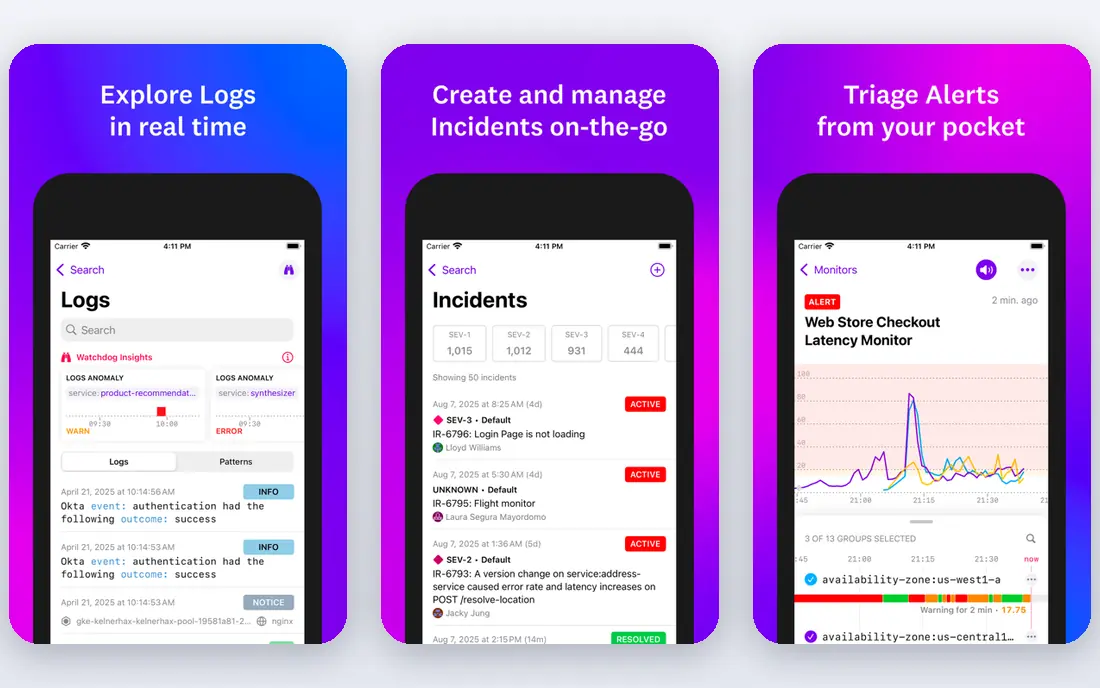
Datadog suits teams whose infrastructure is mainly cloud, containers, and modern applications. It brings infrastructure metrics, logs, traces, network monitoring, and incident workflows into one platform, which helps a team see a problem from several angles without switching tools. Its dashboards and alerting are also easier for a mixed operations and development team to use than a legacy event console.
The limit is legacy network depth. Datadog is excellent for cloud and application estates, but a telecom team with a very large legacy network may still want DX Spectrum or ScienceLogic for topology and device-level detail. For cloud-first teams, though, Datadog is one of the cleanest Netcool replacements.
- Unified infrastructure, application, log, and network monitoring
- Strong cloud and container coverage
- Clear dashboards
- Per-host and per-feature pricing can add up
- Less focused on legacy telecom network estates than DX Spectrum
SolarWinds Network Performance Monitor
Great for: Network performance monitoring
SolarWinds Network Performance Monitor, often called NPM, is a natural pick for network teams that want direct device and performance visibility. It monitors routers, switches, and other network gear, tracks performance and availability, and presents network health in maps and dashboards that network engineers already understand. For a team replacing Netcool network monitoring, that familiarity shortens migration.
The trade-off is event correlation depth. NPM is primarily a network monitoring tool, not a full AIOps correlation platform, so teams that need heavy cross-domain correlation should pair it with BigPanda or choose Splunk or ScienceLogic instead. Module pricing also needs checking, since added features can change the total.
- Strong network device and performance monitoring
- Clear network maps and alerts
- Familiar to many network teams
- Enterprise pricing is quote-based
- Module-based pricing can grow with added features
Nagios XI is the classic choice for teams that want proven, on-premises network and server monitoring without a cloud-first platform. Its host and service checks, plugin ecosystem, and alerting cover the core monitoring job well, and many operations teams already know how to run it. For a smaller or mid-size estate, that maturity is reassuring.
The honest limit is modernisation. Nagios XI interface and workflow feel older than Datadog or ScienceLogic, and large, dynamic cloud estates need more tuning. It suits teams that value control, on-premises deployment, and a known tool over a polished cloud console.
- Long-established monitoring with many plugins
- Clear host and service checks
- On-premises deployment option
- Interface feels older than cloud platforms
- Large estates need tuning and plugin management
Zabbix is the open-source pick for teams that want full network monitoring without a licence fee. It monitors networks, servers, virtual machines, and cloud resources, supports templates for common devices, and offers alerting, visualisation, and escalation workflows. For a technical team with admin capacity, it can cover a large estate at low software cost.
Self-hosting is the real cost. A team must run, upgrade, back up, and secure the Zabbix server, and its interface takes longer to learn than a hosted platform. Zabbix suits teams that already run open-source infrastructure and want control, rather than teams that want a managed service with phone support.
- Free open-source monitoring for networks, servers, and cloud
- Strong templating and alerting
- No licence fee for core use
- Self-hosting and setup need admin time
- Interface and learning curve are steeper than hosted tools
ManageEngine OpManager suits mid-size network teams that want solid device monitoring, bandwidth views, and alerting without enterprise complexity. Its dashboards give a clear picture of network health, and its pricing is often easier for a mid-size budget than a hyperscale monitoring platform. For a team moving from Netcool for network visibility alone, OpManager is a practical step.
The limit is scale and correlation depth. Very large estates or teams that need advanced cross-domain event correlation may outgrow it, or need to pair it with a correlation tool. For a mid-size estate with a clear network focus, though, it offers a good balance of features and cost.
- Good mid-size network monitoring with device and bandwidth views
- Clear dashboards
- Competitive pricing for its range
- Very large or telecom-scale estates may need a heavier platform
- Advanced correlation is thinner than BigPanda
ScienceLogic is built for hybrid IT estates that span on-premises systems, cloud, and networks. It discovers and monitors infrastructure across those environments, handles events with automation, and supports managed service providers that run monitoring for many clients. That hybrid strength makes it a credible Netcool replacement for complex estates.
The trade-off is enterprise weight. ScienceLogic is sold and set up as an enterprise platform, so pricing is quote-based and full use takes training. Teams with a single-cloud estate may find Datadog simpler, while hybrid and provider teams will get more from ScienceLogic depth.
- Strong hybrid and multi-cloud monitoring
- Good automation and event handling
- Suited to managed service providers
- Enterprise pricing and setup
- Learning curve for full platform use
DX Spectrum, now part of Broadcom, is the pick for very large network estates where topology matters. It models network devices and their relationships, which helps operations teams trace an outage to its root cause rather than chasing a long list of related alarms. Telecom and large enterprise teams have used it for that reason for many years.
The catch is specialisation. DX Spectrum is a network-focused platform, not a general cloud observability tool, and its deployment and pricing reflect enterprise scale. Teams with a mainly cloud estate should look at Datadog or Splunk first, while large network operators will value DX Spectrum topology depth.
- Strong network topology and root-cause analysis for large estates
- Long telecom and enterprise history
- Scalable device monitoring
- Enterprise pricing and deployment complexity
- Interface feels specialised rather than general-purpose
BigPanda is the closest specialist match to the Netcool correlation job itself. It sits above existing monitoring tools, collects their alerts, correlates related events into incidents, and helps operations teams see root cause faster. For a team drowning in alerts from many tools, that layer can cut noise more directly than adding another monitoring product.
The limit is that BigPanda is not a monitoring tool on its own. It needs alerts from tools such as Datadog, SolarWinds, or Zabbix to correlate, so a team without solid monitoring underneath will not get full value. Use it as the correlation layer in a wider monitoring stack, not as a standalone replacement for device monitoring.
- Focused event correlation across monitoring tools
- Reduces alert noise into incidents
- Good for operations teams with many tools
- Needs existing monitoring tools to feed it
- Pricing is enterprise and quote-based
How we picked these
We compared official feature pages, pricing pages, and public reviews for network monitoring, event management, and AIOps tools, and we kept only tools that handle network events, correlation, or incident workflows at enterprise or mid-size scale. We did not include Netcool itself, and we favoured a mix of monitoring platforms and correlation specialists so readers can choose between replacing the whole stack or adding a correlation layer. Prices are shown as See website where the vendor does not publish a standard price, since enterprise monitoring pricing varies by device count, data volume, and deployment.
What to check before you migrate
Inventory every event source feeding Netcool today, including network devices, servers, applications, and cloud services, and check that each source has a supported integration on the new platform. Then test correlation rules on real historical alerts, since a tool that looks good on a demo may group or miss events differently on your data. Run the new platform in parallel with Netcool during a trial period before cutting over.
Plan for probes and rules
Netcool deployments often rely on custom probes and rules built over years, and those do not migrate automatically. Budget time to rebuild rules, test alert thresholds, and retrain operators on the new console. A migration that only copies dashboards, without rebuilding correlation logic, will feel like a step back even on a better platform.
Frequently asked questions
What is the best Netcool alternative for event correlation?
BigPanda is the closest correlation specialist, since it groups alerts from many tools into incidents. Splunk and ScienceLogic also offer strong correlation, with wider analytics and monitoring built in.
Which Netcool alternative is best for network monitoring alone?
SolarWinds Network Performance Monitor, DX Spectrum, and ManageEngine OpManager are strong network-first picks. DX Spectrum suits very large estates, SolarWinds suits familiar network workflows, and OpManager suits mid-size teams.
Is there a free Netcool alternative?
Zabbix is a free open-source monitoring platform that covers networks, servers, and cloud resources. It needs self-hosting and admin time, but it has no licence fee for core use.
Can I replace Netcool without replacing all my monitoring tools?
Yes, in many cases. BigPanda is designed to sit above existing monitoring tools and correlate their alerts, so a team can keep current monitoring and replace only the correlation layer. That approach suits teams with a large, working monitoring estate.
Why are Netcool customers looking for alternatives?
IBM ended standalone Netcool OMNIbus and Impact licensing, pushing customers toward a wider platform migration, and many teams also want simpler deployment and modern interfaces. Those two pressures make it sensible to review alternatives before the next renewal.
Sources
- https://www.rightitnow.com/ibm-netcool-replacement.html
- https://www.peerspot.com/products/ibm-tivoli-netcool-alternatives-and-competitors
- https://www.splunk.com
- https://www.datadoghq.com
- https://www.solarwinds.com/network-performance-monitor
- https://www.nagios.com/products/nagios-xi/
- https://www.zabbix.com
- https://www.manageengine.com/network-monitoring/
- https://sciencelogic.com
- https://www.broadcom.com/products/software/automation/dx-spectrum
- https://www.bigpanda.io
See where you really rank - block by block
ProMapRanker scans Google Maps across a grid of your service area. Simple monthly plans from $19, white-label on every plan.
Start freeKeep reading
 zyte alternatives
Best Zyte Alternatives in 2026
These zyte alternatives cover managed scraping APIs, proxy networks and no code tools for lawful collection from your own or consented sources only in 2026.
Read → zerto alternatives
Best Zerto Alternatives in 2026
Compare the best zerto alternatives for disaster recovery and replication, with recovery targets, cloud options and honest trade-offs for teams in 2026.
Read → zerofox alternatives
Best ZeroFox Alternatives in 2026
We compared 9 zerofox alternatives for brand protection, phishing takedowns, dark web monitoring, and social impersonation, with clear coverage notes.
Read →