 ProMapRanker
Best MongoDB Alternatives in 2026

Key takeaways
- PostgreSQL with JSONB is the safest general replacement for teams that want documents plus strong transactions and complex queries.
- Couchbase is the closest document-database replacement, with JSON documents, SQL-style queries, and mobile sync.
- Cassandra and DynamoDB suit very high write volumes and global scale, but their query models are narrower than a document database.
- Firestore suits mobile and web apps that need real-time sync, while CouchDB suits offline-first apps with multi-master replication.
- FerretDB-style compatibility was not needed here, since the tools below stand on their own, but teams that need MongoDB API compatibility should check that path separately.
Quick comparison
| Pick | Great for | Pricing starts at | Free tier | |
|---|---|---|---|---|
 Couchbase | JSON documents with SQL queries | See website | Yes | Visit |
 Apache Cassandra | Massive write scale | Free | Yes | Visit |
 Amazon DynamoDB | Serverless AWS workloads | See website | Yes | Visit |
 PostgreSQL | Documents plus strong transactions | Free | Yes | Visit |
 Apache CouchDB | Offline-first sync | Free | Yes | Visit |
 Firebase Firestore | Mobile and web real-time apps | Free | Yes | Visit |
 ArangoDB | Multi-model data | Free | Yes | Visit |
 RavenDB | Document database for .NET teams | See website | Yes | Visit |
 Azure Cosmos DB | Globally distributed apps | See website | Yes | Visit |
 SurrealDB | Modern multi-model apps | Free | Yes | Visit |
The best MongoDB alternatives
MongoDB is a document database, so its alternatives range from other document stores to relational, wide-column, and multi-model systems. We note the query trade-off for each, since that trade-off decides more than raw speed does.
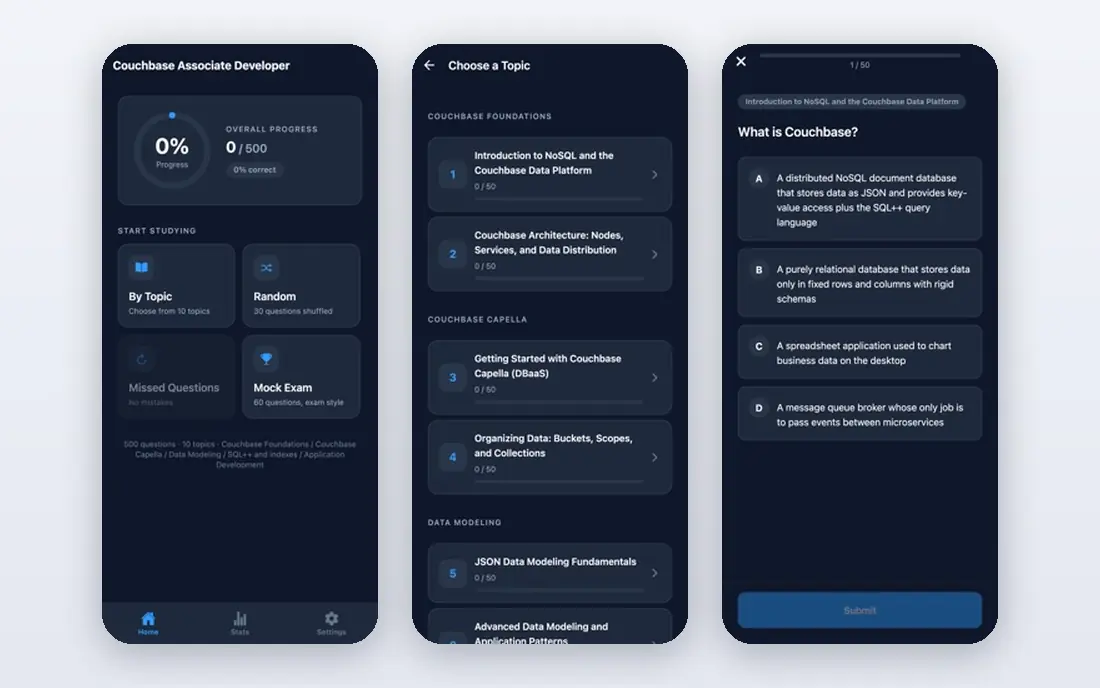
Couchbase is the closest like-for-like document replacement for many MongoDB teams. It stores JSON documents, supports key-value access, and offers a SQL-style query language with joins, which can simplify queries that need aggregation across documents. Built-in full-text search removes the need for a separate search tool in many setups, and mobile sync supports offline-first apps.
Operational complexity is the honest cost. Running Couchbase well takes more planning than a small hosted document store, and production features sit in paid editions. Teams that want a managed option can use Couchbase Capella, while teams that self-host should budget for operations time. For document workloads that also need SQL-style queries, Couchbase is a strong first look.
- JSON document and key-value models
- SQL-style query language
- Mobile sync with Couchbase Lite
- Enterprise features add cost
- More complex to operate than a simple hosted document store
Cassandra is built for very large, write-heavy workloads that must stay available across regions. Its distributed design handles massive throughput and node failures well, which is why it suits time-series data, event stores, and global write workloads. The software itself is free and open source, though managed services charge for hosting.
The query model is the main adjustment for MongoDB users. Cassandra expects data modeled around known queries, with no joins and limited ad hoc querying, so a team that queries flexibly will need to rethink its schema. That is a real migration cost, not a minor detail. Choose Cassandra when scale and availability outrank flexible querying.
- Highly scalable distributed design
- High availability
- Open source
- Query model is narrow and needs careful data modeling
- No joins like a relational database
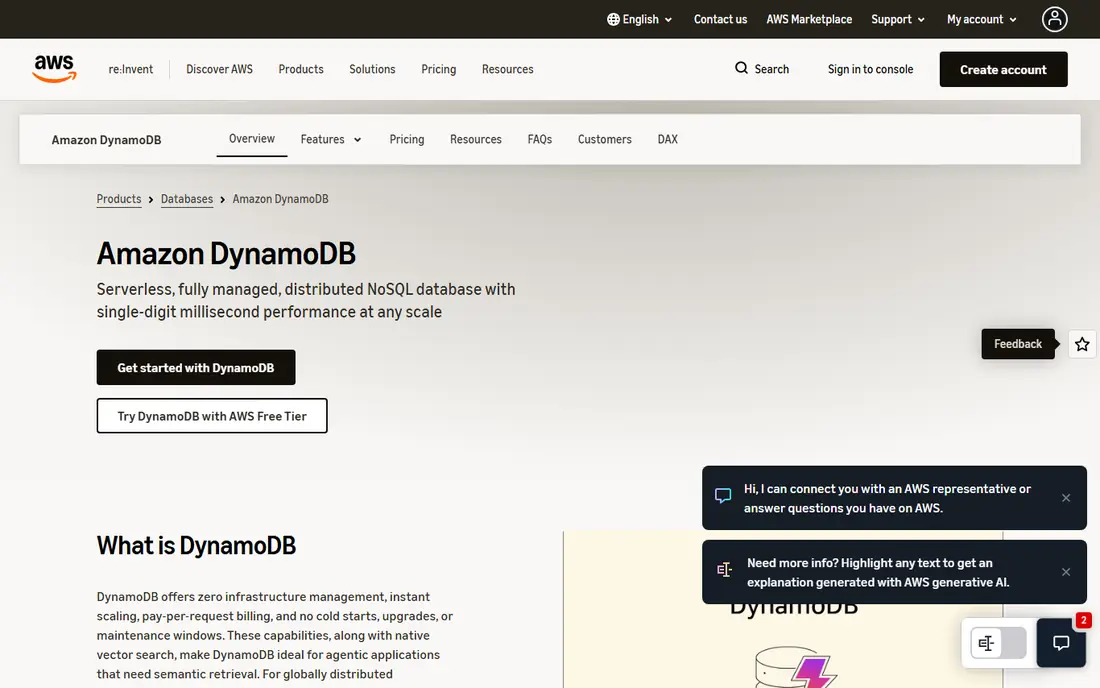
DynamoDB suits AWS-native teams that want a fully managed NoSQL store without running servers. It scales with traffic, offers fast key-based access, and integrates with the wider AWS stack, from Lambda to analytics tools. A free tier covers small workloads, and on-demand pricing suits spiky traffic.
Query flexibility is narrower than MongoDB. Access patterns need planning up front, and secondary indexes add write cost, so a schema designed for flexible ad hoc queries can become expensive. Teams that already live in AWS, and whose access patterns are well understood, will find DynamoDB smooth. Teams that query unpredictably should test costs with real traffic first.
- Fully managed and serverless
- Single-digit millisecond latency at scale
- AWS integration
- Query patterns are narrow
- Costs can grow with secondary indexes and traffic
PostgreSQL is the safest general replacement for teams that want documents without giving up relational strengths. JSONB columns store flexible documents, while SQL, joins, and transactions handle the complex queries that pure document stores handle less well. The ecosystem is enormous, with extensions for search, geospatial data, and analytics, and managed options exist on every major cloud.
Horizontal write scaling is where PostgreSQL gives ground to Cassandra and DynamoDB. A single primary handles writes, so very high write volumes need sharding or a distributed variant. For most app workloads, that limit never appears, and the combination of documents plus transactions wins. Teams that already run PostgreSQL can often consolidate onto it instead of running two databases.
- JSONB document support
- Strong transactions and joins
- Huge ecosystem and extensions
- Scaling writes across many nodes is harder than with Cassandra
- Document queries need JSONB knowledge
CouchDB is a document database with a clear specialty: replication and offline-first sync. Multi-master replication lets devices and servers sync documents even when connections drop, which suits mobile and field apps that must work offline. Its HTTP API is simple to use, and the software is free and open source.
Querying is less flexible than MongoDB aggregation pipelines, so teams that rely on complex analytics inside the database may need another tool for that job. The ecosystem is also smaller than PostgreSQL or DynamoDB. Choose CouchDB when sync and offline access are the core need, not when complex querying is.
- Multi-master replication
- Offline-first sync
- Simple HTTP API
- Querying is less flexible than MongoDB aggregation
- Smaller ecosystem
Firestore, part of Google Firebase, suits mobile and web apps that need real-time updates without managing servers. Clients can listen to document changes live, which fits chat, collaborative tools, and dashboards. A free tier covers small apps, and the managed service scales without operations work.
Query limits matter for MongoDB migrants. Firestore has no full joins, and queries need indexes planned in advance, so complex relational-style queries become harder. Read and write costs also grow with traffic, so a chatty app needs cost modeling. For mobile-first apps with real-time needs, Firestore is a natural fit; for complex server-side analytics, it is not.
- Real-time sync for mobile and web
- Serverless scaling
- Generous free tier for small apps
- Query limits, including no full joins
- Costs grow with reads and writes at scale
ArangoDB combines document, graph, and key-value models in one engine, which helps teams whose data does not fit a single model. A product catalog with relationships, recommendations, and document details can live in one database instead of three. Its query language covers all three models, and the core is open source.
The community is smaller than PostgreSQL or MongoDB, so hiring and troubleshooting help are thinner. Multi-model flexibility also needs learning, since graph and document patterns differ. Teams that genuinely need graph plus documents will value the combination. Teams that only need documents should prefer Couchbase or PostgreSQL for ecosystem depth.
- Document, graph, and key-value models in one engine
- Flexible query language
- Open source core
- Smaller community than PostgreSQL
- Multi-model depth needs learning
RavenDB is a document database with strong support for .NET teams, though it also serves other stacks. Indexing, querying, and replication are built in, and it can run self-hosted or as a managed cloud service. Teams in the Microsoft ecosystem often find its tooling and documentation a comfortable fit.
Ecosystem size is the limit. Fewer third-party integrations and community resources exist than for PostgreSQL, DynamoDB, or Couchbase, and larger production use needs a paid tier. For .NET teams that want a document database without leaving their stack, RavenDB is worth a trial. For polyglot teams, a larger ecosystem may matter more.
- Document database with strong .NET support
- Indexing and querying built in
- Self-host or cloud
- Smaller ecosystem than larger rivals
- Paid tiers needed for larger production use
Cosmos DB suits teams that need a globally distributed database on Azure, with replication across regions and managed scaling. It offers several APIs, including a MongoDB-compatible API, which can ease migration for some workloads, though compatibility is not complete for every feature. That global story is its main strength.
Pricing complexity is the caution. Request units, storage, and multi-region writes all affect the bill, so a team should model costs with real traffic before committing. Azure-native teams that need global distribution will find Cosmos DB compelling. Teams outside Azure, or with simple regional needs, may prefer a simpler option.
- Global distribution and replication
- Multiple APIs including MongoDB API
- Managed scaling
- Costs need careful modeling
- Pricing model is complex for new users
SurrealDB is a newer multi-model database that combines document, graph, and relational features in one system. Its modern query language and flexible schema appeal to teams building new apps that mix data shapes. The project is open source, with a cloud option for teams that do not want to self-host.
Youth is the honest limit. The ecosystem, hiring pool, and long production track record are thinner than for PostgreSQL, Cassandra, or DynamoDB, so a team adopting SurrealDB accepts more risk. For a new project where flexibility matters and the team can tolerate a younger tool, it is an interesting pick. For a critical migration, a more established database is safer.
- Document, graph, and relational features in one system
- Modern query language
- Open source
- Younger project with a smaller ecosystem
- Production track record is shorter than rivals
How we picked these
We compared official documentation, pricing pages, and public migration guides for databases that work in October 2026. We kept a mix of document, relational, wide-column, key-value, and multi-model systems, since MongoDB users leave for different reasons: cost, transactions, scale, or sync. Where a vendor used usage-based pricing without a simple starting figure, we wrote See website instead of inventing a monthly total.
What to check before you switch
Start with your query patterns, not with a feature list. List your ten most common queries, including joins, aggregations, and text search, and test each one on the shortlisted database before migrating data. Next, model costs at real traffic, including indexes, replication, and data transfer, since the cheapest license rarely produces the cheapest bill. Finally, migrate one service first, run it in parallel, and compare results before moving the rest.
A note on MongoDB API compatibility
Some tools offer a MongoDB-compatible API, which can reduce code changes, but compatibility is rarely complete. Aggregation pipelines, indexes, and transactions may differ in edge cases, so test your real queries against the compatibility layer. A tool that passes a demo query may still fail on a complex production pipeline, and that gap is cheaper to find in a trial than after a full migration.
Frequently asked questions
What are the best MongoDB alternatives?
PostgreSQL with JSONB is the best general MongoDB alternative, Couchbase is the best document-database alternative, and Cassandra and DynamoDB are the best scale alternatives. Firestore suits mobile real-time apps, while CouchDB suits offline-first sync. The best pick depends on whether transactions, scale, or sync matters most.
What are alternatives to MongoDB for document storage?
Couchbase, CouchDB, RavenDB, and SurrealDB are document-focused alternatives, while PostgreSQL stores documents in JSONB columns beside relational tables. Couchbase offers SQL-style queries, CouchDB offers replication, and RavenDB offers strong .NET support. Choose by query style and ecosystem, not by document storage alone.
Is PostgreSQL a good MongoDB alternative?
Yes, PostgreSQL is a good MongoDB alternative for most app workloads, thanks to JSONB documents, strong transactions, joins, and a huge ecosystem. It gives ground on horizontal write scaling to Cassandra and DynamoDB, but for typical app traffic that limit rarely matters. Teams that already use PostgreSQL can often consolidate onto it.
Which MongoDB alternative is best for mobile apps?
Firestore suits mobile apps that need real-time sync and serverless scaling, while Couchbase Lite and CouchDB suit offline-first apps that must work without a connection. Firestore is easier to start on Google Cloud, while CouchDB gives more control over replication. Pick by whether real-time or offline access matters more.
Can I migrate from MongoDB to DynamoDB easily?
Migration to DynamoDB is possible, but it is not a simple lift, since DynamoDB access patterns need planning and its query model is narrower than MongoDB. Teams should redesign their schema around known access patterns and test costs with real traffic. Tools and guides can move data, but query redesign is the real work.
Is Cassandra better than MongoDB for large scale?
Cassandra is better than MongoDB for very large, write-heavy workloads that need high availability across regions, thanks to its distributed design. It is worse for flexible, ad hoc querying, since its query model needs careful data modeling. Choose Cassandra when write scale and availability outrank query flexibility.
Sources
See where you really rank - block by block
ProMapRanker scans Google Maps across a grid of your service area. Simple monthly plans from $19, white-label on every plan.
Start freeKeep reading
 zscaler alternatives
Best Zscaler Alternatives in 2026
Looking for zscaler alternatives? We compare 9 SASE and zero trust platforms on architecture, data protection, pricing, and fit for your network and team.
Read → zapier alternatives free
Best Zapier Alternatives Free in 2026
Nine automation tools for zapier alternatives free in 2026, all with genuinely free tiers, plus free plan limits, starting prices and upgrade paths explained.
Read → which platform is best for online reputation
Which Platform Is Best for Online Reputation in 2026
Wondering which platform is best for online reputation? We compare 8 review, listing, and response tools for small and multi-location businesses and agencies.
Read →