 ProMapRanker
Best Modal Alternatives in 2026

Key takeaways
- In this article, Modal means Modal Labs, the Python serverless GPU compute platform, not any other product called Modal.
- The closest replacements are serverless GPU platforms such as RunPod Serverless, Replicate, Baseten, Beam, and fal.ai, plus GPU clouds for training.
- Billing differs by second, minute, hour, or token, so compare total cost on your real workload, not just the headline GPU rate.
- Cold starts, GPU availability, and packaging format matter more than a small hourly difference for production inference.
Quick comparison
| Pick | Great for | Pricing starts at | Free tier | |
|---|---|---|---|---|
 RunPod | GPU variety with serverless and pods | See website | No | Visit |
 Replicate | Running public models by API | See website | No | Visit |
 Baseten | Production model serving | See website | No | Visit |
 Together AI | Open model inference and tuning | See website | No | Visit |
 Fireworks AI | Fast open model serving | See website | No | Visit |
 Lambda | Dedicated GPU instances and clusters | See website | No | Visit |
 Vast.ai | Lowest-cost marketplace GPU rental | See website | No | Visit |
 Beam | Python serverless with low cold starts | See website | No | Visit |
 fal.ai | Generative media model serving | See website | No | Visit |
The best Modal alternatives
We use Modal in this article to mean Modal Labs, the serverless GPU compute service for Python workloads. We compared these tools on serverless behavior, GPU choice, billing, and developer workflow, and we did not list Modal itself, since this article covers replacements for it.

RunPod suits teams that want both serverless endpoints and always-on pods from one provider. Serverless endpoints scale to zero for bursty inference, while pods suit training, notebooks, and long-running jobs. Its GPU catalog covers many NVIDIA cards, which helps teams match a model to the cheapest card that fits it.
The trade-off is operational load. RunPod gives more control through Docker and pod settings, but that control means teams handle more setup than with a Python-decorator workflow. Cold starts also depend on image and endpoint settings, so production teams should test warm pools and caching early.
- Wide GPU catalog
- Serverless and pod options
- Per-second billing on serverless
- Raw Docker workflow needs more ops skill
- Cold starts vary by setup
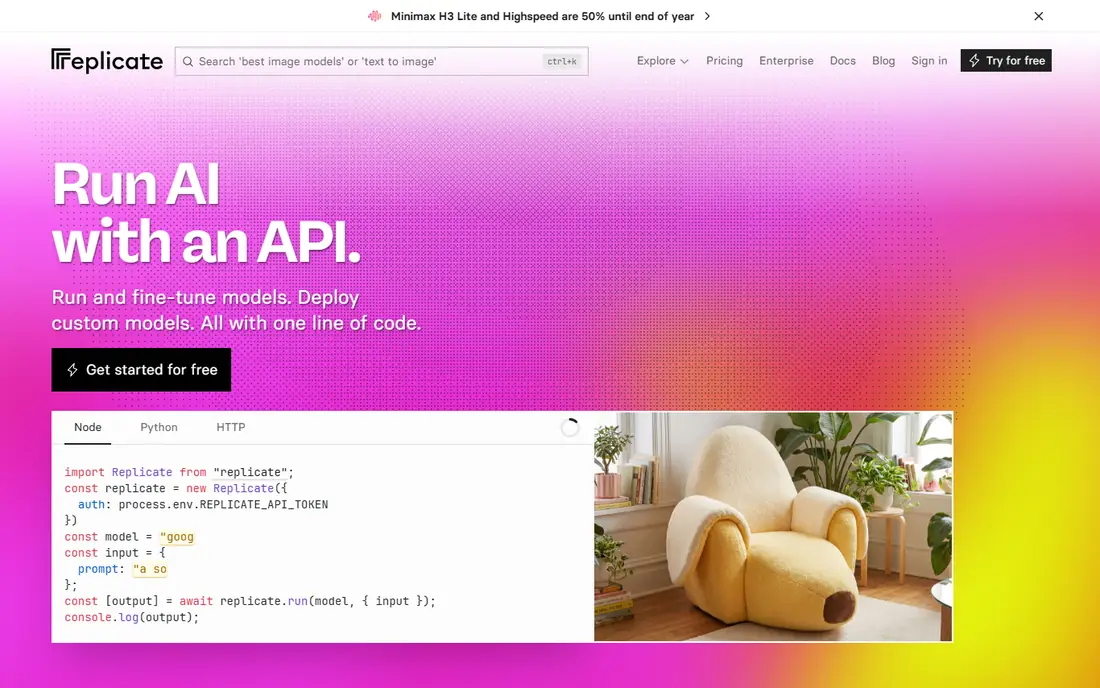
Replicate is the fastest path to serving a public model behind an API, without managing GPU servers. Teams can call thousands of community models, or package a custom model with Cog and serve it the same way. Per-second billing and per-output pricing on popular models help low-volume teams avoid paying for idle GPUs.
Cost and control are the limits. Per-hour equivalents can run higher than RunPod or Lambda for steady workloads, and teams have less control over the underlying GPU setup. For production at scale, compare Replicate totals with Baseten or RunPod Serverless on real traffic.
- Large public model catalog
- Simple API
- Cog packaging for custom models
- Higher per-hour rates on some models
- Less control than raw GPU rentals

Baseten suits teams that need production-grade model serving with autoscaling, monitoring, and a managed inference runtime. Its Truss packaging standardizes model deployment, and its model library helps teams start from open models quickly. Autoscaling handles traffic spikes without manual capacity planning.
Billing needs care. Baseten charges per minute per replica, and production guidance often favors keeping replicas warm for reliability, which can turn a scale-to-zero plan into a steadier bill. Teams should model costs with their expected minimum replica count, not just with zero idle time.
- Polished production serving
- Autoscaling
- Truss packaging and model library
- Per-minute billing
- Keeping replicas warm can raise costs
Together AI suits teams building on open-weight models, with serverless inference, fine-tuning, and GPU clusters in one platform. Its hosted models cover many popular open models, and LoRA and full-parameter tuning help teams adapt models to their data. GPU clusters also support larger training runs beyond simple inference.
It is less of a general compute platform than RunPod or Lambda, since its focus is model serving and tuning. Pricing also spans per-token inference and hourly clusters, so teams should separate inference costs from training costs when budgeting.
- Open model library
- Fine-tuning
- GPU clusters for training
- Less general-purpose compute than RunPod
- Pricing spans tokens and hours
Fireworks AI targets teams that need low-latency serving of open models, with tiered serving options and optimizations such as speculative decoding. Serverless LoRA training lets teams adapt models without managing training clusters, and per-token pricing suits variable inference traffic. Its hosted model library covers many common open models.
The scope is narrower than a general GPU cloud. Teams that need custom Python jobs, batch processing, or non-model compute may still need RunPod or Lambda alongside Fireworks. Check serving tier pricing for your model size, since tiers affect both speed and cost.
- Fast serving tiers
- Speculative decoding
- Serverless LoRA training
- Open-model focus
- Hourly GPU pricing varies by tier
Lambda, formerly Lambda Labs, suits training and steady inference on dedicated GPU instances. Its 1-Click Clusters and on-demand instances give predictable capacity for multi-GPU training, with fast interconnects for large models. Teams that train regularly often value that stability over pure serverless flexibility.
Serverless scale-to-zero is not its core strength. Lambda is closer to a dedicated GPU cloud than to a Modal-style function platform, so bursty, low-volume inference may cost more than on RunPod Serverless or Replicate. Longer reservations also suit teams with steady demand rather than sporadic jobs.
- Dedicated instances
- Strong training clusters
- No egress fees on many plans
- Less serverless than Modal
- Reservations suit longer commitments
Vast.ai is a marketplace where hosts set GPU prices, which often makes it the cheapest option for experiments, training, and batch jobs. Its range covers consumer cards through data-center GPUs, and spot pricing can cut costs further for jobs that tolerate interruption. Teams with checkpointing and automation can save a great deal here.
Reliability is the trade-off. Host quality, uptime, and support vary, since Vast.ai does not own all the hardware it lists. Production inference teams should test hosts carefully and keep a fallback provider, rather than relying on the cheapest listing alone.
- Very low marketplace prices
- Wide GPU range
- Spot and on-demand options
- Host quality varies
- Less managed support than dedicated clouds
Beam is one of the closest workflow matches to Modal Labs, with a Python-first serverless model and warm pools that keep cold starts low. Teams can define functions, schedules, and GPU jobs in Python, and pay per second for active compute. That makes it appealing for teams that liked Modal developer experience but want another provider.
Its ecosystem is smaller than RunPod or Replicate, so connector, template, and community support may be thinner. Teams should test Beam at production traffic, including cold starts, scaling, and GPU availability for their chosen card, before migrating a critical service.
- Python-first workflow
- Warm pools for low latency
- Per-second billing
- Smaller ecosystem than RunPod
- Production features need testing at scale
fal.ai suits teams serving image, video, and audio generation models, where fast startup and per-output pricing matter. Its catalog covers many generative media models, and its runner model can deliver very low latency for popular models. That makes it a strong pick for creative tools, media apps, and content pipelines.
General Python compute is not its focus. Teams that need batch jobs, training, or non-media inference will need another platform alongside fal.ai. Pricing also varies by model and runner state, so check the billing page for your exact models before estimating costs.
- Strong generative media catalog
- Fast cold starts
- Per-output options
- Media focus limits general compute
- Pricing varies by model and state
How we picked these
We compared official pricing and documentation pages, plus current serverless GPU guides, for platforms that are actively sold in October 2026 and that cover Modal Labs ground: serverless GPU compute, model serving, and GPU rental for AI workloads. We wrote See website for prices where billing varies by GPU, tier, or usage, rather than repeating a single rate that may not match your workload.
How to choose a serverless GPU replacement
Start with the workload shape. Bursty inference favors scale-to-zero serverless, steady inference favors dedicated or warm replicas, and training favors clusters with fast interconnects. Match the platform to that shape first, then compare GPU availability for your model size.
Packaging, cold starts, and total cost
Check how each platform packages models, since Python decorators, Docker, Cog, and Truss all create different migration work. Test cold starts with your real model and image, and model total cost including CPU, memory, storage, and egress, not just GPU hours. A cheap GPU rate can still lose if cold starts hurt user experience or if warm replicas are required.
Frequently asked questions
Is Modal Labs the same as other products called Modal?
No. In this article, Modal means Modal Labs, the Python serverless GPU compute platform. Other products with similar names cover different jobs, such as UI components or payment tools, and are not listed here.
Which Modal alternative is closest in developer experience?
Beam is the closest workflow match, with a Python-first serverless model and warm pools. RunPod Serverless is close on GPU flexibility, while Replicate is simpler if you mainly serve public models by API.
What is the cheapest Modal alternative?
Vast.ai often has the lowest marketplace GPU prices, especially for experiments and batch jobs. For production inference, RunPod Serverless and Replicate may be cheaper once reliability, cold starts, and support are counted.
Do these tools scale to zero?
RunPod Serverless, Replicate, Baseten, Beam, and fal.ai all support scaling down when idle, though details differ. Baseten production setups often keep replicas warm, so check minimum replica settings before assuming zero idle cost.
Should I use serverless GPUs or dedicated instances for training?
Training usually suits dedicated instances or clusters, such as Lambda or RunPod pods, thanks to predictable capacity and fast interconnects. Serverless suits inference and short jobs that scale with traffic.
How do I avoid surprise GPU bills?
Set usage caps and alerts, test with a small traffic slice, and model costs on real GPU hours, tokens, or credits. Check whether CPU, memory, storage, and egress are billed separately, since those charges can add up.
Sources
- https://www.runpod.io
- https://replicate.com
- https://www.baseten.co
- https://www.together.ai
- https://fireworks.ai
- https://lambdalabs.com
- https://www.vast.ai
- https://www.beam.cloud
- https://fal.ai
- https://dreaming.press/posts/serverless-gpu-compute-scale-to-zero-vs-dedicated-september-2026.html
- https://www.runpod.io/articles/alternatives/modal
See where you really rank - block by block
ProMapRanker scans Google Maps across a grid of your service area. Simple monthly plans from $19, white-label on every plan.
Start freeKeep reading
 zyte alternatives
Best Zyte Alternatives in 2026
These zyte alternatives cover managed scraping APIs, proxy networks and no code tools for lawful collection from your own or consented sources only in 2026.
Read → zerto alternatives
Best Zerto Alternatives in 2026
Compare the best zerto alternatives for disaster recovery and replication, with recovery targets, cloud options and honest trade-offs for teams in 2026.
Read → zerofox alternatives
Best ZeroFox Alternatives in 2026
We compared 9 zerofox alternatives for brand protection, phishing takedowns, dark web monitoring, and social impersonation, with clear coverage notes.
Read →