 ProMapRanker
Best Meta Workplace Alternatives in 2026

Key takeaways
- Workplace from Meta was discontinued on 1 June 2026, after a read-only period from 1 September 2025 to 31 May 2026, so it is not a live option.
- Workvivo was Meta's preferred migration path, while Staffbase, Blink, and Simpplr suit different mixes of desk and frontline staff.
- Blink is the only platform in this list with a clearly published entry price, at $3.75 per user per month billed annually.
- Most enterprise internal communication tools are quote-based, so compare quotes by licensed headcount, not by headline claims.
- Teams that already use Microsoft 365 or Google Workspace should check Teams or Slack first, before buying a separate intranet.
Quick comparison
| Pick | Great for | Pricing starts at | Free tier | |
|---|---|---|---|---|
 Workvivo | Workplace-style community | See website | No | Visit |
 Staffbase | Enterprise desk plus frontline | See website | No | Visit |
 Blink | Mobile-first frontline app | $3.75 per user per month | Free trial | Visit |
 Microsoft Teams | Microsoft 365 teams | See website | Yes | Visit |
 Slack | Team chat and channels | See website | Yes | Visit |
 Simpplr | Intranet-led communication | See website | Free trial | Visit |
 Haiilo | Employee advocacy and intranet | See website | No | Visit |
 LumApps | Google Workspace intranet | See website | No | Visit |
 Connecteam | Frontline ops plus chat | $29 per month | Free trial | Visit |
 Firstup | Campaign-style internal comms | See website | No | Visit |
The best Meta Workplace alternatives
Workplace from Meta is gone, and this needs stating plainly. Meta announced the shutdown in May 2024. The platform ran normally until 31 August 2025, became read-only from 1 September 2025 to 31 May 2026, and was fully deactivated on 1 June 2026, with Workplaces deleted. If your team still has data or workflows tied to Workplace, that data is no longer recoverable through the platform, and the priority is choosing a live replacement. Workplace itself is not listed below. The ten platforms here are independent employee communication tools that are live in October 2026.
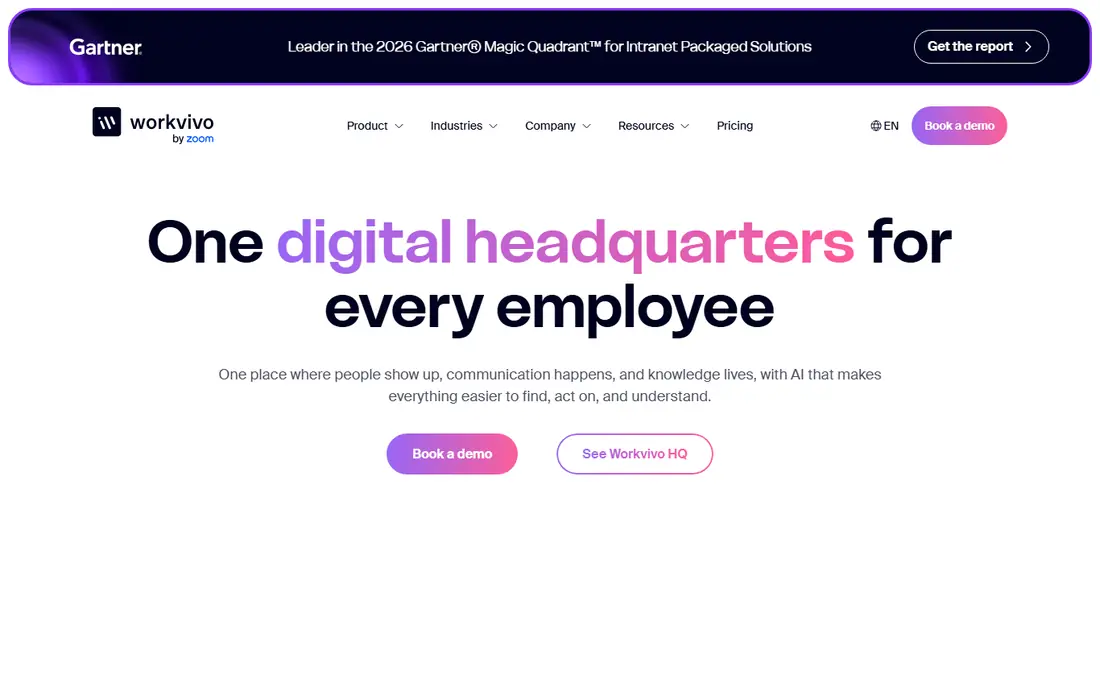
Workvivo is the closest replacement for teams that liked Workplace's social style. It offers a company feed, groups, recognition, knowledge pages, and targeted communications, with mobile apps for desk and frontline staff. Meta named Workvivo as its preferred migration partner, and many Workplace customers moved their communities across with structured migration help.
The cost model needs care. Pricing is quote-based by licence count and add-ons, and chat sits as a paid add-on rather than a core inclusion. Teams that need chat as a core tool should price that add-on from the start. For culture, recognition, and company-wide communication, Workvivo is the most natural next step.
- Closest social feel to Workplace
- Recognition, knowledge, and targeted comms
- Official migration path from Workplace
- Quote-based pricing
- Chat is a paid add-on
- No free trial on standard terms
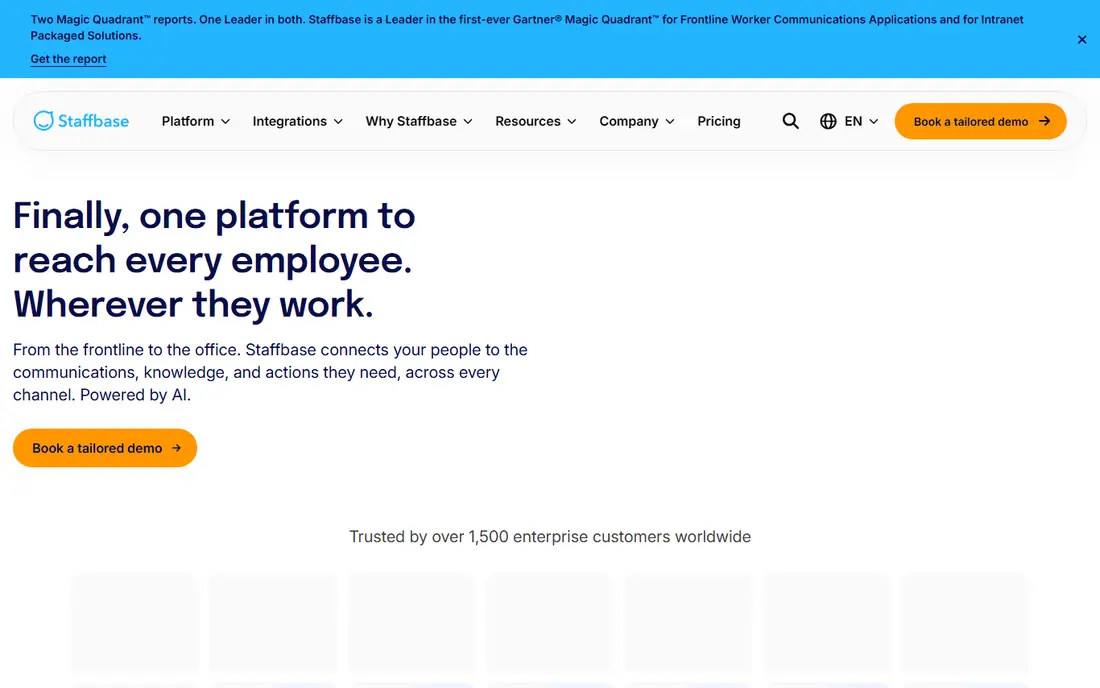
Staffbase suits large employers with a mix of desk workers and frontline staff who do not have corporate email. Communications teams can target messages by location, role, and language, and deliver them through the app, intranet, email, SMS, and digital signage from one platform. That multi-channel reach is why it is often shortlisted for retail, manufacturing, and healthcare workforces.
Pricing is quote-based and depends on headcount, frontline share, and modules chosen. There is also no mobile admin app on some configurations, which matters for comms teams that work on the move. For enterprises that need governance, targeting, and measurement at scale, Staffbase is a strong choice.
- Targeted publishing across app, intranet, email, SMS, and signage
- Strong frontline reach
- Enterprise governance
- Quote-based pricing
- No mobile admin app on some plans
- Implementation takes planning
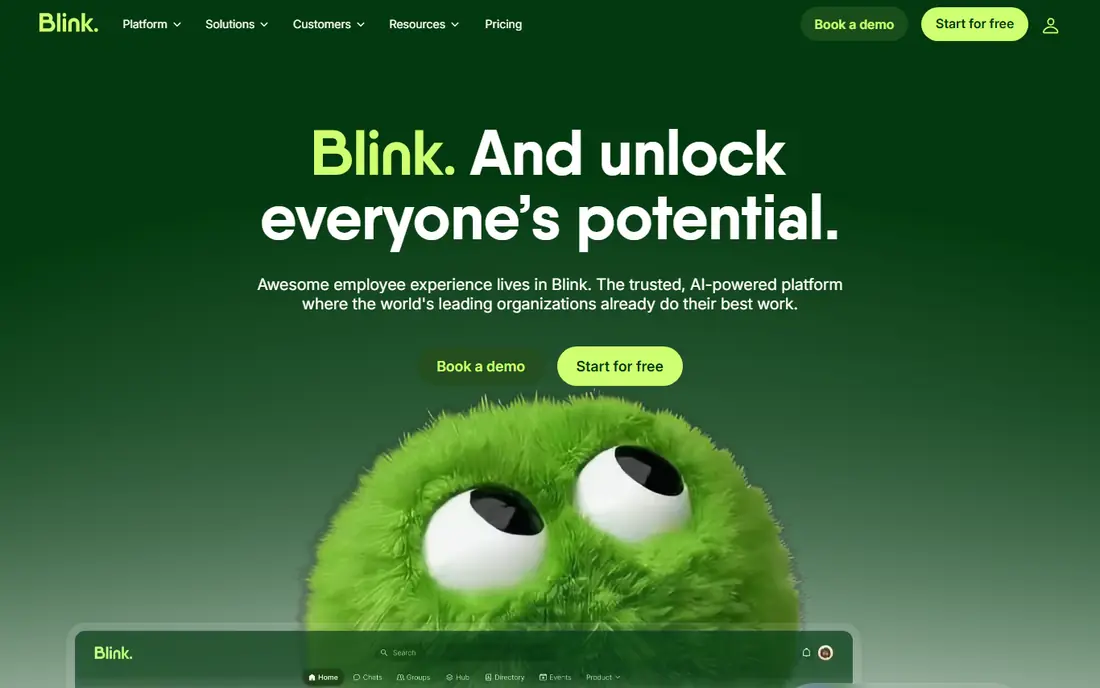
Blink is the most transparently priced platform in this list. Core costs $3.75 per user per month billed annually, with Pro at $5.00 per user per month, giving small and mid-sized employers a clear floor to budget against. The app centers on a personalized feed, employee chat, and a central content hub, and it is designed for staff who work from phones rather than desks.
It is not a workforce operations platform. There is no built-in scheduling, time tracking, or task management, so frontline operations teams may need a second tool. For pure employee communication with a published price, Blink is the easiest to evaluate.
- Published per-user pricing
- Mobile-first feed, chat, and content hub
- Works without corporate email
- No built-in scheduling or time tracking
- Enterprise features are quote-based
- Smaller intranet depth than Staffbase or Simpplr
Microsoft Teams is the default for organizations already running Microsoft 365, because chat, meetings, files, and channels sit alongside Outlook, SharePoint, and OneDrive. A free tier covers basic chat and meetings, while paid value depends on the Microsoft 365 plan already in place. For desk-heavy teams, that integration avoids buying and managing a separate communication platform.
Teams is less of a company-wide community platform on its own. Social feeds, recognition, and intranet publishing need SharePoint and Viva components, and governance matters, since open channels can become noisy. If your workforce is already in Microsoft 365, start here and add a dedicated comms tool only for gaps Teams cannot fill.
- Chat, meetings, and channels in one place
- Deep Microsoft 365 integration
- Free tier available
- Can become noisy without governance
- Community and intranet features need SharePoint and Viva
- Pricing depends on Microsoft 365 plan
Slack remains the standard for fast team chat, especially for desk-based and hybrid teams. Channels, threads, direct messages, and a large integration catalog make it easy for project teams to coordinate in real time, and a free tier lets small teams start without a licence. For day-to-day collaboration, few tools feel as quick.
Slack is not a company intranet or frontline community platform. It lacks the targeted publishing, recognition, and knowledge structure that Workplace offered, and per-user pricing rises with headcount. Use Slack for team collaboration, and pair it with a comms platform if company-wide announcements and frontline reach are also required.
- Fast team chat with channels and threads
- Huge integration catalog
- Free tier for small teams
- Message history limits on free plan
- Community and intranet features are limited
- Costs rise per user at scale
Simpplr builds employee communication around an intranet that staff actually visit: company news, leadership updates, knowledge pages, and targeted announcements in one destination. Volume-based pricing scales with organization size, and integrations with Microsoft Teams and other tools help it fit existing workflows. Comms teams value its analytics on what employees read and engage with.
Pricing is quote-based, so small teams cannot budget from a public price list. Frontline chat depth is also thinner than dedicated frontline apps. For desk-heavy organizations that want a modern intranet first and chat second, Simpplr is a strong Workplace successor.
- Intranet as a destination for news and knowledge
- Targeted publishing
- Volume-based pricing
- Quote-based pricing
- Less frontline chat depth than Blink or Connecteam
- Implementation needs content planning
Haiilo combines an intranet with employee engagement and advocacy tools, letting staff share approved company content on their own social channels and participate in communities. Multi-language support and Microsoft Teams integration help multinational employers run one platform across regions. That combination suits companies that want both internal communication and external advocacy from the same vendor.
The platform is broad, and small teams may find more than they need. Pricing is quote-based, and advocacy only delivers value when employees actually participate, so it needs internal promotion. For mid-sized and large employers with engagement goals, Haiilo is worth evaluating.
- Intranet, employee advocacy, and engagement in one platform
- Multi-language support
- Microsoft Teams integration
- Quote-based pricing
- Breadth can overwhelm small teams
- Advocacy features need staff participation to work
LumApps is the intranet choice for Google Workspace organizations, with news, knowledge, communities, and targeted communications built around Google tools. Its acquisition of Beekeeper added a frontline app, giving it reach to deskless staff as well as office workers. That dual coverage makes it a credible Workplace replacement for Google-centric companies.
Outside Google Workspace, the value drops, since much of its strength comes from that integration. Pricing is quote-based and demo-led, so budget only after a scoped quote. For Google shops that need an intranet and frontline reach in one platform, LumApps deserves a demo.
- Strong Google Workspace integration
- Intranet plus frontline app through Beekeeper
- Targeted communications
- Quote-based pricing
- Best value only inside Google Workspace
- Setup benefits from intranet planning
Connecteam suits frontline teams that need communication and operations in one app. The entry plan costs $29 per month for the first 30 users, covering chat, updates, schedules, time tracking, tasks, and training in a mobile-first package. Managers can send updates, assign tasks, and track shifts without asking deskless staff to use email or a separate intranet.
It is not an enterprise intranet, and its communication features are practical rather than polished for large comms teams. For retail, hospitality, construction, and field service teams, the operations bundle is the selling point. For large enterprises with complex comms governance, Staffbase or Workvivo may fit better.
- Chat and updates plus schedules, time tracking, tasks, and training
- Flat price for first 30 users
- Mobile-first
- Not an enterprise intranet
- Communication depth is thinner than Staffbase
- Add-ons raise cost at scale
Firstup treats internal communication as campaigns, not just posts. Comms teams can plan a message journey, deliver it across email, app, intranet, and other channels, and measure reach and engagement by audience segment. That campaign model helps large organizations run structured rollouts for policy changes, benefits enrollment, or safety updates.
Pricing is quote-based across three tiers, and the intranet sits as an add-on rather than a core inclusion. Small teams with simple announcement needs will find campaign tooling heavier than necessary. For large comms teams that run planned, measured campaigns, Firstup is a serious option.
- Campaign planning for internal comms
- Multi-channel delivery including email and app
- Analytics on reach and engagement
- Quote-based pricing
- Intranet is an add-on
- Smaller teams may find campaign tooling heavy
How we picked these
We compared official product pages and recent internal communications comparisons for platforms live in October 2026 that cover company-wide announcements, groups or communities, and mobile reach. We excluded Workplace from Meta itself, since it was fully deactivated on 1 June 2026, and we excluded pure team chat tools without company-wide publishing, except Teams and Slack, which many Workplace leavers adopt as part of a combined setup.
What to check before you switch
First, map who Workplace actually reached. List desk staff, frontline staff without email, shared-device users, and staff in each region and language, then test each finalist with those groups, not just with office staff. A platform that works well for headquarters but fails on a shared phone in a warehouse will not replace Workplace.
Second, rebuild governance before migrating content. Decide who can publish company-wide, who approves sensitive messages, how groups are managed, and how long old posts are retained. Migrating years of Workplace groups without cleanup only moves clutter to a new platform, so archive what is no longer needed.
Finally, compare quotes on the same basis. Ask every vendor for a total based on your licensed headcount, frontline share, required modules, and add-ons such as chat or intranet, then divide by headcount to compare fairly. Pilot with one location or department, measure read rates and participation, and only then roll out company wide.
Frequently asked questions
Is Workplace from Meta still available?
No, Workplace from Meta was fully deactivated on 1 June 2026. It ran normally until 31 August 2025, then became read-only from 1 September 2025 to 31 May 2026, after which Workplaces were deleted. Any organization still listing it as a live option should move to a replacement now.
Which Meta Workplace alternative is closest to Workplace?
Workvivo is the closest social replacement and was Meta's preferred migration path, with a feed, groups, recognition, and knowledge features. Staffbase and Simpplr are closer if your priority is structured publishing and intranet content rather than social community.
Which Meta Workplace alternative is cheapest?
Blink publishes the clearest entry price, at $3.75 per user per month billed annually for Core. Connecteam starts at $29 per month for the first 30 users, which can be cheaper for very small frontline teams, while most enterprise platforms are quote-based.
Can I recover data from Workplace after shutdown?
No, Meta deleted Workplaces on 1 June 2026 after the read-only period ended. If your organization exported data before that date, it can be rebuilt in a new platform, but data not exported in time is no longer recoverable through Workplace.
Should I choose Teams, Slack, or a dedicated comms platform?
Choose Teams or Slack when team collaboration is the main need and your company already uses that ecosystem. Choose a dedicated platform such as Workvivo, Staffbase, or Blink when you need company-wide announcements, frontline reach without email, and measured internal communication.
How do I migrate from Workplace to a new platform?
Audit your groups, audiences, and content, export what was saved before shutdown, and rebuild only the active communities in the new tool. Pilot with one department or location, train local champions, and run old and new channels in parallel during the transition if your timeline allows it.
Sources
See where you really rank - block by block
ProMapRanker scans Google Maps across a grid of your service area. Simple monthly plans from $19, white-label on every plan.
Start freeKeep reading
 zyte alternatives
Best Zyte Alternatives in 2026
These zyte alternatives cover managed scraping APIs, proxy networks and no code tools for lawful collection from your own or consented sources only in 2026.
Read → zerto alternatives
Best Zerto Alternatives in 2026
Compare the best zerto alternatives for disaster recovery and replication, with recovery targets, cloud options and honest trade-offs for teams in 2026.
Read → zerofox alternatives
Best ZeroFox Alternatives in 2026
We compared 9 zerofox alternatives for brand protection, phishing takedowns, dark web monitoring, and social impersonation, with clear coverage notes.
Read →