 ProMapRanker
Best Merge.dev Alternatives in 2026

Key takeaways
- Nango suits teams that want code-first control and custom integrations rather than only pre-built connectors.
- Apideck and Unified.to suit teams that want a pre-built unified API across several mainstream categories.
- Kombo and Finch suit HR and payroll products, with Kombo covering a wider HR set and Finch focused on US employment data.
- Paragon and Prismatic suit products that need customer-facing embedded integrations and a branded connect flow.
- Codat suits fintech and accounting products that need financial data rather than general SaaS categories.
- Knit suits teams that want a lean unified API with a smaller, focused connector set.
Quick comparison
| Pick | Great for | Pricing starts at | Free tier | |
|---|---|---|---|---|
 Nango | Code-first custom integrations | Free | Yes | Visit |
 Apideck | Pre-built unified API with a marketplace | $599 per month | Free trial | Visit |
 Unified.to | Broad multi-category coverage | $750 per month | Free trial | Visit |
 Kombo | HRIS, ATS and payroll integrations | See website | No | Visit |
 Paragon | Embedded customer-facing integrations | See website | Free trial | Visit |
 Codat | Accounting and financial data | See website | Free trial | Visit |
 Finch | US employment and payroll data | $65 per connection per month | Free trial | Visit |
 Knit | Lean unified API for HR and finance | See website | Free trial | Visit |
 Prismatic | Embedded integrations with self-service | See website | Free trial | Visit |
The best Merge.dev alternatives
Merge.dev offers a unified API across HRIS, ATS, CRM, accounting, ticketing, file storage and other categories, so a product team can integrate once and reach many customer systems. The alternatives below split into two groups: pre-built unified APIs that trade control for speed, and code-first or embedded platforms that trade simplicity for flexibility. We compared official feature pages, pricing pages, documentation and public reviews, and we note where pricing is custom, because most enterprise integration platforms quote by volume and category.

Nango is our pick for teams whose integrations are a core product feature. Engineers write integrations in code, control field mappings and sync logic, and keep that logic in version control alongside the rest of the product. A self-hosted option adds data control for teams with strict hosting rules.
The cost is engineering effort. Nango does not hand you a fixed schema for every category and walk away; your team builds and maintains the integrations it needs. For teams with integration engineers, that control is the point. For teams without them, a pre-built unified API will ship faster.
- Code-first integrations with full control over sync logic
- Self-hosted option
- Free tier for starting
- Needs engineering time
- Less plug-and-play than a fixed unified API
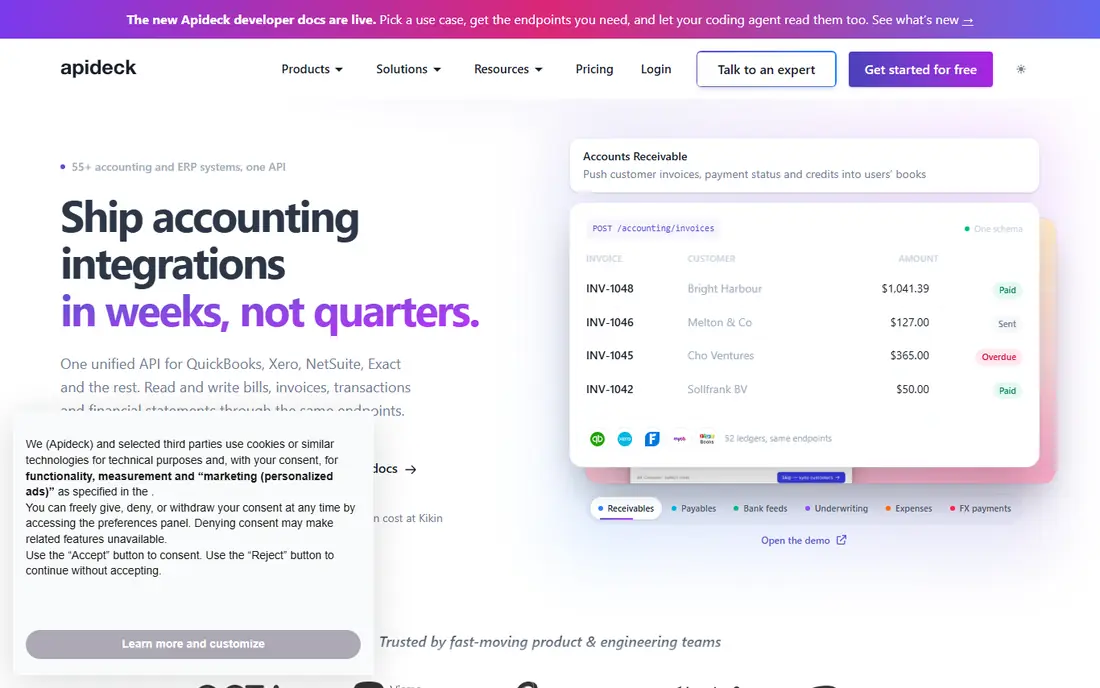
Apideck is the closest like-for-like swap for Merge for many teams. It offers a fixed unified API across several mainstream categories, plus a Vault that lets customers connect their own accounts under your brand. An integrations marketplace option helps products that want to show customers what can connect.
The limit is the same as with any fixed unified API: if a customer needs a field, object or provider outside the supported schema, you wait for the vendor or build around it. Teams that stay inside mainstream categories will move fast; teams with unusual requirements should check coverage field by field.
- Unified APIs across CRM, HRIS, accounting, file storage and e-commerce
- White-label Vault for customer connections
- Marketplace option
- Customisation is limited to the supported schema
- Pricing starts at a business tier
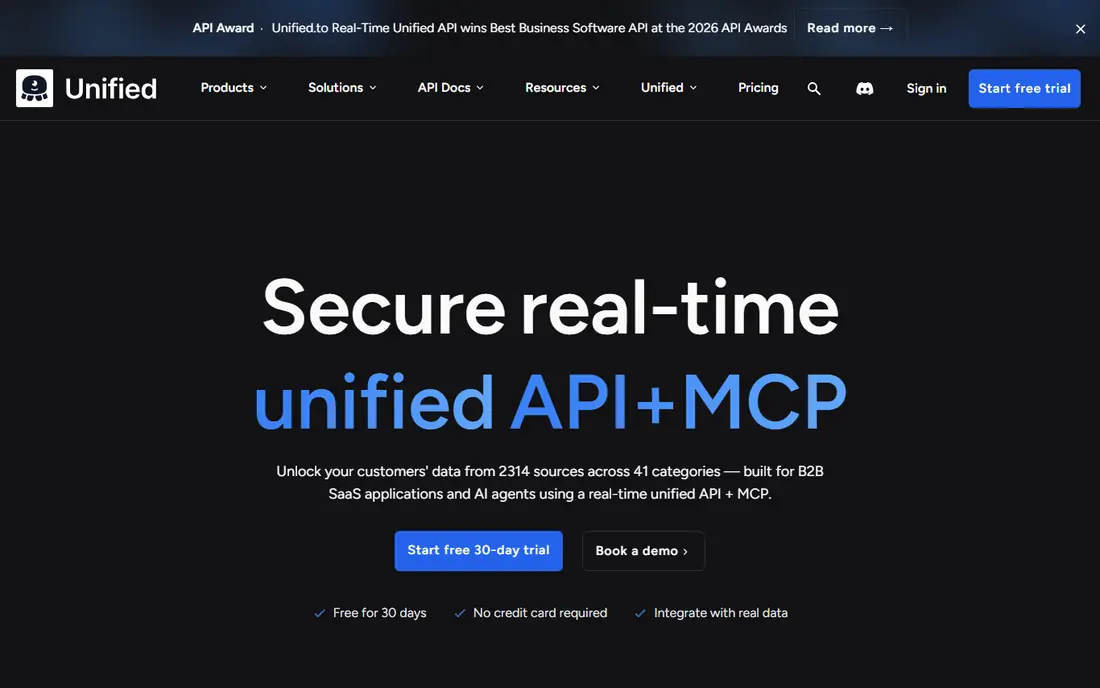
Unified.to suits teams that need an unusually broad category set from one vendor. Beyond HRIS, CRM and accounting, it covers categories other unified APIs skip, such as messaging and source code repositories. That breadth helps products that integrate with many different kinds of customer tools.
Breadth comes with a trade. Coverage in any single category may be thinner than a specialist vendor, and teams that need deep write support should verify endpoints before committing. For broad, mostly read-heavy integrations, it is a practical single-vendor choice.
- Wide category set including messaging and repositories
- Real-time and sync options
- AI agent workflow support
- Coverage can be thin in niche categories
- Observability is lighter than code-first platforms
Kombo is the specialist pick for HR technology. It covers HRIS, payroll, ATS, LMS and assessment systems in depth, with real-time sync and write support for common HR workflows such as stage moves. Teams building recruiting or HR products get deeper coverage here than from a general unified API.
The scope is the limit. Kombo does not cover CRM, accounting or ticketing in the same way, so a product that needs those categories will need a second vendor. For HR-only products, that focus is a strength, not a weakness.
- Deep HRIS, ATS, payroll, LMS and assessment coverage
- Real-time sync
- Strong European provider coverage
- Focused on people data, so other categories need another vendor
- Pricing is custom
Paragon suits SaaS products that want integrations inside their own product. Customers connect their tools through a branded portal, and Paragon handles sync, actions and workflow triggers behind it. That embedded experience matters when integrations are part of the sale, not an internal tool.
Paragon is an enterprise-style purchase, with custom pricing and a setup that touches product design as well as engineering. Smaller teams may find a simpler unified API faster to start, while products that sell on integrations will value the branded, customer-facing flow.
- White-label Connect Portal for end users
- Managed sync and workflow actions
- Broad integration catalogue
- Pricing is custom
- Setup needs product and engineering coordination
Codat is the right alternative when the integration problem is financial data, not general SaaS data. It connects accounting, banking and commerce systems and standardises that data for lending, underwriting, cash-flow and bookkeeping products. That financial focus gives it depth a general unified API cannot match in this niche.
Do not pick Codat for HRIS or CRM work. Its value sits in financial categories, and teams that need both financial and people data will pair it with another vendor. For fintech products, that specialisation is exactly why it belongs on the shortlist.
- Deep accounting, banking and commerce connectivity
- Built for lending, underwriting and financial products
- Standardised financial data models
- Not a general SaaS unified API
- Pricing is custom and volume-based
Finch suits products that need US employment data at a predictable price. It covers a wide set of HRIS and payroll providers, with support for reading employment records and writing deductions and benefits data where providers allow it. Per-connection pricing makes early costs easy to model.
International coverage is the gap. Teams hiring across many countries will need a vendor with broader global payroll support, such as Kombo, or a second provider. For US-focused benefits, payroll and HR products, Finch is a focused and fairly priced option.
- Wide US HRIS and payroll provider coverage
- Read and write support for deductions and benefits
- Clear per-connection pricing
- US-focused, so international payroll coverage is thinner
- People data only
Knit suits teams that want a unified API without the weight of a large enterprise platform. It covers core categories such as HRIS, ATS and accounting, with a smaller footprint and a simpler integration model. That leanness helps early-stage teams ship integrations without a long procurement process.
The catalogue is smaller than Apideck or Unified.to, so check that your must-have providers are covered before choosing it. For teams whose customers use mainstream systems, Knit offers a clean middle path between building in-house and buying a large platform.
- Unified API for HRIS, ATS, accounting and other core categories
- Simpler footprint than larger platforms
- Pass-through and sync options
- Smaller connector catalogue than the largest unified APIs
- Pricing is custom
Prismatic suits products that need many customer-specific integrations, not just a fixed set. Its builder mixes low-code steps with code, and its embedded marketplace lets customers browse and enable integrations themselves. Per-customer management helps support teams see what is connected and what has failed for each account.
The platform is broader than a simple unified API, so new teams should expect a learning curve. Products that sell custom integrations as a feature will get the most from it, while teams that need one standard category may find a fixed unified API simpler.
- Low-code and code-first builder
- Embedded marketplace for customers
- Per-customer integration management
- Pricing is custom
- Learning the builder takes time for new teams
How we picked these
We compared official feature pages, pricing pages, documentation and public reviews for each platform. We kept only platforms that exist and work today, offer a unified API, embedded integration or code-first integration service that a product team can buy, and cover at least one category Merge covers or a specialist niche that replaces part of it. We left out general automation tools that do not offer a customer-facing unified API, and we note custom pricing plainly where vendors do not publish a starting price.
What to check before you switch
Start with your must-have providers and fields, not with a connector count. List every provider your top customers use, every field your product reads, and every write your product must perform, then verify each one against the vendor's documentation. A platform that lists 200 connectors can still miss the one write endpoint your workflow depends on.
Check data handling next. Ask whether data is synced and stored, passed through in real time, or both, and how webhooks, retries and error logs work for each customer. Integration failures become support tickets fast, so observability and per-customer status matter as much as the first successful connection.
Finally, price by connections and volume, not by seats alone. Unified API pricing often combines a platform fee with per-connection or usage charges, so model your first year at realistic customer counts. A short pilot with two or three real customer systems gives better evidence than a sales demo with sample data.
Frequently asked questions
What is the best Merge.dev alternative for most teams?
Apideck is the closest like-for-like swap for teams that want a pre-built unified API across mainstream categories. Nango is the better pick for teams that want code-first control and custom integrations. The right choice depends on whether your team has integration engineers and how custom your needs are.
Is there a free Merge.dev alternative?
Nango offers a free tier for starting, which suits prototypes and small volumes. Most other platforms in this list offer a free trial rather than a permanent free plan, and enterprise pricing is custom. Check trial limits and per-connection charges before you build on a free tier.
Which alternative is best for HR integrations?
Kombo is the deepest HR specialist here, covering HRIS, ATS, payroll, LMS and assessment systems. Finch is a strong US-focused option with clear per-connection pricing. For HR plus other categories from one vendor, Apideck or Unified.to may fit better.
Which alternative is best for accounting integrations?
Codat is the best pick for accounting, banking and commerce data, because it is built for financial products. Apideck and Unified.to also cover accounting as part of a wider unified API, which suits products that need accounting alongside CRM or HR data.
Do these platforms support AI agent workflows?
Several do, in different ways. Unified.to and Paragon support agent-facing workflows and actions, while Nango gives engineers code-level control over tools an agent can call. Check each vendor's documentation for the exact agent, MCP or tool support your product needs, because the models differ.
Can I build integrations myself instead of using a unified API?
Yes, but the cost is maintenance. Building direct integrations gives full control and avoids vendor fees, yet every provider change, auth update and rate limit becomes your team's work. A unified API or code-first platform pays off when you support many providers or when integrations are not your core product.
Sources
See where you really rank - block by block
ProMapRanker scans Google Maps across a grid of your service area. Simple monthly plans from $19, white-label on every plan.
Start freeKeep reading
 zyte alternatives
Best Zyte Alternatives in 2026
These zyte alternatives cover managed scraping APIs, proxy networks and no code tools for lawful collection from your own or consented sources only in 2026.
Read → zerto alternatives
Best Zerto Alternatives in 2026
Compare the best zerto alternatives for disaster recovery and replication, with recovery targets, cloud options and honest trade-offs for teams in 2026.
Read → zerofox alternatives
Best ZeroFox Alternatives in 2026
We compared 9 zerofox alternatives for brand protection, phishing takedowns, dark web monitoring, and social impersonation, with clear coverage notes.
Read →