 ProMapRanker
Best Maxio Alternatives in 2026

Key takeaways
- Chargebee is the closest like-for-like replacement for most SaaS teams, with multi-gateway billing and strong dunning tools.
- Stripe Billing suits teams already processing on Stripe, while Paddle and FastSpring suit teams that want tax handled as merchant of record.
- Recurly and Zuora target larger subscriber businesses, with retention and enterprise revenue controls respectively.
- Billing fees sit on top of payment processing fees on most platforms, so model the total cost at your real volume.
Quick comparison
| Pick | Great for | Pricing starts at | Free tier | |
|---|---|---|---|---|
 Chargebee | Flexible SaaS billing | $99 per month | Free trial | Visit |
 Stripe Billing | Stripe-native teams | 0.7% of billing volume | No | Visit |
 Recurly | Subscriber retention | $249 per month | No | Visit |
 Zuora | Enterprise monetization | See website | No | Visit |
 Paddle | Global tax handling | 5% plus $0.50 per transaction | No | Visit |
 Zoho Billing | Small business billing | $39 per month | Yes | Visit |
 ChargeOver | Mid-market recurring billing | See website | Free trial | Visit |
 FastSpring | Global software sales | See website | No | Visit |
 Younium | B2B contract billing | See website | No | Visit |
The best Maxio alternatives
Maxio, formed from Chargify and SaaSOptics, targets finance-led B2B SaaS teams with billing, revenue recognition, and SaaS metrics in one platform. The alternatives below split that job in different ways, from developer-friendly billing to enterprise revenue systems. Note that Chargify is not listed here, since it merged into Maxio and is not a separate alternative.

Chargebee is the most natural first shortlist entry for SaaS teams leaving Maxio. It handles subscriptions, trials, coupons, and usage billing across many payment gateways, so teams are not locked to one processor. Its dunning tools help recover failed payments, which directly protects monthly recurring revenue.
The main caveat is that full revenue recognition sits in a separate Chargebee product, so finance teams that need that depth should price the bundle, not just billing. For most SaaS billing needs, though, Chargebee covers the core job with a mature, well-documented platform.
- Multi-gateway support
- Strong dunning and retention tools
- Usage-based billing support
- Revenue recognition is a separate product
- Pricing includes a volume percentage on top of the base fee
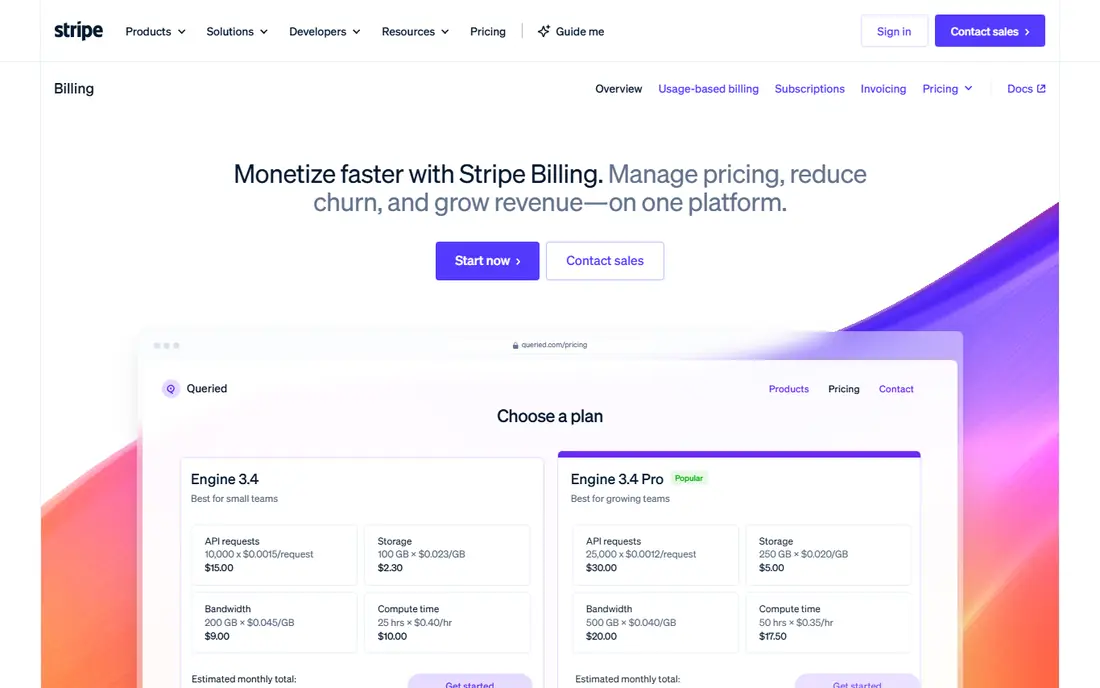
Stripe Billing suits teams that already process payments through Stripe and want billing without a second vendor. Subscriptions, invoicing, trials, and usage billing live in the same dashboard as payments, and the API is among the best documented in the category. A revenue recognition add-on is available for finance teams.
The limitation is structural: if you need another gateway, Stripe Billing cannot help. Volume-based pricing also means the bill grows with revenue, so larger teams should compare it with flat-fee rivals at their actual volume.
- Billing built into the payment processor
- Strong API and developer tools
- Revenue recognition add-on available
- Stripe only, with no multi-gateway choice
- Costs rise with billing volume

Recurly has built its reputation on keeping subscribers, not just billing them. Its dunning sequences, retry logic, and recovery tools target involuntary churn, the failed payments that quietly shrink a subscriber base. Gateway flexibility also helps media and subscription businesses that use more than one processor.
Smaller teams may balk at the entry price, and revenue recognition costs extra. For growing subscriber businesses where retention is the priority, Recurly is a focused, proven choice.
- Strong dunning and involuntary churn recovery
- Gateway-agnostic billing
- Subscriber lifecycle tools
- Entry price is high for small teams
- Revenue recognition is a paid add-on
Zuora is the enterprise end of this list, built for large organisations with complex pricing, multiple entities, and strict revenue rules. Its order-to-revenue controls, CPQ tools, and revenue recognition depth suit companies where billing touches many systems and compliance teams. Global, hybrid, and usage models are all in scope.
That power comes with enterprise cost and implementation time. A startup with a few flat plans will find Zuora slow and expensive. For large, complex monetization, it remains the benchmark many finance teams compare against.
- Deep revenue recognition and multi-entity support
- CPQ and order-to-revenue controls
- Handles complex hybrid pricing
- Enterprise pricing and long implementation
- Overkill for small or simple billing needs
Paddle takes a different model: as merchant of record, it handles payments, global sales tax, and compliance, so a small team can sell worldwide without building a tax operation. That simplicity is valuable for software and digital product sellers with customers in many countries.
The fee reflects that service, at 5 percent plus 50 cents per transaction, which is higher than Stripe processing plus a billing fee for many sellers. Teams that want full control over gateways and tax should choose a billing layer instead. Teams that want tax off their plate will find Paddle worth the fee.
- Merchant of record handling for global sales tax
- Payments, billing, and fraud tools in one fee
- Simple for lean teams
- Higher per-transaction cost than gateway billing
- Less control than a direct processor setup
Zoho Billing is the budget-friendly entry point for early-stage SaaS and service businesses. Its standard plan is modestly priced, a free plan covers small volumes, and it integrates naturally with other Zoho tools for CRM, accounting, and support. For a team under one million dollars in annual billings, it often covers the essentials.
Larger or more complex billing models will outgrow it, since usage billing and enterprise revenue features sit on higher tiers. For simple subscriptions, invoicing, and customer portals, it is good value.
- Low entry price
- Free plan for small volumes
- Fits teams already using Zoho apps
- Usage billing depth is limited on lower tiers
- Enterprise revenue recognition needs the higher edition
ChargeOver targets mid-market recurring billing with a focus on practical features: subscriptions, invoicing, dunning, and customer self-service portals. Its pricing models cover seats, usage, and tiered plans, which suits service and SaaS businesses with varied contracts.
Its ecosystem is smaller than the largest rivals, so teams that need many native integrations should check availability first. For teams that want a capable billing tool without enterprise complexity, ChargeOver is a solid, less-hyped option.
- Recurring billing with dunning and customer portals
- Flexible pricing models
- US-based support
- Smaller ecosystem than Chargebee or Stripe
- Pricing is not fully published
FastSpring, like Paddle, acts as merchant of record for software sellers, handling global tax, compliance, and payments. Its checkout and storefront tools help software companies sell direct, and its global coverage suits teams with customers worldwide. For lean software teams, that offloading is the main attraction.
The revenue-share model costs more per sale than a gateway plus billing layer, and its billing depth is less than a dedicated SaaS platform such as Chargebee. If global tax handling matters more than deep subscription logic, FastSpring fits. If billing complexity dominates, look at the billing-first tools above.
- Merchant of record for global software sales
- Tax and compliance handling
- Checkout and storefront tools
- Revenue-share pricing is higher than gateway billing
- Less billing depth than dedicated SaaS platforms
Younium focuses on B2B SaaS companies with negotiated contracts, amendments, and renewals. It tracks contract changes, subscription terms, and revenue recognition in a way that suits sales-led teams, and it integrates with Salesforce and HubSpot for quote-to-cash workflows. That contract focus sets it apart from self-serve billing tools.
Pricing is quote-led, and it is a smaller vendor than the enterprise names here, so due diligence matters. For B2B teams whose billing follows contracts rather than simple checkout plans, Younium is worth a demo.
- Contract and subscription management for B2B SaaS
- Revenue recognition support
- Salesforce and HubSpot integrations
- Quote-led pricing
- Smaller vendor than Zuora or Chargebee
How we picked these
We compared official feature pages, pricing pages, documentation, and public reviews for each platform, and we checked that each one was actively offered for subscription billing in October 2026. We excluded Chargify as a separate listing because it merged into Maxio. Where pricing is quote-led we wrote See website rather than repeating an unverified estimate, and we noted where billing fees sit on top of payment processing fees.
What to check before you switch
Start with your pricing model, not the vendor list. Map every plan, seat tier, usage meter, discount, and contract amendment you actually sell, then test each one on the shortlisted platform. Billing migrations fail on edge cases, not on the standard monthly plan.
Next, model total cost at your current volume and at double that volume, including processing fees, billing percentages, and any revenue recognition add-on. Finally, plan the migration itself: historical invoices, open trials, failed payments, and dunning state all need a clean cutover plan, and finance should sign off before the switch date.
Frequently asked questions
What is the best Maxio alternative for B2B SaaS?
Chargebee and Younium are the strongest B2B fits, with Chargebee covering broader SaaS billing and Younium focusing on contract-led deals. Zuora suits larger enterprises with complex revenue needs, while Stripe Billing suits Stripe-native teams.
Is Chargify an alternative to Maxio?
No. Chargify merged into Maxio, along with SaaSOptics, so it is not a separate product to switch to. The tools on this list are independent alternatives.
How much does subscription billing software cost?
It varies widely, from a low monthly plan at Zoho Billing to volume percentages at Stripe Billing and Chargebee, and quote-led enterprise pricing at Zuora. Always add payment processing fees, since most billing platforms charge on top of them.
Do these tools handle revenue recognition?
Some do, with limits. Zuora and Maxio-style platforms include deep revenue recognition, while Chargebee and Recurly offer it as a separate product or add-on. Check whether your required standard and reporting depth are included or extra.
Can I migrate billing history from Maxio?
Most platforms support migration of customers, subscriptions, and payment methods, but the effort varies with contract complexity. Ask each vendor for a migration plan, a test import, and a rollback option before committing.
Sources
- https://www.chargebee.com
- https://stripe.com/billing
- https://www.recurly.com
- https://www.zuora.com
- https://www.paddle.com
- https://www.zoho.com/billing/
- https://www.chargeover.com
- https://www.fastspring.com
- https://www.younium.com
- https://www.stackscout.net/articles/cc_20260930_173932.html
- https://baremetrics.com/blog/chargebee-and-alternatives
See where you really rank - block by block
ProMapRanker scans Google Maps across a grid of your service area. Simple monthly plans from $19, white-label on every plan.
Start freeKeep reading
 zyte alternatives
Best Zyte Alternatives in 2026
These zyte alternatives cover managed scraping APIs, proxy networks and no code tools for lawful collection from your own or consented sources only in 2026.
Read → zerto alternatives
Best Zerto Alternatives in 2026
Compare the best zerto alternatives for disaster recovery and replication, with recovery targets, cloud options and honest trade-offs for teams in 2026.
Read → zerofox alternatives
Best ZeroFox Alternatives in 2026
We compared 9 zerofox alternatives for brand protection, phishing takedowns, dark web monitoring, and social impersonation, with clear coverage notes.
Read →