 ProMapRanker
Best LocalStack Alternatives in 2026

Key takeaways
- LocalStack emulates AWS services locally, and in March 2026 its Community edition was replaced by a proprietary image that needs an account and auth token.
- Floci, fakecloud, and MiniStack are the closest free drop-in replacements, all listening on the same local endpoint and needing no account or token.
- Moto suits Python unit tests, while MinIO, DynamoDB Local, and ElasticMQ suit teams that only need one service mocked well.
- Check service coverage before switching: a full emulator and a single-service mock solve different problems, and a mismatch will waste test time.
Quick comparison
| Pick | Great for | Pricing starts at | Free tier | |
|---|---|---|---|---|
 Floci | Free drop-in AWS emulator | Free | Yes | Visit |
 fakecloud | Free local AWS emulator | Free | Yes | Visit |
 MiniStack | Light free AWS emulator | Free | Yes | Visit |
 Moto | Python AWS mocks | Free | Yes | Visit |
 MinIO | S3-compatible storage | Free | Yes | Visit |
 DynamoDB Local | Local DynamoDB testing | Free | Yes | Visit |
 ElasticMQ | Local SQS testing | Free | Yes | Visit |
 Testcontainers | Service containers in tests | Free | Yes | Visit |
 AWS SAM CLI | Local Lambda testing | Free | Yes | Visit |
The best localstack alternatives
LocalStack is a local AWS emulator that lets developers test S3, Lambda, DynamoDB, SQS, and other services without touching real cloud resources. We compared official documentation, project pages, and public reviews, and we kept only tools that are actively maintained and genuinely useful for local AWS development or testing.
Floci is the most direct answer for teams whose LocalStack workflow broke in 2026. It is a free, open-source AWS emulator that runs on the same local port as LocalStack, needs no account or auth token, and has no paid feature gates. Developers can point the AWS CLI, SDKs, Terraform, or CDK at a local endpoint and keep existing workflows with only an image swap in many setups.
Its design choice also helps accuracy: where fidelity matters, Floci runs real containers, such as official Lambda runtime images and real databases for RDS-style services. The catch is youth. Floci is newer than LocalStack, so its community, examples, and edge-case coverage are smaller, and teams should test their exact services before replacing a production CI pipeline.
- MIT-licensed with no account or token
- Drop-in replacement on the same local port
- Lambda runs in real runtime containers
- Newer project with a smaller community than LocalStack
- Service coverage is still growing
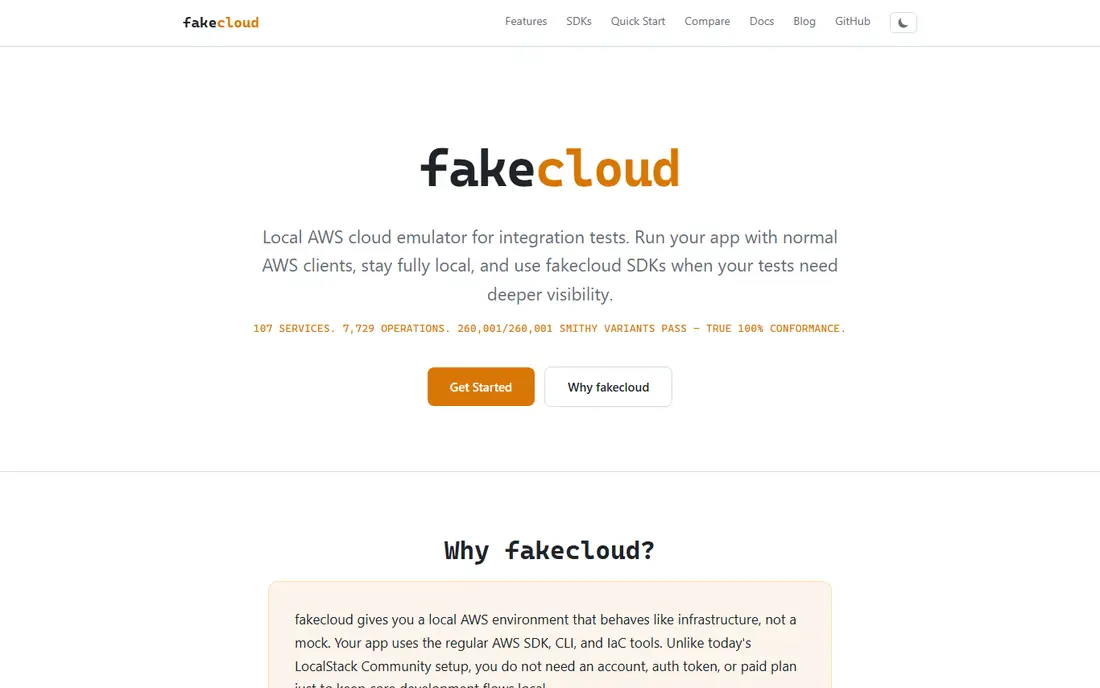
fakecloud is another free, open-source local AWS emulator built as a direct response to the LocalStack Community change. It runs on a single local port, needs no account or auth token, and aims to replicate AWS behaviour closely enough for integration tests and local development. Its service list covers core services such as S3, Lambda, SQS, SNS, DynamoDB, and many more, with a large operation count.
The honest limit is the same as for any new emulator: real AWS has many edge cases, and a new project will not match every one at first. fakecloud suits teams that want a free, local, CI-friendly emulator and are willing to report gaps. Teams with very unusual service combinations should run their full test suite against it before switching.
- Free and open-source with no account or token
- Single binary and Docker options
- Broad service and operation coverage described on project pages
- Newer project
- Some advanced service behaviours may differ from real AWS

MiniStack presents itself as a light, free AWS emulator with a small Docker image and low idle memory use. It listens on the same local port as LocalStack, accepts the same endpoint overrides, and supports many AWS services including S3, Lambda, EC2, RDS, ECS, and EKS in its service list. For a developer laptop or a CI runner with limited memory, that lightness is a practical advantage.
As with Floci and fakecloud, MiniStack is newer than LocalStack, so teams should verify their specific services and Terraform or CDK workflows. Its use of real databases for some services can improve fidelity, but it also means those services behave like the underlying database rather than a pure AWS mock, which is worth knowing for test design.
- MIT-licensed with no account or telemetry
- Same local port as LocalStack
- Light image and low idle memory described on vendor pages
- Newer project
- Some services are backed by real databases, which changes setup for certain tests
Moto is the long-standing choice for Python developers who want to mock AWS in tests. Instead of running a server, Moto intercepts AWS SDK calls in test code and returns mock responses for S3, DynamoDB, SQS, Lambda, and many other services. That makes tests fast, repeatable, and easy to run without Docker or a local emulator process.
The limit is language and scope. Moto is a Python library first, so teams in other languages need a different tool, and its mocks are still approximations of AWS. It is best for unit and integration tests where speed and isolation matter, while a full emulator suits end-to-end local development.
- Mature Python mock library for AWS services
- Excellent for unit and integration tests
- No Docker or server needed for most tests
- Python-only workflow
- Mock behaviour can differ from real AWS in edge cases
MinIO is the right pick when the only AWS service in question is S3. It provides S3-compatible object storage that runs locally, supports buckets, objects, versioning, and multipart uploads, and works with the AWS SDK by pointing the endpoint at a local MinIO server. For a team testing uploads, downloads, and storage logic, that single-service focus gives a stable and well-tested mock.
It is not a LocalStack replacement on its own, since it does not emulate Lambda, DynamoDB, SQS, or other services. Use MinIO when storage is the job, and pair it with another mock or emulator when the app touches several AWS services at once.
- Mature S3-compatible object storage
- Runs locally or on a server
- Strong for storage-heavy local testing
- Only covers storage, not Lambda, queues, or databases
- S3 compatibility has small gaps for some advanced features
DynamoDB Local is Amazon own downloadable version of DynamoDB for development and testing. It lets a team create tables, write items, run queries, and test application logic without touching a real DynamoDB table or paying for provisioned capacity. Because it comes from Amazon, its core table behaviour is a close match for local work.
The scope is narrow by design. DynamoDB Local does not emulate S3, Lambda, or queues, so it suits a team whose AWS use is mainly DynamoDB, or a team that pairs it with other single-service mocks. Always check the documented differences from the managed service before relying on it for performance or scaling tests.
- Official Amazon tool for local DynamoDB
- Faithful table and query behaviour for local tests
- Docker and downloadable versions
- Only covers DynamoDB
- Some features and limits differ from the managed service
ElasticMQ is a small, SQS-compatible message queue server that runs locally and works well in tests. It supports queues, FIFO queues, and dead-letter handling for common cases, and it runs easily in Docker or as a standalone process. For a team testing producers, consumers, and retry logic, ElasticMQ gives a fast and isolated queue without real AWS costs.
Like other single-service tools, ElasticMQ does not replace a full emulator. It covers SQS, not the whole AWS stack, and some advanced features may differ from real SQS. Use it when queue behaviour is the test focus, and use a full emulator when the app also needs storage, databases, and functions in one local run.
- Lightweight local SQS-compatible server
- Easy to run in Docker
- Good for queue logic tests
- Only covers SQS, not SNS or other messaging services in full
- Some advanced SQS features are limited
Testcontainers takes a different approach: instead of mocking AWS, it spins up real service containers during tests, such as Postgres, Redis, or a storage service, and tears them down afterwards. That gives tests real service behaviour rather than mock approximations, and it works across several languages with test framework integrations. For a team that already uses containers in tests, it fits naturally.
The catch is that Testcontainers is a framework, not an AWS emulator. AWS-specific services still need a suitable container image, such as an emulator image, and test setup takes more code than a simple mock. It is best for teams that want real-service fidelity and already run Docker in CI.
- Runs real service containers in tests across languages
- Good for databases, queues, and storage
- Integrates with common test frameworks
- Needs Docker and more test setup
- Not an AWS emulator by itself, so AWS services need container images
AWS SAM CLI is Amazon own tool for building and testing serverless applications locally. It can invoke Lambda functions locally, run local APIs backed by those functions, and test event-driven code before deployment. For a team building with SAM templates, that local loop is faster than deploying to AWS for every change.
SAM CLI is not a general emulator. It does not provide a full local AWS account with S3, DynamoDB, and queues in one place, so teams with broad AWS use will still need an emulator or mocks alongside it. Use it for serverless development, and pair it with Floci, fakecloud, or Moto for wider integration tests.
- Official Amazon tool for local Lambda and API testing
- Works with SAM templates
- Useful for serverless development
- Focused on serverless apps, not a general AWS emulator
- Local API and event behaviour can differ from deployed services
How we picked these
We compared official documentation, project pages, and public reviews for local AWS tools, and we kept only tools that are actively maintained and useful for local development or testing in October 2026. We did not include LocalStack itself, and we included full emulators, language mocks, and single-service tools so readers can match the tool to the exact services their app uses. Prices are shown as Free where the tool is open-source or offered free by its maker, since local testing tools in this group do not carry a standard paid entry price.
What to check before you switch
Run your existing test suite against the new tool before removing LocalStack from CI. Check each AWS service in use, each SDK call pattern, and any Terraform or CDK workflow, since emulator gaps usually appear in edge cases rather than basic calls. Also check startup time and memory use on CI runners, because a heavier emulator can slow every pipeline run.
Full emulator or single-service mock
Choose a full emulator when the app touches several AWS services together and the test needs them to interact. Choose a single-service mock when only one service matters and fidelity for that service is the priority. Mixing both is common: a full emulator for end-to-end tests, and Moto or a single-service tool for fast unit tests.
Frequently asked questions
What is the best free LocalStack alternative?
Floci, fakecloud, and MiniStack are the closest free drop-in replacements, all with no account or token and the same local endpoint. Test all three against your exact services, since coverage differs by service and operation.
Why are people leaving LocalStack in 2026?
In March 2026, LocalStack replaced its Community edition with a proprietary image that needs an account and auth token, and its free tier no longer allows commercial use in the same way. Teams that relied on the free edition in CI looked for free, open-source replacements.
Is Moto a full LocalStack replacement?
No. Moto is a Python mock library for tests, not a local AWS server for general development. It is excellent for Python unit and integration tests, while a full emulator suits end-to-end local development and non-Python teams.
Can I use MinIO instead of LocalStack?
Only for storage. MinIO provides S3-compatible storage, but it does not emulate Lambda, DynamoDB, SQS, or other AWS services. Pair it with another tool when the app uses more than storage.
Do these tools work with Terraform and CDK?
Full emulators such as Floci, fakecloud, and MiniStack are designed to work with Terraform, CDK, and the AWS CLI by pointing endpoints at a local address. Single-service mocks and Moto work differently, so check the tool documentation for your exact workflow.
Sources
See where you really rank - block by block
ProMapRanker scans Google Maps across a grid of your service area. Simple monthly plans from $19, white-label on every plan.
Start freeKeep reading
 zyte alternatives
Best Zyte Alternatives in 2026
These zyte alternatives cover managed scraping APIs, proxy networks and no code tools for lawful collection from your own or consented sources only in 2026.
Read → zerto alternatives
Best Zerto Alternatives in 2026
Compare the best zerto alternatives for disaster recovery and replication, with recovery targets, cloud options and honest trade-offs for teams in 2026.
Read → zerofox alternatives
Best ZeroFox Alternatives in 2026
We compared 9 zerofox alternatives for brand protection, phishing takedowns, dark web monitoring, and social impersonation, with clear coverage notes.
Read →