 ProMapRanker
Local SEO for Auto Repair Shops: Drive More Cars to Your Bay

As Md Shihab Mia, founder of ProMapRanker (promapranker.com), a product of rankite.com, I regularly see auto repair shops struggling to connect with local customers online. Local SEO for auto repair shops is the strategic process of optimizing your online presence to attract more customers from your immediate service area, particularly through Google Maps and local search results. This involves meticulous Google Business Profile optimization, a mobile-friendly and fast website, consistent NAP information across online directories, and proactive reputation management. By mastering these elements, your auto repair shop can significantly increase its local visibility, drive more targeted traffic to your bays, and ultimately boost your bottom line.
What is Local SEO for Auto Repair Shops and Why Does It Matter?
Local SEO for auto repair shops is the practice of optimizing your online presence to rank higher in local search results and Google Maps when potential customers in your area search for services like "brake repair near me" or "oil change [city name]". It matters because 80% of local searches lead to a conversion, with many users visiting the business within 24 hours, according to Google's SEO Starter Guide. This direct path from search to customer visit makes local SEO an indispensable tool for filling your service bays.
Traditional marketing methods are becoming less effective for local businesses. Today, when a car breaks down or needs service, the first place most people turn is their smartphone. They're looking for immediate, trustworthy solutions nearby. If your auto repair shop isn't visible in the Google Map Pack or local search results, you're essentially invisible to a vast segment of your potential customer base.
Beyond simple visibility, effective local SEO builds trust and credibility. A well-optimized Google Business Profile (GBP) with positive reviews and accurate information signals reliability to prospective clients. This isn't just about getting found; it's about being chosen over competitors, leading to a steady stream of new appointments and repeat business.
How Do You Optimize Your Google Business Profile for Auto Repair?
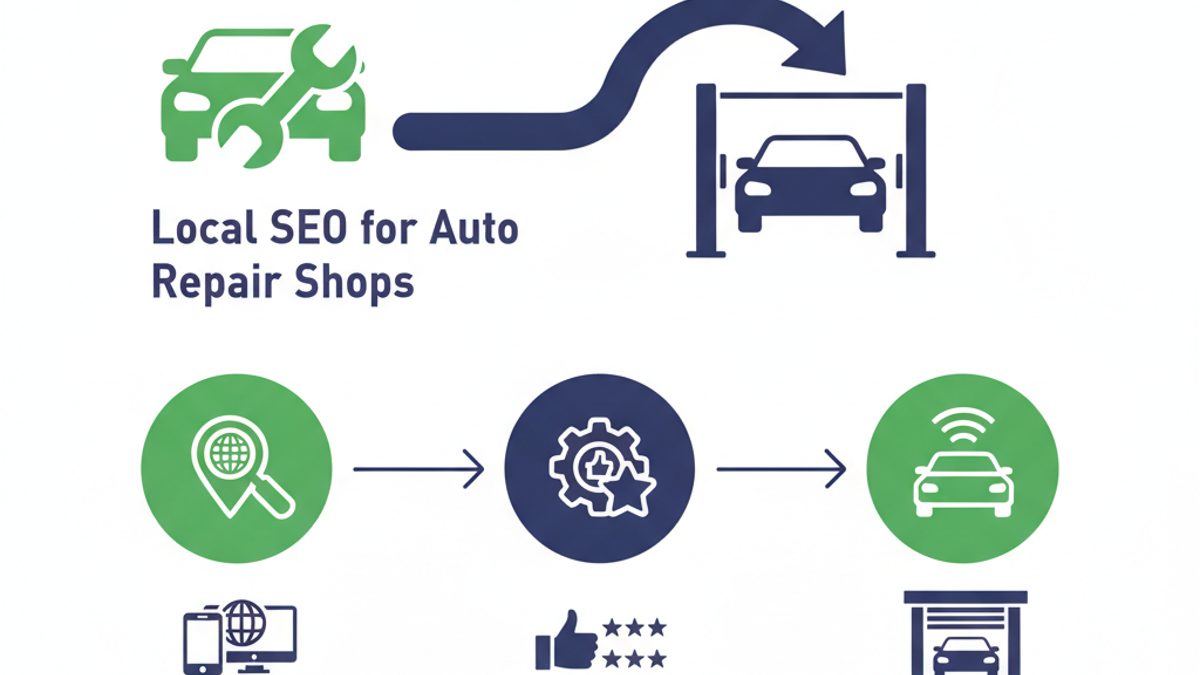
Optimizing your Google Business Profile (GBP) is the single most impactful action for auto repair shops aiming for local search dominance. A fully optimized GBP acts as your shop's digital storefront, providing critical information directly in search results and on Google Maps, enabling customers to easily find, contact, and choose your services.
Here’s a breakdown of the essential elements:
1. Accurate and Consistent NAP Information
Your Name, Address, and Phone number (NAP) must be identical across your GBP, website, and all online directories. Even slight variations, like "St." vs. "Street," can confuse search engines and dilute your local ranking signals. Ensure your business name matches your official registration, your address is precise, and your phone number is current and local.
For example, if your shop is "Shihab's Auto Repair," use that exact name everywhere. Not "Shihab's Auto Repair Shop" or "Shihab Auto Repair." This consistency is foundational for local SEO and helps search engines confidently verify your business legitimacy. You can learn more about this critical aspect in our guide on NAP consistency.
2. Strategic Category Selection
Choose your primary category carefully, as it's the most important signal for what your business does. For most auto repair shops, "Auto Repair Shop" or "Car Repair and Maintenance" will be the best primary choice. Supplement this with secondary categories that accurately reflect your specialized services, such as "Brake Shop," "Oil Change Service," "Tire Shop," "Auto Tune Up Service," or "Transmission Shop." Google allows you to select up to nine categories, so use them all if they apply.
Incorrect or insufficient categories can severely limit your visibility for relevant searches. Think about what specific services customers are searching for and ensure your categories align.
3. Compelling Business Description
Use the 750-character business description to highlight your unique selling propositions, specialties, and service area. Naturally weave in relevant keywords like "engine diagnostics," "European car repair," "truck repair," or "ASE certified mechanics" without keyword stuffing. Focus on what makes your shop stand out and why customers should choose you.
For instance, instead of just "We fix cars," try: "Expert auto repair in [City Name] specializing in reliable engine diagnostics, brake service, and routine maintenance for all makes and models. Our ASE certified technicians provide transparent, quality service you can trust."
4. High-Quality Photos and Videos
Visuals significantly boost engagement and trust. Upload high-resolution photos of your shop's exterior (from different angles, clearly showing your signage), interior (clean waiting area, organized bays), your team at work, and examples of quality repairs. Include photos of your technicians, especially if they're ASE certified. Videos, even short ones, can showcase your facility and team personality. Aim for at least 10-15 diverse photos and update them regularly. Businesses with photos receive 42% more requests for driving directions and 35% more clicks to their websites, according to Google Business Profile Help.
5. Utilizing GBP Posts and Q&A
GBP Posts are like mini-blog posts or social media updates directly on your profile. Use them to announce promotions (e.g., "10% off oil changes this month"), new services, holiday hours, or share helpful car maintenance tips. Post at least once a week to keep your profile active and fresh. The Q&A section allows customers to ask questions directly, and you (or others) can answer. Monitor this section diligently and provide prompt, helpful responses. You can also proactively seed common questions and answers to address frequent customer inquiries.
6. Proactive Review Management
Reviews are paramount for auto repair shops, influencing both search rankings and customer decision-making. Encourage every satisfied customer to leave a review. Make it easy by providing direct links or QR codes. Respond to all reviews, positive and negative, promptly and professionally. Thank positive reviewers and address negative feedback constructively, offering solutions or inviting further discussion offline. A strong review profile (4.5+ stars, 50+ recent reviews) signals trust and quality to both Google and potential customers. Our local reputation management guide offers deeper insights.
7. Service Area and Business Hours
Clearly define your service area, especially if you offer mobile repair services or pick-up/drop-off. List accurate and up-to-date business hours, including special holiday hours. If your hours vary, make sure to update them on your GBP to prevent customer frustration.
To ensure your GBP is fully optimized and outperforming competitors, ProMapRanker offers a comprehensive Google Business Profile audit. This tool helps identify gaps and provides actionable recommendations to maximize your local search visibility.
How Can Your Website Drive More Local Auto Repair Customers?
While your Google Business Profile is critical, your website serves as your digital showroom and authority hub, providing detailed information that GBP cannot. A well-optimized website reinforces your local presence, converts interested prospects, and supports your overall local SEO strategy.
1. Local Keyword Research and On-Page SEO
Identify the specific terms local customers use to find auto repair services. This goes beyond "auto repair." Think about "transmission fluid flush [your neighborhood]," "tire rotation [city]," or "car AC repair [nearby town]." Integrate these keywords naturally into your website's title tags, meta descriptions, H1 headings, and body content. Each service you offer (e.g., brake repair, oil changes, engine diagnostics) should ideally have its own dedicated page, optimized with relevant local keywords.
For example, a title tag for a brake service page might be: "Brake Repair & Service in [City Name] | [Your Shop Name]."
2. Dedicated Service Pages
Create individual pages for each major service your auto repair shop offers. This allows you to provide in-depth information, target specific keywords, and demonstrate expertise for each service. For example:
- "Oil Change Service in [City Name]"
- "Brake Repair & Replacement"
- "Engine Diagnostics & Check Engine Light"
- "Tire Sales & Installation"
- "AC Repair & Recharge"
Each page should include detailed descriptions of the service, benefits to the customer, types of vehicles serviced, and a clear call to action (e.g., "Schedule Brake Service Now").
3. Schema Markup for Local Businesses
Schema markup (structured data) helps search engines understand the context of your website's content. Implement LocalBusiness schema on your homepage, including your NAP, hours, services, and reviews. Use Service schema on individual service pages. This code tells Google exactly what your business is, where it is, and what it offers, enhancing your chances of appearing in rich snippets and local knowledge panels.
4. Mobile-Friendliness and Site Speed (Core Web Vitals)
Given that most local searches happen on mobile devices, your website must be fully responsive and load quickly. Google prioritizes mobile-first indexing, meaning your mobile site is the primary version used for ranking. Aim for excellent Core Web Vitals scores: a Largest Contentful Paint (LCP) under 2.5 seconds, a First Input Delay (FID) or Interaction to Next Paint (INP) under 200ms, and a Cumulative Layout Shift (CLS) under 0.1. Tools like Google PageSpeed Insights can help you identify and fix performance issues.
5. Local Content and Blog
Regularly publish blog posts or articles that address common car problems, maintenance tips, or local automotive news. Examples include "5 Signs Your Brakes Need Inspection in [City Name]," "Winter Car Care Tips for [Local Climate]," or "Understanding Your Check Engine Light." This type of content attracts organic traffic, establishes your shop as an authority, and provides fresh content for search engines.
How Do You Build Trust and Authority with Local Citations and Backlinks?
Beyond your Google Business Profile and website, building a strong network of local citations and backlinks is crucial for signaling trustworthiness and authority to search engines. These off-page SEO factors tell Google that your auto repair shop is a legitimate, established business in the community.
1. Consistent Local Citations
Citations are mentions of your business's NAP information on other websites, even without a link back to your site. The more consistent and accurate your NAP is across high-authority directories, the more confident Google will be in your business's existence and location. Prioritize major data aggregators like Yelp, Yellow Pages, and industry-specific directories such as AutoMD, Car Talk, RepairPal, and AAA Approved Auto Repair. Aim for citations on 20+ relevant directories. For a deeper dive, check out our guide on top local citation sites.
Regularly audit your citations to correct any inconsistencies. ProMapRanker's tools can help monitor your NAP consistency across the web, ensuring your information is always accurate.
2. Strategic Local Link Building
Backlinks from other reputable local websites are powerful endorsements. Focus on earning links from:
- Local Businesses: Partner with local tire shops, car washes, or dealerships that don't directly compete with you.
- Community Organizations: Sponsor local sports teams, charities, or events. These often come with a link from the organization's website.
- Local News Outlets/Blogs: Offer expert advice on automotive topics, or participate in local stories.
- Suppliers and Manufacturers: If you use specific parts or brands, they might feature your shop on their "dealer locator" pages.
The quality and relevance of the linking site are far more important than the quantity of links. A single link from your local Chamber of Commerce or a popular local news site is more valuable than dozens from low-quality directories.
Mastering Reviews: Your Reputation is Your Gold Standard
For auto repair shops, customer reviews are arguably the most influential ranking factor and conversion driver. They directly impact your local search visibility and, more importantly, customer trust and decision-making. People trust online reviews as much as personal recommendations.
1. Strategies for Earning More Reviews
Make it a seamless part of your customer experience. After a service is completed:
- Directly Ask: Train your staff to politely ask satisfied customers for reviews.
- Follow-up: Send a follow-up email or text message shortly after service with a direct link to your Google Business Profile review page.
- In-Shop Prompts: Place subtle signs or QR codes at your front desk or in the waiting area.
- Review Management Tools: Utilize tools that automate review requests and make it easy for customers to leave feedback.
Focus on Google reviews first, as they carry the most weight for local SEO. Then, expand to other platforms like Yelp, Facebook, and industry-specific sites.
2. Responding to All Reviews (Positive and Negative)
Your responses demonstrate that you value customer feedback and are attentive to their needs. This engagement boosts your ranking signals and improves your reputation.
- Positive Reviews: Thank the customer by name, mention the specific service they received, and invite them back. E.g., "Thank you, Sarah, for your kind words about our brake service! We appreciate your business and look forward to seeing you again."
- Negative Reviews: Respond promptly, professionally, and empathetically. Apologize for any negative experience, acknowledge their concerns, and offer to resolve the issue offline. Avoid getting defensive. E.g., "We're truly sorry to hear about your experience, John. This is not the standard of service we aim for. Please contact us directly at [phone number] so we can discuss this further and make it right."
Consistent, thoughtful responses show potential customers that you are committed to customer satisfaction.
Pro-Tip from ProMapRanker: Share of Local Voice (SoLV)
Understanding your review landscape isn't just about your star rating. ProMapRanker's Share of Local Voice (SoLV) metric provides a competitive analysis of review volume and sentiment across your local market. It helps you see how your shop compares to competitors in terms of review quantity and quality, allowing you to prioritize your reputation management efforts where they'll have the biggest impact. Are your competitors getting twice as many 5-star reviews? SoLV will tell you.
Advanced Local SEO Strategies for Auto Repair Shops
To truly dominate local search results for auto repair, you need to move beyond the basics and leverage advanced tools and tactics. This is where competitive insights and precision tracking come into play.
1. Geo-Grid Local Rank Tracking
Traditional rank tracking only shows your position from a single point, usually your shop's address. However, local search results vary significantly based on the searcher's exact location. A customer 5 miles north of your shop might see completely different results than someone 5 miles south.
ProMapRanker's geo-grid local rank tracking provides a "heatmap" view of your Google Map Pack and organic local rankings across a grid of specific locations (e.g., a 5x5 grid at 1-mile or 5-mile increments). This reveals your true local visibility, pinpointing areas where you rank well and "blind spots" where competitors are outranking you. This data is invaluable for fine-tuning your GBP optimization and targeted local marketing efforts. Learn more about geo-grid local rank tracking.
2. Competitive Analysis: Share of Local Voice and Average Rank Position (ARP)
Knowing where you stand isn't enough; you need to know where your competitors stand. ProMapRanker offers competitive metrics like:
- Share of Local Voice (SoLV): Compares your review volume and sentiment against your top local competitors.
- Average Rank Position (ARP): Shows your average ranking across your tracked keywords and grid points, relative to competitors.
These insights allow you to identify competitor strengths (e.g., they have more reviews, better rankings for specific services) and weaknesses, helping you develop targeted strategies to outperform them. If a competitor dominates a specific part of your service area for "tire repair," you can focus your GBP optimization, local content, and even local ad spend to improve your visibility in that precise area.
3. Google Local Service Ads (LSAs)
While not strictly SEO, LSAs appear at the very top of Google search results, above traditional paid ads and organic listings. Auto repair shops can become "Google Guaranteed" or "Google Screened," displaying a badge of trust. LSAs are pay-per-lead, meaning you only pay when a customer calls or messages you directly through the ad. This is a powerful way to generate high-quality leads, especially if your organic local rankings are still developing. Integrate LSAs as part of a holistic local search strategy.
4. Content Marketing for Local Relevance
Regularly creating valuable content positions your shop as an expert resource. This could include blog posts, how-to guides, or videos addressing common car issues, maintenance schedules, or even local driving conditions that affect vehicles. For example, "Common Pothole Damage in [Your City]" or "Preparing Your Car for [Local Season]'s Weather." This content not only attracts organic traffic but also provides shareable material for social media and enhances your E-E-A-T (Experience, Expertise, Authoritativeness, Trustworthiness).
Step-by-Step: Your Auto Repair Local SEO Action Plan
Here’s a practical checklist to guide your auto repair shop's local SEO efforts, ensuring you cover all critical bases and drive more cars to your bay:
- Claim and Fully Optimize Your Google Business Profile:
- Ensure NAP consistency.
- Select primary and secondary categories accurately (e.g., "Auto Repair Shop," "Brake Shop").
- Write a compelling, keyword-rich business description.
- Upload 10+ high-quality photos and videos (exterior, interior, team, work).
- Add accurate business hours and special hours.
- Define your service area.
- Use GBP Posts weekly for updates, promotions, and tips.
- Monitor and respond to all Q&A.
- Action: Use ProMapRanker's Google Business Profile audit checklist.
- Optimize Your Website for Local Search:
- Conduct local keyword research (e.g., "oil change [city name]").
- Create dedicated service pages for each offering (e.g., brake repair, engine diagnostics).
- Implement LocalBusiness and Service schema markup.
- Ensure your site is mobile-friendly and passes Core Web Vitals (LCP < 2.5s, INP < 200ms).
- Embed your Google Map and prominently display NAP information.
- Start a blog with local automotive content.
- Build and Maintain Local Citations:
- List your business on major directories (Yelp, Yellow Pages, Facebook).
- Register with industry-specific directories (AutoMD, RepairPal, AAA).
- Ensure 100% NAP consistency across all listings.
- Regularly audit citations for accuracy.
- Implement a Proactive Review Strategy:
- Systematically ask every satisfied customer for a review.
- Provide easy ways to leave reviews (direct links, QR codes).
- Respond to ALL reviews (positive and negative) promptly and professionally.
- Monitor your average star rating and review volume.
- Action: Track your Share of Local Voice with ProMapRanker.
- Earn Quality Local Backlinks:
- Seek partnerships with non-competitive local businesses.
- Sponsor local events or sports teams.
- Engage with local media or community groups.
- Get listed on local Chamber of Commerce or business association websites.
- Monitor and Analyze Your Performance:
- Utilize ProMapRanker's geo-grid local rank tracking to see your true local visibility across your service area (e.g., a 5x5 grid at 5 miles).
- Track your Average Rank Position (ARP) for key services and locations.
- Analyze competitor performance using SoLV and geo-grid data.
- Regularly check your GBP insights for calls, direction requests, and website clicks.
- Adjust your strategy based on performance data and competitive intelligence.
- Action: Start your ProMapRanker free trial to get unparalleled local insights.
How ProMapRanker Drives Your Auto Repair Shop to the Top
At ProMapRanker, we understand the unique challenges and opportunities for auto repair shops in local search. Our platform provides the precise, actionable data you need to outrank competitors and attract more customers.
Our industry-leading geo-grid local rank tracking allows you to see exactly where your shop ranks across your entire service area, not just from a single point. This "heatmap" view uncovers hidden opportunities and tells you precisely where to focus your optimization efforts. Coupled with our Google Business Profile audit tool, you get a clear, step-by-step roadmap to fix any GBP deficiencies.
Furthermore, our Share of Local Voice (SoLV) and Average Rank Position (ARP) metrics provide invaluable competitive intelligence. Understand your position in the market, identify top competitors, and craft data-driven strategies to improve your local reputation and search standing. With AI-powered insights, ProMapRanker helps you prioritize actions that will yield the highest ROI for your auto repair shop, ensuring you drive more cars to your bay consistently.
Ready to see your auto repair shop dominate local search? Sign up for ProMapRanker today and unlock the power of precision local SEO. Or, start with a free GBP audit to see where you stand.
Frequently Asked Questions
How to promote your auto repair shop?
To effectively promote your auto repair shop, focus on a multi-faceted local SEO strategy. This includes optimizing your Google Business Profile with accurate information and engaging content, building a mobile-friendly website with dedicated service pages, actively managing customer reviews, securing local citations, and considering targeted Google Local Service Ads. Consistent effort across these channels will significantly boost your shop's visibility and attract more local customers.
How much does a local SEO package cost?
The cost of a local SEO package for an auto repair shop can vary widely, typically ranging from $300 to $1,500+ per month, depending on the scope of services. Factors influencing cost include the competitiveness of your local market, the number of services offered, the complexity of your website, and whether the package includes advanced features like geo-grid tracking, content creation, or extensive link building. Basic packages might cover GBP optimization and citation building, while premium packages offer comprehensive strategies and ongoing management.
What are the 3 C's of auto repair?
While not a universally standardized industry term like the 3 R's (Repair, Replace, Rebuild), the "3 C's of auto repair" commonly refer to Customer, Car, and Competence (or Care). "Customer" emphasizes customer service and communication, "Car" focuses on the vehicle's specific needs and accurate diagnostics, and "Competence" highlights the skill, training, and professionalism of the technicians. These principles are crucial for building trust and ensuring repeat business in the auto repair industry.
How to get a local SEO?
To implement local SEO, you can either perform the optimizations yourself or hire a specialized local SEO agency. Doing it yourself involves dedicated time to learn and apply best practices for Google Business Profile, website optimization, and review management. Hiring an agency or using a tool like ProMapRanker provides expert guidance, access to specialized tools (like geo-grid tracking), and ongoing management, ensuring your local SEO strategy is consistently effective and competitive.
{"@context": "https://schema.org", "@type": "FAQPage", "mainEntity": [{"@type": "Question", "name": "How to promote your auto repair shop?", "acceptedAnswer": {"@type": "Answer", "text": "To effectively promote your auto repair shop, focus on a multi-faceted local SEO strategy. This includes optimizing your Google Business Profile with accurate information and engaging content, building a mobile-friendly website with dedicated service pages, actively managing customer reviews, securing local citations, and considering targeted Google Local Service Ads. Consistent effort across these channels will significantly boost your shop's visibility and attract more local customers."}}, {"@type": "Question", "name": "How much does a local SEO package cost?", "acceptedAnswer": {"@type": "Answer", "text": "The cost of a local SEO package for an auto repair shop can vary widely, typically ranging from $300 to $1,500+ per month, depending on the scope of services. Factors influencing cost include the competitiveness of your local market, the number of services offered, the complexity of your website, and whether the package includes advanced features like geo-grid tracking, content creation, or extensive link building. Basic packages might cover GBP optimization and citation building, while premium packages offer comprehensive strategies and ongoing management."}}, {"@type": "Question", "name": "What are the 3 C's of auto repair?", "acceptedAnswer": {"@type": "Answer", "text": "While not a universally standardized industry term like the 3 R's (Repair, Replace, Rebuild), the \"3 C's of auto repair\" commonly refer to Customer, Car, and Competence (or Care). "Customer" emphasizes customer service and communication, "Car" focuses on the vehicle's specific needs and accurate diagnostics, and "Competence" highlights the skill, training, and professionalism of the technicians. These principles are crucial for building trust and ensuring repeat business in the auto repair industry."}}, {"@type": "Question", "name": "How to get a local SEO?", "acceptedAnswer": {"@type": "Answer", "text": "To implement local SEO, you can either perform the optimizations yourself or hire a specialized local SEO agency. Doing it yourself involves dedicated time to learn and apply best practices for Google Business Profile, website optimization, and review management. Hiring an agency or using a tool like ProMapRanker provides expert guidance, access to specialized tools (like geo-grid tracking), and ongoing management, ensuring your local SEO strategy is consistently effective and competitive.See where you really rank - block by block
ProMapRanker scans Google Maps across a grid of your service area. Simple monthly plans from $19, white-label on every plan.
Start freeKeep reading
 philippines best loan apps
Philippines Best Loan Apps in 2026
The Philippines best loan apps for 2026, compared on SEC or BSP registration, loan limits, monthly rates and fees, from GCash GLoan and Maya to Tala and BillEase.
Read → best secret management tools enterprise devsecops
Best Secret Management Tools for Enterprise DevSecOps in 2026
The best secret management tools for enterprise DevSecOps in 2026, compared on pricing, free tiers, rotation, dynamic secrets and self-hosting, from Vault to Infisical.
Read → best png to svg free tool
Best PNG to SVG Free Tool in 2026
Looking for the best PNG to SVG free tool? We compared 7 free converters in 2026, from Inkscape and SVGcode to Adobe Express, on tracing quality, limits and privacy.
Read →