 ProMapRanker
Local Online Marketing: A Complete Guide
As Md Shihab Mia, founder of ProMapRanker, I've spent years immersed in the intricacies of local search, watching businesses thrive or falter based on their ability to connect with nearby customers. Local online marketing is not just a buzzword; it's the lifeline for any business serving a specific geographic area.
What is Local Online Marketing and Why is it Essential?
Local online marketing is the strategic effort to promote a business to customers within a specific geographic area through digital channels. It ensures your business appears prominently when local consumers search for products or services you offer, directly driving foot traffic, calls, and online inquiries from your immediate community.
In an increasingly digital world, the "near me" search has become a cornerstone of consumer behavior. Data from Google indicates that searches like "stores open near me" or "restaurants near me" have grown significantly, highlighting a clear intent for immediate, local solutions. For small and medium-sized businesses, this isn't just an opportunity; it's a necessity for survival and growth.
Unlike broad digital marketing, local online marketing hyper-focuses your efforts, making every marketing dollar work harder by targeting the most relevant audience. It leverages platforms like Google Business Profile, local SEO, online reviews, and geo-targeted ads to capture the attention of customers who are ready to make a purchase or visit your location right now.
What are the Key Pillars of a Successful Local Online Marketing Strategy?
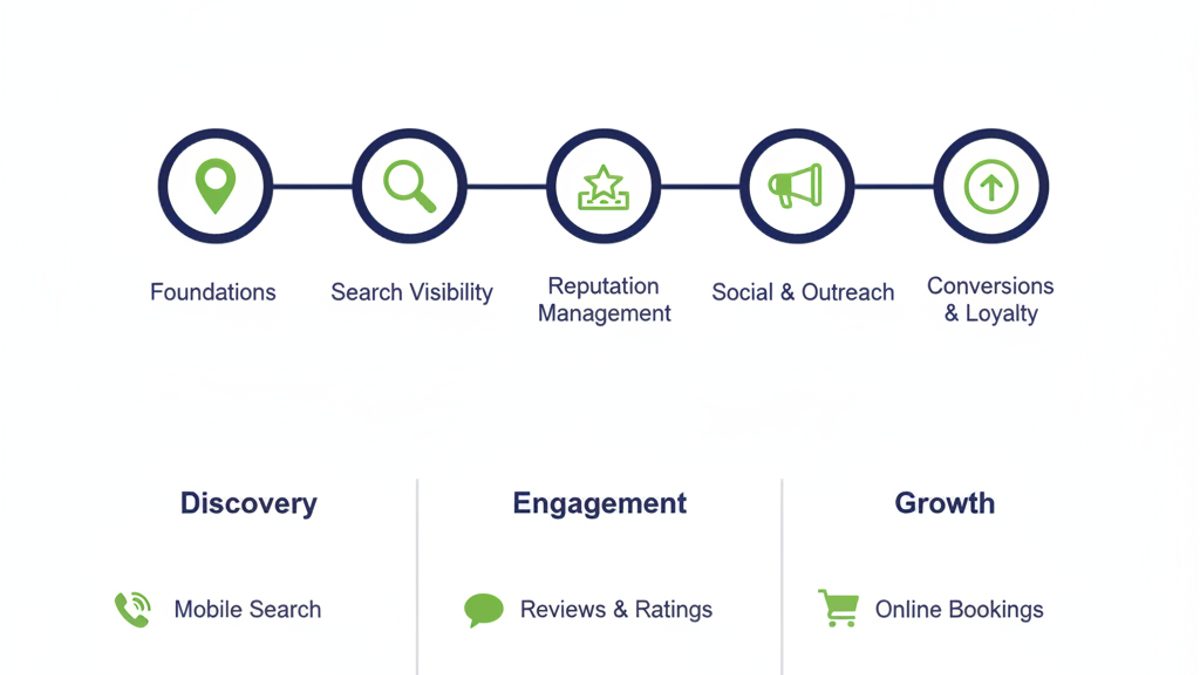
A successful local online marketing strategy is built upon several interconnected pillars, each contributing to your visibility and reputation within your target geography. Mastering these elements ensures your business is discoverable, credible, and competitive in the local search landscape.
Optimize Your Google Business Profile (GBP)
Your Google Business Profile (GBP) is arguably the single most critical component of your local online marketing strategy, acting as your digital storefront on Google Search and Maps. An optimized GBP ensures your business is discoverable, provides essential information, and builds trust with potential customers.
- Complete and Verify Your Profile: Ensure all sections are filled out accurately and completely. Verification is crucial; it establishes ownership and authenticity.
- Accurate Business Information: Maintain consistent Name, Address, Phone number (NAP) across all online listings. Inconsistencies confuse search engines and customers.
- Select Primary and Secondary Categories: Choose the most specific categories that accurately describe your business to help Google understand what you offer.
- Craft a Compelling Business Description: Use relevant keywords naturally to describe your services and unique selling propositions.
- Upload High-Quality Photos and Videos: Showcase your storefront, interior, products, and team. Businesses with photos receive more requests for directions and website clicks.
- Utilize GBP Posts: Regularly share updates, offers, events, and product news. Posts appear directly in your profile and can drive engagement.
- Answer Questions and Respond to Reviews: Actively engage with customers through the Q&A section and by thoughtfully responding to all reviews, positive and negative alike. This demonstrates excellent customer service and boosts your GBP's ranking signals. Learn more about how Google reviews help SEO.
Pro Tip: Regularly audit your GBP for accuracy and completeness. Tools like ProMapRanker offer a free GBP audit to identify gaps and opportunities for improvement, ensuring your profile is always performing at its best.
Implement Robust Local SEO & Website Optimization
Local SEO extends beyond your GBP, encompassing your entire online presence to signal relevance and authority to search engines for local queries. This involves on-page, off-page, and technical SEO tactics tailored to your geographic focus.
- NAP Consistency Across the Web: Beyond GBP, ensure your Name, Address, and Phone number are identical on your website, social media profiles, and all online directories.
- Local Keyword Research: Identify keywords customers use when searching for your services locally (e.g., "plumber [city name]," "best coffee shop near me"). Integrate these naturally into your website content. For advanced strategies, explore local keyword research with grid tracking.
- On-Page Optimization for Local Search:
- Location-Specific Content: Create service pages for each location you serve, or blog posts about local events, landmarks, or community involvement.
- Schema Markup: Implement LocalBusiness schema markup on your website to provide structured data about your business to search engines, including address, phone, hours, and reviews.
- Title Tags and Meta Descriptions: Include your target city/region and primary keywords in these elements for relevant pages.
- Technical SEO for Local Visibility:
- Mobile-Friendliness: Ensure your website is responsive and functions flawlessly on all devices, as local searches are predominantly performed on mobile.
- Page Speed: Optimize loading times, aiming for a Core Web Vitals INP under 200ms, to improve user experience and search rankings.
- SSL Certificate: Secure your website with HTTPS; it's a ranking factor and builds trust.
- Local Link Building: Acquire backlinks from relevant local websites (e.g., local chambers of commerce, community blogs, news sites). These signal local authority to Google. Discover more local link building tips.
Leverage Geo-Grid Local Rank Tracking
Traditional rank tracking only shows your business's average position, but local search results vary significantly based on the searcher's exact location. Geo-grid local rank tracking provides a precise, granular view of your business's visibility across a defined geographic area.
A geo-grid scan, typically a 5x5 or 7x7 grid with points spaced every 0.5 to 5 miles, reveals your Google Maps and organic rankings from multiple points within your service area. This visualization helps you understand where your business ranks well and where it's struggling (often visualized as red spots on the grid), allowing for targeted SEO adjustments. For a deeper dive into this, read our guide on geo-grid local rank tracking and what to do when your geo-grid is mostly red.
ProMapRanker specializes in this, offering comprehensive geo-grid scans that track not just your business, but also competitors, providing crucial insights into your local market share. This is a significant advantage over many traditional tools, serving as a powerful BrightLocal alternative for businesses serious about local dominance.
Manage Online Reviews and Reputation
Online reviews are powerful social proof, influencing over 90% of consumers' purchasing decisions. Actively managing your online reputation is crucial for local trust and ranking signals.
- Encourage Reviews: Implement strategies to gently ask satisfied customers for reviews on Google, Yelp, and industry-specific platforms. Make the process easy for them.
- Respond to All Reviews: Acknowledge every review, positive or negative. For positive reviews, express gratitude. For negative ones, apologize, empathize, and offer a solution offline. This shows you care about customer experience.
- Monitor Review Platforms: Stay vigilant across all major review sites to catch new reviews and respond promptly.
- Understand Share of Local Voice (SoLV): This metric helps you understand your market share in terms of online conversations and reviews compared to competitors. Tools like ProMapRanker can help you track and improve your Share of Local Voice.
Develop Local Content Marketing
Creating content that resonates with your local audience establishes your business as a community expert and resource.
- Local Blog Posts: Write about local events, community news, partnerships with other local businesses, or solutions to common local problems related to your industry.
- Location-Specific Landing Pages: If you serve multiple areas, create unique landing pages optimized for each location, detailing specific services offered there.
- "Best Of" Guides: Curate lists of local attractions, restaurants, or services that subtly integrate your business.
Engage with Local Social Media Marketing
Social media offers direct avenues to connect with your local community and drive engagement.
- Geo-Tagged Posts: Always tag your location in posts to increase local visibility.
- Join Local Groups: Participate in local Facebook groups, Nextdoor communities, or other neighborhood forums to offer advice and build connections.
- Run Local Campaigns: Use social media advertising with precise geo-targeting to reach users within a specific radius of your business.
- Share Local Content: Promote your local blog posts, events, and community involvement on your social channels.
Consider Paid Local Advertising
While organic efforts are foundational, paid advertising can significantly accelerate your local visibility.
- Google Ads Local Campaigns: These campaigns focus on driving store visits, calls, and local actions, appearing prominently in Google Search, Maps, YouTube, and partner sites.
- Geo-Targeted Social Media Ads: Platforms like Facebook and Instagram allow you to target users based on their precise location, interests, and demographics, making them ideal for local promotions.
- Local Directory Ads: Some local directories offer premium placement or ad options for increased visibility.
How to Measure Your Local Online Marketing Success?
Measuring the effectiveness of your local online marketing efforts is crucial for optimizing strategies and demonstrating ROI. Without tracking, you're flying blind.
The primary metrics to monitor include:
- Google Business Profile Insights: Track calls, direction requests, website visits, and direct/discovery searches from your GBP dashboard.
- Website Analytics: Monitor local organic traffic, conversion rates from local visitors, and bounce rates for location-specific pages.
- Geo-Grid Rankings: Regularly check your geo-grid scans for improvements in your local search positions across your service area. This is where tools like ProMapRanker excel, providing detailed historical data and competitor comparisons.
- Online Review Volume and Sentiment: Track the number of new reviews, your average star rating, and the overall sentiment of customer feedback.
- Local Citations and Backlinks: Monitor the growth of your local directory listings and backlinks from local authoritative websites.
- Share of Local Voice (SoLV): Understand your business's presence in local online conversations compared to competitors. ProMapRanker's SoLV metric provides a clear picture of this.
For agencies and businesses managing multiple locations, ProMapRanker provides advanced reporting features, including white-label local SEO reporting, allowing you to scale rank tracking and insights efficiently across all your clients or locations.
Step-by-Step Action Plan for Local Online Marketing
Ready to implement a winning strategy? Follow this actionable checklist:
- Claim and Optimize Your Google Business Profile:
- Verify your business.
- Fill out all sections completely and accurately (NAP, hours, services, categories).
- Add high-quality photos and videos.
- Enable messaging and Q&A.
- Conduct Local Keyword Research:
- Identify service + city/neighborhood keywords.
- Look for "near me" variations.
- Optimize Your Website for Local SEO:
- Ensure NAP consistency across your site.
- Create location-specific content.
- Implement LocalBusiness schema markup.
- Check mobile-friendliness and page speed.
- Build Local Citations and Backlinks:
- List your business on 20+ relevant online directories (Yelp, Yellow Pages, industry-specific sites).
- Seek partnerships with local businesses for reciprocal links or mentions.
- Engage with local media or community groups.
- Implement a Review Generation and Management Strategy:
- Actively ask satisfied customers for reviews.
- Respond promptly and professionally to all reviews.
- Create Local Content:
- Start a blog with local topics (events, guides, news).
- Share customer success stories relevant to your area.
- Engage on Social Media Locally:
- Use geo-tags in all relevant posts.
- Join and participate in local community groups.
- Run geo-targeted social media ads for promotions.
- Monitor and Analyze Performance:
- Set up ProMapRanker for geo-grid rank tracking and GBP audits.
- Regularly check GBP Insights and Google Analytics.
- Track your Share of Local Voice and competitor performance.
- Iterate and Improve:
- Based on your data, refine your strategies.
- Experiment with new tactics and content ideas.
Where Can You Advertise Locally for Free?
You can advertise locally for free through several effective online and offline channels, primarily by leveraging free listing services and community engagement. The most powerful free tool is your Google Business Profile, which allows you to appear in Google Maps and local search results without direct advertising costs.
Beyond GBP, here are key avenues for free local advertising:
- Google Business Profile (GBP): Create and optimize your profile for free. This is paramount for local visibility, allowing you to list your business, hours, services, and collect reviews.
- Social Media Platforms: Create business pages on platforms like Facebook, Instagram, and LinkedIn. Post regularly, engage with local groups, and use relevant local hashtags and geo-tags to reach your community without spending on ads.
- Online Directories and Citation Sites: List your business on free directories such as Yelp, Yellow Pages, Foursquare, and industry-specific aggregators. Ensure NAP consistency across all listings.
- Local Community Websites and Forums: Participate in local online forums, community blogs, or neighborhood platforms like Nextdoor. Offer helpful advice, answer questions, and subtly promote your expertise.
- Local Partnerships and Cross-Promotions: Collaborate with non-competing local businesses for mutual promotion. This could involve social media shout-outs, joint events, or shared flyers.
- Local Events and Sponsorships: Offer to speak at local events, sponsor a local sports team, or participate in community fairs. While some sponsorship may involve a small fee, participation can often be free or low-cost, offering significant local exposure.
- Email Marketing: Build an email list of local customers and send regular newsletters with updates, promotions, and local news.
- Content Marketing: Create valuable, localized content (blog posts, guides) on your website that answers local questions or highlights local interests. This attracts organic search traffic from your community.
The Future of Local Search: AI and Generative Experiences
The landscape of local search is continually evolving, with Artificial Intelligence (AI) and Generative Engine Optimization (GEO) poised to reshape how businesses connect with local customers. Google's AI Overviews, powered by large language models, are increasingly providing direct answers and recommendations, often sourcing information from well-optimized local profiles and content.
This means that simply ranking high isn't enough; your business needs to be the definitive, trustworthy answer to a user's query. Generative AI will prioritize businesses that offer comprehensive, accurate, and contextually rich information, making your Google Business Profile and website content more critical than ever. Understanding Generative Engine Optimization (GEO) for local search will be key.
At ProMapRanker, we're already preparing for this shift. Our platform includes advanced capabilities to track Maps and AI ranks on the same grid, providing insights into how your business performs in both traditional and AI-driven search results. This proactive approach ensures our users are always ahead of the curve, optimizing for current and future search behaviors.
Frequently Asked Questions
What is the 3-3-3 rule in sales?
The 3-3-3 rule in sales is a guideline suggesting that sales professionals should aim to make three calls, send three emails, and connect with three prospects on social media each day. Its purpose is to encourage consistent, multi-channel outreach and maintain momentum in sales prospecting activities.
What is the 3 3 3 rule in social media?
The 3-3-3 rule in social media typically suggests posting three times a day: once about your business (promotional), once about something helpful or educational (value-driven), and once about something personal or engaging (community-building). This approach aims to balance promotion with value and engagement to maintain an active and appealing social media presence.
How often should I update my Google Business Profile?
You should aim to update your Google Business Profile regularly, ideally at least once a week with fresh GBP posts about offers, events, or news. Core information (hours, services) should be reviewed monthly for accuracy, and new photos or responses to reviews should be added as they arise, ensuring your profile remains dynamic and up-to-date.
Is local SEO only for brick-and-mortar businesses?
No, local SEO is not only for brick-and-mortar businesses. Service-area businesses (SABs) that serve customers at their locations (e.g., plumbers, electricians) also benefit immensely from local SEO, even if they don't have a physical storefront. While their address might be hidden, optimizing their Google Business Profile and website for their service areas is crucial for attracting local leads.
What is the Google Map Pack?
The Google Map Pack, also known as the Local Pack, is a prominent block of three business listings that appears at the top of Google's search results for local queries, typically above organic search results and accompanied by a map. It includes key information like business name, star rating, address, and phone number, and is a critical driver of local traffic and customer inquiries. Understanding what is the Google Map Pack is essential for local visibility.
Local online marketing isn't just a strategy; it's a fundamental shift in how businesses connect with their most valuable customers. By mastering your Google Business Profile, optimizing your website for local search, actively managing your reputation, and leveraging precise tools like geo-grid rank tracking, you can ensure your business doesn't just survive, but thrives in the competitive local marketplace.
Ready to see exactly where your business ranks in your local service area? Start your journey with ProMapRanker today and gain unparalleled insights into your local search performance. Or, begin with a free GBP audit to pinpoint your immediate opportunities for growth.
See where you really rank - block by block
ProMapRanker scans Google Maps across a grid of your service area. Simple monthly plans from $19, white-label on every plan.
Start free