 ProMapRanker
Liveblocks Alternatives in 2026

Key takeaways
- Ably and Pusher suit teams that need managed realtime messaging without building infrastructure from scratch.
- Convex and Supabase suit teams that want data and realtime updates in one backend rather than a separate messaging layer.
- PartyKit, LiveKit, and Socket.IO suit teams that want more control over hosting, cost, or a specific realtime pattern.
- Firebase remains a practical pick for small teams that already use Google services and need a fast start.
- PubNub fits large, chat-heavy or event-heavy products where global delivery and message history matter more than price.
Quick comparison
| Pick | Great for | Pricing starts at | Free tier | |
|---|---|---|---|---|
 Ably | Managed realtime messaging at scale | $29 per month | Yes | Visit |
 Pusher | Simple pub/sub for web and mobile apps | $49 per month | Yes | Visit |
 PubNub | Chat and live events at global scale | See website | Yes | Visit |
 Convex | Realtime apps with a built-in backend | See website | Yes | Visit |
 Supabase | Postgres apps with realtime updates | See website | Yes | Visit |
 PartyKit | Edge-based multiplayer features | See website | Yes | Visit |
 Firebase | Fast starts on Google infrastructure | Free | Yes | Visit |
 LiveKit | Live audio, video, and data rooms | See website | Yes | Visit |
 Socket.IO | Self-hosted realtime connections | Free | Yes | Visit |
The best liveblocks alternatives
Liveblocks focuses on multiplayer collaboration, including presence, comments, and shared editing. The tools below cover that same ground in different ways, from hosted messaging to full backends and open source libraries. Pick by the part you actually need to build first.

Ably gives teams a hosted realtime platform for pub/sub messaging, presence, and live updates. It works well when an app needs many concurrent connections and steady delivery without a dedicated infrastructure team. The documentation and SDK range also make it easier to add realtime features to web, mobile, and server code in one project.
The trade-off is cost planning. Teams should model peak connections and message volume before launch, since both drive the bill. For a small prototype, the free plan is a useful test bed, but production apps with constant traffic should compare Ably against a self-hosted option before committing.
- Global realtime network
- Broad SDK coverage
- Presence and message history built in
- Usage-based pricing can grow quickly
- Advanced features need higher plans
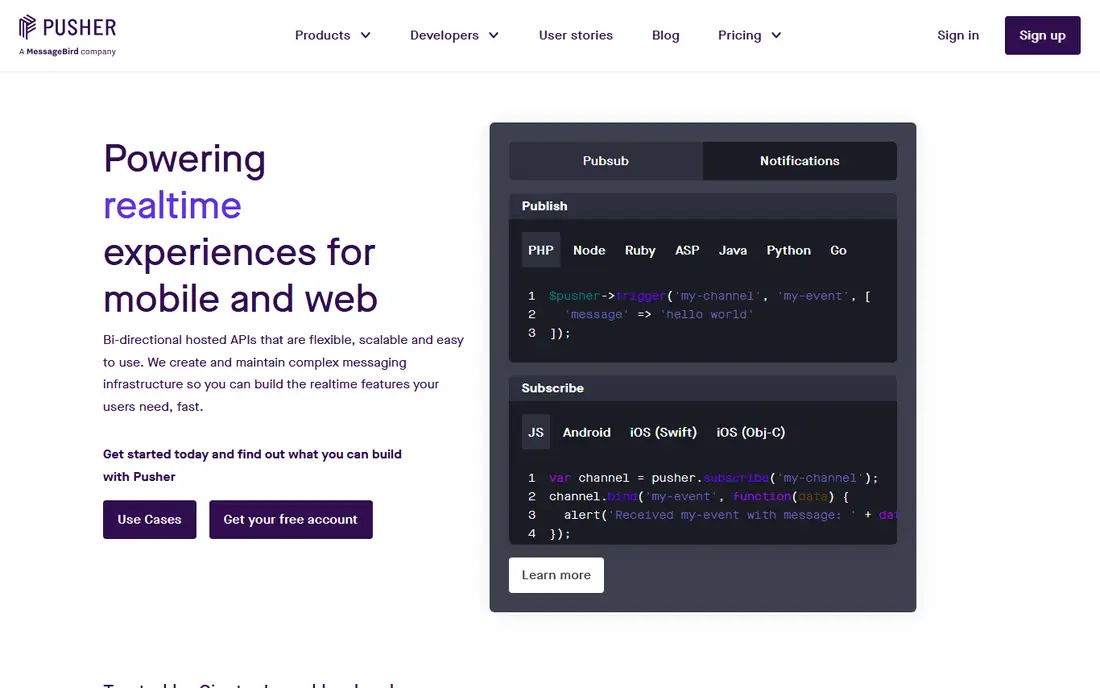
Pusher Channels is one of the simplest ways to add live dashboards, notifications, and chat-like updates to an app. Developers publish events to channels, and subscribed clients receive them over WebSockets with an HTTP fallback. That model is easy to explain to a team and easy to debug in early development.
The catch is that Pusher is a messaging layer, not a collaboration suite. Teams that need shared document state, conflict handling, or comments will still need to build that logic themselves. It is strongest when the realtime need is broadcast and presence, rather than deep co-editing.
- Easy setup for channels and events
- Clear channel model
- Separate push product for notifications
- Paid plans start higher than some rivals
- Connection limits matter at scale
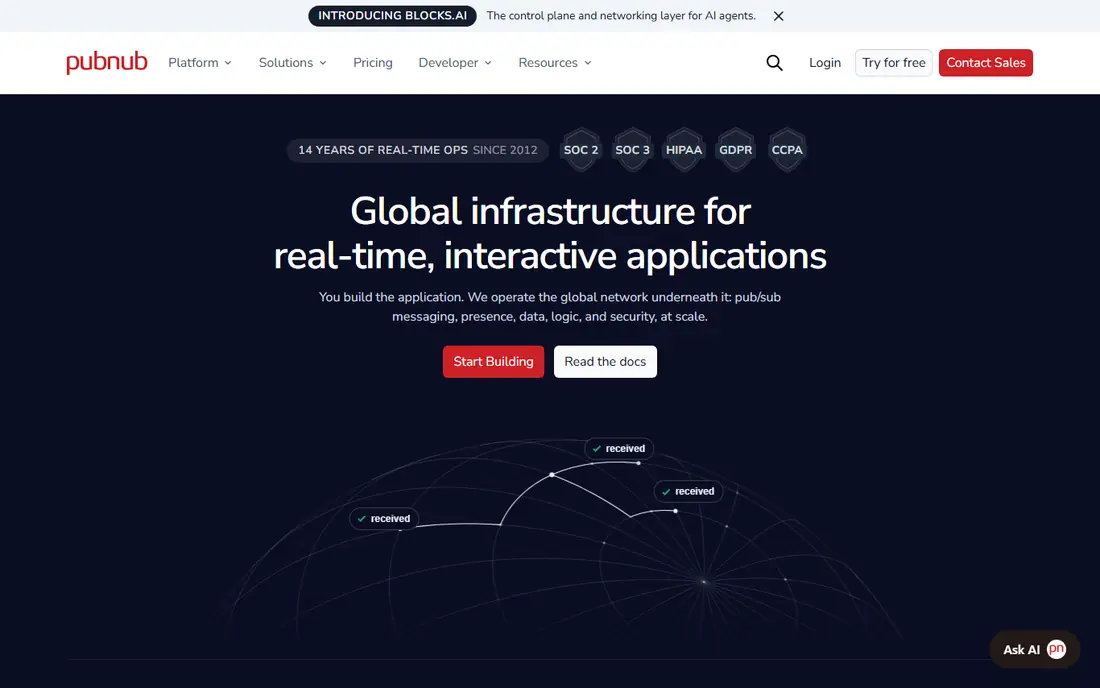
PubNub targets chat, live events, location updates, and Internet of Things messaging. Its edge network and failover design suit products where a dropped update is visible to users, such as a live event feed or a support chat. Built-in message storage and server-side functions reduce the extra services a team must run.
For a small app, PubNub can feel larger than needed. The platform covers many use cases, so the first setup takes longer than a single-purpose library. It earns its place when scale, reliability, and chat features are the main buying reasons.
- Global edge network
- Chat, presence, and push in one platform
- Message history and functions
- Pricing needs a sales conversation for larger use
- Feature breadth adds learning time
Convex treats realtime as a normal part of the database, not an add-on. When data changes, subscribed clients update without polling or a separate sync service. That design shortens the path from a data model to a live collaborative screen, especially for teams building with TypeScript and React.
The honest limit is fit. A team already invested in Postgres or another database may not want to move its data model for realtime alone. Convex is most attractive for new apps, internal tools, and products where the backend can be chosen fresh.
- Realtime queries update clients automatically
- Database, auth, and functions in one place
- TypeScript-first workflow
- Less suited to teams committed to another database
- Smaller ecosystem than older backends
Supabase gives developers a Postgres database plus auth, storage, edge functions, and realtime subscriptions. Teams that like SQL and want full control over their data often prefer it to a proprietary backend. The hosted cloud removes much of the setup work, while the open source code allows self-hosting for teams with strict data rules.
Realtime in Supabase follows database changes, so it fits data-driven screens such as dashboards, feeds, and shared lists. It is less of a ready-made collaboration editor than Liveblocks. Teams building document co-editing will need extra work on conflict handling and presence.
- Open source Postgres backend
- Auth, storage, and realtime in one project
- Generous free tier for testing
- Realtime features need Postgres configuration
- Self-hosting adds operational work
PartyKit lets developers build stateful multiplayer rooms that run close to users. It suits collaborative whiteboards, multiplayer games, live cursors, and shared editing prototypes. The room model maps well to a document, a game session, or a live workspace, and the open source code gives teams a self-hosting path.
Because PartyKit is now part of Cloudflare, buyers should check current pricing and limits on the official site before planning a budget. It is a strong pick for builders who are comfortable with JavaScript and edge concepts, and a weaker pick for teams that want a fully managed collaboration suite with no code.
- Stateful rooms on edge infrastructure
- Open source option
- Good fit for games and collaborative tools
- Cloudflare ownership changes pricing and packaging over time
- Smaller vendor support team than large platforms
Firebase Realtime Database and Firestore both sync data to clients as it changes. That makes Firebase a natural choice for chat, shared lists, live scores, and simple collaborative screens. Auth, hosting, and cloud functions sit in the same project, so a small team can ship without assembling many vendors.
The main caution is data modeling. Firestore queries and pricing reward a careful structure, and a design that reads too much data can become expensive. Firebase is best when the team already uses Google Cloud, or when speed to a working product matters more than full control over the database.
- Realtime Database and Firestore for live sync
- Auth and hosting included
- Large community and guides
- Query limits can shape the data model
- Costs need care at high read and write volume
LiveKit started as a realtime media platform, but its data channels also carry custom messages between room members. That combination suits products that mix voice, video, and shared state, such as tutoring tools, live events, and multiplayer workspaces. The open source server can run on a team's own infrastructure.
For a purely text-based editor, LiveKit is more machinery than needed. Teams should pick it when live media is part of the product, not just a future idea. When media matters, its room model and SDK coverage are a clear advantage over a text-only messaging service.
- Open source realtime media
- Data channels for custom sync
- Cloud and self-hosted options
- Media focus means more setup for text-only collaboration
- Scaling media rooms needs planning
Socket.IO is a widely used library for bidirectional communication between browsers and servers. It handles rooms, namespaces, reconnection, and fallbacks, which covers the transport layer for chat, dashboards, and multiplayer features. Because it is free and open source, the software cost is zero.
The cost moves to operations instead. A team must host, monitor, and scale its own servers, and must design presence, history, and conflict handling itself. Socket.IO is the right pick for teams with backend skills and a tight budget, and the wrong pick for teams that want a managed collaboration product out of the box.
- Free and open source
- Long track record
- Rooms, namespaces, and fallbacks included
- Teams run and scale the servers
- Collaboration state must be built on top
How we picked these
We compared official feature pages, pricing pages, app store listings where relevant, public documentation, and public reviews for realtime and collaboration tools. We kept only products that exist and work in October 2026 and that cover a clear part of the Liveblocks use case, such as messaging, presence, live data sync, or media rooms. We left out the named product itself and tools that only handle one-way notifications with no live interaction.
What to check before you choose
Start with the interaction you must ship first. A live dashboard needs messaging, a shared editor needs state and conflict handling, and a live classroom needs media plus data. That single decision narrows the list faster than comparing feature tables line by line.
Next, test with real connection counts, not just one browser tab. Open many clients, disconnect and reconnect, and watch how presence and missed messages behave. A tool that feels instant with two users can behave differently with two hundred, and that gap is where production problems usually appear.
Finally, model price at your expected peak, including message volume, connections, and storage. Free tiers help with prototypes, but they rarely describe a busy product. Check the vendor pricing page again before signing, since usage limits change more often than headline features.
Frequently asked questions
What is the closest alternative to Liveblocks for collaborative editing?
PartyKit and Convex come closest for builders, since both support shared state and live updates. Neither is a drop-in copy, so teams should expect to build editor logic, presence, and comments on top. For a managed chat or presence layer, Ably and Pusher are closer to a ready service.
Can I replace Liveblocks with a free tool?
Yes, for a prototype or a small internal tool. Socket.IO is free and open source, and Supabase, Firebase, and PartyKit offer free tiers. The free route works best when the team can host or configure the backend, and when user counts stay modest.
Do I need a separate database with Ably or Pusher?
Yes, in most designs. Ably and Pusher move messages, but they do not replace a database for long-term storage. Teams usually pair them with Postgres, Firestore, or another store for history, permissions, and user data.
Which option is best for chat?
PubNub and Ably are strong for chat at scale, since both cover presence, history, and push. Firebase also works well for smaller chat products, especially when auth and hosting already live in the same project.
How do Convex and Supabase differ for realtime apps?
Convex updates clients automatically from its own database and query model. Supabase streams Postgres changes to subscribed clients. The practical difference is whether the team wants a new integrated backend or wants to keep Postgres at the center.
Sources
See where you really rank - block by block
ProMapRanker scans Google Maps across a grid of your service area. Simple monthly plans from $19, white-label on every plan.
Start freeKeep reading
 zyte alternatives
Best Zyte Alternatives in 2026
These zyte alternatives cover managed scraping APIs, proxy networks and no code tools for lawful collection from your own or consented sources only in 2026.
Read → zerto alternatives
Best Zerto Alternatives in 2026
Compare the best zerto alternatives for disaster recovery and replication, with recovery targets, cloud options and honest trade-offs for teams in 2026.
Read → zerofox alternatives
Best ZeroFox Alternatives in 2026
We compared 9 zerofox alternatives for brand protection, phishing takedowns, dark web monitoring, and social impersonation, with clear coverage notes.
Read →