 ProMapRanker
Langfuse Alternatives in 2026


LangChain and LangGraph teams · Pricing starts at: $39 per seat per month
Key takeaways
- LangSmith suits LangChain and LangGraph teams, while Arize Phoenix suits teams that want open, framework-neutral tracing.
- Helicone is the fastest to start, because it works as a proxy, while Braintrust and Comet Opik suit evaluation-led teams.
- Self-hosting matters: Phoenix and Opik offer free self-hosted options, while LangSmith self-hosting is an enterprise feature.
- Pricing units differ, so compare traces, spans, seats, and data volume for your real traffic before choosing.
Quick comparison
| Pick | Great for | Pricing starts at | Free tier | |
|---|---|---|---|---|
| LangSmith | LangChain and LangGraph teams | $39 per seat per month | Yes | Visit |
 Arize Phoenix | Open self-hosted tracing | Free | Yes | Visit |
 Helicone | Fast proxy-based cost tracking | $79 per month | Yes | Visit |
 Braintrust | Evaluation-led development | $249 per month | Yes | Visit |
 Comet Opik | Budget open-source observability | $19 per month | Yes | Visit |
 Weights and Biases Weave | ML teams already using Weights and Biases | $60 per month | Yes | Visit |
 PromptLayer | Prompt versioning for product teams | $49 per month | Yes | Visit |
 Portkey | AI gateway with observability | $49 per month | Yes | Visit |
 Maxim AI | Agent simulation and testing | $29 per seat per month | Yes | Visit |
 HoneyHive | Evaluation and prompt workflows | See website | Yes | Visit |
The best Langfuse alternatives
This list covers only alternatives, with tracing, evaluation, prompt management, or cost tracking for large language model apps. We group them by their main strength, because a proxy tool, an evaluation platform, and a gateway solve different problems, even though all of them log model calls.
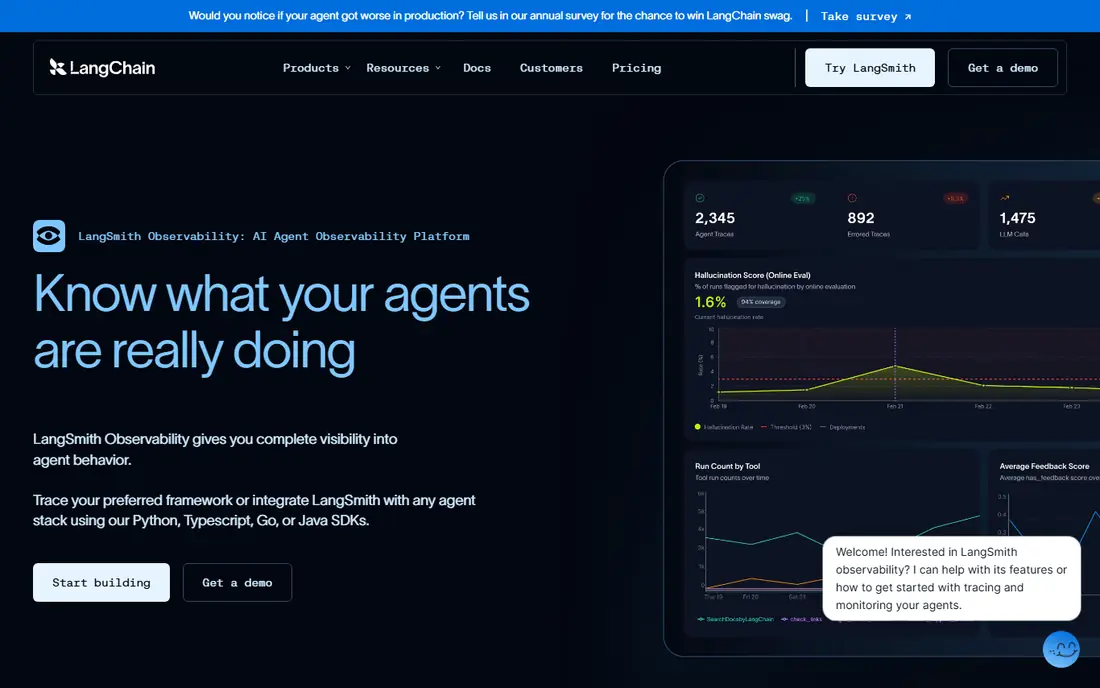
LangSmith is the natural alternative for teams already building with LangChain or LangGraph. Its tracing understands LangChain runs, agents, and retrieval steps natively, and its evaluation tools support offline and online testing with experiment comparison. The Prompt Hub adds versioned prompts that teams can share and test without editing code for every change.
The catch is cost structure. The free Developer plan covers 5,000 traces per month in recent summaries, and Plus costs $39 per seat per month plus trace overage, so a team with many engineers and high trace volume can see bills rise quickly. Self-hosting is also an enterprise feature, not a free option. For LangChain teams, the depth is worth it. For framework-neutral teams, a more open tool may fit better.
- Deepest tracing for LangChain and LangGraph
- Strong evaluation and prompt hub
- Good experiment comparison
- Pricing scales per seat plus trace usage
- Self-hosting is enterprise only
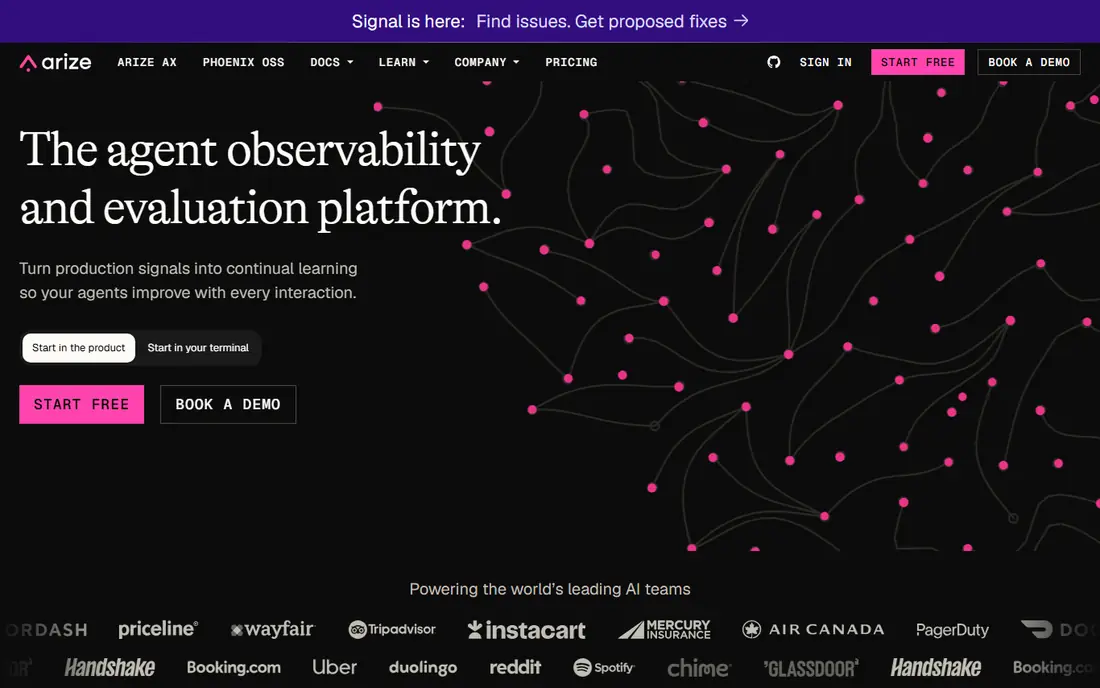
Arize Phoenix is the strongest open alternative for teams that want tracing without vendor lock-in. The open-source tool is free to self-host, is built on OpenTelemetry, and works across frameworks, not only one stack. Its evaluation library covers hallucination, relevance, faithfulness, and retrieval metrics, which matters once a team moves from asking if an agent works to asking if it is improving.
The honest distinction is between Phoenix and Arize AX. Phoenix is the free open tool, while AX is the managed cloud platform, with a free tier of 25,000 spans per month and Pro at $50 per month in recent summaries. Teams that self-host Phoenix get tracing and evaluation at no license cost, but they own operations. Teams that want managed hosting should price AX, not assume Phoenix pricing applies.
- Free open-source tracing
- OpenTelemetry native
- Strong evaluation library
- Cloud pricing is separate from the open-source tool
- Enterprise features sit in Arize AX
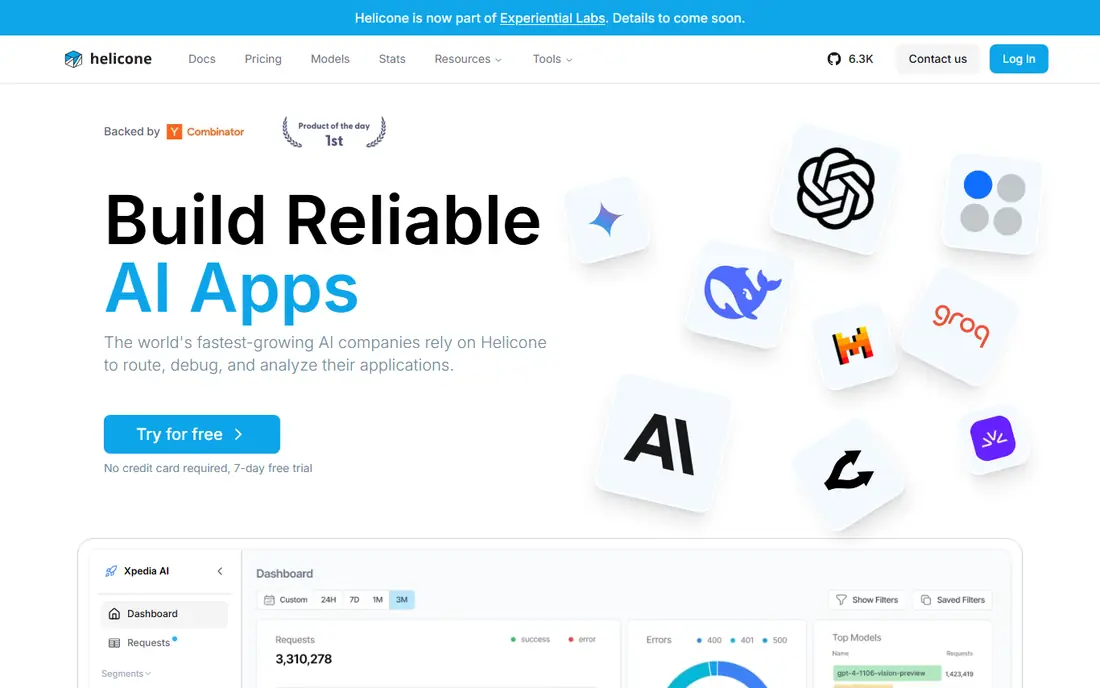
Helicone is the fastest alternative to start, because it works as an HTTP proxy. Change the base URL, and every model call is logged automatically, with no instrumentation code, decorators, or SDK wrappers. That makes it ideal for teams that need immediate cost visibility on raw API calls, with a free tier of 10,000 requests per month and Pro at $79 per month in recent summaries.
The trade-off is depth. Because Helicone works at the HTTP layer, it sees requests and responses but has less native context on agent reasoning chains than SDK-based tools. Evaluation depth is also lighter. For cost tracking and quick setup, Helicone is excellent. For deep agent debugging, pair it with, or choose, a tracing-first tool.
- Fastest setup through a proxy URL change
- Clear per-request cost tracking
- Open-source proxy
- Proxy view is shallower than SDK tracing for agent steps
- Evaluation depth is lighter
Braintrust puts evaluation first, which suits product teams whose main loop is changing a prompt, running an evaluation, and comparing scores. Its Starter plan is free with 1 GB of processed data and 10,000 scores in recent summaries, and Pro costs $249 per month with 5 GB and 50,000 scores, plus model credits for judge scoring and playground runs. That model rewards teams that run heavy evaluations on small payloads.
The catch is the jump from free to paid, which is the steepest in this list, and the billing unit is different from trace-based tools, so direct price comparison needs care. Teams logging large production prompts may also find per-GB charges add up. For evaluation-led development, Braintrust is one of the most polished options available.
- Evaluation-first workflow
- Prompt, dataset, and experiment tools
- Unlimited users on paid plans in some summaries
- Steepest entry price in this list at $249 per month
- Pricing is based on data and scores, not traces alone
Comet Opik, often called Opik, is the budget open-source pick. Its entire feature set, including guardrails and online evaluation, sits in the open-source build, with no enterprise key gating core features. The cloud free tier covers 25,000 spans per month in recent summaries, and Pro Cloud costs $19 per month with 100,000 spans, plus usage beyond that.
The honest limit is ecosystem size. Opik is newer and smaller than LangSmith or Arize, so integrations and community examples are thinner in some areas. For teams that need an OSI-approved license, low entry cost, and full-featured self-hosting, Opik is one of the strongest alternatives here, and its pricing is easy to understand.
- Apache 2.0 open-source build with full features
- Low cloud entry price
- Self-hosting with Docker and Kubernetes
- Smaller ecosystem than the largest platforms
- Cloud pricing is usage-based beyond the entry tier
Weights and Biases Weave, often called W and B Weave, suits teams that already track machine learning experiments and fine-tuning in Weights and Biases. Weave adds LLM tracing, evaluation, and prompt tracking to that same workspace, so a team can follow a model from training data through fine-tuning to production prompts without switching tools.
The trade-off is fit. Teams with no Weights and Biases history may prefer a tracing-first tool with a lower entry price or a free self-hosted option. Recent summaries list Pro at $60 per month with a free tier also available. For ML-heavy teams, the unified workspace is a real advantage. For pure LLM app teams, it may be more platform than needed.
- Combines LLM tracing with experiment and fine-tuning tracking
- Familiar to ML teams
- Good evaluation tools
- Pro entry at $60 per month in recent summaries
- Strongest for teams already in the Weights and Biases ecosystem
PromptLayer is the prompt-focused alternative. Product teams can edit, version, and test prompts without an engineer for every change, while logging requests and tracking performance over time. That workflow suits teams where prompt quality is the main lever, and where marketing, product, and engineering all need to see prompt history.
The honest weakness is tracing depth. PromptLayer logs and versions prompts well, but it is not as deep on multi-step agent tracing as LangSmith or Phoenix. Teams that need both prompt management and deep agent debugging may need a second tool. For prompt-led teams, PromptLayer is simple, clear, and practical.
- Friendly prompt editing and versioning
- Request logging and analytics
- Good for non-engineer product teams
- Less deep on agent tracing than LangSmith or Phoenix
- Entry price is $49 per month in recent summaries
Portkey is an AI gateway first, with observability built in. It routes requests across providers, adds fallbacks and caching, and logs cost and performance in one place, which suits teams that use several model providers and want one control point. Recent summaries list a free tier and paid plans from $49 per month.
The catch is scope. If you only need tracing and evaluation, a gateway may add complexity you do not need, and some controls sit on enterprise plans. Portkey was also reported as acquired by Palo Alto Networks in May 2026 in one summary, so teams should confirm roadmap and terms before a long commitment. For multi-provider teams, the gateway plus observability combination is compelling.
- Gateway with routing, fallbacks, and caching plus observability
- Cost tracking across providers
- Guardrails
- Gateway scope is broader than pure observability
- Enterprise features gate some controls
Maxim AI focuses on testing agents before release, with simulation and evaluation workflows that help teams find failure modes early. Recent summaries list a free Developer plan and a Professional plan at $29 per seat per month, with evaluation and testing tools at the center. That pre-release focus is different from production tracing, and it fills a gap many teams feel.
The honest limit is maturity. Maxim AI is newer and smaller than LangSmith or Arize, so production tracing depth and ecosystem coverage are thinner in some areas. For teams that want to simulate agents, test prompts, and catch regressions before shipping, Maxim AI is a strong specialist pick, best paired with a production tracing tool.
- Agent simulation and pre-release testing
- Evaluation workflows
- Free Developer plan
- Newer and smaller than the largest platforms
- Pricing and features have changed as the product evolved
HoneyHive combines evaluation, prompt management, and observability for teams that want one workflow from prompt iteration to production monitoring. Its evaluation tools help teams compare prompt versions and model outputs, while its tracing shows what happened in production. A free tier is listed in recent summaries, with paid pricing quoted rather than published as a single starting price.
The trade-off is price transparency and scale. Without a published starting price, budgeting needs a sales conversation, and the ecosystem is smaller than LangSmith or Arize. For product teams that want evaluation and prompts in one place without stitching together several tools, HoneyHive is worth a trial.
- Evaluation, prompt management, and observability in one product
- Friendly workflow for product teams
- Pricing is not published as a single starting figure in recent summaries
- Smaller ecosystem than the largest rivals
How we picked these
We compared official vendor pages and October 2026 public LLM observability comparisons for tools that offer tracing, evaluation, prompt management, cost tracking, or gateway observability for language model apps. We favored tools that are live today, publish pricing or a free tier, and fit a distinct need, from proxy setup to self-hosting to evaluation-led development. We listed prices as See website where recent summaries conflicted or pricing was quoted, and we compared pricing units carefully, because traces, spans, seats, and data volume are not the same measure. We did not claim hands-on testing of every platform on the same workload.
How to choose the right alternative
Start with your stack and your main problem. LangChain and LangGraph teams should trial LangSmith first. Teams that want open, framework-neutral tracing should trial Arize Phoenix, with Comet Opik as the budget open-source option. Teams that need cost visibility today should trial Helicone, because proxy setup takes minutes. Teams that live in evaluation should trial Braintrust, Maxim AI, or HoneyHive, depending on whether production tracing or pre-release simulation matters more.
Compare pricing on your real traffic shape
Do not compare headline prices alone. A single user request can produce many spans, so a tool priced per span can cost far more than a tool priced per trace at the same request volume. Model your real trace shape: requests per month, spans per request, engineers who need seats, data volume, and evaluation scores per month. Run a trial with production-like traffic, check retention limits, and confirm overage rates in writing before committing to a paid tier.
Check self-hosting, data residency, and compliance
If data residency or security review matters, check self-hosting, regions, and compliance certifications before you invest in migration. Phoenix and Opik offer free self-hosted options, while LangSmith self-hosting is enterprise only and Helicone enterprise plans add on-prem options. Confirm SOC 2, HIPAA, and GDPR status for your tier, and confirm whether prompts and traces leave your region. A tool that fits technically but fails a security review will cost more in rework than a slightly higher monthly fee.
Frequently asked questions
What are the best alternatives to Langfuse?
LangSmith, Arize Phoenix, Helicone, Braintrust, and Comet Opik are the most commonly cited alternatives, each with a different strength. LangSmith suits LangChain teams, Phoenix suits open self-hosting, Helicone suits fast cost tracking, and Braintrust suits evaluation-led teams.
Which alternative is best for self-hosting?
Arize Phoenix and Comet Opik offer free self-hosted options with full tracing features. LangSmith self-hosting is an enterprise feature, so teams that need free self-hosting should trial Phoenix or Opik first.
Which alternative is cheapest to start?
Comet Opik Pro Cloud starts at $19 per month in recent summaries, with a free tier, while Arize Phoenix open-source tracing is free to self-host. Helicone and LangSmith also offer free tiers, but paid entry prices and billing units differ.
Which alternative is best for evaluation?
Braintrust is the most evaluation-led platform here, with prompt, dataset, and experiment tools built around scoring. Arize Phoenix also offers a strong open evaluation library, and Maxim AI suits pre-release agent simulation and testing.
Is it hard to switch tracing tools?
Migration effort depends on how deeply your code is tied to one SDK. Proxy tools such as Helicone and gateway tools such as Portkey are easiest to adopt, while SDK-based tracing may need code changes and data mapping. Trial the new tool in parallel before cutting over production traffic.
Sources
See where you really rank - block by block
ProMapRanker scans Google Maps across a grid of your service area. Simple monthly plans from $19, white-label on every plan.
Start freeKeep reading
 zoho inventory alternatives
6 Alternatives to Zoho Inventory, Compared on Price and Fit
Zoho Inventory alternatives: 6 tools compared on price, free plans and fit. Katana leads the list for manufacturers. Fit and flaws are laid out for each entry.
Read → zoho crm alternatives
Best Zoho CRM Alternatives (2026)
Need Zoho CRM alternatives? We compare 7 tools on cost, free access and who each suits. Every pick gets a straight assessment. Built for quick decisions.
Read → zelle alternatives
Best Zelle Alternatives in 2026
Compare the best Zelle alternatives for sending money to friends, paying sellers and moving funds abroad, with honest notes on fees, speed and safety in 2026.
Read →