 ProMapRanker
Best KNIME Alternatives in 2026

Key takeaways
- Alteryx and Dataiku are the strongest enterprise visual workflow rivals, with Alteryx favouring business users and Dataiku favouring mixed code and visual teams.
- Orange and Apache NiFi are the best low cost or open options, but they suit different jobs: Orange for learning and analysis, NiFi for data movement.
- Talend and Databricks suit larger data programmes, while Tableau Prep and Weka fit narrower prep or teaching needs.
- Pricing is often quote based, so shortlist by workflow style and governance needs before you ask for a price.
Quick comparison
| Pick | Great for | Pricing starts at | Free tier | |
|---|---|---|---|---|
 Alteryx | Business user data prep | See website | Free trial | Visit |
 Dataiku | Mixed code and visual teams | See website | Free trial | Visit |
 Altair RapidMiner | Predictive modelling | See website | Yes | Visit |
 Orange | Free visual analysis | Free | Yes | Visit |
 Talend | Data integration at scale | See website | Free trial | Visit |
 Apache NiFi | Open data movement | Free | Yes | Visit |
 Weka | Free machine learning teaching | Free | Yes | Visit |
 Tableau Prep | Visual prep for Tableau users | $75 per user per month | Free trial | Visit |
 Databricks | Large scale data and AI work | See website | Free trial | Visit |
The best KNIME alternatives
We compared official feature pages, pricing pages, documentation, and public reviews. KNIME itself is not listed, since this is a list of alternatives, and we focused on tools that build visual data workflows, prepare data, or run machine learning models.
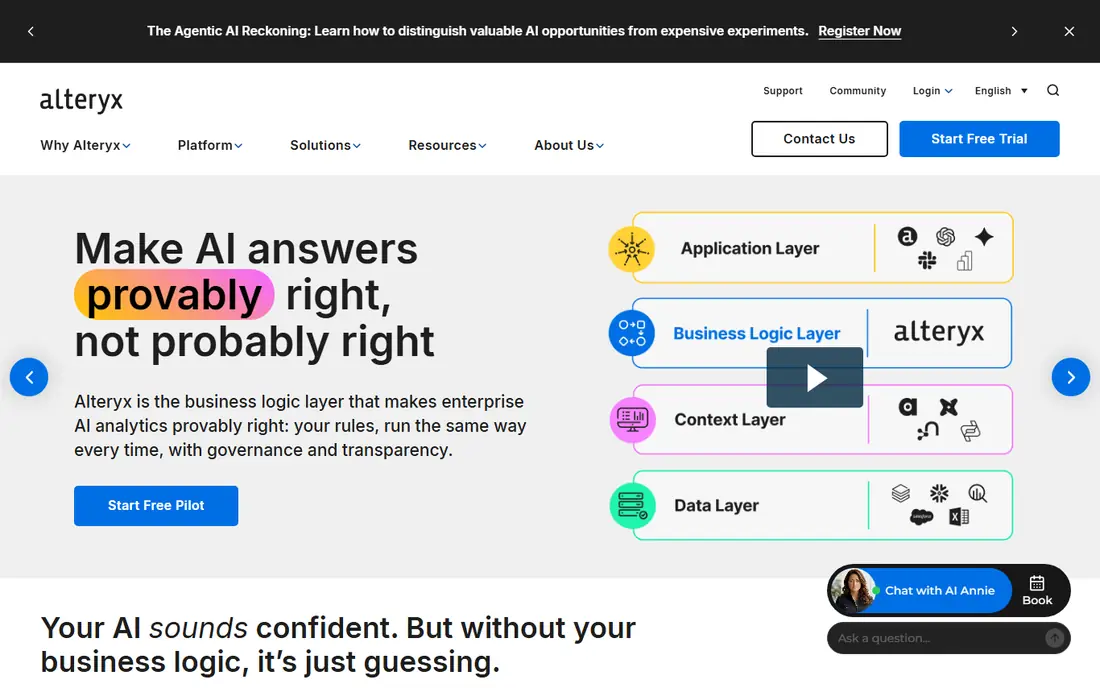
Alteryx is the closest commercial rival for business analysts who want to build workflows without writing code. Its drag and drop tools cover cleaning, joining, blending, and automating repeatable data tasks, and the interface is designed so a finance or operations analyst can build a workflow that once needed a developer. That ease of use is why many teams accept the price.
Cost is the main barrier. Alteryx Designer is priced per user at an enterprise level, and server based scheduling and governance add more. Alteryx fits organisations that will use it daily across a team, not a solo analyst with an occasional data task.
- Drag and drop workflow is easy for non coders
- Strong data prep and automation
- Large connector library
- High per user cost
- Server and automation features add further cost
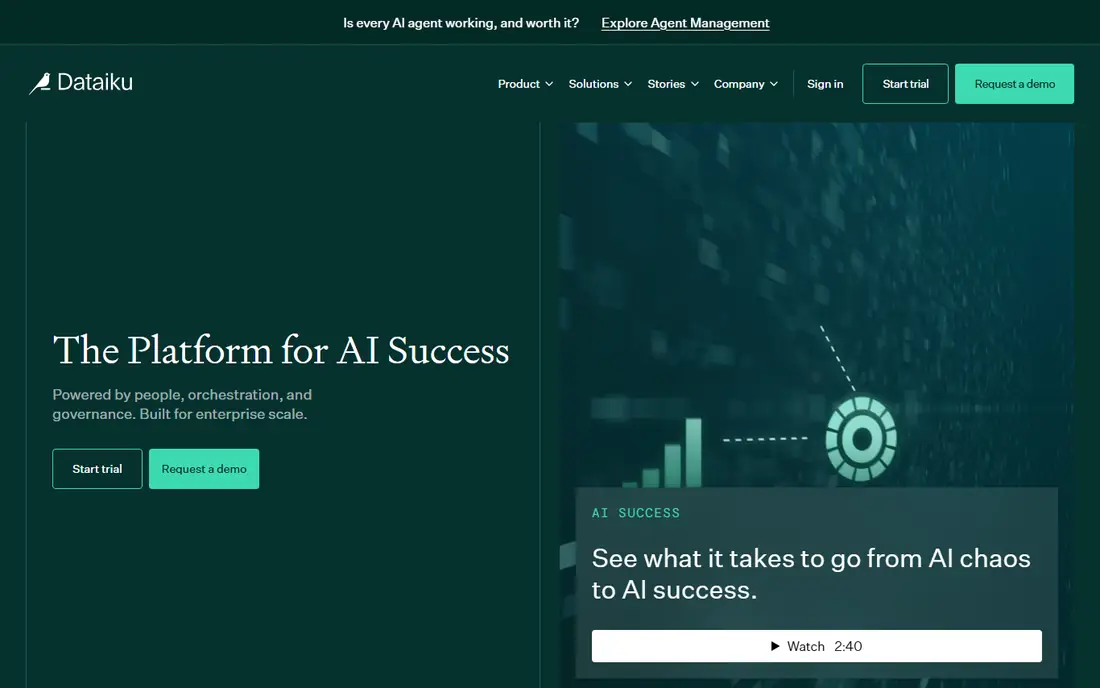
Dataiku suits teams where analysts and data scientists need to work on the same project. Visual flows handle preparation and modelling for non coders, while Python, R, and SQL users can drop into code where they need finer control. Collaboration, versioning, and governance features help larger teams keep projects organised and auditable.
That breadth comes with enterprise pricing and admin work. Dataiku is not a simple desktop download for a solo user, and smaller teams may find the setup heavy. Choose Dataiku when a whole data team, not just one analyst, will share the platform.
- Visual flows plus code notebooks in one platform
- Strong collaboration and governance
- Broad ML support
- Quote based pricing
- Setup and admin effort is higher than a desktop tool
Altair RapidMiner, formerly RapidMiner Studio, is a strong pick when the goal is prediction rather than just cleaning data. Its visual operators cover data prep, modelling, and evaluation, and automated modelling helps analysts test many approaches without hand tuning every model. A free edition makes it accessible for students and small projects.
For simple data prep, RapidMiner can feel heavier than Alteryx or Orange, because the tool is built around modelling workflows. Enterprise deployment, scheduling, and governance also sit behind paid tiers. RapidMiner fits analysts who want to move from a clean dataset to a tested model in one place.
- Visual modelling with AutoML support
- Strong predictive analytics focus
- Free edition for learning
- Full enterprise features are paid
- Interface feels dense for simple prep tasks
Orange is the best free visual alternative for learning, exploration, and small analysis projects. Its widget based canvas lets you load data, clean it, visualise it, and test models by connecting boxes, with no code needed. For a student, a researcher, or a small team testing an idea, Orange removes the cost barrier completely.
Production use is where it falls short. Orange is not built for scheduled enterprise pipelines, large scale data movement, or strict governance in the way Dataiku or Alteryx are. Use Orange to learn and explore, and move to a commercial platform when a workflow must run reliably on a schedule.
- Free and open source
- Visual widgets are easy to learn
- Good for teaching and exploration
- Less suited to large production pipelines
- Fewer enterprise connectors than commercial tools
Talend is the integration led alternative, and it fits teams whose main problem is moving and transforming data between systems. Its visual job designer, large connector set, and data quality tools help build reliable pipelines from databases, cloud apps, and files into a warehouse or a reporting layer. For a data engineering heavy programme, that focus is a strength.
It is less of a direct modelling workbench than KNIME, Dataiku, or RapidMiner. Teams that need visual machine learning as well as integration may need a second tool. Talend suits organisations where clean, governed data movement is the priority.
- Strong ETL and integration connectors
- Visual job design
- Cloud and on premise options
- Quote based pricing
- Integration focus means less built in ML modelling than Dataiku
Apache NiFi is a free, open source system for moving data between systems, with a visual flow editor and built in tracking of where data came from and where it went. That provenance view is useful for teams that need to trace a record through a pipeline, and the processor library covers many common sources, formats, and destinations. For engineers comfortable with self hosting, NiFi is a powerful free building block.
It is not a KNIME replacement for analysts. NiFi does not offer the same visual modelling, statistical analysis, or reporting experience, and setup, security, and scaling are your responsibility. Choose NiFi when data movement is the job and you have engineering support.
- Free and open source
- Visual flow design for data movement
- Strong provenance and tracking
- Needs technical setup and hosting
- Not a modelling or dashboard tool
Weka, from the University of Waikato, is a classic free machine learning workbench. It offers data prep, classification, clustering, and evaluation in a desktop app, with many well documented algorithms that are ideal for teaching and for testing a modelling idea quickly. For a student or a researcher, Weka remains a useful, no cost starting point.
The interface and scale show its age. Weka is not a modern cloud platform, it is not built for huge datasets or production pipelines, and deep learning support is limited compared with Dataiku or Databricks. Use Weka to learn and experiment, not to run a business critical pipeline.
- Free and open source
- Wide set of classic ML algorithms
- Good for teaching and experiments
- Interface feels dated
- Not built for large production workflows or modern deep learning
Tableau Prep is the natural pick if your end point is Tableau. Its visual flow shows how data is cleaned, joined, and shaped, and the output flows straight into Tableau for dashboards, without exporting and reimporting files. For a reporting team already on Tableau, that short path saves time and reduces errors.
Outside Tableau, the value drops. Prep is priced as part of a Creator licence, and it does not offer the same modelling, automation, or general workflow breadth as KNIME or Dataiku. Choose Prep when Tableau is already your reporting standard, and choose a broader tool when it is not.
- Visual flow for cleaning and joining
- Tight Tableau output
- Easy for Tableau users to learn
- Price is tied to a Tableau Creator licence
- Modelling and automation are thinner than KNIME
Databricks is the scale pick for teams that have outgrown desktop workflows. It unifies data engineering, analytics, and machine learning on a cloud platform built around Spark, with notebooks, workflows, and model management for large datasets. For an engineering led team building production AI features, Databricks offers a depth that desktop tools cannot match.
It is not a business user tool in the KNIME sense. Most serious work needs code, usage pricing needs careful monitoring, and small teams may find the platform heavy for a simple prep task. Databricks fits when data volume, engineering skill, and production AI goals all point the same way.
- Unified data and AI platform at scale
- Strong Spark and ML support
- Good for engineering teams
- Usage based pricing is hard to forecast
- Needs coding skill for most serious work
How we picked these
We compared official feature pages, pricing pages, documentation, and public reviews, and we kept only live tools that support visual data workflows, data preparation, or machine learning. We checked workflow style, code support, governance, connectors, and pricing transparency, and we favoured tools with clear documentation over tools with vague claims. We did not claim hands on testing, and many enterprise prices are quote based, so confirm pricing for your team size.
How to choose the right workflow tool
Start with who will build the workflows. Business analysts should shortlist Alteryx, Orange, and Tableau Prep, while mixed teams should look at Dataiku first. Engineers building pipelines should compare Talend and Apache NiFi, and teams with large scale AI goals should test Databricks.
Next, test a real workflow, not a demo dataset. Clean a messy file, join two sources, build a simple model, and schedule or export the result, then check how long each step took and who could maintain it. A tool that looks simple in a demo can feel slow when your own data has missing values, duplicates, and changing formats.
Frequently asked questions
What is the best free KNIME alternative?
Orange is the best free visual alternative for learning and exploration, while Apache NiFi is the best free option for data movement. Weka is also free and useful for classic machine learning teaching, but it is less suited to production pipelines.
Is Alteryx better than Dataiku?
Alteryx is usually better for business users who want a simple drag and drop prep tool, while Dataiku is better for mixed teams that combine visual flows with code. Alteryx can be simpler to adopt, and Dataiku can be stronger for collaboration and governance at scale.
Can I replace KNIME without coding?
Yes, for many prep and analysis tasks. Alteryx, Orange, Tableau Prep, and RapidMiner all offer visual workflows, though some advanced modelling and automation still benefit from code. Test your hardest workflow in a trial before you commit.
Do these tools handle large datasets?
It varies. Desktop tools like Orange and Weka suit smaller datasets, while Talend, Dataiku, and Databricks are built for larger, production scale work. Check memory, scheduling, and cloud options for your data size, not just the feature list.
Why are so many prices quote based?
Enterprise data platforms price by users, usage, deployment, and support, so a single list price would mislead many buyers. Ask vendors for a quote based on your team size, data volume, and whether you need cloud, on premise, or hybrid deployment.
Sources
See where you really rank - block by block
ProMapRanker scans Google Maps across a grid of your service area. Simple monthly plans from $19, white-label on every plan.
Start freeKeep reading
 zyte alternatives
Best Zyte Alternatives in 2026
These zyte alternatives cover managed scraping APIs, proxy networks and no code tools for lawful collection from your own or consented sources only in 2026.
Read → zerto alternatives
Best Zerto Alternatives in 2026
Compare the best zerto alternatives for disaster recovery and replication, with recovery targets, cloud options and honest trade-offs for teams in 2026.
Read → zerofox alternatives
Best ZeroFox Alternatives in 2026
We compared 9 zerofox alternatives for brand protection, phishing takedowns, dark web monitoring, and social impersonation, with clear coverage notes.
Read →