 ProMapRanker
Best JAMS Scheduler Alternatives in 2026

Key takeaways
- JAMS here means JAMS Scheduler, the workload automation and job scheduling tool, so every pick schedules and automates jobs across systems.
- Control-M and Stonebranch are the strongest enterprise replacements, with hybrid-cloud orchestration, governance and audit trails.
- Apache Airflow is the best free starting point for data and Python teams, while Prefect suits modern Python workflows with a simpler setup.
- Most enterprise scheduler pricing is custom, so compare agent costs, support and migration help, not just the headline licence fee.
Quick comparison
| Pick | Great for | Pricing starts at | Free tier | |
|---|---|---|---|---|
 Control-M | Enterprise workload orchestration | $2,400 per month | No | Visit |
 ActiveBatch | Cross-platform IT automation | See website | No | Visit |
 Stonebranch | Hybrid event-driven automation | See website | No | Visit |
 Apache Airflow | Open source data workflows | Free | Yes | Visit |
 Tidal | Centralized enterprise scheduling | See website | No | Visit |
 Redwood RunMyJobs | SAP and ERP scheduling | See website | No | Visit |
 Broadcom Automic | Large-scale governance | See website | No | Visit |
 IBM Workload Automation | Mainframe and hybrid scheduling | See website | No | Visit |
 Prefect | Modern Python orchestration | Free | Yes | Visit |
The best jams scheduler alternatives
We compared official feature pages, pricing pages and public reviews for workload automation tools live in October 2026. The list covers enterprise schedulers, open source orchestration and cloud-native services, because JAMS buyers range from Windows-centric IT teams to data engineering groups.
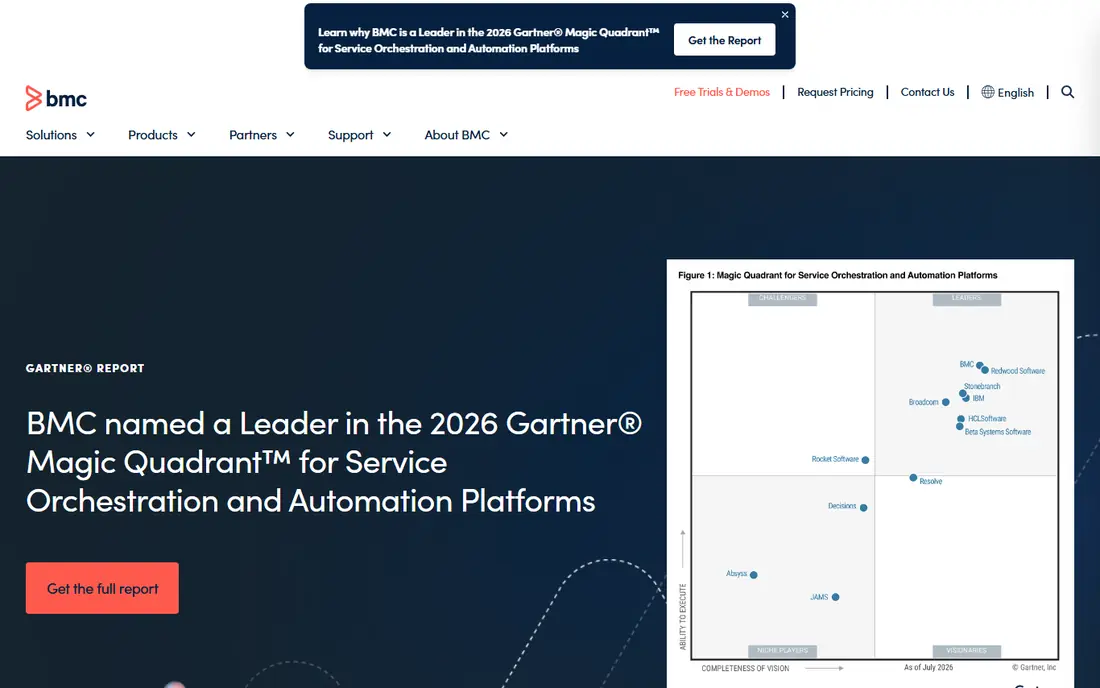
Control-M, from BMC, is the enterprise standard many teams compare JAMS against. It schedules and orchestrates jobs across on-premises systems, cloud services and data pipelines from one control point, with dependencies, calendars, SLA monitoring and audit trails. Jobs-as-Code lets developers define workflows in code alongside application code.
The cost and weight are real. Entry pricing in recent comparisons sits from $2,400 per month, and a full deployment needs staff time for design, governance and support. For a small team with a handful of nightly jobs, Control-M is too much. For a large estate with strict SLAs, it is the most proven replacement here.
- Hybrid-cloud workload orchestration at scale
- Jobs-as-Code and self-service
- AI-assisted monitoring and SLA management
- High entry price
- Setup and governance take dedicated staff
- Overkill for a small set of scheduled jobs
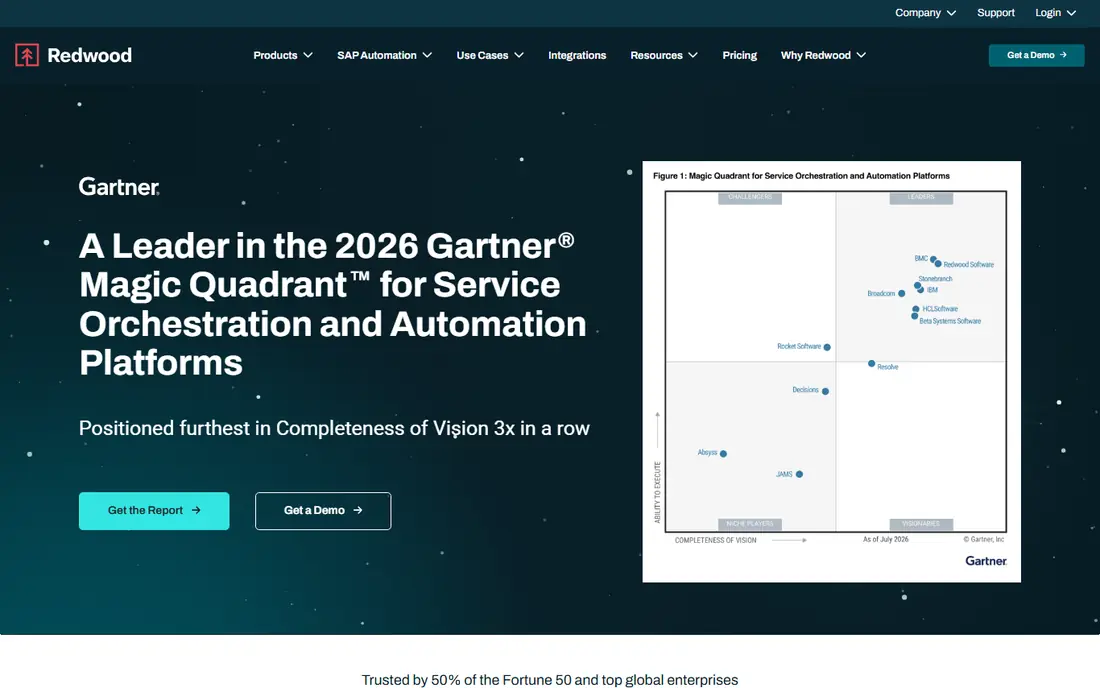
ActiveBatch, now part of Redwood, suits IT operations teams that need broad integration without writing every job from scratch. Its low-code designer and prebuilt job-step library cover common tasks across Windows, Linux, cloud and business applications, while a self-service portal lets business users run approved jobs themselves.
Pricing is the main uncertainty, because ActiveBatch does not publish prices and buyers must request a quote. Migration also needs care, though vendors in this space offer converters for common job types. Choose ActiveBatch when integration breadth and low-code assembly matter more than a published price list.
- Low-code job assembly with a prebuilt job-step library
- Broad cross-platform support
- Self-service portal for business users
- Pricing is not published
- Enterprise setup needs planning
- Migration from another scheduler needs a conversion effort
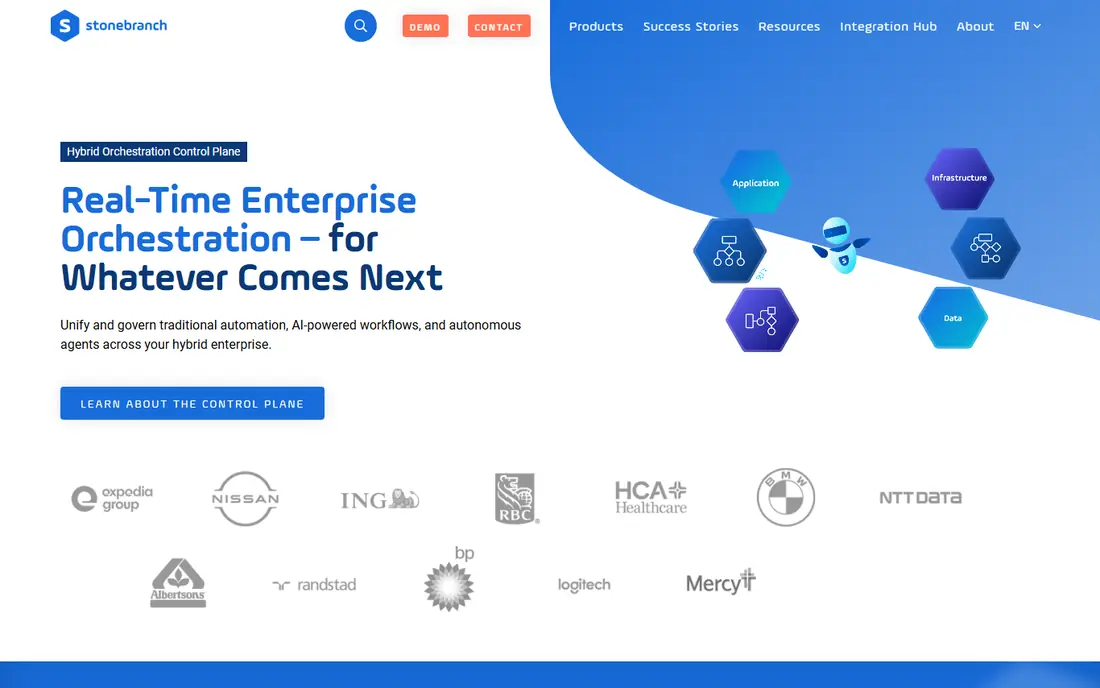
Stonebranch Universal Automation Center focuses on event-driven automation in hybrid environments. Instead of only running jobs on a clock, it reacts to events in real time, which suits teams that need files, messages or system events to trigger work. Universal agents extend control across on-premises and cloud systems, and a visual builder helps teams design workflows.
Custom pricing means you must request a quote for your agent and job volume. Enterprise design work is also needed to get event triggers, security and auditing right. For hybrid teams that outgrow time-based scheduling, Stonebranch is a strong, modern enterprise pick.
- Real-time, event-driven automation across hybrid IT
- Universal agents for many platforms
- Drag-and-drop workflow builder
- Pricing is custom
- Enterprise deployment needs design work
- Smaller brand than BMC or IBM for some buyers
Apache Airflow is the free, open source pick for data teams. You define workflows as directed acyclic graphs in Python, schedule them, and track runs in a web interface. A large ecosystem of providers covers databases, cloud services and data tools, which makes Airflow a natural fit for ETL, reporting and machine learning pipelines.
Airflow is not a turnkey enterprise scheduler. Your team owns hosting, scaling, upgrades and monitoring, and it is less suited to general IT jobs such as Windows services or mainframe batches. If your jobs are Python data workflows and you have engineering capacity, Airflow costs nothing to license and scales well. If you need vendor support and business scheduling, look at a commercial tool.
- Free and open source
- Code-first DAG scheduling in Python
- Large ecosystem of providers and operators
- You own hosting, scaling and upgrades
- Not ideal for non-Python IT jobs
- Scheduler and worker setup takes engineering time
Tidal Workload Automation, from Cisco, gives IT teams one control point for jobs across applications and platforms. It covers dependencies, calendars, SLA management and alerting, with integrations for enterprise systems. That central view helps operations teams spot a failed job and its downstream impact quickly.
Tidal is an enterprise product, with custom pricing and a setup effort to match. Small teams will find it heavy, and large migrations need planning and testing. Choose Tidal when centralized control and SLA management across many applications are the main requirements.
- Centralized cross-platform job control
- SLA management
- Many integrations for enterprise applications
- Pricing is custom
- Interface and setup feel enterprise-heavy for small teams
- Migration planning needed for large estates
Redwood RunMyJobs is a cloud-native SaaS scheduler with particular strength in SAP and ERP processes. It automates jobs across business applications from a hosted service, which reduces the infrastructure burden compared with a self-hosted scheduler. For SAP-heavy operations, its process depth is a real advantage.
Custom pricing and the SaaS model are the limits. Teams with strict on-premises rules may need a self-hosted option instead, and non-ERP teams may not need the SAP depth. If your workload centres on SAP or ERP systems and you want a hosted service, RunMyJobs belongs on the shortlist.
- Cloud-native SaaS workload automation
- Deep SAP and ERP process support
- Simple pricing model by quote
- Pricing is custom
- SAP depth matters less for non-ERP teams
- SaaS model may not suit strict on-premises rules
Broadcom Automic Automation, formerly CA Automic, suits large enterprises that need governance at scale. Role-based access, audit trails and centralized control support regulated environments where every job change must be traceable. It covers a broad range of platforms and business applications.
Complexity is the trade-off. Automic needs skilled staff to design, implement and maintain, and large deployments take time. Smaller teams will find it heavier than JAMS or a cloud service. For enterprises where governance and audit matter as much as scheduling itself, Automic is a credible replacement.
- Large-scale automation with strong governance
- Role-based access and audit trails
- Broad platform and application support
- Pricing is custom
- Enterprise complexity needs skilled staff
- Implementation time can be long for large estates
IBM Workload Automation covers a range from mainframe z/OS jobs to distributed and cloud workloads, which makes it useful for hybrid estates that still run mainframe systems. It offers dashboards, workflow folders, flexible reruns and AI anomaly detection to flag unusual job behaviour.
Pricing is custom, and public comparisons note that costs can be high, especially across development and enterprise environments. Setup also benefits from IBM expertise. Choose IBM Workload Automation when mainframe and hybrid control in one tool outweighs the appeal of a lighter, cloud-native scheduler.
- Mainframe and distributed scheduling in one tool
- Hybrid workload control
- AI anomaly detection for job issues
- Pricing is custom and can be high
- Enterprise setup needs IBM expertise
- Interface feels dated to some users
Prefect is the modern Python alternative to Airflow for teams that want simpler setup. You write workflows in Python, run them locally or in Prefect Cloud, and track runs, retries and failures in a clean interface. A free tier lets small teams start without a licence, and paid plans add collaboration and scale.
Prefect is still a data and Python workflow tool, not a general IT scheduler for Windows services, mainframe jobs or business applications. It also needs Python skills to use well. For data and machine learning teams that find Airflow heavy, Prefect is the most approachable open source-rooted pick here.
- Free tier and open source core
- Developer-friendly Python workflows
- Flexible deployment from local to cloud
- Paid plans start above the free tier for larger teams
- Data-workflow focus, not general IT scheduling
- Needs Python skills to get full value
How we picked these
We compared official feature pages, pricing pages and public reviews for workload automation tools live in October 2026. We kept only tools that schedule, orchestrate and monitor jobs across systems, and we left out JAMS itself. Where vendors publish no price, we wrote See website, and we treated free open source tools as free to license, while noting the hosting and staff costs of running them.
How to migrate from JAMS safely
Start by inventorying your jobs before you pick a replacement. List job types, platforms, dependencies, calendars, credentials and failure handling, and mark which jobs are business-critical. That inventory decides whether you need mainframe support, SAP depth, Python data workflows or simple Windows scheduling, and it prevents buying a tool that covers only half your estate.
Run a pilot on a non-critical job set, with the same schedules and dependencies, and compare run times, failure alerts and rerun behaviour. Test migration converters on a sample, not on the full estate at once, and keep JAMS running in parallel until the pilot passes. A clean cutover on a Friday night is tempting, but a parallel run with a rollback plan is safer for jobs the business depends on.
Frequently asked questions
What is the best JAMS Scheduler alternative?
Control-M and Stonebranch are the strongest enterprise replacements, while Apache Airflow is best for free Python data workflows. The right pick depends on your platforms: SAP teams should look at Redwood RunMyJobs, mainframe teams at IBM Workload Automation, and Python teams at Airflow or Prefect.
Is there a free JAMS alternative?
Yes. Apache Airflow is free and open source, and Prefect offers a free tier with an open source core. Free here means no licence fee, not no cost: you still pay for hosting, setup and staff time. For a small set of Windows jobs, a simpler scheduler may cost less overall than a free tool that needs heavy setup.
How much does enterprise workload automation cost?
Enterprise pricing is usually custom, with Control-M cited from $2,400 per month in recent comparisons. Other vendors quote by agents, jobs or environment size, so request a quote based on your inventory. Include support, migration help and any per-agent fees in the total.
Can Airflow replace JAMS for IT jobs?
Airflow can replace JAMS for Python data workflows, but it is less suited to general IT jobs such as Windows services, ERP batches or mainframe work. If your estate mixes data pipelines with business application jobs, a commercial scheduler or a hybrid of Airflow plus a commercial tool may fit better.
How long does a scheduler migration take?
It depends on job count, dependencies and testing needs. A small pilot can run in weeks, while a large enterprise estate can take months, including conversion, parallel running and cutover. Budget time for inventory, pilot testing and rollback planning, not just for licence purchase.
Do I need a SaaS or self-hosted scheduler?
SaaS suits teams that want less infrastructure work and can run jobs from a hosted service, such as Redwood RunMyJobs. Self-hosted suits teams with strict data rules, mainframe systems or on-premises requirements. Check data residency, network access and audit needs before you choose a model.
Sources
See where you really rank - block by block
ProMapRanker scans Google Maps across a grid of your service area. Simple monthly plans from $19, white-label on every plan.
Start freeKeep reading
 zyte alternatives
Best Zyte Alternatives in 2026
These zyte alternatives cover managed scraping APIs, proxy networks and no code tools for lawful collection from your own or consented sources only in 2026.
Read → zerto alternatives
Best Zerto Alternatives in 2026
Compare the best zerto alternatives for disaster recovery and replication, with recovery targets, cloud options and honest trade-offs for teams in 2026.
Read → zerofox alternatives
Best ZeroFox Alternatives in 2026
We compared 9 zerofox alternatives for brand protection, phishing takedowns, dark web monitoring, and social impersonation, with clear coverage notes.
Read →