 ProMapRanker
Is It Best Usage Based Billing Software in 2026


Teams already processing on Stripe · Pricing starts at: 0.7% of billing volume
Key takeaways
- Stripe Billing is the easiest start for teams already on Stripe, but its metered billing suits simpler models better than very high event volumes.
- Orb and Metronome handle complex, high-volume usage pricing, with Orb aimed at developer-led products and Metronome at large enterprise contracts.
- Lago gives cost-conscious teams an open-source core they can self-host, while Chargebee and Maxio suit subscription businesses adding usage charges.
- Total cost includes engineering time, not just the platform fee, so weigh metering, rating, invoicing, and revenue recognition together.
Quick comparison
| Pick | Great for | Pricing starts at | Free tier | |
|---|---|---|---|---|
| Stripe Billing | Teams already processing on Stripe | 0.7% of billing volume | No | Visit |
 Orb | Developer-led API and AI products | See website | No | Visit |
 Metronome | Large enterprise usage contracts | See website | No | Visit |
 Lago | Open-source control and lower cost | Free | Yes | Visit |
 Chargebee | Subscription businesses adding usage | $0 per month plus 0.80% of billing | Yes | Visit |
 Maxio | Finance-led B2B SaaS teams | $599 per month | No | Visit |
 Zuora | Large enterprises with complex needs | See website | No | Visit |
 Recurly | High-volume subscription businesses | $249 per month plus 0.9% of volume | No | Visit |
The best usage based billing software
Usage based billing charges customers for what they actually consume, such as API calls, seats used, or minutes processed. The right platform depends on your event volume, contract complexity, and how much engineering help you can spare. We compared official pricing pages, product documentation, and public comparisons for platforms that work in October 2026.

Stripe Billing is the lowest-friction start for most early teams. If you already take payments through Stripe, you can add metered items to subscriptions and turn reported usage into invoice lines without onboarding a second vendor. That matters when you are still proving a pricing model and need to ship billing this month, not this quarter. The documentation is extensive, and accountants and engineers are likely to know the system already.
The limits show up at scale and complexity. A percentage of billing volume becomes expensive as revenue grows, and multi-dimensional pricing or intricate committed-spend contracts need more than basic metering. Stripe now offers Metronome for advanced usage billing, which tells you where the boundary sits. Choose Stripe Billing when your model is simple and your volume is modest. Plan a migration path early if usage is your core revenue engine.
- Fast setup inside an existing Stripe account
- Payments, invoicing, and subscriptions in one place
- Large documentation and integration ecosystem
- Percentage fee grows with revenue
- Metered billing is simpler than purpose-built metering
- Very high event volumes can push teams toward Metronome
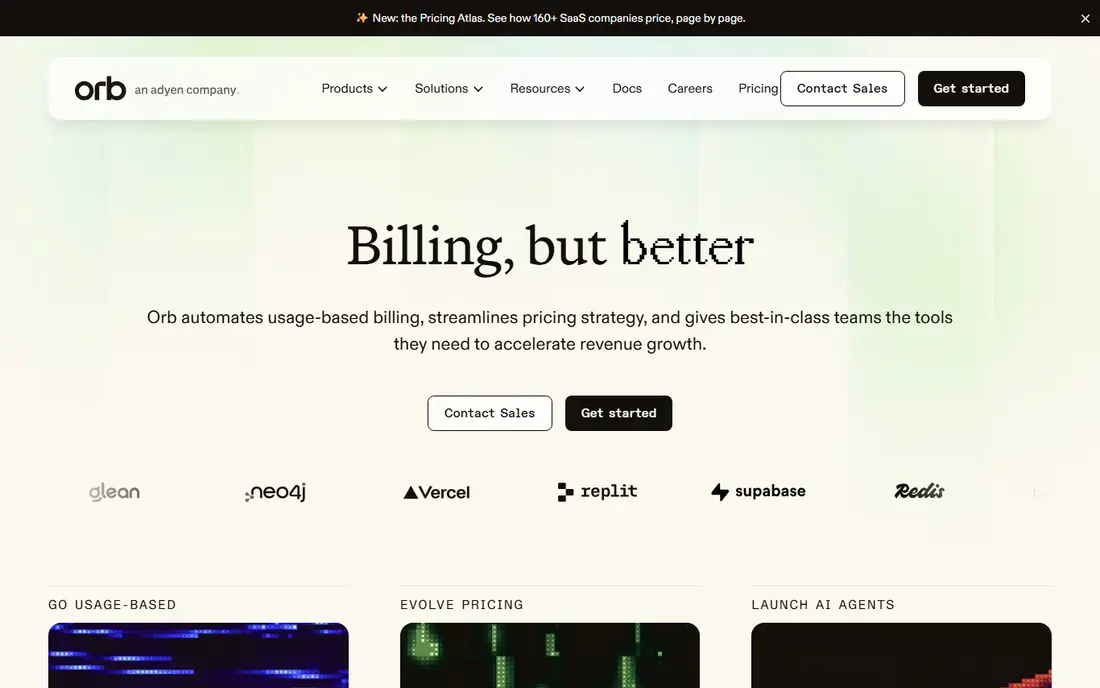
Orb is built for products where usage is the product, such as APIs, AI tools, and developer platforms. It ingests usage events in real time, applies pricing rules, and lets teams test a new price against past usage before they ship it. That simulation feature is genuinely valuable, because a pricing change that looks small on paper can move revenue a lot once real traffic runs through it. Orb also handles hybrid models that mix subscriptions, usage, and credits.
The catch is commitment. Pricing is quoted, setup needs developer time, and you still need a payment processor and tax handling alongside it. Orb fits teams that already treat billing as infrastructure and have engineers to own metering. If your usage model is simple, Stripe Billing will get you further with less work. If your pricing logic is your competitive edge, Orb is worth the deeper evaluation.
- Real-time metering built for high-volume products
- Flexible pricing models including committed spend
- Pricing simulation against historical usage
- Sales-led pricing with no public entry price
- Heavier developer setup than Stripe
- Not a full payments or tax layer on its own
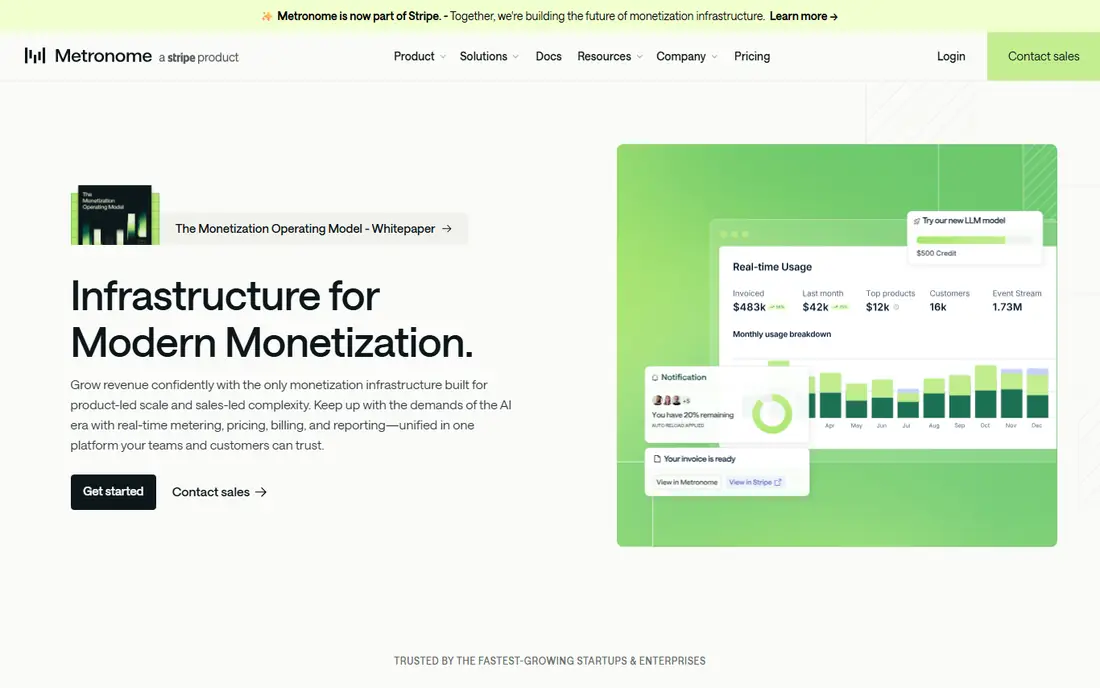
Metronome is the enterprise end of usage billing. It is designed for companies with billions of events, custom contracts, committed spend, true-ups, and credits that must reconcile cleanly. Large AI and data companies use this class of platform precisely because a spreadsheet or a simple meter breaks under that volume and contract variety. Its rating engine separates pricing logic from application code, so finance and product teams can change terms without a redeploy.
That power comes with weight. You should expect a sales process, a custom contract, and a real implementation project, not a self-serve signup. Small teams will find it slow and expensive, and they should not buy it on ambition alone. Metronome earns its place when your contracts are complex, your volume is large, and billing errors would cost real revenue or trust. For everyone else, it is a useful benchmark for what mature usage billing looks like.
- Very high throughput metering
- Strong support for complex enterprise contracts
- Now part of Stripe for teams already in that ecosystem
- Custom enterprise pricing only
- Implementation can take weeks to months
- Overkill for small or simple usage models
Lago appeals to teams that want control over their billing stack. The open-source core lets you self-host metering, rating, and invoicing, which avoids a percentage fee on your revenue and keeps your usage data inside your own infrastructure. For cost-conscious startups and developer-led teams, that trade can be attractive, especially when Stripe or Orb pricing would scale with every dollar you bill.
The honest cost is engineering time. Someone must run, upgrade, and monitor the system, handle metering integrity, and manage failure cases when events arrive late or duplicated. Paid cloud options reduce that burden, but their pricing is quoted rather than published. Choose Lago when your team can own infrastructure and values independence. If you want billing fully managed, a hosted platform will save you more time than the license savings are worth.
- Open-source core can be self-hosted at no license cost
- Provider-agnostic metering and rating
- Flexible pricing models without a revenue percentage
- Self-hosting adds operations work
- Paid cloud and premium features are quoted
- Revenue recognition support is limited compared with finance suites
Chargebee suits companies that already sell subscriptions and want to add usage without rebuilding billing. You can mix seat charges, recurring fees, and metered usage on one invoice, which keeps customers from receiving confusing separate bills. The published pricing makes budgeting easier than with quote-only vendors, and the free starting tier lets small teams test the model before committing to a monthly fee.
The limits mirror Stripe in one way: the percentage fee grows with volume, so high-scale usage products may outgrow it. Chargebee also separates revenue recognition into its own product, which matters if finance needs ASC 606 reporting built in. For hybrid subscription and usage businesses in the small to mid market, Chargebee is a practical middle ground. For pure usage at massive scale, Orb or Metronome fit better.
- Combines recurring and usage charges on one invoice
- Published pricing with a free starting tier
- Broad gateway and integration support
- Percentage fee adds up at scale
- Very high event volumes suit purpose-built metering better
- Advanced revenue recognition is a separate product
Maxio is built for finance-led teams that want billing and revenue recognition in one system. Instead of stitching a billing tool to a separate recognition tool, Maxio lets finance see billings, deferred revenue, and SaaS metrics in the same place. That appeals to growth-stage B2B companies whose board and auditors care as much about recognized revenue as about cash collected. The platform handles usage charges alongside subscriptions, which covers the common hybrid model.
The entry price sets the audience. At $599 per month for up to $100,000 in monthly billings, Maxio is not a starter tool for a pre-revenue product. It also trades some metering flexibility for finance depth, so API products with exotic pricing may still prefer Orb. Choose Maxio when finance owns the decision and clean revenue reporting matters as much as the invoice itself.
- Billing and revenue recognition together
- Strong SaaS metrics and reporting
- Suits finance teams that own billing decisions
- Entry price is high for small teams
- Less flexible than Orb or Metronome at very large scale
- Product combines several legacy tools, so onboarding takes care
Zuora is the enterprise incumbent for subscription and usage billing. It handles multiple entities, currencies, complex product catalogs, and formal compliance workflows that smaller tools simply do not attempt. Large companies with global operations and layered approval processes often need that depth, and Zuora revenue adds the recognition layer finance teams require. Its staying power in the enterprise market is a real signal about reliability at scale.
For most readers, Zuora is a reference point, not a recommendation. Implementation takes months, pricing is quoted, and the system assumes a dedicated billing team. A startup that buys Zuora early will spend more time configuring it than selling. Consider Zuora only when your billing complexity, entity structure, or compliance needs already exceed what Chargebee, Maxio, or Stripe can handle cleanly.
- Deep support for complex, multi-entity billing
- Separate revenue module for formal compliance
- Long track record with large enterprises
- Quote-only enterprise pricing
- Long implementation timelines
- Far more system than a small or mid-size team needs
Recurly fits businesses with many subscribers where failed payments and involuntary churn cost real money. Its dunning tools retry failed cards, manage recovery flows, and help teams keep subscribers who would otherwise lapse. That focus matters for consumer and B2B subscription companies moving toward usage, because the billing problem is often collection as much as calculation. Recurly also supports usage charges alongside recurring plans on one platform.
The pricing structure needs a clear-eyed read. You pay a monthly base plus a percentage of volume, and revenue recognition costs extra, so the total can climb faster than the headline suggests. Pure usage products with complex rating will still prefer a metering-first platform. Choose Recurly when subscriber volume is high, churn recovery matters, and usage is an addition to subscriptions rather than the whole model.
- Strong dunning and payment recovery tooling
- Handles subscription to usage transitions
- Broad payment and gateway support
- Percentage fee on top of a monthly base
- Revenue recognition is a paid add-on
- Less metering depth than Orb or Metronome for pure usage products
How we picked these
We compared official pricing pages, product documentation, and public platform comparisons for tools that support usage based billing in October 2026. We favored platforms with real metering and rating depth, published or verifiable pricing where available, and a clear fit for a specific stage or model. We left out generic invoicing tools that only add a usage line by hand, since they do not meter or rate consumption.
What to check before you commit
Start by writing down your pricing model in plain terms: what you meter, how often you bill, whether customers prepay credits, and what happens when they exceed a commitment. Then test that model against historical usage if you have it, or against realistic sample traffic if you do not. A platform that cannot simulate a price change will leave you guessing about revenue impact, and guessing is expensive once customers are live.
Also check the parts around the invoice. Ask who owns late or duplicate events, how refunds and credits appear, and whether revenue recognition is included or a separate purchase. Confirm the total fee, including payment processing, platform percentage, and any add-ons, and ask about event limits and overage terms in writing. The cheapest platform on paper can become the most expensive once engineering time, finance reconciliation, and migration costs are counted. Pick the tool that matches the model you have today, with a credible path to the model you expect in two years.
Frequently asked questions
Is it best usage based billing software for a startup?
For most startups, Stripe Billing is the best start, because it is fast to set up inside an existing Stripe account and handles simple metered billing well. Move to Orb, Lago, or Metronome when event volume, pricing complexity, or contract variety outgrows basic metering.
Is it best usage-based billing software for AI products?
Orb and Metronome are the strongest fits for AI products with high event volumes and credit or token based pricing. Lago is a credible lower-cost option for teams that can self-host, while Stripe Billing works for early AI products with simpler models.
How much does usage based billing software cost?
Costs range from free self-hosted Lago to a percentage of billing volume on Stripe Billing and Chargebee, and $599 per month on Maxio. Quote-only platforms such as Orb, Metronome, and Zuora require a sales conversation, so budget for implementation time as well as the platform fee.
What is the difference between metering and rating?
Metering collects and counts usage events, such as API calls or minutes used. Rating turns those counts into money by applying pricing rules, tiers, discounts, and commitments. A good platform does both reliably, and keeps an audit trail so finance can explain every invoice line.
Can I mix subscriptions and usage charges?
Yes, and most businesses do. Chargebee, Stripe Billing, Maxio, and Recurly all support hybrid invoices that combine a recurring fee with metered usage. Keep the invoice readable for customers, and state clearly what is included, what is metered, and what happens at the overage threshold.
Sources
See where you really rank - block by block
ProMapRanker scans Google Maps across a grid of your service area. Simple monthly plans from $19, white-label on every plan.
Start freeKeep reading
 worlds best local seo company
8 Worlds Best Local SEO Companies for Map Pack Growth in 2026
Compare the worlds best local seo company options for Google Business Profile work, citations, reviews, and multi-location rankings and reporting in 2026.
Read → world's best web hosting company
World's Best Web Hosting Company in 2026
Searching for the world's best web hosting company? We compared 10 hosts on price, renewal rates, speed, and support to help you choose well today in 2026.
Read → who's got the best nanny tax services
Who's Got the Best Nanny Tax Services in 2026
We answer who's got the best nanny tax services, comparing full filing, back taxes, software, and pricing so families can handle nanny taxes correctly.
Read →