 ProMapRanker
Best Integrate.io Alternatives in 2026

Key takeaways
- Airbyte and Stitch suit smaller budgets, while Fivetran and Matillion suit teams that want managed pipelines and can pay for that care.
- Volume is the price driver everywhere, so model your bill on changed rows or synced volume, not on the number of sources alone.
- Self-hosted tools look free until you count servers, monitoring, and staff time, so compare total cost, not just the licence line.
- Reverse and transformation features matter as much as connectors, because a pipeline that lands raw data still needs cleaning before it is useful.
Quick comparison
| Pick | Great for | Pricing starts at | Free tier | |
|---|---|---|---|---|
 Fivetran | Managed pipelines for larger teams | See website | Yes | Visit |
 Airbyte | Open and cloud ELT for engineers | $10 per month | Yes | Visit |
 Stitch | Simple replication for small teams | $100 per month | Free trial | Visit |
 Hevo Data | No-code pipelines for growing teams | See website | Yes | Visit |
 Matillion | Warehouse-native transformation | $1,000 per month | Free trial | Visit |
 Estuary | Real-time streaming pipelines | See website | Yes | Visit |
 Rivery | Ingestion plus SQL and Python work | See website | Free trial | Visit |
 Talend | Enterprise data integration | See website | Free trial | Visit |
 AWS Glue | Pay-as-you-go jobs on AWS | See website | No | Visit |
The best integrate.io alternatives
Integrate.io is a data integration platform, and the alternatives below are for teams that need to move data from apps and databases into a warehouse, then keep it fresh. Some teams leave because pricing is hard to predict, some because they want more connectors, and some because they want a self-hosted option. We compared official pricing and connector pages, and we left Integrate.io itself off this list, since an alternatives list should not include the product being replaced. Prices here are starting points only, because most of these tools bill on volume, and your bill depends on how much data changes.

Fivetran fits teams that want pipelines to run with little day-to-day care and are willing to pay for managed connectors, monitoring, and schema changes handled by the vendor. It connects common SaaS apps and databases to warehouses, keeps tables in sync, and adjusts when source schemas change, which saves data teams from rebuilding pipelines by hand.
The catch is cost at volume. Fivetran bills on monthly active rows, with a minimum charge per connection in recent pricing, so a table that changes often can cost far more than a quiet one. Model a real month of changes before signing, and watch delete and refresh behaviour in your plan terms.
- Wide connector library
- Automated schema handling
- Managed maintenance and monitoring
- Usage-based pricing can rise fast with changed data
- Connector-level billing needs careful tracking

Airbyte fits engineering-led teams that want control over connectors and deployment, or a low-cost cloud start for a modest pipeline. The open-source version can be run on your own infrastructure, while Airbyte Cloud removes server work and bills on usage, so a team can start small and move up as volume grows.
The catch is the trade-off between the two paths. Cloud bills climb with synced volume, including failed or repeated syncs in some cases, while self-hosting shifts the cost into servers and staff time. Pick the path whose cost you can actually measure, and test your heaviest source early.
- Open-source self-hosted option
- Large connector catalog
- Cloud plans for teams that do not want servers
- Cloud costs scale with volume
- Self-hosting needs engineering time and monitoring
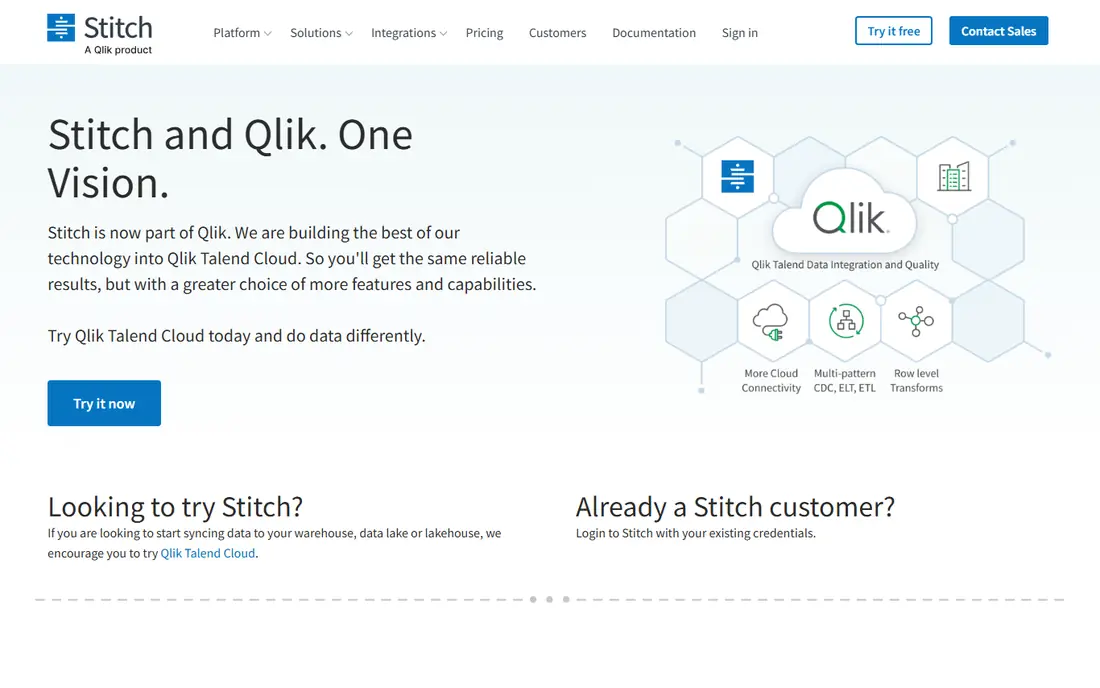
Stitch fits small teams that need a simple, predictable replication job from a handful of sources into a warehouse, without a large data platform project. It replicates rows on a tiered plan, so a team can estimate cost from monthly row volume, and setup is closer to connecting a source and picking tables than to building a pipeline by hand.
The catch is scope. Stitch is best as a mover of data, not as a full transformation or orchestration suite, so teams that need heavy cleaning will pair it with another tool. Confirm connector coverage for your sources, because a missing connector ends the shortlist fast.
- Straightforward setup
- Row-based tiers that are easy to read
- Part of the Qlik Talend family
- Smaller connector range than larger rivals
- Limited transformation depth on its own
Hevo Data fits product and analytics teams that want pipelines without writing code, and that need sources and destinations connected quickly. Its interface walks users through source setup, schema mapping, and destination choice, and it supports a broad set of SaaS and database sources for warehouse loading.
The catch is how events are counted. Every record write, including repeats from frequent updates, can count toward the event limit, so a chatty source costs more than a quiet one. Test with your busiest source, and check which plan includes the transformation and monitoring features you need.
- No-code pipeline setup
- Auto schema mapping
- Real-time options on higher plans
- Event-based billing can multiply with frequent updates
- Higher plans are needed for advanced features
Matillion fits data teams whose main job is not just moving data, but transforming it inside Snowflake, Databricks, Redshift, or BigQuery. Its visual builder lets teams design ingestion, transformation, and orchestration in one place, with jobs that run on warehouse compute, which suits teams already committed to a cloud warehouse.
The catch is price and fit. Entry pricing is far above the simple replication tools on this list, and teams that only need to copy tables will pay for power they do not use. Choose Matillion when transformation depth is the deciding factor, not when a simple sync would do.
- Visual pipelines built for cloud warehouses
- Strong transformation and orchestration
- Enterprise controls
- High starting cost
- Best value only when transformation is central to the work
Estuary fits teams that need fresh data quickly, such as operational dashboards or fraud checks, rather than a once-a-day batch load. It captures changes from sources and streams them toward a destination, with a free tier for small use, so teams can test latency before committing to a larger plan.
The catch is that real-time value only matters if someone acts on fresh data. For a weekly report, a cheaper batch tool may be enough. Check connector coverage and the per-connector and per-volume charges together, because both shape the monthly bill.
- Real-time and batch capture
- Usage pricing by data volume
- Free tier for small starts
- Smaller connector catalog than the largest rivals
- Streaming design needs a clear use case
Rivery, now part of Boomi, fits mid-size data teams that want ingestion and transformation in one tool, without adding a separate orchestration system. Its Logic Flows run SQL and Python steps alongside ingestion, so a team can clean and shape data on the same platform that moved it, with scheduling built in.
The catch is credit maths. Different source types consume credits at different rates, and the base plan is thin on users, environments, and advanced features. Run your real source mix through the credit model before judging the headline rate, and confirm which features sit on each tier.
- Ingestion, SQL, and Python transformation on one credit meter
- Scheduling and orchestration included
- Credit pricing needs modelling
- Connector catalog is smaller than the largest rivals
Talend, now part of Qlik, fits larger organisations that need to connect legacy systems, cloud apps, and warehouses under governance and data quality controls. It covers a wide range of source types, including older enterprise systems that newer ELT tools may not reach, and it adds profiling, cleansing, and governance features on top of movement.
The catch is weight. Talend is an enterprise platform with enterprise setup, so a small team with a few SaaS sources will find it slow and costly. It earns its place when legacy coverage, governance, or complex transformation rules are the real requirement.
- Broad legacy and cloud connectivity
- Data quality and governance tools
- Qlik ecosystem
- Enterprise pricing and implementation effort
- Heavier than needed for simple syncs
AWS Glue fits teams already on AWS that want to build extract, transform, and load jobs on managed Spark, without buying a separate integration platform. It runs jobs on AWS compute, integrates with S3, Redshift, and other AWS services, and charges for the compute time jobs use, so quiet periods cost less than a fixed platform fee.
The catch is that Glue is a toolkit, not a finished connector product. Teams write and tune jobs, watch for over-provisioned capacity and idle endpoints, and own monitoring themselves. For a team without AWS engineering time, a managed connector tool will be faster and, in practice, cheaper.
- Serverless Spark jobs on AWS
- Pay for compute used
- Strong fit for AWS-native teams
- Needs engineering skill
- Costs vary with job design and idle resources
How we picked these
We compared official feature pages, pricing pages, and app store listings, and we checked public documentation for each product before including it. We kept only products that exist and work now, that fit the topic directly, and that a reader could sign up for or buy without guessing at the cost. Where a price was not published clearly, we wrote See website instead of filling in a number we could not confirm.
We also weighed the trade-offs that show up after signup, such as limits on the free plan, per-user or per-location billing, and how hard it is to move data out later. A product that looked cheap at first glance did not stay on the list if its limits made it a poor fit for ordinary use. We did not claim hands-on testing that did not happen, and we left out the named product itself from its own alternatives list.
How to choose a data integration tool
Start with your sources and destination, not with the feature list. Write down every source you must connect in the next year, including the awkward legacy system, and check each shortlisted tool for that exact source. One missing connector can force a second tool, and that second tool often costs more than the saving on the first.
Then model cost on your real data behaviour. A table that updates every minute, a table that reloads in full, and a table that rarely changes will bill very differently on row, event, and credit models. Run a month of real volumes through two or three pricing models before signing, and ask what happens on a full refresh, a delete, and a failed sync.
Finally, decide who will own the pipeline. A managed tool suits a small analytics team that needs data without a data engineering hire. A self-hosted or code-heavy tool suits a team that already owns infrastructure and wants control. The cheapest licence is rarely the cheapest pipeline once staff time is counted.
Frequently asked questions
What is the best alternative to Integrate.io?
There is no single best pick, because the right tool follows your volume and your team. Airbyte suits engineering teams that want control, Stitch suits simple small pipelines, Fivetran suits managed reliability at scale, and Matillion suits warehouse transformation work.
Are Integrate.io alternatives cheaper?
Some are cheaper at low volume, especially Airbyte Cloud and Stitch, but none is cheap at high volume without care. Usage-based billing means a busy source can push any of these tools past a fixed-fee plan, so model your own volumes before comparing headline prices.
Can I self-host a data integration tool?
Yes, Airbyte offers an open-source self-hosted version, and AWS Glue runs on your AWS account, but both need engineering time for servers, upgrades, and monitoring. Managed cloud plans remove that work and replace it with a usage bill.
Do these tools transform data as well as move it?
Matillion and Rivery include transformation and orchestration, while Stitch and Fivetran focus more on moving data cleanly into a warehouse. If you need heavy cleaning, check transformation features and costs separately from connector coverage.
How do I migrate pipelines from Integrate.io?
List every source, destination, table, and schedule, then rebuild one pipeline at a time on the new tool and run both in parallel until row counts match. Keep the old pipelines running during the check, because a quiet source can hide a mapping error for days.
Sources
See where you really rank - block by block
ProMapRanker scans Google Maps across a grid of your service area. Simple monthly plans from $19, white-label on every plan.
Start freeKeep reading
 zscaler alternatives
Best Zscaler Alternatives in 2026
Looking for zscaler alternatives? We compare 9 SASE and zero trust platforms on architecture, data protection, pricing, and fit for your network and team.
Read → zapier alternatives free
Best Zapier Alternatives Free in 2026
Nine automation tools for zapier alternatives free in 2026, all with genuinely free tiers, plus free plan limits, starting prices and upgrade paths explained.
Read → which platform is best for online reputation
Which Platform Is Best for Online Reputation in 2026
Wondering which platform is best for online reputation? We compare 8 review, listing, and response tools for small and multi-location businesses and agencies.
Read →