 ProMapRanker
Instapage Alternatives in 2026

Key takeaways
- Unbounce is our pick for testing-led marketers, while Leadpages is the simpler value choice for small businesses.
- Landingi suits teams that publish many pages on a budget, and Swipe Pages suits mobile-first paid campaigns.
- Webflow and HubSpot fit teams that need a full website or CRM beside landing pages, not just a standalone page builder.
- Visitor caps and testing tiers matter more than headline price, so check caps and A/B testing availability before you buy.
- The named product in this topic is not listed here, because this article covers alternatives only.
Quick comparison
| Pick | Great for | Pricing starts at | Free tier | |
|---|---|---|---|---|
 Unbounce | Testing-led marketers | $29 per month | Free trial | Visit |
 Leadpages | Affordable lead generation | See website | Free trial | Visit |
 Landingi | Many pages on a budget | $29 per month | Free trial | Visit |
 ClickFunnels | Full funnels with checkout | $97 per month | Free trial | Visit |
 Webflow | Design-led websites and pages | See website | Yes | Visit |
 HubSpot | CRM teams and free pages | Free | Yes | Visit |
 GetResponse | Email-first businesses | $19 per month | Free trial | Visit |
 Swipe Pages | Mobile-first paid campaigns | $29 per month | Free trial | Visit |
 Carrd | Simple one-page sites | $19 per year | Yes | Visit |
The best instapage alternatives
We compared official feature pages, pricing pages, and public documentation for landing page builders that can replace the named product. Each tool below is an alternative, and the named product itself is not listed as a product in this article.
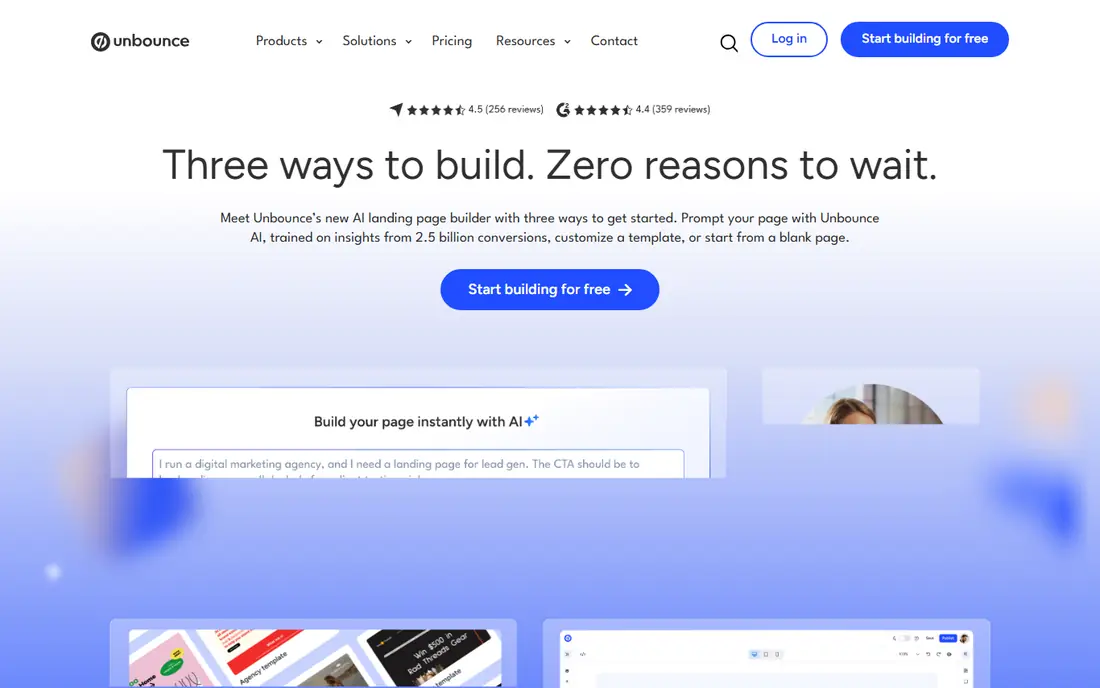
Unbounce is the classic testing-led landing page builder, and it remains the strongest choice for marketers who run paid campaigns and test variants seriously. Its editor gives design freedom, its template library covers common campaign types, and Smart Traffic can route visitors to the variant most likely to convert. For a team that treats landing pages as a testing program, that depth matters.
The catch is tiering. A/B testing sits on higher plans, and every plan has a visitor cap, so a low-traffic team may pay for testing it rarely uses, while a high-traffic team may hit caps. Check your monthly visits and your testing needs together, and trial the plan that actually includes the features you will use.
- Mature A/B testing on higher tiers
- Smart Traffic routing
- Large template library
- Testing is not on entry tiers
- Visitor caps on every plan
- Price rises with testing needs

Leadpages suits small businesses that need a clean page, a form, and a reliable lead capture flow without a steep learning curve. The builder is fast, the templates are practical, and the focus stays on conversion rather than on pixel-perfect design. For a solo marketer or a small team, that simplicity saves time every week.
Design-led teams may find the editor less flexible than Unbounce or Webflow, and testing features depend on the plan you choose. If your main job is turning traffic into leads at a fair price, Leadpages is a strong value alternative. If design control is the priority, shortlist Webflow instead.
- Simple builder for small businesses
- Lead capture and alerts built in
- No visitor cap on some plans in recent comparisons
- Less design flexibility than Unbounce or Webflow
- Testing availability varies by plan
- Pricing has changed across years

Landingi fits teams that publish many pages, such as agencies, local businesses with many locations, or marketers running programmatic campaigns. Paid plans allow unlimited landing pages, and reusable sections help you keep branding consistent without rebuilding each page from scratch. That volume model is the main reason to choose Landingi over a per-page tool.
Visitor caps and testing tiers still need checking, because the lowest plan caps visits and advanced testing sits higher. For a team that needs many pages but modest traffic per page, Landingi is good value. For a team that needs deep analytics, pair it with your analytics tool rather than relying on built-in reports alone.
- Unlimited landing pages on paid plans
- Reusable sections for scale
- Low entry price for page volume
- Visitor caps on lower plans
- Advanced testing on higher tiers
- Analytics are adequate rather than deep
ClickFunnels is not just a landing page builder, it is a funnel system with pages, checkout, email, and CRM features. That breadth suits course creators, coaches, and info product sellers who need a full path from ad to purchase, not just a single page. Testing and funnel steps are built in, which reduces the need for separate tools.
For a team that only needs a few standalone pages, ClickFunnels is more system and more cost than necessary. Choose it when the funnel, not the page, is the product, and when checkout and follow-up email matter as much as the landing page itself.
- Funnels, checkout, and email in one system
- Testing included on entry plans in recent comparisons
- Good for courses and info products
- Higher price than a page-only builder
- More system than a simple page needs
- Design flexibility differs from Webflow
Webflow suits design-led teams that want a landing page inside a full website, with a real CMS behind it. The visual builder gives control over layout, interactions, and responsive design that a template builder cannot match, and the output is clean enough for production sites. For a brand team, that control is the point.
The learning curve is real, and native A/B testing is not a core strength, so testing teams may need a third-party tool or a higher tier. If you need a standalone page quickly, Unbounce or Leadpages will be faster. If you need a website that happens to include strong landing pages, Webflow is the better long-term choice.
- Near-total design control
- Real CMS for full websites
- Clean output and fast hosting
- Real learning curve
- Native testing needs higher tiers or third-party tools
- Layered pricing for sites and workspaces
HubSpot is the best free starting point in this list for teams already using its CRM. You can build landing pages, capture forms, and store contacts in one system without paying for a separate builder. That integration helps small teams that want to follow up on leads without syncing tools.
Advanced marketing features, testing, and higher page limits sit on paid HubSpot tiers, so the free plan is a starting point, not a full replacement for a dedicated builder. If your team already lives in HubSpot, the free pages are a strong reason to stay. If you need deep testing, pair HubSpot with a testing tool or choose Unbounce.
- Free landing pages with CRM
- Forms and contacts in one system
- Good for teams already on HubSpot
- Advanced features need paid HubSpot tiers
- Less design freedom than Webflow
- Page limits on free tools
GetResponse fits businesses where email is the main channel and landing pages support it. You can build a page, capture a subscriber, and run automation from the same account, which keeps a small marketing stack simple. The entry price at 1,000 contacts in recent comparisons makes it easy to trial.
If landing pages are your main job, a dedicated builder will give you more design and testing depth. GetResponse earns its place for email-first teams that want pages as part of a wider marketing system, not as a standalone specialty.
- Email marketing plus landing pages
- Automation for follow-up
- Low entry price at small contact counts
- Pages are secondary to email
- Testing on higher tiers
- Pricing rises with contact count
Swipe Pages targets mobile-first paid campaigns, where page speed directly affects cost per lead. Its AMP-style pages load fast on mobile, and its templates lean toward funnels rather than brochure pages. For advertisers running mobile traffic, that speed edge can be worth more than a larger template library.
The ecosystem is smaller than Unbounce or Landingi, and traffic caps need checking, with metered overages on some plans. If your traffic is mainly desktop or your need is a full website, another tool fits better. For mobile paid campaigns, Swipe Pages is a focused and fast alternative.
- Fast AMP-style mobile pages
- Funnel-oriented templates
- Testing on higher tiers
- Smaller integration range than Unbounce
- Traffic caps with metered overages
- Less suited to full websites
Carrd is the budget pick for a single simple page, such as a portfolio, a link page, or a waitlist page. At $19 per year for Pro Standard in recent comparisons, it costs less than a month of most builders, and the setup takes minutes. For a personal project or a simple campaign page, that price and speed are hard to beat.
It cannot replace a full landing page system. There is no native A/B testing, pages are limited to one page per site, and form submissions have caps. Use Carrd when one page is enough, and choose a dedicated builder when you need testing, funnels, or many pages.
- Very low yearly price
- Fast and clean one-page sites
- Simple setup for link pages and portfolios
- One-page sites only
- No native A/B testing
- Form limits on lower plans
How we picked these
We compared official feature pages, pricing pages, and public documentation, and we favored builders that are available in October 2026 and that cover the core job of the named product: building a page, capturing a lead, and testing or routing traffic. We included page-only builders, funnel systems, website builders, and free options because teams switch for different reasons, including price, testing, and CRM fit. Where a price could not be verified, we wrote "See website" rather than guessing.
How to choose for your campaign type
For paid campaigns with testing, shortlist Unbounce and Swipe Pages, and check visitor caps against your monthly traffic. For many pages on a budget, shortlist Landingi and Leadpages. For a full website, shortlist Webflow, and for CRM-led follow-up, shortlist HubSpot and GetResponse. For a course funnel with checkout, shortlist ClickFunnels. Matching the tool to the campaign avoids paying for features you will not use.
Before you migrate
Rebuild your best-performing page first, test it against the old page if you can, and check form integrations, analytics, and mobile speed before you move all traffic. Keep the old pages live until the new pages prove they convert, because a migration that drops conversion costs more than a month of overlap.
Frequently asked questions
What is the best Instapage alternative?
Unbounce is best for testing-led marketers, Leadpages for affordable lead generation, and Landingi for many pages on a budget. Webflow suits design-led websites, HubSpot suits CRM teams, and Swipe Pages suits mobile paid campaigns. The right choice depends on traffic, testing needs, and whether you need a full website.
Are there free Instapage alternatives?
Yes. HubSpot offers free landing pages with its CRM, Carrd offers a free tier for simple pages, and Webflow offers a free tier for site building. Free tiers have limits on pages, features, or branding, so they suit small projects and trials rather than large paid campaigns.
Which alternative has the best A/B testing?
Unbounce has the most mature testing suite in this list, but testing sits on higher tiers, so check the plan that includes it. ClickFunnels includes testing on entry plans in recent comparisons, while Landingi and Swipe Pages offer testing on higher tiers. Carrd offers no native testing.
Can I use a landing page builder without coding?
Yes, all the builders in this list are no-code for basic pages, with drag-and-drop editors and templates. Webflow offers the most design control, but it also has the steepest learning curve. For a first page, Leadpages, Landingi, and Carrd are the fastest to learn.
How much do Instapage alternatives cost?
Entry prices in this list range from free for HubSpot and Carrd tiers to $19 per month for GetResponse, $29 per month for Unbounce, Landingi, and Swipe Pages, and $97 per month for ClickFunnels. Visitor caps, testing tiers, and contact counts affect total cost, so compare plans for your real traffic.
Sources
See where you really rank - block by block
ProMapRanker scans Google Maps across a grid of your service area. Simple monthly plans from $19, white-label on every plan.
Start freeKeep reading
 zscaler alternatives
Best Zscaler Alternatives in 2026
Looking for zscaler alternatives? We compare 9 SASE and zero trust platforms on architecture, data protection, pricing, and fit for your network and team.
Read → zapier alternatives free
Best Zapier Alternatives Free in 2026
Nine automation tools for zapier alternatives free in 2026, all with genuinely free tiers, plus free plan limits, starting prices and upgrade paths explained.
Read → which platform is best for online reputation
Which Platform Is Best for Online Reputation in 2026
Wondering which platform is best for online reputation? We compare 8 review, listing, and response tools for small and multi-location businesses and agencies.
Read →