 ProMapRanker
Best Informatica Alternatives in 2026

Key takeaways
- Fivetran and Airbyte suit teams that want managed ELT with many ready connectors and little pipeline code.
- Talend, Boomi and Workato suit larger estates where governance, application integration and workflow automation matter as much as data movement.
- Usage-based pricing can rise fast, so model a month of real volumes before you sign a contract.
- Stitch and Hevo Data are easier starting points for small teams with a clear warehouse destination.
Quick comparison
| Pick | Great for | Pricing starts at | Free tier | |
|---|---|---|---|---|
 Fivetran | Managed ELT at scale | Free | Yes | Visit |
 Airbyte | Open-source flexibility | $20 per month | Free trial | Visit |
 Talend | Enterprise data management | See website | No | Visit |
 Matillion | Warehouse-native transformation | See website | Free trial | Visit |
 Hevo Data | No-code pipelines | See website | Yes | Visit |
 Stitch | Simple SaaS replication | $100 per month | Free trial | Visit |
 Boomi | Enterprise application integration | $99 per month | Free trial | Visit |
 Workato | Business workflow automation | See website | Free trial | Visit |
 Azure Data Factory | Microsoft cloud pipelines | See website | Free trial | Visit |
The best informatica alternatives
We compared these tools on connector coverage, deployment, pricing clarity, transformation options and the effort needed to keep pipelines running. Our pick for most teams is Fivetran when reliability matters more than a low entry price, and Airbyte when control and cost matter more.
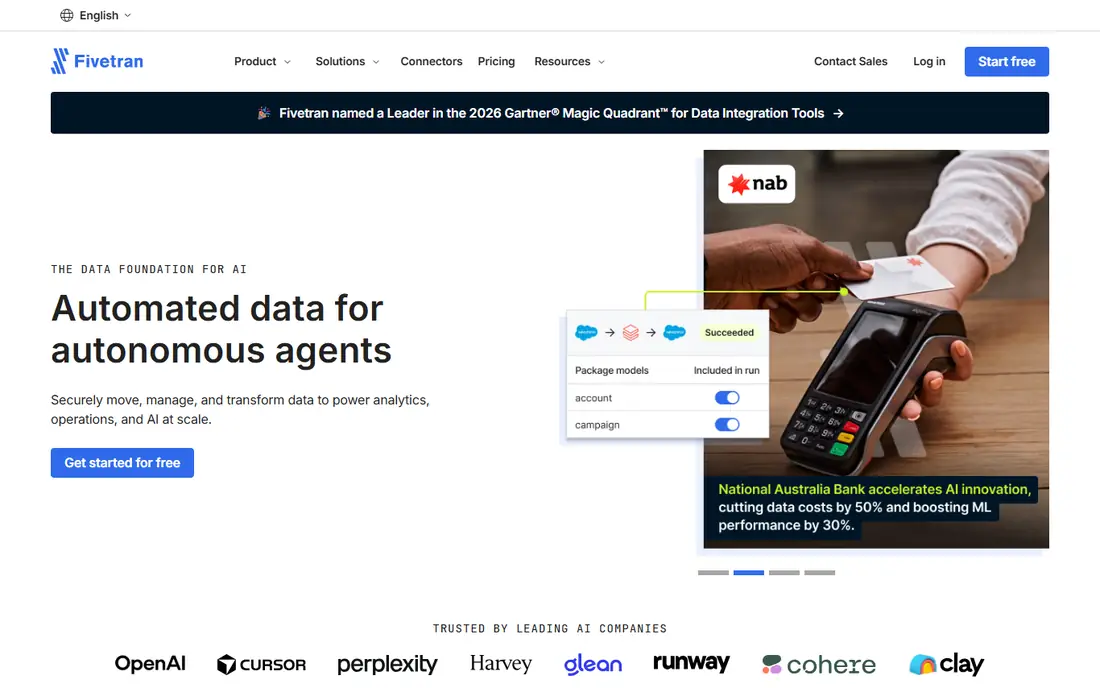
Fivetran moves data from business systems into a warehouse or lakehouse with managed connectors, so a small data team does not have to maintain a separate ingestion service for each source. The free tier covers up to 500,000 monthly active rows, which is enough to test a few sources and check how the warehouse models behave. That managed approach is the main reason many teams choose it over building pipelines by hand.
The catch is the billing model. Fivetran charges on monthly active rows per connection, with a small base charge on paid standard connections, so a high-churn source can cost more than a quiet one. Teams that add many connectors without watching row counts can see a surprise bill. Check the pricing page and run a trial on real data before you commit to a yearly plan.
- Large connector catalog
- Managed schema changes
- Strong reliability focus
- Usage-based cost can be hard to predict
- Real-time sync is limited on lower tiers
Airbyte gives teams two clear routes. Airbyte Core can be self-hosted at no license cost, which suits teams that want control over where data runs and how connectors are built. Airbyte Cloud starts at 20 dollars per month on the Standard plan, with extra credits priced separately, so smaller workloads can start without a large contract. The connector builder also helps teams connect an internal API that is not in the catalog.
The trade-off is ownership. Self-hosting means your team owns upgrades, monitoring and capacity planning, and that work can erase the license saving. Cloud pricing is clearer than a row-based model in some cases, but it still rises with the amount of data moved. Airbyte is a strong pick for teams with engineering capacity and a wish to avoid vendor lock-in.
- Free self-hosted core
- Large connector catalog
- Credit-based cloud pricing
- Self-hosting needs engineering time
- Cloud costs rise with volume
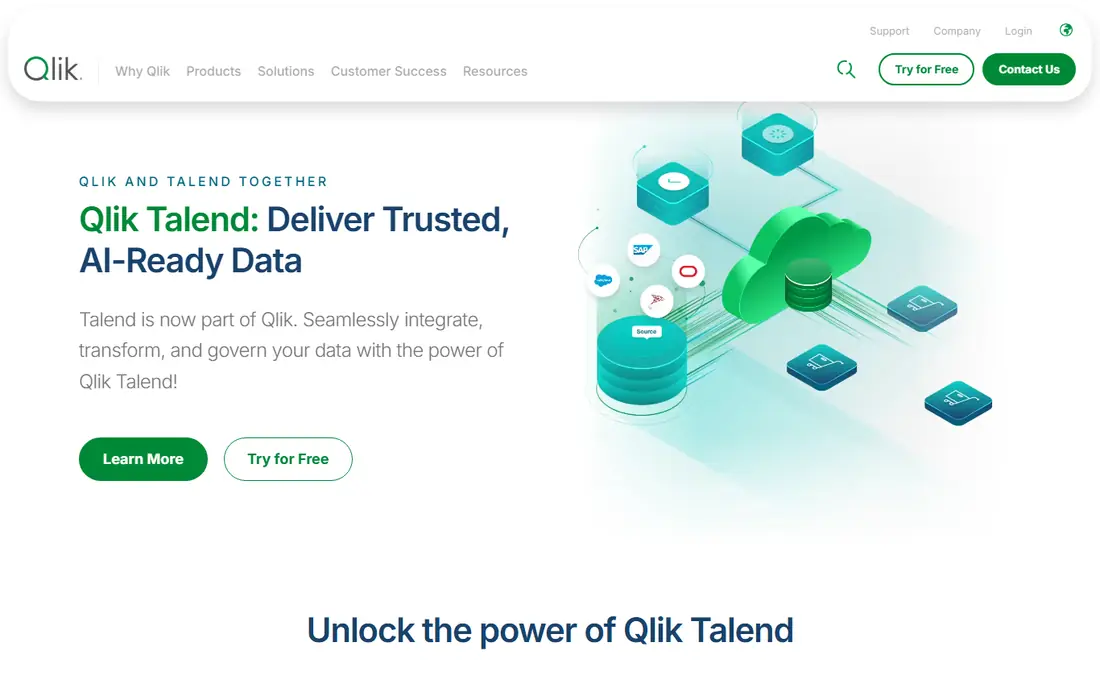
Talend, now sold as Qlik Talend Cloud, covers integration, data quality and governance in one suite rather than only moving rows. That breadth matters for regulated teams that need lineage, profiling and stewardship alongside pipelines. Hybrid deployment also helps companies that still run important systems on premises and cannot move everything to the cloud at once.
The main drawback is complexity and price opacity. Pricing is quote-based and metered on several dimensions, so budgeting needs a sales conversation and a realistic volume estimate. Implementation can also take weeks for a large estate. Talend fits best when data quality and governance are formal requirements, not when a team only needs a few SaaS connectors.
- Broad data quality and governance tools
- Many connectors
- Hybrid deployment
- Quote-only pricing
- Long implementation for large estates
Matillion is built around cloud warehouses, with visual pipelines that run transformation inside the warehouse rather than on a separate engine. That design suits analytics teams that already live in Snowflake, Databricks or a similar platform and want pipelines that are easy to read and hand over. The visual builder also lowers the barrier for analysts who know SQL but do not want to maintain Python jobs.
The catch is scope and cost. Matillion is less of a general application-integration tool than Boomi or Workato, and credit consumption depends on how jobs run. Teams should test a representative set of pipelines and watch credit use during the trial. It is a good fit for warehouse-first analytics, not for every integration problem in a company.
- Visual pipeline building
- Strong warehouse focus
- Transformation controls
- Credit-based pricing needs care
- Mainly warehouse-centered
Hevo Data is a managed ELT platform aimed at teams that want pipelines running quickly without writing ingestion code. The free tier supports a limited number of events per month, which is useful for a proof of concept or a small reporting project. Drag-and-drop transformation blocks and Python options give teams a middle path between pure no-code and full code.
The limitation is the event model. Every insert, update and delete in the destination can count, so a source with frequent changes can push a team into a higher tier sooner than expected. Connector coverage is also narrower than Fivetran or Airbyte. Hevo fits small and mid-size teams with a clear list of sources and a wish to avoid pipeline maintenance.
- No-code setup
- Free tier
- Pre-load transformation options
- Event-based pricing can rise with churn
- Smaller connector catalog than leaders
Stitch focuses on a simple job: replicate data from SaaS tools and databases into a warehouse on a schedule. Setup is quick, and the plan structure makes it clear how many sources and destinations each tier allows. That simplicity is an advantage for a team that needs reliable reporting data and does not want a second platform to learn.
The weakness shows when a team needs heavy transformation or complex orchestration. Stitch is not a full data platform, and higher tiers are needed as source counts grow. It is best for teams with a modest source list, a single warehouse and a preference for a tool that stays out of the way.
- Fast setup
- Clear source and destination limits
- Long track record
- Fewer advanced transformation options
- Tier limits on sources and destinations
Boomi is an integration platform that connects applications, data and processes across cloud and on-premises systems. It covers application integration, API management, B2B and EDI work and data pipelines in one platform, which suits companies with a mixed estate. A pay-as-you-go option starting at 99 dollars per month plus usage gives smaller teams a way to test the platform before a larger subscription.
The drawback is that most subscription pricing is not published, so a full deployment needs a sales discussion and careful scoping. The breadth of the platform can also feel heavy for a team that only needs warehouse replication. Boomi is a strong choice when integration spans departments and legacy systems, not when the only goal is analytics ingestion.
- Broad integration and API tools
- Hybrid support
- Pay-as-you-go entry point
- Subscription pricing is quote-based
- Enterprise scope can be heavy for small teams
Workato is best known for recipes that automate work across SaaS apps, such as syncing a CRM with billing or routing approvals. That makes it a useful Informatica alternative when the real need is business process automation rather than only warehouse loading. Business users can build many workflows with a visual builder, while IT keeps control over connectors and governance.
The main risk is pricing. Workato does not publish list prices, and costs scale with task volume, recipe complexity and connector tier. A team that automates a high-volume process without a cap or forecast can face a larger bill than expected. Workato fits teams that value workflow automation and can model task volume before they scale.
- Business-friendly recipe builder
- Many SaaS connectors
- Automation beyond data movement
- Quote-only pricing
- Usage costs can grow with automation volume
Azure Data Factory is Microsoft's cloud service for building data pipelines and orchestrating movement between sources, Azure services and other destinations. It fits teams that already use Azure, Microsoft Fabric or Synapse, since identity, monitoring and billing sit in the same cloud account. Pipelines can be built visually or with code, and scheduling and dependency handling are built in.
The limitation is fit outside Azure. Teams on another cloud may find a neutral ELT tool simpler, and Azure pricing depends on pipeline activity and data movement, so a busy schedule needs a cost check. For Microsoft-centered teams, though, Data Factory is often the lowest-friction alternative to a separate integration suite.
- Deep Azure integration
- Visual and code options
- Strong orchestration
- Best inside Azure
- Pricing depends on activity runs and data movement
How we picked these
We compared official product and pricing pages, connector documentation and recent third-party pricing guides, and we favored tools that are still sold and supported in October 2026. We excluded tools that only cover one narrow job, such as a single database migration, and we avoided pricing figures that conflicted across sources by writing See website instead. We did not claim hands-on testing. The list mixes managed ELT, warehouse transformation and broader integration platforms because Informatica itself covers more than one job.
What to check before you switch
Start with the sources you actually have, not the full catalog. List each source, its change rate and its destination, then test the top two tools on that list with a real trial. Watch how schema changes are handled, how errors are reported and how long a failed sync takes to notice. A tool that looks cheap on a price page can become costly if it needs daily manual fixes.
Check governance early if you work with customer or financial data. Ask how access is controlled, how lineage is shown and whether data can stay in a chosen region. Also check the exit path. Export pipeline definitions and keep transformation logic in a place you control, such as dbt or SQL files, so a future move does not mean rebuilding everything from scratch. Finally, agree on who owns the pipelines after launch, since a tool without an owner tends to drift and break quietly.
Frequently asked questions
What are the best alternatives to Informatica?
Fivetran and Airbyte are the closest managed ELT replacements for most teams, while Talend and Boomi suit larger estates that need governance and application integration. The right pick depends on the main job: warehouse reporting, data quality or business workflow automation.
Is there a free Informatica alternative?
Airbyte Core is free to self-host, and Fivetran and Hevo Data offer free tiers with volume limits. Free options still need hosting, monitoring or a paid upgrade as volume grows, so check the limits before you rely on them for production reporting.
Which alternative is easiest for a small team?
Stitch and Hevo Data are among the easiest to set up for a small source list and a single warehouse. They need less code than a full integration suite, but they also offer less transformation depth than Matillion or Talend.
Do these tools replace data quality and governance?
Some do, and some do not. Talend and Boomi include broader governance and quality tools, while Fivetran, Airbyte and Stitch focus mainly on movement. If governance is a formal requirement, shortlist the broader suites and test lineage and access controls during the trial.
How do I estimate the real cost?
Model one month of real volumes, including deletes and updates where the vendor counts them, and add the cost of the warehouse and any transformation tool. Run a trial on production-like data and review the first invoice before you sign a yearly contract.
Sources
See where you really rank - block by block
ProMapRanker scans Google Maps across a grid of your service area. Simple monthly plans from $19, white-label on every plan.
Start freeKeep reading
 zscaler alternatives
Best Zscaler Alternatives in 2026
Looking for zscaler alternatives? We compare 9 SASE and zero trust platforms on architecture, data protection, pricing, and fit for your network and team.
Read → zapier alternatives free
Best Zapier Alternatives Free in 2026
Nine automation tools for zapier alternatives free in 2026, all with genuinely free tiers, plus free plan limits, starting prices and upgrade paths explained.
Read → which platform is best for online reputation
Which Platform Is Best for Online Reputation in 2026
Wondering which platform is best for online reputation? We compare 8 review, listing, and response tools for small and multi-location businesses and agencies.
Read →