 ProMapRanker
Best Fivetran Alternatives in 2026

Key takeaways
- Airbyte is the clearest open-source alternative, with a free self-hosted edition and a managed cloud option.
- Stitch and Hevo suit smaller teams that want managed pipelines without running infrastructure.
- Estuary fits teams that need low-latency streaming, while Integrate.io fits teams that want a fixed monthly price.
- Pricing models differ sharply, so compare cost at your real data volume, not at the entry tier.
Quick comparison
| Pick | Great for | Pricing starts at | Free tier | |
|---|---|---|---|---|
 Airbyte | Open-source ELT | $20 per month | Yes | Visit |
 Stitch | Simple managed replication | $100 per month | Free trial (14 days) | Visit |
 Hevo Data | Managed no-code pipelines | $239 per month | Yes | Visit |
 Estuary | Real-time streaming | Free | Yes | Visit |
 Integrate.io | Fixed-price pipelines | $1,999 per month | Free trial | Visit |
 Rivery | ELT plus orchestration | See website | Free trial | Visit |
 Qlik Talend | Enterprise data integration | See website | Free trial | Visit |
 Skyvia | Low-cost cloud replication | $79 per month | Yes | Visit |
The best fivetran alternatives
Fivetran is known for managed ELT pipelines that move data into a warehouse with little upkeep, but its usage-based pricing can be hard to forecast at scale. These alternatives to fivetran cover the same job in different ways: open-source control, simpler managed replication, streaming, and fixed-price plans.
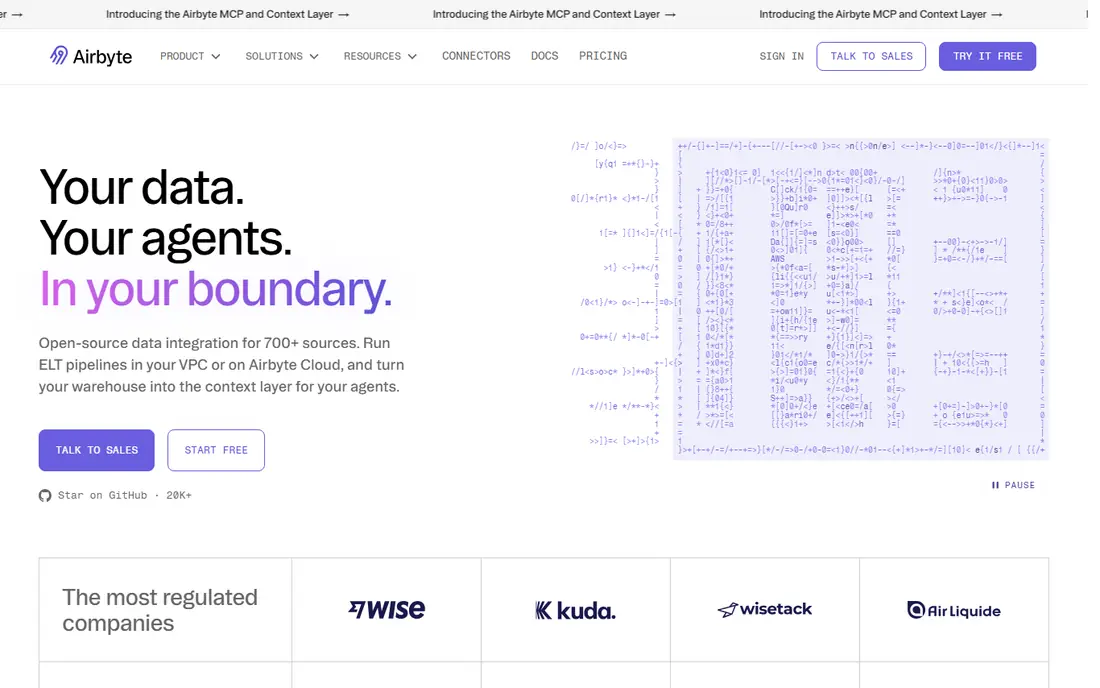
Airbyte is the first tool most teams test when they leave Fivetran, and the reason is control. Airbyte Core is free to self-host, while Airbyte Cloud starts at $20 per month for Standard with five credits, and Plus starts at $189 per month for 40 credits. Sync frequency improves by plan, from hourly on Standard to every 15 minutes on Plus and every five minutes on Pro.
The trade-off is operational work. Self-hosting saves subscription cost but adds infrastructure, monitoring, and connector maintenance. Cloud removes that burden but still charges by credits, so a team with heavy API volume should model credit use before committing. For engineering teams that want connector control and a hybrid deployment path, Airbyte is the strongest alternative.
- Free self-hosted open-source edition
- More than 700 connectors
- Custom connector builder for unusual sources
- Self-hosting means you own upgrades and scaling
- Transformation happens after loading, through dbt or SQL
- Community connector quality varies
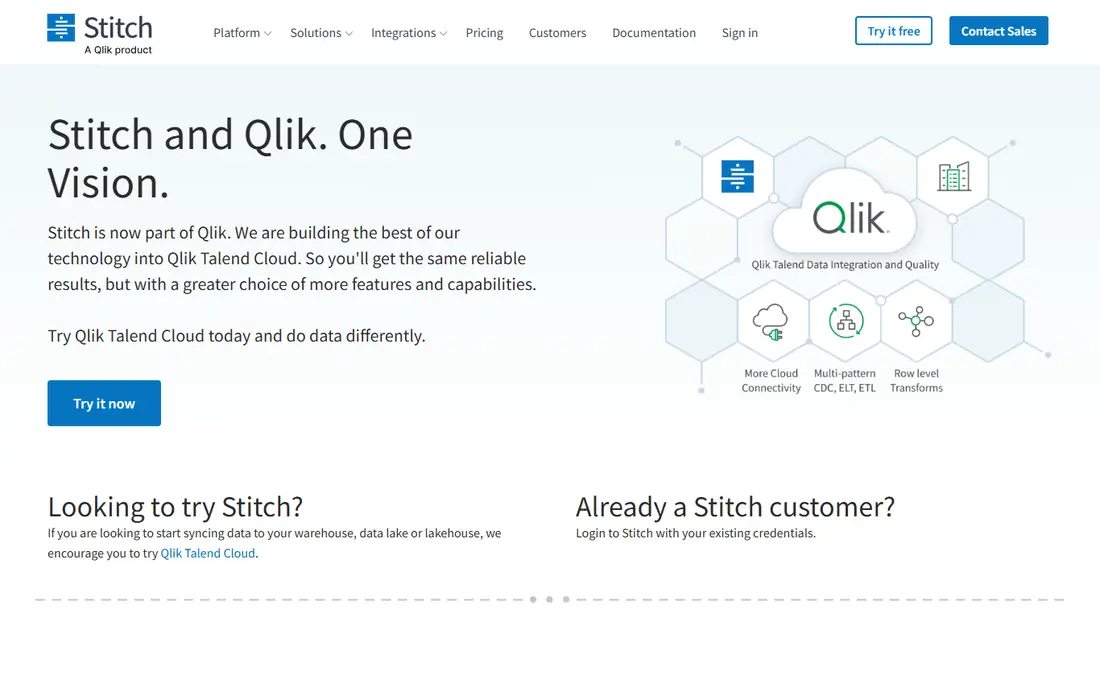
Stitch is the simplest managed alternative for a lean team that just needs data in the warehouse. Standard starts at $100 per month for five million monthly active rows, one destination, and ten sources, with Advanced and Premium tiers for larger volumes. Setup is quick, and the pricing model is easier to explain to finance than a credit system.
The limit is what happens after the data lands. Stitch does not offer built-in transformations, so teams use dbt or warehouse SQL for modelling. It also lacks the fastest sync options for teams that need near real-time data. For a small team that values simplicity over streaming, Stitch remains a solid, low-friction pick.
- Simple setup for SaaS replication
- Transparent row-based pricing
- Singer-based connectors for many sources
- No built-in transformation
- Sync is not real-time for most sources
- Roadmap has been slower under Qlik ownership
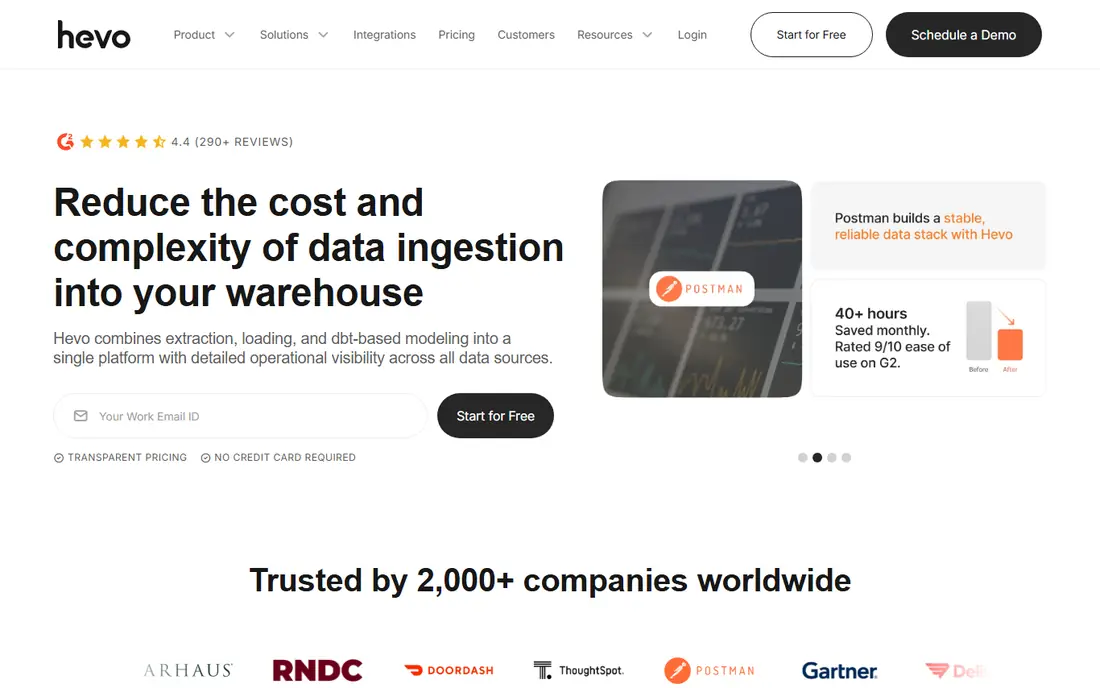
Hevo Data is built for teams that want managed pipelines without engineering overhead. The free tier covers one million events with a limited connector set, and Starter starts at $239 per month. Pipelines are set up without code, schema changes are handled automatically, and failed jobs are retried, which reduces the daily work of keeping data fresh.
The main drawback is price at the entry level, which is higher than Airbyte Cloud or Stitch for a small team. Hevo also does not offer an on-premises deployment, so teams with strict data location rules should check that early. For a business team that wants reliable pipelines and clear event-based pricing, Hevo is a strong managed choice.
- No-code pipeline setup
- Auto-healing pipelines and schema handling
- Free tier with one million events
- Paid entry is higher than Stitch
- No on-premises deployment
- Advanced transformations may need Python or dbt
Estuary is different from most ELT tools because it is built for streaming first. Data can move with very low latency, and pricing is based on GB moved plus connector instances: $0.50 per GB plus $100 per connector per month for the first six, dropping to $50 after that. The free tier includes up to 10 GB per month and two connector instances, with no credit card required.
That model suits teams that need fresh data for operations or analytics, not just nightly loads. The catalogue, at more than 200 managed connectors, is smaller than Airbyte or Fivetran, so check your key sources first. For streaming use cases, Estuary is one of the most cost-transparent alternatives on this list.
- Free tier with 10 GB per month and two connector instances
- Low-latency streaming
- Pricing by GB and connector, not by row changes
- Smaller managed connector catalogue than Airbyte
- Complex transformations need SQL, Python, or TypeScript
- No drag-and-drop transformation canvas
Integrate.io is the pick for a team that is tired of translating usage meters into a budget. For $1,999 per month, the platform includes unlimited data volumes, pipelines, and connectors, plus ETL and ELT flexibility, reverse ETL, API generation, and Salesforce Sync. That fixed price becomes attractive once volume passes a few hundred GB per month, where credit and row-based tools can cost more.
The entry price rules it out for startups and small teams, and the platform is more than a simple replication tool. If you only need ten sources moved nightly, Stitch or Airbyte Cloud will be cheaper. If you run a large, growing data operation and need predictable costs, Integrate.io is worth a serious look.
- Fixed monthly fee with unlimited data volumes and pipelines
- More than 220 drag-and-drop transformations
- 60-second CDC on all plans
- High entry price for small teams
- Overkill for simple replication
- Onboarding and setup are heavier than Stitch
Rivery, now part of Boomi, combines ELT pipelines with orchestration in one place. Teams can ingest data, run SQL and Python logic flows, schedule work, and send data back to operational tools, without adding a separate orchestrator. The base credit rate is published at $0.90 per credit, with database replication at one credit per 100 MB and log-based CDC at two credits per 100 MB.
The pricing model is the main warning. Only the base rate is published, higher tiers are not, and the base tier limits syncs to 60 minutes and excludes Python, CLI, and API access. For a mid-size data team moving a few hundred GB per month, Rivery can be efficient. For a team that needs a simple published price, Airbyte or Integrate.io will be easier to budget.
- Ingestion, SQL and Python transformation, and scheduling in one tool
- About 200 managed connectors
- API connector without extra cloud functions
- Credit pricing can be hard to forecast
- Base tier is thin, with 60-minute syncs and no Python
- Smaller catalogue than Airbyte
Qlik Talend Cloud is the enterprise alternative for organisations that need governance, data quality, and integration across many systems, not just warehouse loading. It supports log-based CDC, a wide connector range, and deployment in the cloud, client-managed, or hybrid setups. That breadth suits large companies with compliance, lineage, and access control requirements.
The cost is opacity. Pricing is quote-only and depends on data volume, job executions, and duration on higher tiers, so a sales cycle is unavoidable. Small teams should not start here. For an enterprise that already uses Qlik or Talend tools, or that needs a governed integration platform, Qlik Talend is a credible, if expensive, alternative.
- Broad enterprise integration and governance
- Log-based CDC from the Standard tier
- Hybrid and client-managed deployment options
- Quote-only pricing
- Enterprise complexity and implementation time
- Overkill for small ELT needs
Skyvia is a practical low-cost option for teams that need cloud replication without enterprise pricing. The free tier covers 10,000 records per month, and Basic at $79 per month on annual billing covers five million records. It runs on Azure in the cloud, with an on-premises agent for databases behind a firewall, and it supports one-minute syncs on Professional and higher plans.
Skyvia will not replace a full enterprise platform for very large or complex workloads, and its transformation depth is lighter than tools built around data modelling. For a small or mid-size team that needs reliable replication, backup, and simple integration at a clear price, Skyvia is a strong budget alternative to Fivetran.
- Free tier with 10,000 records per month
- Basic at $79 per month on annual billing for five million records
- On-premises agent for firewalled databases
- Smaller scale than enterprise ELT platforms
- Advanced transformation is lighter than Integrate.io
- Sync frequency is limited on lower plans
How we picked these
We compared official pricing pages, documentation, and public reviews for tools that move data from SaaS apps and databases into a warehouse or lake, and that are live in October 2026. We kept a mix of open-source, managed, streaming, and fixed-price models, and we checked connector range, sync frequency, transformation options, and deployment choices. We did not claim hands-on pipeline testing; our comparison is based on vendor pages and published reviews.
Choosing by volume, latency, and team skill
Start with data volume and how often it changes. A team moving a few GB per month can use a free tier or a low-cost cloud plan, while a team moving hundreds of GB should model credit, row, and GB pricing side by side. A small difference in unit price becomes a large bill at scale, so test with a month of real volume, not a demo dataset.
Next, decide how fresh the data must be. Hourly syncs are enough for daily reporting, while operations, fraud checks, and live dashboards need streaming or minute-level syncs. Estuary and Integrate.io suit the second case, while Stitch and Airbyte Standard suit the first. Do not pay for streaming if your reports are only read each morning.
Finally, be honest about engineering time. Self-hosted Airbyte saves money but needs someone to run it. Managed tools cost more but remove that work. If no one on the team can own infrastructure, choose a managed plan, even if the headline price is higher, because a broken pipeline costs more than a subscription.
Frequently asked questions
What is the best free alternative to Fivetran?
Airbyte Core is the best free alternative for teams that can self-host, since the open-source edition has no software cost, though you still pay for infrastructure. Estuary and Skyvia offer free tiers for low volumes, and Hevo offers a free tier with one million events. For a fully managed free start, test Estuary or Skyvia first.
Is Airbyte better than Fivetran?
Airbyte is better for teams that want open-source control, custom connectors, and self-hosting or hybrid deployment. Fivetran is better for teams that want a fully managed service with minimal upkeep and are willing to pay usage-based pricing. The right choice depends on whether your team has engineering time to run pipelines.
What is the cheapest Fivetran alternative for a small team?
Airbyte Cloud Standard at $20 per month and Skyvia Basic at $79 per month are among the cheapest paid starting points, while Estuary and Hevo free tiers can cover very low volumes at no cost. Stitch at $100 per month is also reasonable for simple replication. Compare cost at your real row or GB volume, since entry prices do not tell the full story.
Do these alternatives support change data capture?
Yes, most do, though coverage varies by database and plan. Airbyte, Estuary, Integrate.io, Rivery, and Qlik Talend support log-based CDC for common databases such as PostgreSQL, MySQL, and SQL Server. Stitch supports log-based replication for select sources and key-based replication for many others. Check your exact database version before you choose.
Can I migrate pipelines from Fivetran without rebuilding everything?
In many cases, yes, especially for mainstream sources, since connector overlap is high across Airbyte, Stitch, Hevo, and Integrate.io. Transformations that lived in dbt can usually move with the pipeline or stay in the warehouse. Budget time for testing, since schema handling, sync timing, and data types can differ between tools.
Which alternative is best for real-time data?
Estuary is the strongest pick for low-latency streaming on this list, with pricing by GB and connector rather than by row changes. Integrate.io also offers 60-second CDC across plans. Airbyte Pro offers five-minute syncs, which is fast enough for many near real-time reports but not true streaming.
Sources
See where you really rank - block by block
ProMapRanker scans Google Maps across a grid of your service area. Simple monthly plans from $19, white-label on every plan.
Start freeKeep reading
 leg extension alternatives
Leg Extension Alternatives in 2026
Leg extension alternatives that build quad strength without a machine, from goblet squats to step-ups, with form tips for home and gym training in our guide.
Read → kemono alternatives
Kemono Alternatives in 2026
Find legal kemono alternatives for creators in 2026, from Patreon and Ko-fi to Substack and Ghost, with fees, features, safety notes, and honest limits.
Read → kafka alternatives
Kafka Alternatives in 2026
Compare the best Kafka alternative platform options for event streaming, queues and messaging, with trade-offs on scale, ops and cost for developers now.
Read →