 ProMapRanker
Fintech Companies With Best Risk Management in 2026

Key takeaways
- This is a guide based on publicly reported factors, not a verified ranking, because risk tools differ by fraud type, volume, and regulation.
- Feedzai and Featurespace suit high-volume banks and payment firms that need real-time fraud and transaction monitoring.
- Alloy, ComplyAdvantage, and Unit21 suit fintechs that need identity, screening, and AML workflows in one system.
- Riskified, Sift, and Forter suit ecommerce and payments teams focused on chargebacks, account takeover, and abuse.
- Our advice is to pilot on one risk type first, measure approval rates and false positives, and then expand to wider coverage.
Quick comparison
| Pick | Great for | Pricing starts at | Free tier | |
|---|---|---|---|---|
 Feedzai | Bank-scale fraud and RiskOps | See website | No | Visit |
 ComplyAdvantage | Screening and financial crime data | See website | No | Visit |
 Alloy | Identity and compliance orchestration | See website | No | Visit |
 Riskified | Chargeback protection for ecommerce | See website | No | Visit |
 Sift | Account takeover and abuse prevention | See website | No | Visit |
 Forter | Fraud prevention for digital commerce | See website | No | Visit |
 Featurespace | Adaptive behavioral fraud detection | See website | No | Visit |
 Socure | Digital identity verification | See website | No | Visit |
 Unit21 | AML monitoring and investigations | See website | No | Visit |
The best fintech risk management companies
We looked at public product pages, use cases, and widely reported strengths for fraud, anti-money laundering, identity, and compliance work. This guide covers risk management platforms used by fintech companies, rather than ranking fintech brands themselves, since a platform choice depends on the risk type. No scores, salary figures, or pay claims are used here.
Feedzai is a RiskOps platform that combines fraud prevention, anti-money laundering, and case management for banks, payment companies, and large fintechs. Its models score transactions in real time and feed alerts into investigation workflows, which helps teams act on suspicious activity without switching systems. Public product pages describe its use across card, payment, and account activity.
Feedzai is built for scale, so small startups may find the commercial and implementation effort heavier than a lighter tool such as Sift or SEON. For high-volume institutions that need fraud and AML in one place, Feedzai is a strong shortlist choice, provided the risk team can support model tuning and case work.
- Real-time fraud scoring for payments
- AML and case operations in one platform
- Suited to high-volume banks and payment firms
- Enterprise scale and pricing can rule out small startups
- Implementation needs data and risk team resources
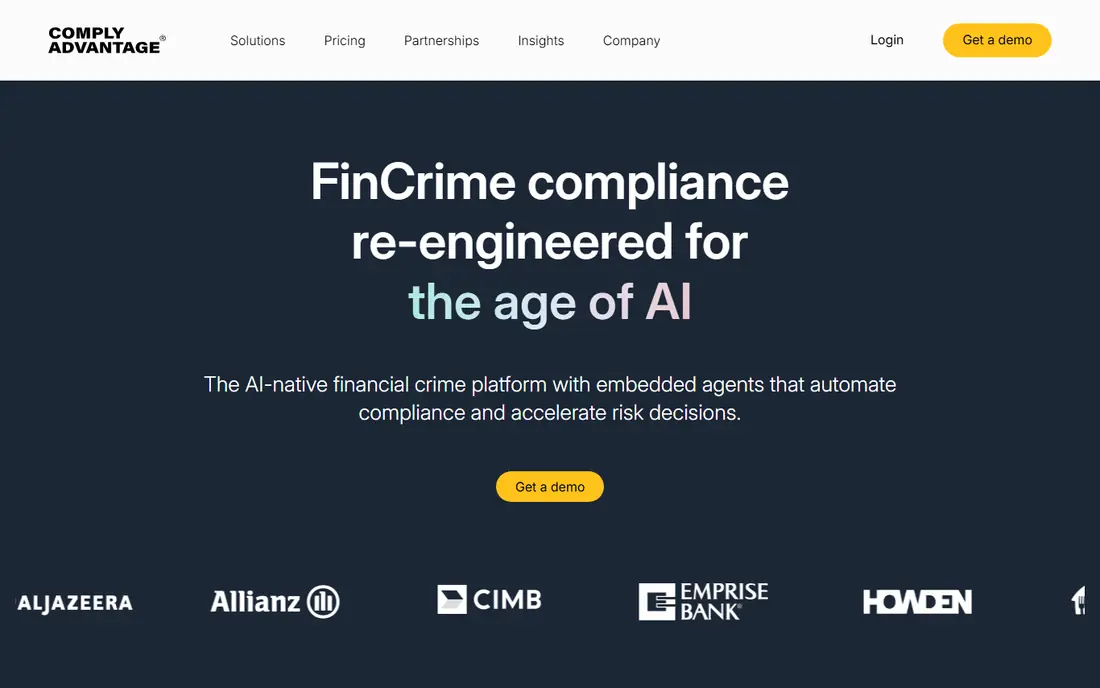
ComplyAdvantage provides financial crime risk data and screening for fintechs, banks, and brokerages. Its platform checks customers and payments against sanctions lists, politically exposed persons, and adverse media, and scores entity risk over time. That screening depth suits digital banks and brokerages that need specialist anti-money laundering controls without building their own data feeds.
Analyst reviews note that built-in reporting can feel basic compared with larger enterprise systems, and that machine learning scoring needs careful explanation for auditors. ComplyAdvantage still fits well for smaller digital banks with detailed screening needs and limited in-house data science resources.
- Real-time sanctions, PEP, and adverse media screening
- Entity risk scoring
- Strong fit for digital banks and brokerages
- Reporting tools are described as basic in some analyst reviews
- Partner ecosystem is narrower than larger enterprise suites
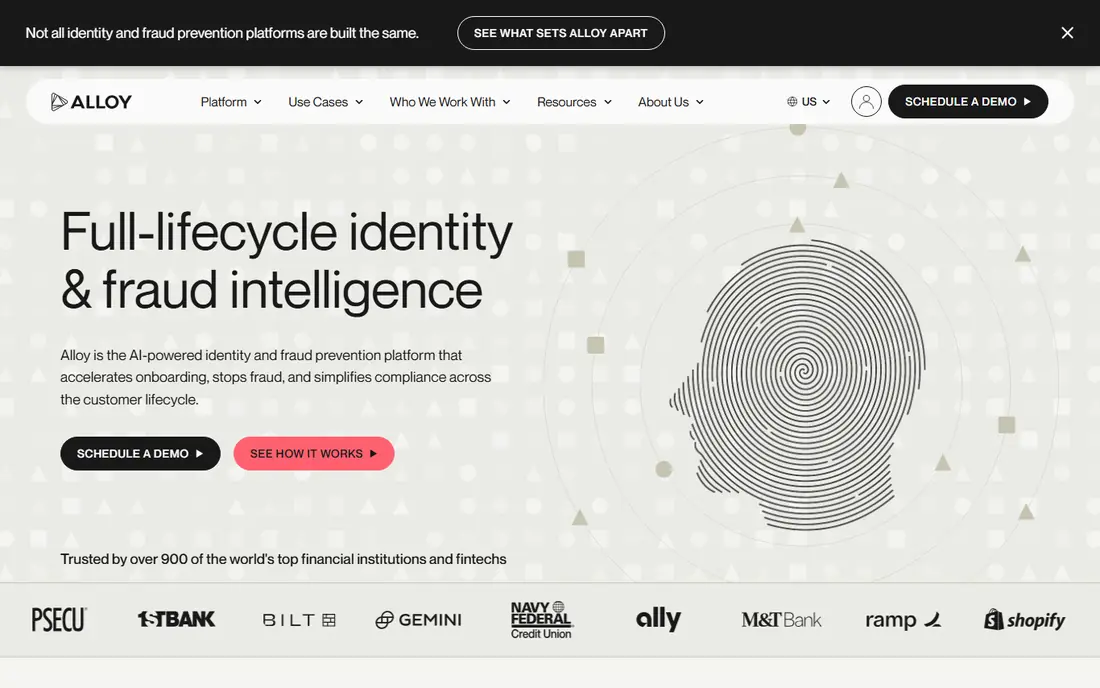
Alloy helps fintechs and neobanks automate onboarding and ongoing risk decisions by orchestrating identity verification, fraud checks, and compliance steps in one workflow. Instead of building separate checks for each vendor, teams can route applicants through rules, data sources, and manual review in a single system. Recent product updates add AI assistance and expanded lifecycle risk controls.
Alloy is most valuable when a fintech needs many checks and wants to change rules without rebuilding integrations each time. A very small startup with one check and low volume may not need that orchestration depth, but a growing neobank with complex onboarding will benefit from it.
- Orchestrates identity, fraud, and compliance checks in one workflow
- Broad data source integrations
- Lifecycle risk controls
- Pricing is quoted
- Value depends on how many data sources and workflows a fintech actually needs
Riskified focuses on ecommerce fraud, helping merchants approve more legitimate orders while reducing chargebacks. Its models assess order risk in real time, and its guarantee model can shift liability for eligible fraud off the merchant, which helps margins when chargebacks are a major cost. That model suits online retailers and marketplaces with high order volumes.
The guarantee does not cover every order or every fraud type, so merchants must read eligibility, exclusions, and fee terms closely. Riskified is best judged on approval lift and net chargeback cost in a pilot, rather than on headline claims alone.
- Chargeback guarantee model for eligible fraud on some plans
- Approval optimization for ecommerce orders
- Fraud insights for merchants
- Guarantee terms and eligibility need careful reading
- Pricing is tied to order volume and risk profile
Sift helps digital businesses detect account takeover, fake accounts, payment abuse, and other trust and safety risks in real time. Its models score events at sign-up, login, and payment, so teams can block abuse early without adding friction for legitimate users. That focus suits fintechs, marketplaces, and ecommerce firms with high-volume user funnels.
Sift needs ongoing tuning, since a model that is too strict blocks good users and a model that is too loose lets abuse through. Teams should pilot with clear metrics for approval rates, false positives, and abuse caught, and should confirm how the platform handles new fraud patterns over time.
- Fast risk scoring for sign-up, login, and payment flows
- Account takeover and abuse detection
- Suited to high-volume digital funnels
- Needs tuning to balance friction and false positives
- Pricing is quoted for larger volumes
Forter provides fraud prevention for digital commerce, using network signals from many merchants to assess transaction risk in real time. That network view can help spot fraud patterns that a single merchant would miss, such as a device or identity linked to abuse elsewhere. Forter covers payment fraud, account protection, and abuse cases for online retailers and payment firms.
Forter is enterprise oriented, so pricing and implementation suit larger merchants better than tiny stores. For mid-sized and large ecommerce firms, a pilot that measures approval rates and fraud losses is the best way to judge whether the network effect justifies the cost.
- Real-time fraud decisions for ecommerce and payments
- Large merchant network signals
- Chargeback and abuse coverage
- Enterprise pricing is quoted
- Smaller merchants may find lighter tools more affordable
Featurespace builds fraud detection around adaptive behavioral analytics, studying how customers normally behave and flagging changes that suggest fraud. That approach can catch new fraud types that rule-based systems miss, since it does not rely only on known patterns. Its platform serves banks, payment firms, and fintechs across fraud and anti-money laundering work.
Behavioral models depend on data quality and history, so new products with little customer history may see slower value. Featurespace suits established payment and banking firms with enough transaction data to train and tune behavioral models over time.
- Adaptive behavioral analytics that adjust as customer behavior changes
- Real-time scoring for payments and accounts
- Fraud and AML use cases
- Enterprise focus can mean longer implementation
- Behavioral models need good data quality to perform well
Socure helps fintechs verify digital identities at onboarding and during high-risk actions, using AI and alternative data signals beside documents and biometrics. Better verification accuracy can raise approval rates for legitimate users while blocking synthetic identities and fraud. That balance matters for neobanks and lenders that onboard users fully online.
Identity verification performance varies by country, population, and data availability, so fintechs should test Socure on their actual applicant mix rather than relying on general claims. Socure fits fintechs that need strong digital onboarding without adding heavy document friction for every user.
- AI-based identity verification using broad data signals
- Helps improve verification accuracy and reduce friction
- Fraud and compliance use cases
- Identity accuracy varies by population and data coverage
- Pricing is quoted and volume based
Unit21 focuses on anti-money laundering monitoring, investigations, and case management for fintechs and financial firms. Teams can build and test transaction monitoring rules, manage alerts, and document investigations in one system, with newer AI tools to help with rule building and case work. That configurability suits fintechs that need control over AML operations without a large enterprise suite.
Unit21 is not a full fraud platform, so firms that also need real-time payment fraud scoring may pair it with Feedzai, Featurespace, or Sift. For fintechs whose main risk gap is AML operations and investigations, Unit21 is a focused and practical choice.
- Configurable AML monitoring and case management
- Agentic AI tools for rule building and investigations
- Suited to fintech compliance teams
- Narrower than a full fraud platform
- Value depends on compliance team capacity to manage rules and cases
How we picked these
We compared public product pages, use cases, and widely reported strengths for fraud, anti-money laundering, identity, and compliance, and we kept only platforms that are active in October 2026. We mixed bank-scale platforms with fintech-focused tools, and fraud, identity, and AML specialists, so readers can match the tool to the risk type. We did not claim hands-on testing or verified rankings, and we avoided scores and other numbers that vary by client and volume.
How to choose a fintech risk management platform
Start with the risk you lose money or regulatory standing on first. Payment fraud, account takeover, synthetic identity, sanctions screening, and transaction monitoring are different problems, and no single platform leads on all of them. Map your top two risk types, then shortlist platforms that specialize in those areas rather than buying the broadest suite available.
Next, run a pilot with real traffic and clear metrics. Measure approval rates for legitimate users, false positive rates, fraud caught, alert volume for analysts, and time to investigate a case. A platform that looks strong in a demo can fail if alert volume overwhelms a small compliance team, or if legitimate users face too much friction at onboarding.
Finally, check integration, data, and audit needs before signing. Confirm API coverage, data source integrations, case management, reporting for regulators, and model explainability for audits. Risk tools also need ongoing tuning, so ask who owns model updates, how often rules change, and what support is included in the price.
Frequently asked questions
What are the best fintech risk management companies?
Feedzai, ComplyAdvantage, Alloy, Riskified, Sift, Forter, Featurespace, Socure, and Unit21 are strong options, each with a different focus. Feedzai and Featurespace suit bank-scale fraud, Alloy and Unit21 suit identity and AML workflows, and Riskified and Forter suit ecommerce fraud. Choose by risk type, volume, and regulatory needs, not by brand alone.
What is fintech risk management?
Fintech risk management covers fraud prevention, identity verification, anti-money laundering, sanctions screening, and compliance monitoring for digital financial services. It includes real-time transaction scoring, customer onboarding checks, ongoing monitoring, and case investigations. Good risk management balances fraud losses, regulatory duties, and a smooth experience for legitimate users.
How do fintechs prevent fraud in real time?
Fintechs score transactions, logins, and sign-ups in real time using device data, behavior patterns, identity signals, and network data, then approve, challenge, or block each event based on risk rules and models. High-risk events go to manual review or step-up checks, while low-risk events pass with little friction. Tuning those thresholds is an ongoing job, since fraud patterns change quickly.
What is the difference between fraud prevention and AML compliance?
Fraud prevention stops unauthorized or abusive transactions, such as stolen cards, account takeover, and fake orders. Anti-money laundering compliance screens customers and transactions for sanctions, illicit funds, and suspicious patterns, and reports them as required by law. Many platforms cover both, but some specialize in one area, so fintechs often use more than one tool.
How much does a fintech risk platform cost?
Most platforms on this list quote pricing based on volume, risk type, and features, so there is no single starting price to compare fairly. Small fintechs should ask for a pilot price, a per-transaction or per-check rate, and any minimums, while larger firms should compare total cost including implementation, data sources, and case management. This is not financial advice, and firms should confirm regulatory duties with compliance counsel.
Sources
See where you really rank - block by block
ProMapRanker scans Google Maps across a grid of your service area. Simple monthly plans from $19, white-label on every plan.
Start freeKeep reading
 zscaler alternatives
Best Zscaler Alternatives in 2026
Looking for zscaler alternatives? We compare 9 SASE and zero trust platforms on architecture, data protection, pricing, and fit for your network and team.
Read → zapier alternatives free
Best Zapier Alternatives Free in 2026
Nine automation tools for zapier alternatives free in 2026, all with genuinely free tiers, plus free plan limits, starting prices and upgrade paths explained.
Read → which platform is best for online reputation
Which Platform Is Best for Online Reputation in 2026
Wondering which platform is best for online reputation? We compare 8 review, listing, and response tools for small and multi-location businesses and agencies.
Read →