 ProMapRanker
Find Me the Top P and C Insurance Software Vendors in 2026


Large carriers needing a full suite · Pricing starts at: See website
Key takeaways
- This is a guide based on public reputation and services, not a verified ranking, because enterprise insurance pricing and fit depend on each carrier.
- Guidewire and Duck Creek are the most widely named full-suite options for large property and casualty carriers.
- Mid-market carriers and managing general agents often get more value from focused platforms such as BriteCore, Insly or OneShield.
- Core platforms usually cover policy, claims, billing and rating, while agency tools cover distribution, so buyers should not confuse the two.
Quick comparison
| Pick | Great for | Pricing starts at | Free tier | |
|---|---|---|---|---|
| Guidewire InsuranceSuite | Large carriers needing a full suite | See website | No | Visit |
 Duck Creek Suite | Cloud-first P and C carriers | See website | No | Visit |
 Sapiens | Carriers wanting P and C plus wider lines | See website | No | Visit |
 Insurity | Mid-market and specialty carriers | See website | No | Visit |
 Majesco | Carriers seeking a configurable core | See website | No | Visit |
 EIS | Carriers wanting a modern core suite | See website | No | Visit |
 BriteCore | Mid-market carriers and mutuals | See website | No | Visit |
 OneShield | Managing general agents and carriers | See website | No | Visit |
 Insly | MGAs and brokers launching products | See website | No | Visit |
The best property and casualty insurance software vendors
Property and casualty, often shortened to P and C, covers home, auto, business and specialty lines. The vendors below sell the core systems carriers use to quote, issue, bill and settle claims. We describe what each vendor is known for, and we do not present this list as a scored ranking.
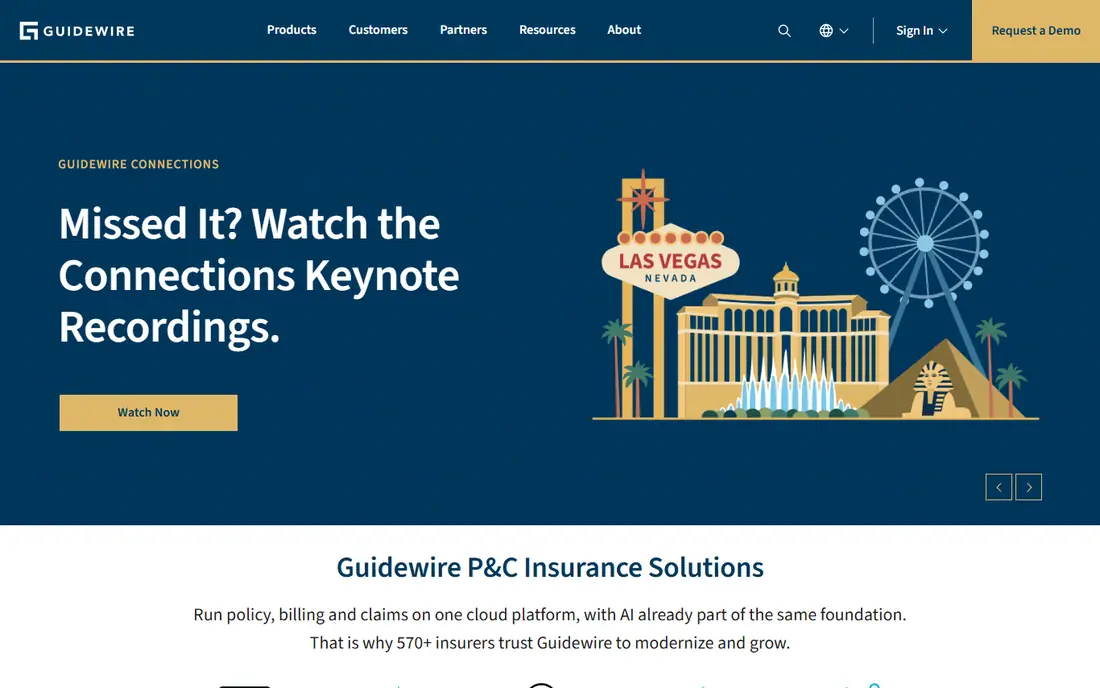
Guidewire InsuranceSuite brings PolicyCenter, ClaimCenter and BillingCenter together for property and casualty carriers. That shared core helps large carriers keep policy, claim and billing data in step, rather than stitching separate systems together. Its marketplace and implementation partner network are among the largest in the P and C market.
Scale is also the drawback. Implementation can be long and costly, and smaller carriers may struggle to staff and support the full suite. Buyers should ask for references in their own lines and a clear view of upgrade and integration costs before they commit.
- Policy, claims and billing in one suite
- Large partner marketplace
- Strong carrier references
- Complex implementation
- Cost can rule out smaller carriers
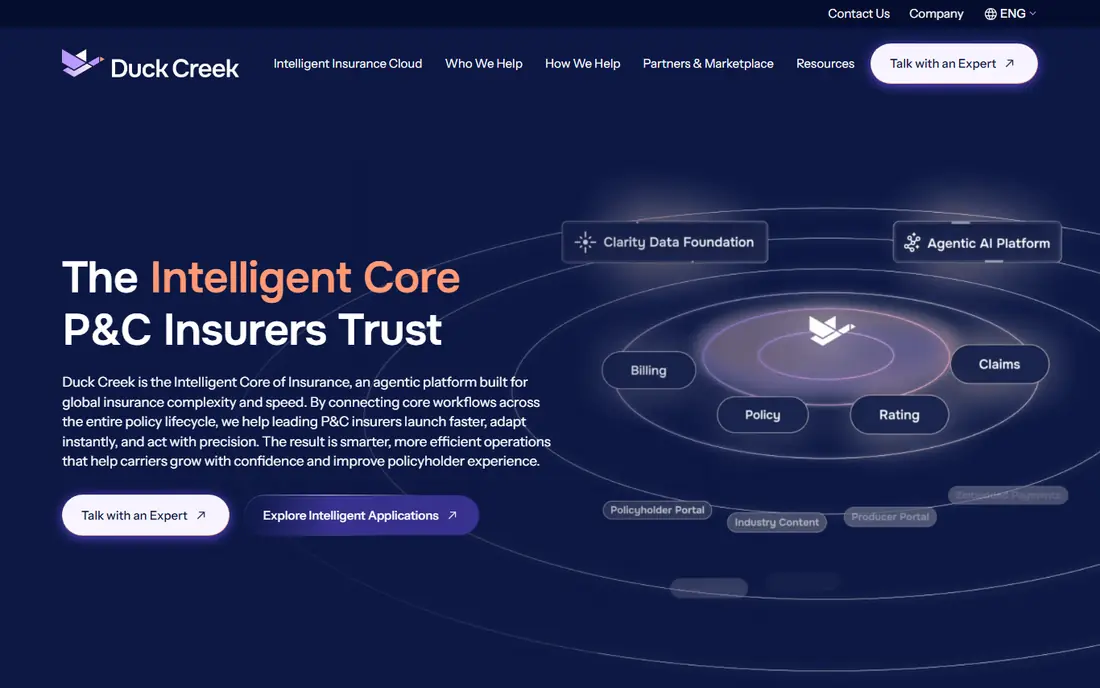
Duck Creek Suite covers policy, billing, claims, rating and related P and C functions in a cloud platform built for configuration. Carriers can shape products and workflows without rebuilding the core, and the vendor stresses evergreen upgrades that reduce large version jumps. That model suits carriers that want steady change rather than rare big projects.
The platform still needs careful scoping, because lines, rating content and integrations vary widely. Pricing is not published as a simple per-user rate, so buyers should get a quote tied to their lines and volumes. Ask how product changes move from test to production in your own team.
- Cloud delivery with regular upgrades
- Configurable products
- Policy, claims and billing coverage
- Enterprise scope still needs careful scoping
- Pricing is quote based

Sapiens offers a P and C core platform alongside life, annuity and reinsurance products, which helps groups that write more than one kind of business. Its platform also stresses data and decision tools across pricing, underwriting and service, rather than treating analytics as a bolt-on. That breadth can reduce the number of vendors a group must manage.
Breadth can also mean more to evaluate. Buyers should check depth in their specific P and C lines, not just the wider product list, and confirm which modules are native and which come through partners. Regional strength and references matter, because insurance regulation and practice differ by market.
- P and C core plus life and reinsurance options
- Data and analytics focus
- Breadth can add complexity
- Fit varies by line and region
Insurity serves property and casualty carriers with core, data and digital tools aimed at the mid-market and specialty segments. Its pitch centres on helping carriers modernise without the scale of a large enterprise program, and on analytics that support underwriting and claims decisions. That focus can suit regional carriers and specialty writers.
As with most enterprise vendors, pricing is quote based and the exact module mix needs careful checking. Buyers should confirm which lines and states the platform supports out of the box, and how rating and regulatory content updates are delivered. References in a similar size band will tell you more than a general demo.
- P and C core and data tools
- Focus on mid-market carriers
- Public pricing is absent
- Module mix needs checking
Majesco provides core insurance software for property and casualty carriers, with policy, claims, billing and related functions in a configurable platform. Its cloud delivery and product configuration tools aim to help carriers launch and change products without long development cycles. That flexibility matters when a carrier enters new lines or states.
Flexibility still needs governance. Buyers should test how product changes are built, tested and released, and who on their own team will own that work. Pricing is not published in a simple form, so a scoped quote and a reference in your lines are essential before selection.
- Configurable P and C core
- Cloud options
- Broad product coverage
- Implementation effort varies by line
- Pricing is quote based
EIS offers a core insurance suite for property and casualty carriers, covering policy administration, claims and billing with an API-led approach. That design helps carriers connect portals, rating tools and third-party data without rebuilding the core each time. It suits carriers that plan to build digital journeys around a modern core.
EIS has a smaller public profile than Guidewire or Duck Creek, so buyers should work harder on references and proof points. Confirm line coverage, billing options and claims workflow depth for your own book, and ask how upgrades and regulatory changes are handled in practice.
- Core suite for policy, claims and billing
- API-led design
- Smaller public profile than the two largest suites
- Scope must be confirmed
BriteCore is a cloud platform aimed at mid-market property and casualty carriers, including mutuals and regional writers. It covers policy administration, claims, billing and related functions in one system, which can simplify operations for carriers that do not want several vendors. Its size focus is a feature, not a limit, for that segment.
Very large carriers with many lines may need more scale than BriteCore targets, so fit depends on book size and complexity. Buyers should check rating, reporting and portal options for their lines, and ask for carriers of a similar size as references. Implementation scope should still be quoted in writing.
- Cloud platform aimed at mid-market carriers
- Policy, claims and billing coverage
- Less suited to very large multi-line carriers
- Line fit must be checked
OneShield is often named for managing general agents and carriers that need to launch products quickly. Its platform covers policy administration and related functions with configuration tools that support new programs and distribution models. That speed matters for MGAs, where time to market can decide whether a program wins.
Speed should not replace depth checks. Buyers should confirm claims, billing and reporting coverage for their program, and how the platform handles rating and regulatory content. Pricing is quote based, so get a scope that covers setup, users and ongoing support, not just the licence.
- Fast product setup for MGAs
- Policy and claims coverage
- Enterprise breadth varies by product
- Pricing is quote based
Insly is built for managing general agents, brokers and insurers that want to launch and run insurance products in the cloud. It covers policy administration, claims and related workflows with a setup aimed at speed and low overhead. That profile suits smaller programs that cannot justify a large core project.
It is not a like-for-like replacement for a large carrier core suite, so buyers should judge it on MGA fit rather than enterprise breadth. Check how it handles your distribution partners, your rating rules and your reporting needs. A trial or pilot on one program gives a clearer read than a feature list alone.
- Quick setup for MGAs
- Policy and claims tools
- Cloud delivery
- Best for MGA and broker models, not large carrier cores
How we picked these
We compared vendor product pages, public product descriptions and third-party comparisons of P and C core platforms. We focused on whether a vendor covers policy administration, claims, billing and rating, which carrier sizes it serves, and whether it is cloud based. Enterprise prices are almost never published, so we list See website for every vendor here and advise readers to request a quote based on lines, volumes and modules. No vendor paid for placement, and no scores were invented for this guide.
How to choose a P and C insurance platform
Start by naming the lines you write and the size of your book. A large national carrier with many lines needs a different platform from a regional mutual or a managing general agent that launches products fast. Match the vendor to that profile before you compare feature lists.
Separate core, agency and point tools
Core platforms run policy, claims, billing and rating for the carrier. Agency management systems run distribution for agents and brokers. Point tools cover one job, such as rating or document handling. Buying the wrong layer is a common and costly mistake, so ask each vendor which layer its product actually covers.
Test implementation, not just the demo
Ask for a reference carrier in your lines and size, a realistic implementation timeline, and the cost of upgrades and integrations. A smooth demo says little about data migration, regulatory content or the partner network you will rely on after go-live. Budget for the full lifetime cost, not just the first year licence fee.
Frequently asked questions
What does P and C insurance software do?
P and C insurance software helps carriers quote, underwrite, issue policies, bill customers, manage claims and report results for property and casualty lines. Core platforms combine several of those jobs, while smaller tools may cover only one job, such as rating or claims intake. The right mix depends on the lines you write and the systems you already run.
How much does P and C insurance software cost?
Prices are usually quoted per carrier, based on premium volume, lines, modules, users and implementation scope. Mid-market and managing general agent platforms can run into six figures a year, while large enterprise programs can run into millions once implementation is included. Always request a written quote that separates licence, implementation and ongoing costs.
Is Guidewire or Duck Creek better?
Both are widely used full-suite vendors for large P and C carriers, and neither is best for every carrier. Guidewire is often linked with scale and a large partner marketplace, while Duck Creek is often linked with cloud delivery and configuration. The better choice depends on your lines, your team, your timeline and the references each vendor can show in your segment.
What is the difference between a core platform and an agency system?
A core platform is the carrier system of record for policies, claims and billing. An agency system helps agents and brokers manage clients, quotes and renewals across carriers. Carriers buy core platforms, agencies buy agency systems, and the two must connect cleanly for quotes and policy data to flow.
Do smaller carriers need a full core suite?
Not always. Smaller carriers, mutuals and managing general agents may do better with a focused cloud platform that covers their lines well, rather than a large suite they cannot staff. The test is whether the platform handles your lines, your rating needs and your distribution model without heavy custom work.
Sources
See where you really rank - block by block
ProMapRanker scans Google Maps across a grid of your service area. Simple monthly plans from $19, white-label on every plan.
Start freeKeep reading
 zscaler alternatives
Best Zscaler Alternatives in 2026
Looking for zscaler alternatives? We compare 9 SASE and zero trust platforms on architecture, data protection, pricing, and fit for your network and team.
Read → zapier alternatives free
Best Zapier Alternatives Free in 2026
Nine automation tools for zapier alternatives free in 2026, all with genuinely free tiers, plus free plan limits, starting prices and upgrade paths explained.
Read → which platform is best for online reputation
Which Platform Is Best for Online Reputation in 2026
Wondering which platform is best for online reputation? We compare 8 review, listing, and response tools for small and multi-location businesses and agencies.
Read →