 ProMapRanker
Best Finch API Alternatives in 2026

Key takeaways
- Merge is the broadest multi-category pick, while Kombo and Knit focus more tightly on HR, payroll and recruiting data.
- Finch stands out for US payroll detail and deduction writes, so check whether a rival matches that depth before you switch.
- Real-time pass-through and stored, synced models behave differently, and that choice affects data freshness, privacy and compliance work.
- Pricing is often per connection or per linked account, so model costs on your customer count, not just on a headline monthly fee.
Quick comparison
| Pick | Great for | Pricing starts at | Free tier | |
|---|---|---|---|---|
 Merge | Broad HRIS and ATS coverage | $650 per month | Yes | Visit |
 Apideck | Real-time unified API across categories | $599 per month | Free trial | Visit |
 Kombo | HR and recruiting data in Europe and beyond | See website | Free trial | Visit |
 Knit | HR-first managed unified API | See website | Free trial | Visit |
 Truto | Multi-category unified API with HRIS | See website | Free trial | Visit |
 Bindbee | HRIS and ATS for early-stage teams | See website | Free trial | Visit |
 Unified.to | Real-time pass-through HRIS reads | $750 per month | Free trial | Visit |
 Nango | Code-first integrations across many APIs | See website | Yes | Visit |
The best finch api alternatives
We compared HR data APIs on provider coverage, payroll detail, write support, sync model and pricing. Our pick for most teams that need HRIS plus ATS is Merge, while teams that need live reads with no stored data should test Apideck or Unified.to. Note that this list covers developer APIs for employment data, not HR software for running your own payroll, and handling employee data brings privacy and security duties you should plan for from the start.
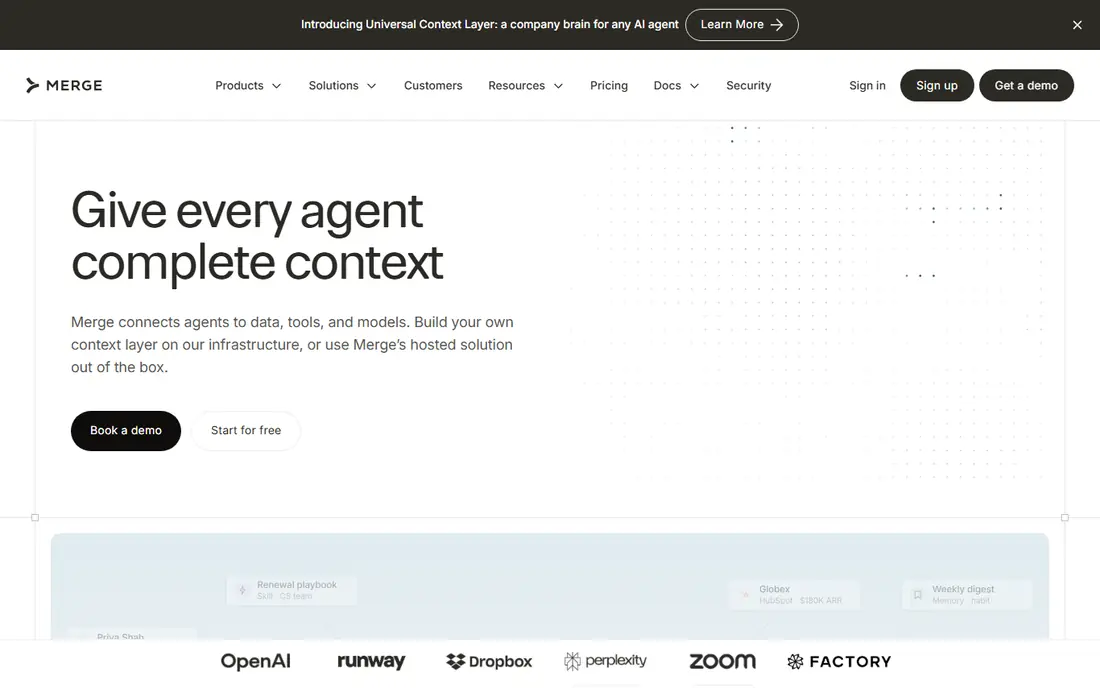
Merge offers a unified API across HRIS, ATS, accounting, CRM and other categories, with a normalised model that hides provider differences from your code. For HR products, that means one integration pattern for providers such as Workday, BambooHR and Deel, plus ATS coverage for recruiting tools. Built-in sync monitoring, logs and webhooks help teams spot a broken connection before customers do.
Paid plans start at $650 per month, with a free tier for testing. The honest gap compared with Finch is payroll detail: Merge covers payroll data, but line-item depth and write support are more limited. Merge is the best pick when you need broad HRIS and ATS coverage in one vendor and you can live without Finch-level payroll writes.
- Unified model across HRIS, ATS and other categories
- Large integration library
- Sync monitoring and webhooks
- Payroll depth is more limited than Finch
- Paid plans start at a higher monthly level
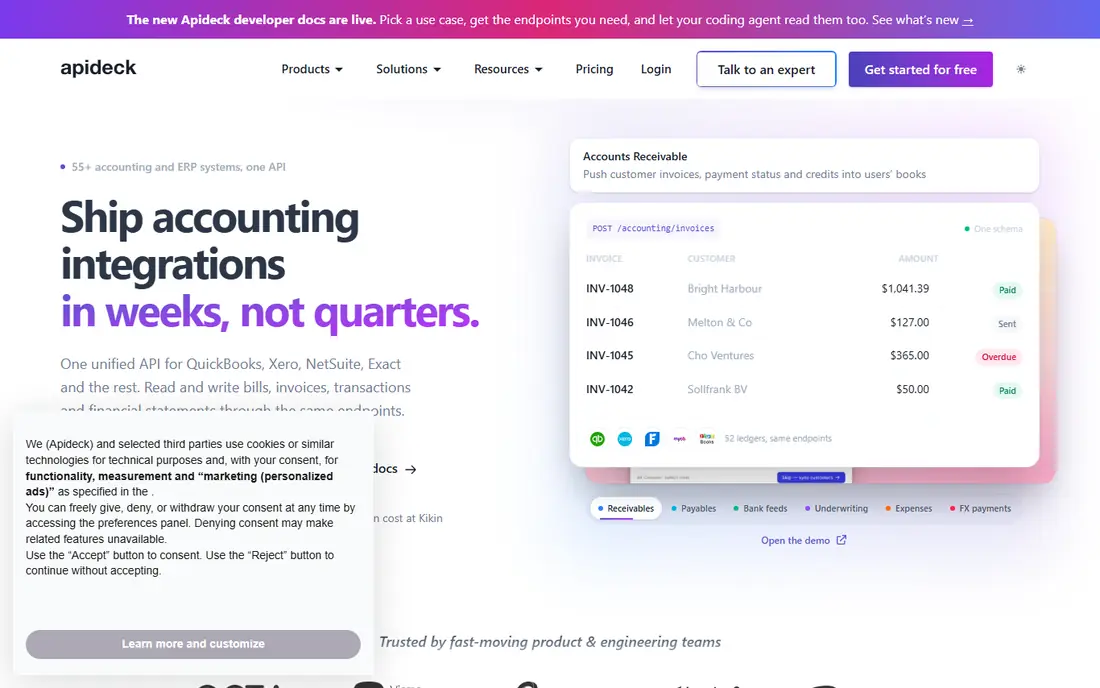
Apideck provides a unified API for HRIS, accounting, CRM, file storage and other categories, using a real-time pass-through model. Instead of storing a synced copy of customer data, it reads live from the provider when your app asks, which can simplify data retention and privacy work. A proxy endpoint also lets you call provider APIs directly through Apideck when the unified model does not cover a field you need.
Paid plans start at $599 per month, with a free trial for testing. The catch for Finch switchers is payroll: Apideck does not match Finch on payroll detail or deduction writes. Apideck suits teams that want live HRIS reads alongside other categories, and that value a no-storage model over deep payroll data.
- Live pass-through reads with no stored data by default
- Proxy access to provider APIs
- Covers HRIS plus CRM and accounting
- HRIS coverage is thinner on some large HCM systems
- Payroll support is limited
Kombo focuses on people data: HRIS, ATS, payroll and learning systems, with around 100 HRIS connectors and a larger ATS set. That focus helps HR and recruiting products that sell to enterprises on Workday or SAP SuccessFactors, and to teams with European customers. ATS writes are a real strength, which matters for recruiting tools that need to move candidates, not just read them.
Pricing is not published as a single starting figure for all teams, so request a quote and check the current pricing page. Payroll detail is the limit: Kombo returns pay rate on many systems rather than the full pay statement detail Finch offers. Pick Kombo when HR and ATS breadth, especially in Europe, matters more than payroll writes.
- Strong HRIS and ATS coverage, including European systems
- Unified people data model
- ATS write support
- Payroll data is mainly pay rate rather than full line-item detail
- Pricing is quote-based for many teams
Knit is a managed unified API with an HR-first focus, covering HRIS, ATS and payroll systems across regions including Asia-Pacific. It offers line-item payroll detail on systems it covers in depth, which puts it closer to Finch than many general unified APIs. Managed integrations mean Knit handles provider quirks, auth and maintenance, so your team writes less integration code.
Pricing is quote-based, so check the vendor site for current plans and a trial. Payroll write support covers only a subset of providers, so teams that rely on deduction writes should test their exact providers before switching. Knit suits HR products that want managed integrations and solid payroll reads without building every connector themselves.
- HR-first managed integrations
- HRIS, ATS and payroll categories
- Line-item payroll detail on covered systems
- Smaller provider count than Merge
- Payroll write coverage is limited to a subset of providers
Truto offers a unified API across more than 30 categories, including HRIS and payroll, accounting and CRM. For HR use, it provides a normalised employment model with line-item payroll detail on the systems it covers, which is useful for benefits, lending and fintech products that need pay statement data. Its multi-category range also suits SaaS products that need HR data plus other business data from one vendor.
Pricing is available on request, so get a quote based on connections and categories. The provider count for HRIS is smaller than Finch, and payroll write support is limited, so test your must-have providers early. Truto is a good fit when you need HRIS data as one part of a wider integration plan.
- Covers HRIS plus many other categories
- Line-item payroll detail on covered systems
- Unified model for SaaS products
- Smaller HRIS provider count than Finch
- Write support for payroll is limited
Bindbee focuses on HRIS, payroll and ATS integrations, with a practical pitch for early-stage teams that need straightforward HRIS reads. It covers Indian HR systems well, alongside global providers, and it offers an on-premises hosting option for teams with strict deployment needs. That combination suits startups and regional HR products that do not need a huge multi-category platform.
Pricing is quote-based, so request details for your provider list and volume. Payroll depth is limited compared with Finch, and write support is not its strength. Bindbee is worth testing when your provider list is focused, your budget is tight, or on-premises hosting is a requirement.
- Focused HRIS and ATS coverage
- Strong coverage of Indian HR systems
- On-premises hosting option
- Payroll depth is limited
- Smaller global provider set than Merge or Finch
Unified.to, often written as Unified, offers a unified API across dozens of categories with a real-time pass-through model. For HRIS, that means your app reads live provider data without Unified storing a copy at rest, which can help with privacy and data residency work. Regional hosting in the US, EU or Australia is another plus for teams with customers in different regions.
Paid plans start at $750 per month or more, with a free trial for testing. The trade-off is writes: Unified is stronger for reads than for employee or payroll writes, so teams that need write-back should test that path carefully. Pick Unified when live reads, low data retention and broad category coverage matter most.
- Real-time pass-through with no data stored at rest
- Wide category range
- Regional hosting options
- Pass-through reads can mean more provider calls
- HR write support is limited
Nango is a code-first integration platform that covers HRIS, ATS and hundreds of other APIs, rather than a single fixed HR model. You define integrations in code, use Nango for auth, sync and webhooks, and keep control over how each provider is handled. That flexibility suits engineering-led teams whose integrations are a core part of the product.
A free tier and self-managed options exist, with paid plans based on usage and features, so check the current pricing page. The catch is effort: Nango gives you building blocks, not a finished Finch replacement, and payroll depth depends on the work you put into each connector. Pick Nango when control and breadth across many APIs matter more than a ready-made HR model.
- Covers more than 1,000 APIs
- Code-first control over integrations
- Fast sync and webhooks
- You write and maintain more integration code
- HR payroll depth depends on the connectors you build
How we picked these
We compared official product pages, provider lists and pricing pages for each API, and we kept only live unified or HR data APIs that genuinely cover HRIS or payroll data in October 2026. We favoured a mix of broad multi-category APIs and HR-focused APIs, so readers can weigh coverage against payroll depth. We did not claim hands-on testing we did not do, and where pricing was quote-only we wrote See website rather than guessing. Employee data is sensitive, so we also favoured vendors that document security, auth and data handling clearly.
What to check before you choose
Start with your must-have providers, not the total provider count. List the HRIS and payroll systems your top customers use, and test each one for read fields, sync speed and write support. A vendor with 200 providers is no help if your largest customer uses the one system it covers weakly.
Next, check the data model for the fields your product actually uses, such as pay statements, deductions, time off and employment status. Ask how often data syncs, how webhooks work, and what happens when a provider changes its API. Finally, model cost per linked account, review security and privacy documentation, and run a sandbox test with realistic data before you migrate customers.
Frequently asked questions
What is the best overall Finch alternative?
Merge is the broadest pick for HRIS plus ATS, while Kombo and Knit are strong HR-focused options. If payroll detail and deduction writes are central, test Knit and Truto closely against Finch before you switch, because few rivals match Finch on that depth.
Does any alternative match Finch on US payroll?
Knit and Truto come closest on line-item payroll reads among the tools here, but payroll write support varies by provider. Test your exact payroll providers, because coverage and write support differ system by system.
What is a unified API?
A unified API gives you one data model and one auth flow for many different HR and payroll systems, instead of building a separate integration for each provider. The vendor handles provider differences, so your code stays simpler when you add new customers.
Should I pick a synced model or a pass-through model?
A synced model stores a copy of data and can offer faster reads and history, while a pass-through model reads live and stores less data. Pass-through suits privacy-sensitive products, while synced models suit reporting and products that need data when a provider is slow or offline.
How is pricing usually charged?
Most vendors charge per linked account or connection, per month, sometimes with a platform fee on top. Model your cost on the number of customer connections you expect, and ask about overage, sandbox and support pricing.
Is employee data safe with these APIs?
Reputable vendors use encrypted connections, scoped auth and access controls, but you still hold duties for how you store and use employee data. Review each vendor security page, limit the fields you request, and follow the privacy rules that apply to your customers and their staff.
Sources
See where you really rank - block by block
ProMapRanker scans Google Maps across a grid of your service area. Simple monthly plans from $19, white-label on every plan.
Start freeKeep reading
 zscaler alternatives
Best Zscaler Alternatives in 2026
Looking for zscaler alternatives? We compare 9 SASE and zero trust platforms on architecture, data protection, pricing, and fit for your network and team.
Read → zapier alternatives free
Best Zapier Alternatives Free in 2026
Nine automation tools for zapier alternatives free in 2026, all with genuinely free tiers, plus free plan limits, starting prices and upgrade paths explained.
Read → which platform is best for online reputation
Which Platform Is Best for Online Reputation in 2026
Wondering which platform is best for online reputation? We compare 8 review, listing, and response tools for small and multi-location businesses and agencies.
Read →