 ProMapRanker
Best ERP Alternatives in 2026

Key takeaways
- There is no single best ERP for every business, because inventory, manufacturing and services need different depths of function.
- Modular and open source systems keep entry costs lower, but implementation and training still take real time and money.
- Quote only enterprise systems can suit large, multi entity businesses, but they are rarely the right first ERP for a small team.
- Trial the system with your real chart of accounts, products and orders before you sign a long contract.
Quick comparison
| Pick | Great for | Pricing starts at | Free tier | |
|---|---|---|---|---|
 Odoo | Modular all-in-one ERP | See website | Yes | Visit |
 Oracle NetSuite | Large multi entity ERP | See website | Free trial | Visit |
 Microsoft Dynamics 365 Business Central | Microsoft ecosystem teams | $80 per user per month | Free trial | Visit |
 SAP Business One | Manufacturing and distribution | See website | Free trial | Visit |
 Acumatica | Unlimited user mid market ERP | See website | Free trial | Visit |
 Sage Intacct | Financial reporting and multi entity | See website | Free trial | Visit |
 ERPNext | Open source ERP | Free | Yes | Visit |
 Zoho One | Broad small business suite | $37 per employee per month | Free trial | Visit |
 SYSPRO | Discrete and process manufacturing | See website | Free trial | Visit |
The best erp alternatives
We compared official pricing pages, product documentation and public feature lists for systems that cover finance, inventory, sales and operations in one place. Our pick for most small and mid sized businesses is Odoo, because its modular apps let you start small and add functions as you grow, without paying for a full enterprise suite on day one.
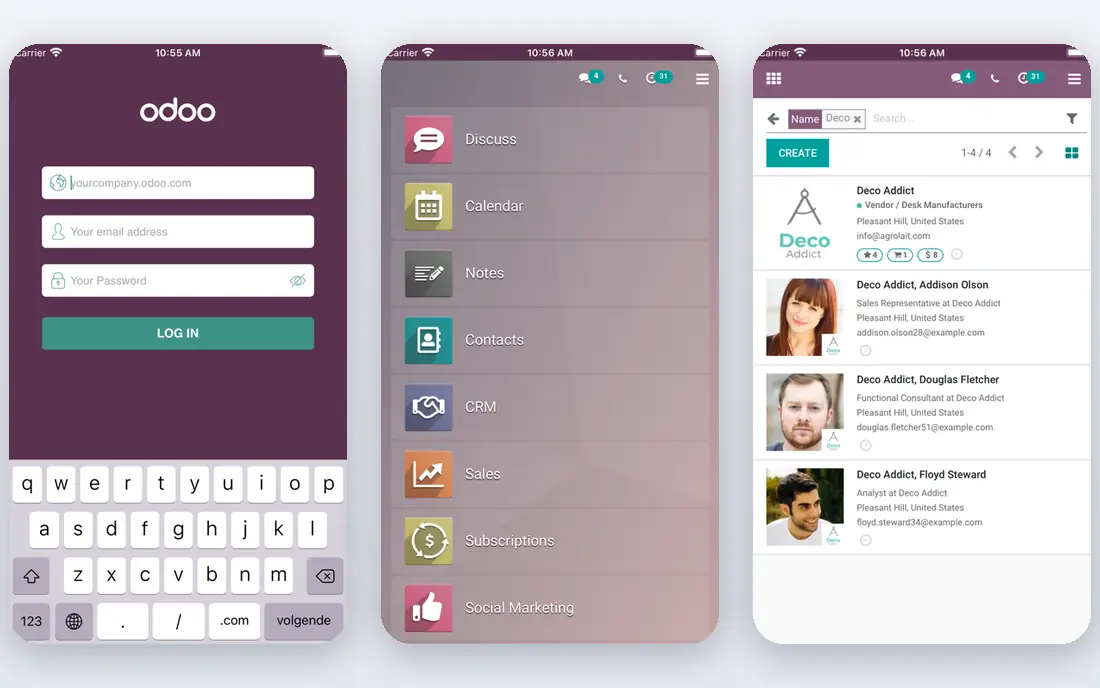
Odoo lets you pick apps for sales, accounting, inventory, manufacturing, HR, eCommerce and more, all sharing the same database. A small team can start with CRM and invoicing, then add inventory or manufacturing later without migrating to a new system. The one app free plan is useful for testing a single function with unlimited users.
The risk is scope creep. Adding many apps at once makes setup, training and data migration harder, and most mid sized rollouts benefit from a partner. Keep the first phase narrow, clean your product and customer data before import, and add modules in stages. For teams that want flexibility at a lower entry cost, Odoo is hard to beat.
- Wide app range from CRM to manufacturing
- One app free plan
- Strong community and partner network
- Implementation can get complex with many apps
- Custom work often needs a partner
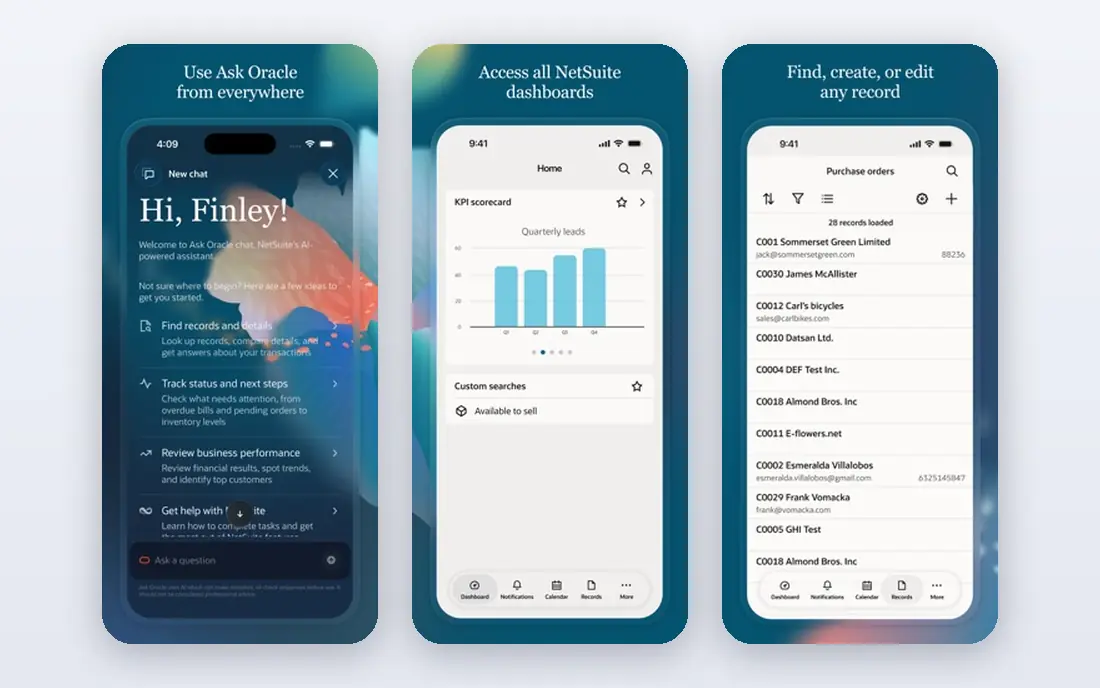
NetSuite is a full cloud ERP from Oracle that covers financials, inventory, order management, CRM and more for growing and large businesses. Multi subsidiary, multi currency and multi location work is a core strength, which suits companies expanding across countries or business units.
Cost and implementation are the barriers. Pricing is quoted, implementation often takes months, and renewals need careful negotiation. NetSuite suits businesses that have outgrown smaller systems and need a single system of record at scale. Smaller teams should compare Odoo or Business Central first, unless multi entity depth is already a must.
- Deep financials, inventory and multi subsidiary support
- Large partner ecosystem
- Proven at scale
- Quote based pricing and long implementation
- Renewal costs can rise sharply

Business Central suits businesses already using Microsoft 365, Outlook, Excel and Teams. Finance, sales, purchasing, inventory and manufacturing sit in one system, and data flows to Excel and Power BI without heavy middleware. Staff who know Microsoft tools usually learn it faster than a wholly new interface.
Licensing needs care. Essentials and Premium tiers differ in manufacturing and service functions, and add ons can push the total up. Partner led implementation is common, so budget for setup as well as licences. For Microsoft centred businesses, Business Central is a natural and well supported ERP choice.
- Strong Microsoft 365 and Teams integration
- Solid finance and supply chain
- Familiar Microsoft interface
- Customisation often needs a partner
- Licensing tiers can confuse buyers
SAP Business One is aimed at small and mid sized businesses that need real manufacturing, warehouse and distribution control. It covers finance, sales, purchasing, inventory and production, with many industry add ons from SAP partners. Companies that plan to grow toward larger SAP products value the shared data model.
It is not a quick self serve purchase. Pricing and implementation go through partners, and the interface is more functional than modern. If your core need is strong MRP and distribution rather than a simple accounting plus CRM mix, Business One deserves a shortlist place, with a partner demo on your own product data.
- Strong inventory, MRP and distribution depth
- Large add on ecosystem
- Path to larger SAP systems
- Partner led pricing and implementation
- Interface can feel dated
Acumatica charges by resources used rather than per user, which suits businesses with many occasional users, such as warehouse staff, sales reps and partners. Distribution, manufacturing, construction and field service editions give it depth beyond generic finance systems, and the cloud design works well for remote teams.
Pricing is quoted, so you need a scoped demo to get a real figure. Implementation still takes months for a full rollout, and partner quality matters. For user heavy mid market businesses that dislike per seat pricing, Acumatica is one of the most interesting options in this list.
- Consumption based pricing with unlimited users
- Strong distribution and manufacturing editions
- Cloud native design
- Quote based pricing
- Implementation through partners takes time
Sage Intacct is a cloud financial management system rather than a full manufacturing ERP. Its strength is multi entity accounting, consolidation, dimensional reporting and audit controls, which suits finance led businesses, nonprofits and services firms with several entities. Dashboards give finance teams a clear view without waiting for month end reports.
If you need deep warehouse, production or distribution control, Intacct alone may not be enough, and you may need connected systems. Pricing is quoted and implementation is partner led. Choose Intacct when finance and reporting are the main pain, not factory floor control.
- Strong financial reporting and consolidation
- Multi entity support
- Good audit trail
- Weaker inventory and manufacturing depth than full ERPs
- Quote based pricing
ERPNext is an open source ERP built on the Frappe framework. It covers accounting, stock, manufacturing, CRM, HR and projects, and you can self host it at no licence cost. Small manufacturers and distributors with technical staff often use it to get ERP depth without enterprise licence fees.
Self hosting means you own updates, backups and security, which is a real ongoing job. A hosted option through Frappe Cloud removes some of that work for a monthly fee. If you have the skills to run it, or a partner to do so, ERPNext offers remarkable depth for the price. If you do not, budget for hosting and support from the start.
- Free self hosted open source core
- Covers finance, inventory, manufacturing and HR
- Hosted option available
- Self hosting needs technical staff
- Support depends on community or paid partners
Zoho One bundles a wide set of business apps, including CRM, Books for accounting, Inventory, People for HR and Projects, under one per employee price. Small businesses that need a bit of everything, rather than deep manufacturing, often find it the best value in this list. Data flows between apps without separate subscriptions.
The trade-off is depth. Zoho One is a broad suite, not a specialist manufacturing ERP, so complex production or warehouse needs may stretch it. Start with the apps you need, hide the rest, and test inventory and accounting with real transactions. For service and trading businesses, Zoho One is a strong, low cost alternative to a traditional ERP.
- More than 40 apps in one subscription
- Strong value for small teams
- Integrated CRM, finance and HR
- ERP depth is lighter than NetSuite or Business Central
- Many apps can overwhelm new users
SYSPRO is an ERP focused on manufacturers and distributors, with strong support for discrete and process production, lot and serial tracking, and warehouse control. Its phased implementation model suits businesses that want to roll out finance and inventory first, then production, rather than a big bang launch.
Pricing is quoted and the partner ecosystem is smaller than SAP or Microsoft, so check partner coverage in your region. For manufacturers that need production depth without moving to a very large enterprise suite, SYSPRO is a credible and focused choice.
- Deep discrete and process manufacturing
- Strong inventory and lot control
- Phased implementation approach
- Quote based pricing
- Smaller ecosystem than SAP or Microsoft
How we picked these
We compared official pricing pages, product documentation and public feature lists for systems that cover finance plus at least inventory or operations, and are live in October 2026. We kept a mix of full ERPs, open source systems and broad suites, so readers can compare a traditional ERP with a lighter alternative. Where a vendor publishes no list price, we wrote See website.
What to check before you buy
List your must have processes before you look at demos: how you quote, order, stock, manufacture, invoice and report. Bring that list to every demo and ask the vendor to run your process, not a generic script. Check data migration effort, because cleaning product, customer and supplier records often takes longer than software setup.
Budget for implementation, training and the first year of support, not only licences. Ask for a total cost over three years, including partners, add ons and renewals. Finally, trial with a small team and real orders, and confirm reporting, permissions and audit trails meet your needs before you migrate the whole business.
Frequently asked questions
What are alternatives to erp systems for small businesses?
Small businesses often start with accounting software plus a CRM and inventory tool, or a broad suite such as Zoho One, instead of a full ERP. That lighter stack works until order volume, warehouse complexity or multi entity reporting makes separate tools hard to reconcile. At that point, a modular ERP such as Odoo or ERPNext is a natural next step.
What is the cheapest ERP alternative?
ERPNext self hosted is the cheapest in licence terms, because the core software is free, though hosting and staff time still cost money. Odoo offers a one app free plan, and Zoho One gives broad coverage at a low per employee price. Compare total cost, including implementation, not only the licence line.
Is Odoo a good ERP alternative?
Odoo suits many small and mid sized businesses because it is modular, covers a wide range of functions, and has a free starting point. It works best when you roll out in stages and use a partner for complex setup. Businesses needing deep multi subsidiary finance or very large scale operations may prefer NetSuite or Business Central.
Do I need a full ERP or just accounting software?
You need a full ERP when inventory, orders, manufacturing or multi location stock must stay in sync with finance in real time, and manual reconciliations are taking hours each week. If you mainly invoice and track expenses, accounting software plus a CRM is usually enough, and cheaper to run.
How long does ERP implementation take?
Small modular rollouts can take weeks, while full mid market implementations often take three to nine months, depending on data quality, custom work and training. Phased rollouts, where finance and inventory go live first, reduce risk and let staff learn the system before production modules follow.
Sources
- https://www.odoo.com/pricing
- https://www.netsuite.com/portal/products/erp.shtml
- https://www.microsoft.com/en-us/dynamics-365/products/business-central
- https://www.sap.com/products/erp/business-one.html
- https://www.acumatica.com
- https://www.sage.com/en-us/products/sage-intacct
- https://erpnext.com/pricing
- https://www.zoho.com/one/pricing
- https://www.syspro.com
See where you really rank - block by block
ProMapRanker scans Google Maps across a grid of your service area. Simple monthly plans from $19, white-label on every plan.
Start freeKeep reading
 zscaler alternatives
Best Zscaler Alternatives in 2026
Looking for zscaler alternatives? We compare 9 SASE and zero trust platforms on architecture, data protection, pricing, and fit for your network and team.
Read → zapier alternatives free
Best Zapier Alternatives Free in 2026
Nine automation tools for zapier alternatives free in 2026, all with genuinely free tiers, plus free plan limits, starting prices and upgrade paths explained.
Read → which platform is best for online reputation
Which Platform Is Best for Online Reputation in 2026
Wondering which platform is best for online reputation? We compare 8 review, listing, and response tools for small and multi-location businesses and agencies.
Read →