 ProMapRanker
Best Elementor Alternatives in 2026


Unlimited sites with lifetime option · Pricing starts at: $89 per year
Key takeaways
- Divi offers the best value for unlimited sites, with $89 a year or $249 lifetime in recent listings.
- Bricks and Breakdance suit performance-focused builders who want cleaner front-end output.
- Beaver Builder suits agencies and client sites that value stability and a clean, simple editor.
- Gutenberg, the built-in WordPress editor, is the best free option for lightweight sites.
- Switching builders usually means rebuilding pages, so test on staging before you commit to a move.
Quick comparison
| Pick | Great for | Pricing starts at | Free tier | |
|---|---|---|---|---|
| Divi | Unlimited sites with lifetime option | $89 per year | Free trial | Visit |
 Beaver Builder | Stable client sites | $89 per year | Yes | Visit |
 Bricks | Performance-first developers | $79 per year | Free trial | Visit |
 Breakdance | Designer-friendly performance | $99.99 per year | Yes | Visit |
 Oxygen | Code-level control, one-time price | $129 one-time | Free trial | Visit |
 Brizy | Beginners building landing pages | $59 per year | Yes | Visit |
 SeedProd | Landing pages and themes fast | $79 per year | Yes | Visit |
 WPBakery | Theme-bundled sites | $69 one-time | Free trial | Visit |
 Gutenberg | Free native WordPress editing | Free | Yes | Visit |
The best Elementor alternatives
Elementor is the most popular WordPress page builder, with a huge template and add-on ecosystem. People look for alternatives when they want better performance, a lifetime license, a simpler editor, a lower price for many sites, or a builder that fits their workflow better. The tools below are WordPress builders and editors that cover the same job: designing pages visually without writing code for every layout. We compared official pricing pages, feature pages and WordPress.org listings, and we kept only builders that are live and useful in October 2026. We do not list Elementor itself as a product here.
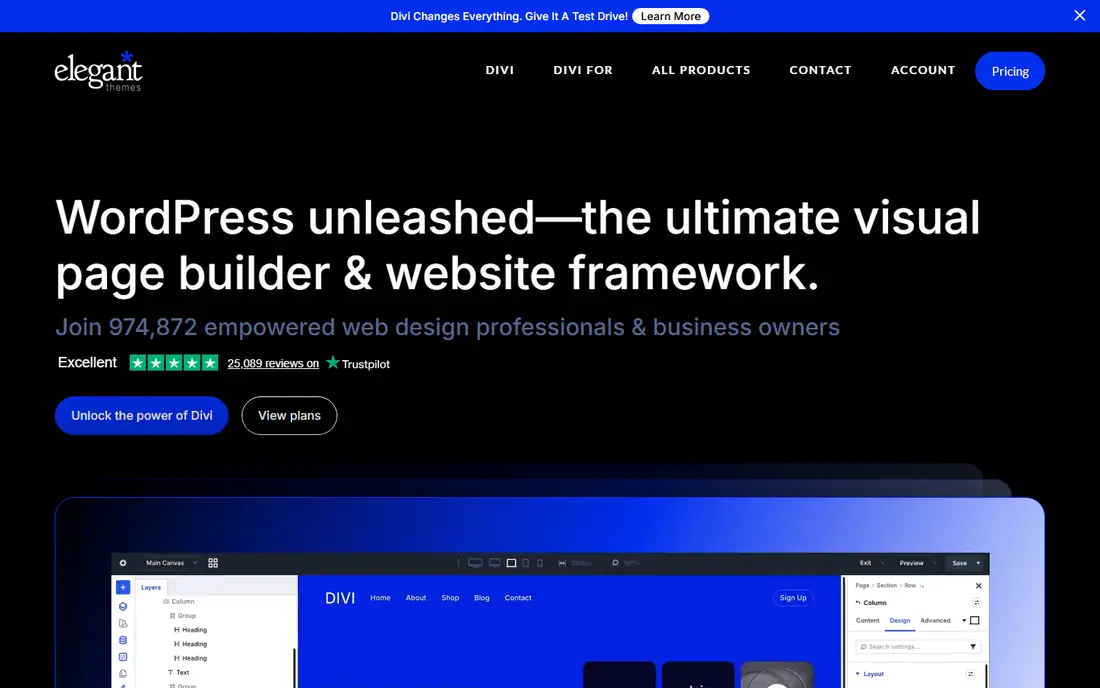
Divi, from Elegant Themes, pairs a theme and a visual builder in one product, with drag-and-drop editing, global elements, templates and built-in split testing. The pricing is what sets it apart: $89 a year covers unlimited sites, and a $249 lifetime option covers unlimited sites with no renewal, which is hard to beat for freelancers and agencies building many sites. Divi Pro, at $277 a year in recent listings, adds AI and cloud services.
The trade-off is performance and editor feel. Divi output is heavier than performance-first builders such as Bricks, and the editor packs in many options that can feel busy on a simple page. There is also no free version to test long term, though a trial and refund terms apply. Divi fits design-heavy marketing sites, freelancers and agencies that want unlimited sites at a predictable price. Performance purists should compare Bricks first.
- Unlimited sites on every paid tier
- Visual editor with many templates
- Lifetime access option at $249
- No free version
- Front-end output is heavier than Bricks or Breakdance
- Editor can feel busy for simple pages

Beaver Builder is known for stability and for client-friendly sites. The front-end editor is simple to learn, the code output is clean, and the plugin has a long record of working well with many themes and plugins without breaking layouts. That reliability is why many agencies use Beaver Builder for client sites they need to hand over and maintain for years. Lite is free on WordPress.org, and paid plans start at $89 a year for one site.
The limits are theme building and multi-site cost. Full theme building needs Themer, a paid add-on, and the unlimited sites plan is listed at $546 a year, which is far above Divi. The template library is also smaller than Divi or Elementor. Beaver Builder fits agencies, developers and small businesses that value stability and a simple handover over the largest template library. If you need many sites at low cost, Divi is cheaper.
- Stable, clean code output
- Simple front-end editor clients can learn
- Lite free version available
- Theme builder needs a paid add-on
- Unlimited sites plan costs $546 a year
- Template library is smaller than Divi
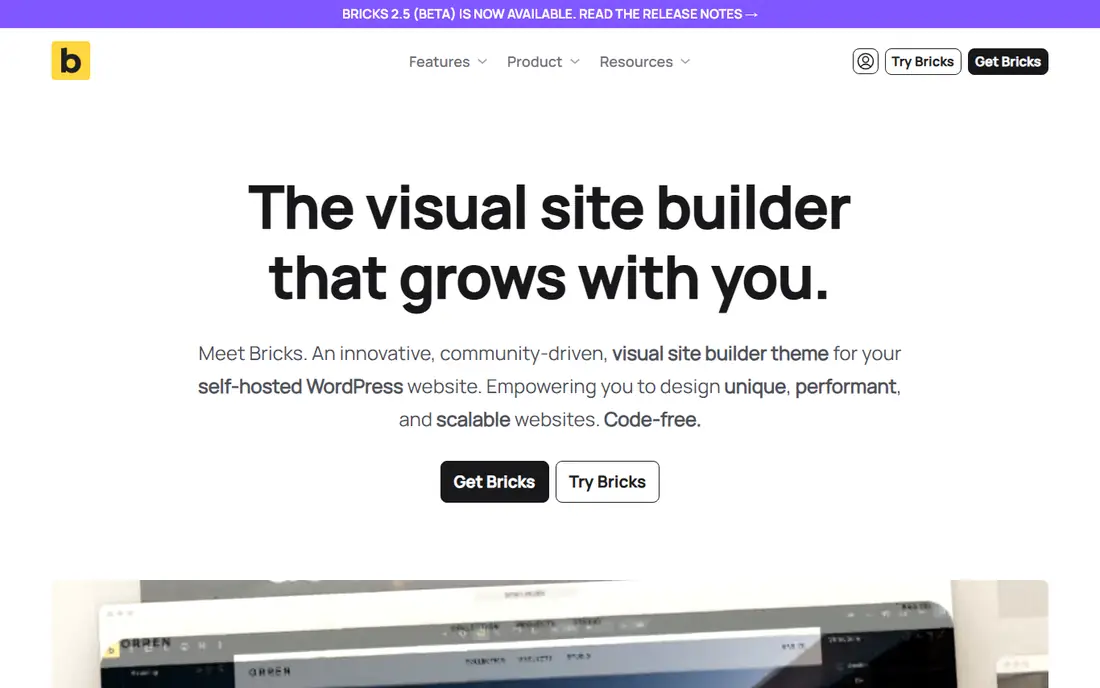
Bricks is the performance-first builder many developers now recommend. It produces cleaner, lighter front-end code than heavier builders, includes a full theme builder for headers, footers, archives and WooCommerce templates, and offers a visual editor with dynamic data and query tools for custom sites. Pricing starts at $79 a year for one site, $249 a year for unlimited sites, and $599 lifetime for unlimited sites in recent listings.
The drawback is the learning curve. Bricks assumes you are comfortable with layout, CSS concepts and WordPress structure, so a complete beginner may find Divi or Brizy easier at first. The add-on ecosystem is also smaller than Elementor, though it is growing. Bricks fits developers, agencies and performance-focused site owners who want fast pages and full theme control, and who are willing to learn a more technical builder.
- Light front-end output and fast pages
- Full theme builder included
- Lifetime Ultimate plan at $599 for unlimited sites
- No free version
- Learning curve for beginners
- Smaller add-on ecosystem than Elementor
Breakdance aims to combine designer-friendly editing with performance, and it does that job well. You get a visual builder, form builder, theme builder and WooCommerce design tools, with output that is lighter than heavier builders. Pricing starts at $99.99 a year for one site, with Pro Unlimited at $199.99 a year in recent listings, and a free version is available for testing.
The limits are ecosystem size and future pricing. Breakdance has fewer third-party add-ons than Elementor or Divi, and some listings note the unlimited plan price will rise, so check the current figure before you buy for many sites. Breakdance fits designers and agencies that want a modern, performance-aware builder without the technical feel of Bricks, and that do not need the largest add-on market.
- Clean performance with a friendly editor
- Full theme and WooCommerce builder
- Free version with unlimited sites in some listings
- Smaller ecosystem than Elementor or Divi
- Unlimited plan price is set to rise in some listings
- Fewer third-party add-ons
Oxygen is the builder for developers who want code-level control. It replaces the theme system with a visual tool that still lets you control structure, classes and CSS closely, and it produces clean output for custom sites. Pricing is one-time, starting at $129 for a basic license with unlimited sites in recent listings, with higher tiers for more features, which appeals to builders who dislike annual renewals.
The catch is effort. Oxygen is not a template-led builder for beginners, and building a polished site takes more manual design work than Divi or Breakdance. There is no free version, and the learning curve is steep if you are new to CSS and WordPress structure. Oxygen fits developers and technical agencies building custom sites who want a one-time license and full control. Beginners should start with Brizy, Divi or Gutenberg instead.
- One-time price from $129 with unlimited sites
- Close control over HTML, CSS and structure
- No annual renewal on base plans
- Steep learning curve for non-developers
- No free version
- Design work needs more manual effort than template-led builders
Brizy is one of the easiest builders to learn. The editor is clean, with drag-and-drop blocks, popups and dynamic content, and the free version covers basic pages and landing pages well. Paid plans start around $59 a year for one site in recent listings, with higher tiers for more sites and features, plus a cloud version for building sites without WordPress.
The limits are depth. Brizy does not match Bricks for performance tuning, Divi for templates, or Beaver Builder for agency handover tools, and advanced dynamic work can feel constrained. Brizy fits beginners, small businesses and marketers who want a landing page or a simple site live fast, without learning a complex builder. Teams building large or highly custom sites should look at Bricks or Breakdance.
- Simple, clean editor for beginners
- Free version for basic pages
- Cloud option for non-WordPress sites
- Fewer advanced features than Bricks or Divi
- Template and add-on library is smaller
- Pro features need a paid plan
SeedProd is best known for landing pages, coming soon pages and maintenance mode, but it has grown into a full theme builder. You can build landing pages, sales pages and full themes from templates, with a visual editor that is quick to learn. Lite is free on WordPress.org, and Basic starts at $79 a year in recent listings, with higher tiers for more features and sites.
The catch is WooCommerce and theme depth. WooCommerce design support is limited to the top Elite plan in recent listings, and full theme building sits on higher tiers, so a store owner should check the plan table carefully. SeedProd fits marketers, course creators and small businesses that need landing pages fast, plus a simple theme, rather than a deeply custom site. For complex layouts, Bricks or Divi offer more control.
- Fast landing page and theme builder with many templates
- Lite free version
- Coming soon and maintenance modes included
- WooCommerce design support is limited to the top Elite plan
- Full theme building needs higher tiers
- Less suited to complex custom layouts
WPBakery, formerly Visual Composer, is a long-standing page builder that many commercial themes bundle, so you may already own it without realizing it. It offers front-end and back-end editors, many content elements and template options, with a one-time price around 69 euros per site in recent listings, including one year of support. That bundle history is why so many older sites still run on WPBakery.
The drawbacks are age and output. The interface feels older than Bricks, Breakdance or Divi, and front-end code can be heavier than performance-first builders. Support and updates after the first year need a renewal, so factor that into the total cost. WPBakery fits owners of existing sites that already use it, and buyers of bundled themes who want to keep the builder their theme was built with. For a new site, a modern builder will usually feel faster and cleaner.
- One-time price per site
- Front-end and back-end editors
- Widely bundled with commercial themes
- Interface feels older than modern builders
- Output can be heavier than Bricks
- Support period is limited to one year on purchase
Gutenberg is the block editor built into WordPress itself, and it is the most honest free alternative in this list. You can build pages and posts with blocks, use patterns for common layouts, and, with a block theme, edit headers, footers and templates through full site editing, all without buying a builder. Because it ships with WordPress, output is light and future updates are tied to core, not to a single vendor.
The limit is design depth. Gutenberg alone does not match a full page builder for advanced layouts, dynamic queries, popups or WooCommerce design, though block plugins such as Spectra, GenerateBlocks and Kadence Blocks add much of that power, with pro versions from around $49 to $99 a year. Gutenberg fits bloggers, small businesses and teams that want a fast, free, future-proof site and are happy to add one block plugin for extra design control. If you need a visual theme builder out of the box, Divi or Bricks will save time.
- Free and built into WordPress core
- Lightweight output with no extra plugin weight
- Full site editing with block themes
- Design control is thinner than a full page builder
- Advanced layouts need block plugins
- Template library is smaller than Divi
How we picked these
We compared official pricing pages, feature pages and WordPress.org listings for WordPress page builders and editors that cover the core Elementor job: visual page design, templates, responsive controls and theme building. We kept builders that are live in October 2026, that publish a usable free version, trial or paid plan, and that serve a clear audience from beginners to developers. We left out general website builders with no WordPress plugin, and we left out Elementor itself, as required for an alternatives article. Prices change with sales and renewals, so confirm the current figure on the vendor site before you buy.
What to check before you switch
Start with performance and hosting. A builder can only do so much if your hosting is slow, so check your host, caching and image sizes alongside the builder choice. Next, check theme and plugin fit. Some builders work best with a lightweight theme, while others bundle their own theme, and a mismatch can cause layout or update problems. Test your must-have plugins, especially WooCommerce, forms and SEO tools, on a staging copy with the new builder.
Then check migration reality. Content built with Elementor does not convert cleanly into another builder, so switching usually means rebuilding pages rather than importing them. Budget time for that rebuild, starting with your highest-traffic pages, and keep your old site live until the new pages are tested. Finally, check licensing for your site count. A $79 one-site license and an $89 unlimited license look similar until you build your third site, so count current and planned sites before you choose between annual and lifetime plans.
Frequently asked questions
What is the best Elementor alternative?
Divi is the best value for unlimited sites, Bricks is best for performance and developer control, and Beaver Builder is best for stable client sites. Gutenberg is best if you want a free, lightweight option. The best choice depends on your site count, your skill level and whether performance or templates matter more to you.
Are there free Elementor alternatives?
Yes. Gutenberg is free and built into WordPress, Beaver Builder Lite and Brizy offer free versions, and Breakdance and SeedProd offer free versions with limits. Free versions usually limit templates, theme building and advanced features, so they suit simple sites best. For full theme building, you will usually need a paid plan.
Which Elementor alternative is fastest?
Bricks and Breakdance consistently produce lighter front-end output than heavier builders, with Oxygen close behind for custom sites. Gutenberg with a block theme is also fast, since it adds no extra builder weight. Speed also depends on hosting, caching and images, so test a real page on your host, not just a demo site.
Can I switch from Elementor without rebuilding pages?
Not cleanly. Pages built with Elementor widgets do not convert automatically into another builder format, so switching usually means rebuilding pages in the new builder. Plan for that work, rebuild your most important pages first, and test on staging before you switch your live site. Keep backups of your old site until the new version is proven.
Which Elementor alternative is best for agencies?
Divi offers unlimited sites at $89 a year or $249 lifetime, which is strong agency value. Bricks Agency at $249 a year and Breakdance Pro Unlimited are also built for multi-site work, while Beaver Builder Agency suits client handover. Choose by site count, performance needs and how much design control your team wants.
Do these builders work with WooCommerce?
Most do, with different depth. Divi, Bricks, Oxygen, Breakdance and Beaver Builder with Themer include WooCommerce design tools, while SeedProd limits WooCommerce support to its top plan and Gutenberg relies on WooCommerce block templates. Check the plan table for the builder you shortlist, and test product, cart and checkout pages on staging before launch.
Sources
See where you really rank - block by block
ProMapRanker scans Google Maps across a grid of your service area. Simple monthly plans from $19, white-label on every plan.
Start freeKeep reading
 zscaler alternatives
Best Zscaler Alternatives in 2026
Looking for zscaler alternatives? We compare 9 SASE and zero trust platforms on architecture, data protection, pricing, and fit for your network and team.
Read → zapier alternatives free
Best Zapier Alternatives Free in 2026
Nine automation tools for zapier alternatives free in 2026, all with genuinely free tiers, plus free plan limits, starting prices and upgrade paths explained.
Read → which platform is best for online reputation
Which Platform Is Best for Online Reputation in 2026
Wondering which platform is best for online reputation? We compare 8 review, listing, and response tools for small and multi-location businesses and agencies.
Read →