 ProMapRanker
Best Domain Name Alternatives in 2026


Lowest long-term cost · Pricing starts at: $10.44 per year
Key takeaways
- This article covers alternative domain name options: alternative extensions and registrars or approaches for finding a usable domain name.
- Renewal price matters more than the first-year price, because you pay it every year you keep the name.
- Cloudflare Registrar and Porkbun offer the lowest long-term .com costs in the comparisons we reviewed.
- Namecheap and Squarespace Domains suit owners who want support and a simple dashboard over the lowest price.
- Turn on two-factor authentication and registry lock where offered, because a registrar account controls your site and email.
Quick comparison
| Pick | Great for | Pricing starts at | Free tier | |
|---|---|---|---|---|
| Cloudflare Registrar | Lowest long-term cost | $10.44 per year | No | Visit |
 Porkbun | Transparent pricing and many extensions | $11.08 per year | No | Visit |
 Namecheap | Beginners and support | $18.48 per year | No | Visit |
 Dynadot | Low renewals and bulk tools | $10.88 per year | No | Visit |
 Hover | Clean checkout with no upsells | $18.99 per year | No | Visit |
 Squarespace Domains | Simple all-inclusive pricing | $20 per year | No | Visit |
 Spaceship | Low register and renew combination | $10.18 per year | No | Visit |
 GoDaddy | Widest extension choice and support | See website | No | Visit |
The best domain name alternatives
This article covers alternative domain name options (alternative extensions and registrars or approaches for finding a usable domain name), since there is no single product called Domain Name to review. If your first-choice .com is taken, the practical alternatives are a different extension, a different wording, or a different registrar with a better renewal price and cleaner controls. We compared official registrar pages and published renewal comparisons for each option below.
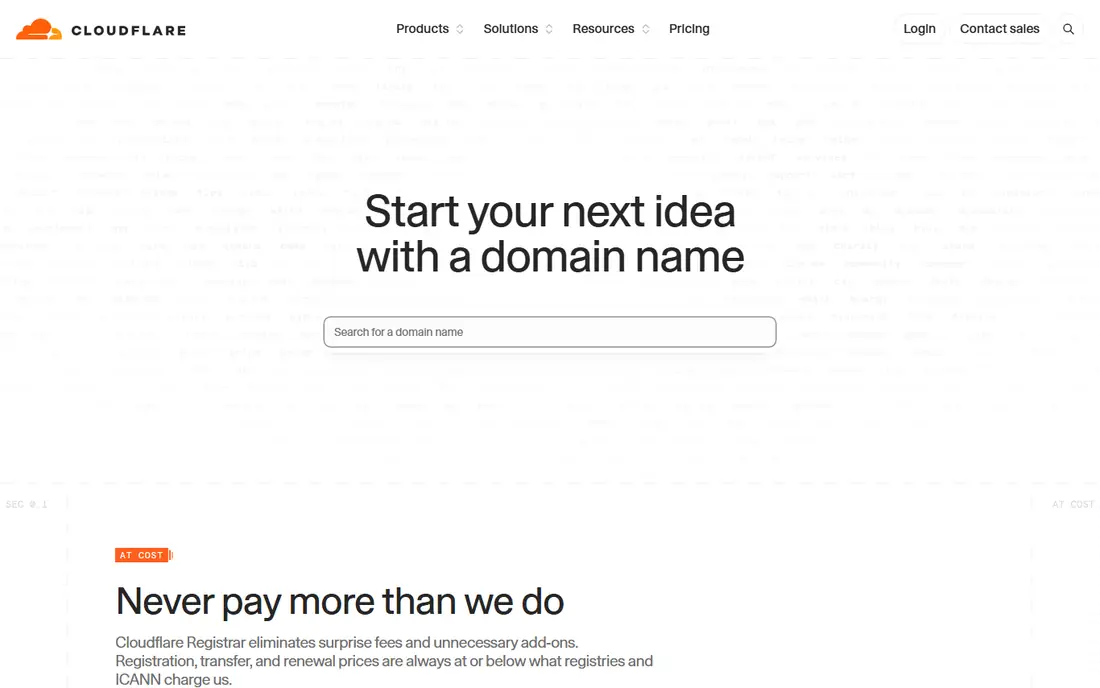
Cloudflare Registrar sells domains at wholesale cost with no markup, which makes its .com renewal price of about $10.44 per year one of the lowest available. Privacy protection is included at no extra charge, and the DNS service behind it is fast and well regarded. For a portfolio or a business that plans to keep names for years, that flat cost adds up to real savings.
The main limit is control. You must use Cloudflare nameservers, so you cannot point a domain to external nameservers in the usual way. The extension range is also narrower than GoDaddy or Namecheap, and many names can only be transferred in rather than newly registered. If those limits fit your setup, it is the cheapest long-term home for a domain.
- At-cost pricing with no markup
- Free privacy protection
- Strong DNS and security tooling
- Must use Cloudflare nameservers
- Fewer extensions than some rivals
- Mainly supports transfers for many names

Porkbun is a favorite among developers and small businesses because its pricing is plain: a .com costs about $11.08 to register and renew, with free privacy protection included. It offers hundreds of extensions, free DNS hosting, and a full API for teams that manage names in code. Checkout has few upsells, which keeps the process short.
The dashboard is less polished than Namecheap or Squarespace, and support is smaller than the largest registrars. Porkbun also bundles fewer website and email tools, so owners who want an all-in-one package may prefer another registrar. For price transparency and extension choice, it is one of the best options on this list.
- Flat register and renew pricing
- Free privacy and SSL
- Broad extension range and API access
- Interface feels quirky to some users
- Support is smaller than large rivals
- Fewer bundled site tools
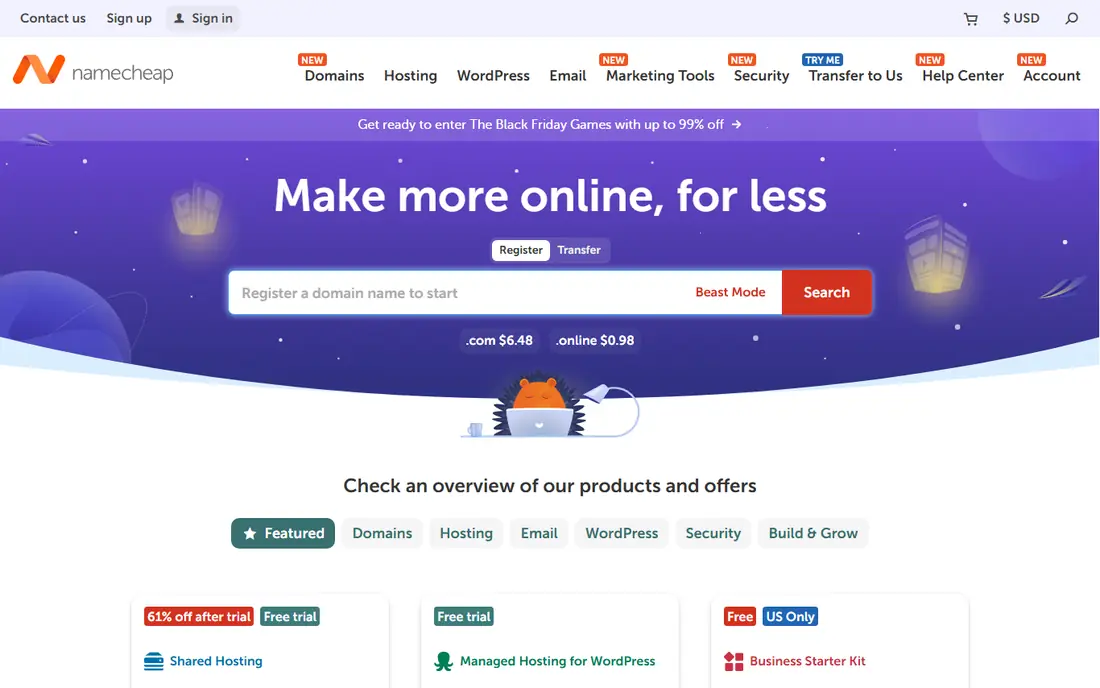
Namecheap remains the easiest registrar for non-technical owners. The dashboard is familiar, support is responsive, and the extension range is broad, so most alternative wordings and extensions are available in one place. Privacy protection is free for life, and free DNS is included with any nameserver choice.
The cost is the trade. A .com renewal of about $18.48 per year is well above Cloudflare or Porkbun, and first-year sale prices can hide that gap. Checkout also promotes hosting, VPN, and certificate add-ons that many buyers do not need. If support and ease matter more than the lowest renewal price, Namecheap is still a sensible pick.
- Familiar dashboard and strong support
- Broad extension range
- Free privacy protection for life
- Renewal price is higher than at-cost rivals
- Checkout includes upsells
- First-year price can mislead
Dynadot suits domain investors and small businesses that hold several names and want low, stable renewals. A .com renewal of about $10.88 per year sits close to Porkbun and Cloudflare, and privacy protection is free. Bulk tools, auction access, and a control panel built for portfolios make it practical for managing many names at once.
The interface is more functional than friendly, and beginners may find Namecheap or Squarespace easier to learn. Dynadot also offers fewer bundled website and email products, so owners who want one provider for everything may look elsewhere. For low renewals and bulk control, it is a strong alternative.
- Low .com renewal price
- Free privacy protection
- Bulk management and auction tools
- Interface is functional rather than friendly
- Fewer bundled services
- Support depth varies by issue
Hover is built for people who dislike checkout pressure. There are no upsells, and the .com price of about $18.99 per year is the same to register, renew, and transfer, which makes budgeting simple. Privacy protection is free on supported domains, and phone support is available for owners who prefer talking to a person.
That simplicity costs more than Cloudflare or Porkbun, and the extension range is smaller than GoDaddy or Namecheap. Hover also bundles fewer site-building tools, so it suits owners who already have hosting and email elsewhere. If a quiet checkout and predictable pricing matter most, Hover earns its place.
- No upsell checkout
- Same price to register, renew, and transfer
- Free privacy on supported domains
- Higher price than at-cost rivals
- Fewer extensions than the largest registrars
- Fewer bundled tools
Squarespace Domains, which took over Google Domains customers, offers a clean and predictable option at about $20 per year for a .com, with fees included and privacy protection free. The dashboard is simple, DNS management is straightforward, and integration with a Squarespace site is smooth for owners who build there.
The price is higher than at-cost registrars, and there is no public API for domain management, which limits developer workflows. The service also nudges owners toward Squarespace site plans, though a domain can be used elsewhere. For a former Google Domains customer or a Squarespace site owner, it is the least disruptive choice.
- Flat all-inclusive pricing
- Free privacy protection
- Clean dashboard and Squarespace site integration
- Higher flat price than at-cost rivals
- No public domain management API
- Pushes toward Squarespace plans
Spaceship is Namecheap's sibling brand and focuses on low, transparent domain pricing. A .com renewal of about $10.18 per year is among the lowest in current comparisons, and privacy protection is free. The interface is modern and uncluttered, which helps owners who found Namecheap checkout busy.
As a newer brand, it has a shorter track record than Namecheap, GoDaddy, or Hover, and its extension range is still growing. Owners with very large portfolios should check bulk tools and transfer support before moving many names. For a single business domain or a small portfolio, the low renewal price is compelling.
- Very low .com renewal price
- Free privacy protection
- Modern interface from the Namecheap team
- Newer brand than its rivals
- Extension range still growing
- Fewer long-term track record signals
GoDaddy is the largest registrar and offers the widest extension choice, which helps when a preferred name is taken and an alternative extension is the answer. Support is available around the clock, and hosting, email, and site tools can be managed in one account. For owners who want one vendor for everything, that convenience matters.
The cost is the clear downside. Renewals for a .com are typically around $22 to $23 per year in recent comparisons, well above at-cost rivals, and checkout promotes many add-ons. First-year promotional prices make the long-term cost easy to miss. Choose GoDaddy for extension range and bundled services, not for the lowest renewal price.
- Widest extension selection
- 24/7 support
- Bundled hosting, email, and site tools in one account
- Renewals are among the highest
- Checkout adds many upsells
- First-year promos hide long-term cost
How we picked these
We compared official registrar pages and published renewal price comparisons checked in October 2026 for .com domains, since .com is the extension most readers compare. We favored registrars with free privacy protection, clear renewal pricing, and active support, and we used See website where pricing is promotional or varies by extension. Prices change with promotions and registry fees, so confirm the renewal price at checkout.
What to check before you choose
Start with the renewal price, not the first-year price, and multiply it by the years you plan to keep the name. Check whether privacy protection is free, whether you can use any nameservers, and whether two-factor authentication and registry lock are available. Those security controls matter more than a small price gap, because a compromised registrar account can redirect your site and email.
Next, think about extensions as alternatives, not just fallbacks. A .co, .io, .dev, .app, or a country extension may fit a tech or local business better than a long .com with hyphens. Test how the name sounds when spoken, how it looks in an email address, and whether a similar name already exists in your market. A short, clear alternative usually beats a long exact-match name.
A simple decision path
If lowest long-term cost matters most, shortlist Cloudflare Registrar, Spaceship, Dynadot, and Porkbun. If support and ease matter most, shortlist Namecheap, Squarespace Domains, and Hover. If extension range or bundled services matter most, shortlist GoDaddy and Namecheap. In every case, register the name for at least a year, set auto-renewal with a current payment method, and set a calendar reminder before expiry.
Frequently asked questions
What are good domain name alternatives?
Good domain name alternatives include a different extension, a shorter wording, or a different registrar with a better renewal price. Alternatives to domain names in the extension sense include .co, .io, .dev, .app, and country extensions, depending on your audience. Domain alternatives in the provider sense include Cloudflare Registrar, Porkbun, Namecheap, and Dynadot, each with different pricing and controls.
Is a .com always the best choice?
Not always. A .com is familiar and easy to trust, but a long or hyphenated .com is often worse than a short .co or a relevant extension such as .dev for a developer tool. Check how the name sounds, how it looks in email, and whether a similar brand already uses the .com. For a local business, a country extension can also be a strong and clear choice.
Why is the renewal price more important than the first-year price?
You pay the renewal price every year you keep the name, while the first-year price applies only once. A $1 first year followed by a $23 renewal costs far more over five years than a flat $11 renewal. Always compare renewal prices across registrars before registering, and set a reminder to review the price before each renewal.
Can I transfer a domain to a cheaper registrar later?
Yes, in most cases. Remove the transfer lock, get the authorization code, and start the transfer at least a week before expiry, since transfers usually add a year at the new registrar's renewal rate. Domains must usually be at least 60 days old and not transferred within the past 60 days. Keep the old registrar account active until the transfer completes.
How do I protect a domain from hijacking?
Turn on two-factor authentication on the registrar account, use a strong unique password, enable transfer lock, and add registry lock where offered for critical domains. Keep contact details current so renewal and transfer notices reach you. These steps matter because a registrar account controls DNS, which controls your website and email.
Sources
See where you really rank - block by block
ProMapRanker scans Google Maps across a grid of your service area. Simple monthly plans from $19, white-label on every plan.
Start freeKeep reading
 zscaler alternatives
Best Zscaler Alternatives in 2026
Looking for zscaler alternatives? We compare 9 SASE and zero trust platforms on architecture, data protection, pricing, and fit for your network and team.
Read → zapier alternatives free
Best Zapier Alternatives Free in 2026
Nine automation tools for zapier alternatives free in 2026, all with genuinely free tiers, plus free plan limits, starting prices and upgrade paths explained.
Read → which platform is best for online reputation
Which Platform Is Best for Online Reputation in 2026
Wondering which platform is best for online reputation? We compare 8 review, listing, and response tools for small and multi-location businesses and agencies.
Read →