 ProMapRanker
Deel Alternatives in 2026

Key takeaways
- Remote and G-P suit teams that put owned-entity compliance first, while RemoFirst suits budget-first startups.
- Oyster and Multiplier suit distributed teams that care about benefits and regional strength.
- Papaya Global and Rippling suit larger teams that want payroll, HR, and IT in fewer systems.
- Employer of record pricing is usually per employee per month, and salaries, taxes, and benefits sit on top of that fee.
- Contractor-only teams should compare contractor plans separately, because EOR prices do not apply to contractors.
Quick comparison
| Pick | Great for | Pricing starts at | Free tier | |
|---|---|---|---|---|
 Remote | Owned-entity compliance | $699 per employee per month | No | Visit |
 Oyster | Benefits for distributed teams | $699 per employee per month | No | Visit |
 Papaya Global | Enterprise payroll consolidation | $499 per employee per month | No | Visit |
 Multiplier | Asia-Pacific and budget hiring | $459 per employee per month | No | Visit |
 RemoFirst | Budget-first startups | $199 per employee per month | No | Visit |
 Rippling | Unified HR, payroll, and IT | See website | No | Visit |
 G-P | Enterprise compliance depth | $599 per employee per month | No | Visit |
 Borderless AI | Fast AI-assisted onboarding | $579 per employee per month | No | Visit |
 Playroll | Global payroll across many countries | $399 per employee per month | No | Visit |
The best deel alternatives
This list covers platforms that hire employees abroad as employer of record, run global payroll, or pay international contractors, so a team can compare like with like. No entry on this list is the platform named in the keyword itself, and every price below is an employer of record starting figure unless a plan says otherwise. Confirm the current quote for each country, because pricing and coverage vary by location.

Remote is the compliance-first pick for teams that want the provider to own the local entity that employs their staff. Owned entities give Remote direct control over payroll, benefits, and local filings, which reduces the chain of third parties a team must trust. Published pricing also helps a buyer shortlist without a sales call.
The trade-off is price. At the published starting figure, Remote costs more than budget providers, and teams hiring in several countries should get a quote for each one before budgeting. For a team hiring a handful of key staff abroad, that premium buys clarity, while a team hiring at volume may want to compare it with RemoFirst or Multiplier first.
- Owns many of its local entities
- Clear published pricing
- Strong compliance and benefits support
- Higher entry price than budget rivals
- Some countries need a custom quote
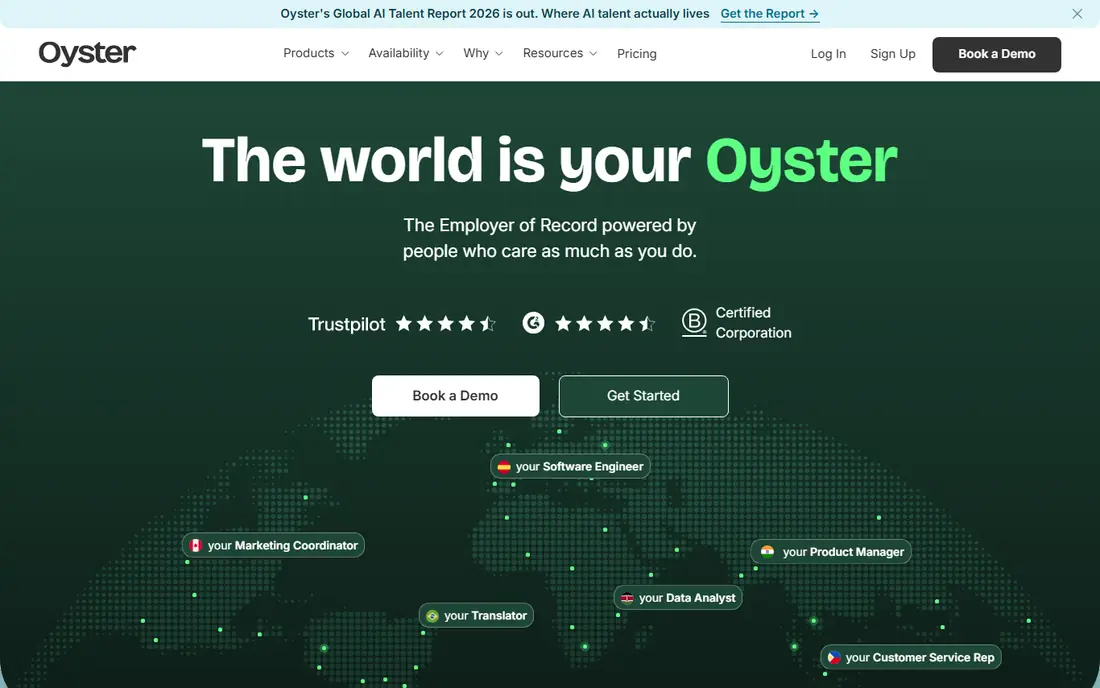
Oyster suits distributed startups that want benefits to feel consistent across countries. Its platform covers hiring, payroll, benefits, and compliance, with support aimed at teams that have no local entity abroad. That breadth matters when a hire in one country needs different statutory benefits from a hire in another.
Price is again the catch, and support quality can vary by country, so a team should ask who handles payroll in each location it plans to hire in. For teams that value a consistent employee experience over the lowest fee, Oyster is a strong shortlist entry.
- Broad country coverage
- Benefits and total rewards focus
- Dedicated support for distributed teams
- Higher entry price
- Contractor and EOR plans must be compared separately

Papaya Global fits mid-market and enterprise teams that already have entities in some countries and need one payroll system across the rest. Its strength is consolidation: payments, reporting, and compliance data in one place, rather than a separate payroll vendor per country. That view helps finance teams close the month with fewer reconciliations.
Small teams may find the setup heavier than a simpler EOR tool, and the headline price is only a starting point. Get a quote that separates EOR fees, payroll fees, and payment fees, because the total depends on which services a team actually uses.
- Consolidates payroll across entities and countries
- Strong payments and reporting tools
- Enterprise scale
- Setup can be heavy for small teams
- Pricing varies by service and country
Multiplier is a practical middle ground between budget and premium providers. Its entry price undercuts Remote and Oyster, while coverage still spans many countries, with particular strength in Asia-Pacific hiring. Onboarding is straightforward, which helps teams that need to move quickly.
Benefits and support depth vary by country, so a team should check the specific package for each hire location rather than assuming one global standard. For a team hiring across Asia-Pacific and other regions on a controlled budget, Multiplier deserves a demo.
- Lower entry price than several rivals
- Broad coverage including Asia-Pacific markets
- Straightforward onboarding
- Benefits depth varies by country
- Support experience differs across regions
RemoFirst is the budget pick, and the price gap is large enough to change a hiring plan. A startup hiring its first few international employees can test a market without committing to a premium monthly fee per head. Country coverage is broad, and contractor management is included free on some plans, which helps mixed teams.
The honest catch is depth. A lower fee can mean less hands-on support and thinner benefits in some countries, so a team should ask about payroll partners, response times, and benefits for each location. For early-stage teams, RemoFirst is a sensible starting point, with a move to a premium provider possible as headcount grows.
- Lowest EOR entry price on this list
- Broad country coverage
- Free contractor management on some plans
- Support and benefits depth can be thinner than premium rivals
- Check each country before hiring
Rippling suits teams that want one system for HR, payroll, IT access, and spend, rather than a standalone EOR tool. A new hire can get payroll, apps, and devices through one workflow, which reduces admin as a team grows. Its global hiring features sit inside that wider system, so a team already using Rippling for US staff gets a simpler expansion path.
Pricing is quote based for global hiring, so a buyer cannot shortlist on price alone. Small teams that only need to hire one person abroad may find a simpler EOR cheaper and faster, while teams that want a single HR and IT stack will value the consolidation.
- Combines HR, payroll, IT, and spend in one system
- Strong automation
- Good for US plus global teams
- Global EOR pricing is quote based
- The full system can be more than a small team needs
G-P, formerly Globalization Partners, is an established enterprise provider with broad coverage and deep compliance resources. Large teams that need to hire in many countries, with legal and finance teams involved, often shortlist G-P for that depth. Its documentation and local expertise help when a hire involves unusual contract terms.
The trade-off is cost and speed. G-P sits at the premium end of this list, and contracting can take longer than with a budget-first rival. For a large, risk-sensitive hire, that premium is defensible, while a startup hiring one contractor may find it more than it needs.
- Long track record in global employment
- Broad coverage
- Strong compliance resources
- Premium pricing
- Setup and contracting can take longer than budget rivals
Borderless AI targets teams that want onboarding to move fast. AI-assisted contract generation and onboarding workflows cut the back-and-forth that slows international hiring, and coverage spans many countries. For a team hiring quickly across several markets, that speed is a real advantage.
As a newer brand, Borderless AI has a shorter public track record than the most established rivals, and AI-generated contracts still need human review for local law. Use it for speed, but keep a compliance check in the workflow, especially for senior or unusual hires.
- AI-assisted onboarding and contract generation
- Broad coverage
- Fast setup for many countries
- Newer brand than G-P or Remote
- AI output still needs human compliance review
Playroll sits between budget and premium pricing, with coverage across many countries and support aimed at growing teams. Its entry price makes it a useful comparison point for teams that find RemoFirst too lean and Remote too expensive. Payroll, benefits, and compliance are handled in one platform, which keeps admin in one place.
Brand recognition is lower than the largest rivals, so a buyer should ask for reference customers near its own size and countries. For a team that wants a mid-price EOR with broad coverage, Playroll is worth a demo alongside Multiplier and RemoFirst.
- Competitive entry price
- Coverage across many countries
- Expert support on paid plans
- Less well known than the largest rivals
- Feature depth varies by country
How we picked these
We compared official pricing pages, country coverage pages, and product documentation for employer of record and global payroll platforms that operate in October 2026, and we excluded the platform named in the keyword itself from the list. We favored providers with published pricing or a clear quote model, broad coverage, and enough public documentation to judge fit. We did not claim hands-on testing, and we marked prices as See website where a vendor prices by quote.
How to choose among these platforms
Start with the hiring model. Employer of record hiring, contractor payments, and global payroll are different services, and a provider can be strong in one and weak in another. Write down how many employees and contractors you will hire, in which countries, and in the next twelve months, then ask each vendor for a quote for those exact locations.
Compare total cost, not just the platform fee
The platform fee is only part of the bill. Salaries, employer taxes, statutory benefits, payment fees, and currency costs sit on top, and they vary sharply by country. Ask for an all-in estimate for a sample hire in each country, and ask what happens to the fee if headcount grows or a hire leaves mid-month.
Check who actually employs your staff
Ask whether the provider owns its local entity, works through a partner, or uses a mix, and ask who handles payroll, benefits, and terminations in each country. Owned entities usually mean more direct control, while partner models can still work well if the partner is named and accountable. Get that answer in writing for your hiring countries.
Test support before you sign
Send a compliance question during the trial or sales process and note how fast and how specific the answer is. Support quality matters most when payroll goes wrong or a contract question arises, and a slow answer then costs more than a lower monthly fee saves. Ask for a named contact, support hours, and response times in your time zone.
Frequently asked questions
What are the best alternatives to Deel?
Remote, Oyster, Papaya Global, Multiplier, RemoFirst, Rippling, G-P, Borderless AI, and Playroll are the strongest alternatives on this list. Remote and G-P suit compliance-first teams, RemoFirst suits budget-first teams, and Papaya Global and Rippling suit teams that want payroll and HR in fewer systems.
Is Remote cheaper than other Deel alternatives?
Remote is not the cheapest option on this list. RemoFirst, Playroll, and Multiplier publish lower EOR starting prices, while Remote and Oyster sit at the premium end. Remote may still be the better value for a team that needs owned-entity compliance, but a buyer should compare all-in costs for the same countries.
What is an employer of record?
An employer of record is a company that legally employs staff on behalf of another company in a country where that company has no local entity. The provider handles payroll, taxes, benefits, and local compliance, while the client company directs the day-to-day work. That model lets a team hire abroad without setting up a local company first.
Can these platforms pay contractors as well as employees?
Many of them can, but contractor plans and EOR plans are priced and managed separately. RemoFirst, Remote, Oyster, and Rippling all offer contractor payments alongside EOR hiring, so ask for a contractor quote as well as an EOR quote. Do not assume the EOR price applies to contractors.
How long does it take to hire through an EOR?
Timing varies by country, role, and how complete the hiring paperwork is. Simple hires can move in days, while countries with stricter registration, benefits, or visa steps can take weeks. Ask the provider for a timeline for each country you plan to hire in, and keep a buffer for background checks and contract review.
Sources
See where you really rank - block by block
ProMapRanker scans Google Maps across a grid of your service area. Simple monthly plans from $19, white-label on every plan.
Start freeKeep reading
 zscaler alternatives
Best Zscaler Alternatives in 2026
Looking for zscaler alternatives? We compare 9 SASE and zero trust platforms on architecture, data protection, pricing, and fit for your network and team.
Read → zapier alternatives free
Best Zapier Alternatives Free in 2026
Nine automation tools for zapier alternatives free in 2026, all with genuinely free tiers, plus free plan limits, starting prices and upgrade paths explained.
Read → which platform is best for online reputation
Which Platform Is Best for Online Reputation in 2026
Wondering which platform is best for online reputation? We compare 8 review, listing, and response tools for small and multi-location businesses and agencies.
Read →