 ProMapRanker
Decagon Alternatives in 2026


Most teams, helpdesk-agnostic · Pricing starts at: $0.99 per resolution
Key takeaways
- Intercom Fin is our pick for most teams, because it publishes a per-resolution price and can run on several helpdesks.
- Zendesk AI Agents suit teams already on Zendesk, while Salesforce Agentforce suits teams already on Service Cloud.
- Ada and Sierra fit high-volume and enterprise teams that need deep customization, but both are quote-based.
- Pricing models differ sharply, from per-resolution and per-conversation to seat plus usage, so model your monthly conversation volume before you sign.
- The named product in this topic is not listed here, because this article covers alternatives only.
Quick comparison
| Pick | Great for | Pricing starts at | Free tier | |
|---|---|---|---|---|
| Intercom Fin | Most teams, helpdesk-agnostic | $0.99 per resolution | Free trial | Visit |
 Zendesk AI Agents | Existing Zendesk teams | See website | Free trial | Visit |
 Ada | High-volume multilingual support | See website | No | Visit |
 Sierra | Enterprise brand-led agents | See website | No | Visit |
 Salesforce Agentforce | Salesforce Service Cloud teams | $2 per conversation | No | Visit |
 Freshworks Freddy AI | Existing Freshdesk teams | See website | Free trial | Visit |
 Help Scout AI Answers | Small to mid-size teams | See website | Free trial | Visit |
 Gorgias AI Agent | Shopify ecommerce teams | See website | Free trial | Visit |
 eesel AI | Layering AI on an existing helpdesk | $299 per month | Yes | Visit |
The best decagon alternatives
We compared official feature pages, pricing pages, and public documentation for AI customer support agents that resolve conversations, take actions, and hand off to humans. Each tool below is an alternative, and the named product itself is not listed as a product in this article.
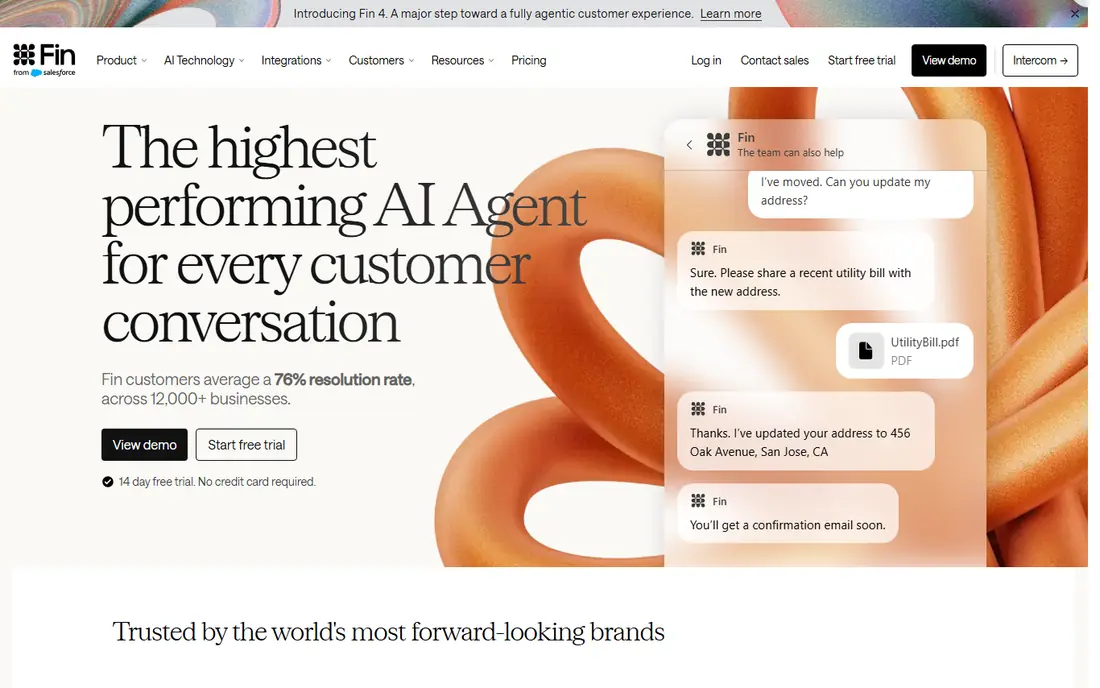
Intercom Fin is the most accessible enterprise-grade alternative in this list because it publishes its price and does not force a helpdesk migration. At $0.99 per resolution in our research, with a minimum volume on some plans, teams can model cost from expected resolutions rather than guessing from a quote. Fin handles chat and email, pulls answers from help content, and hands off with context when it cannot resolve an issue.
The detail to read is the resolution definition, including how abandoned chats and silent customers are counted. That definition affects the bill as much as the headline rate. Even with that caution, Fin earns the top place for teams that want a fast start, a clear price, and the option to keep their current helpdesk.
- Published per-resolution pricing
- Can run on Intercom or other helpdesks
- Fast deployment for digital support
- Seat fees apply on Intercom plans
- Resolution definition needs reading
- Voice needs a separate plan in some cases
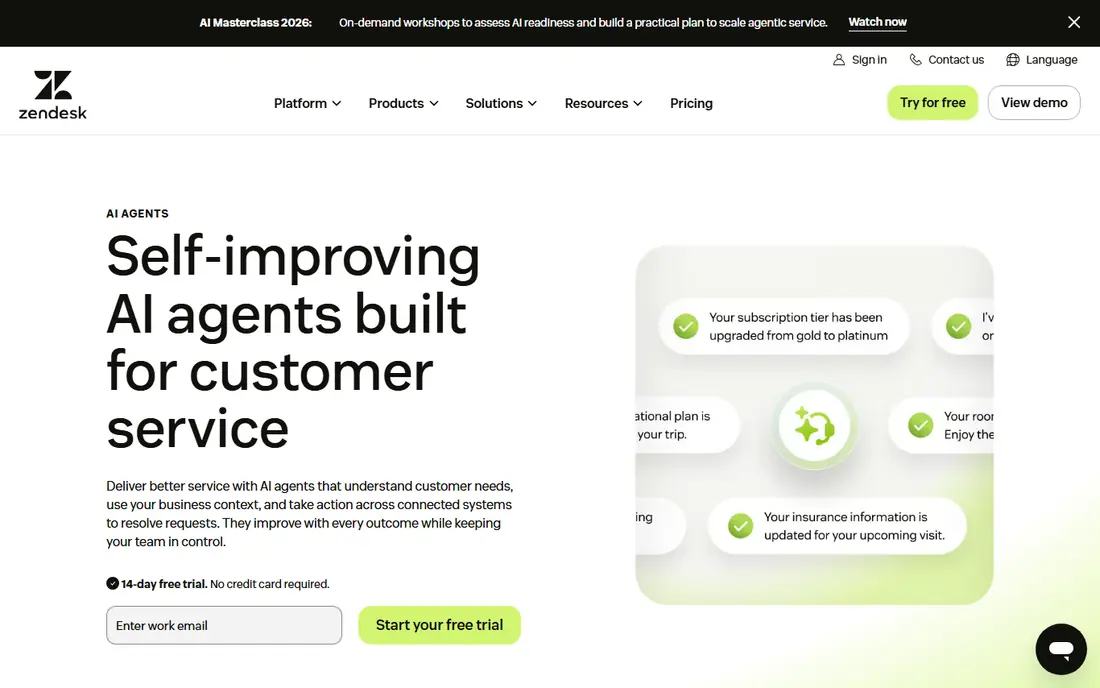
Zendesk AI Agents suit teams that already run Zendesk, because the agent lives inside the ticketing, messaging, and knowledge system the team already uses. Automated resolutions are billed in addition to Suite seats, with published resolution rates reported around $1.50 to $2 in recent comparisons. For a Zendesk team, that native fit reduces integration work and keeps reporting in one place.
Teams outside Zendesk should weigh migration cost against that benefit. If you are happy with Zendesk, the AI agent is a natural next step. If you plan to leave Zendesk, a helpdesk-agnostic tool such as Fin or eesel AI may be a better long-term choice.
- Native to Zendesk ticketing and messaging
- Automated resolutions with seat plans
- Strong admin and reporting tools
- Best value inside Zendesk
- Per-resolution costs add to seat fees
- Setup needs good help content

Ada fits large teams with high digital support volume and a need for multilingual coverage. Its no-code builder lets CX teams design agents without engineering for every change, and its automation focus suits repetitive questions at scale. For global brands, that combination of volume handling and language coverage is a real advantage.
Smaller teams should note the sales-led model and volume floors, which can make Ada costly for low volume. It also depends on clean help content, so a team with thin knowledge articles will see weaker results until that content improves. For high-volume teams with a real automation goal, Ada is a strong alternative.
- Strong automation for high-volume digital support
- Multilingual coverage
- No-code agent building for CX teams
- Quote-only pricing
- Volume floors suit larger teams
- Needs good knowledge content to perform well
Sierra targets enterprises that want an AI agent to reflect their brand voice and pursue commercial outcomes, not just answer FAQs. Its agents cover chat and voice, take actions in connected systems, and are built with heavy customization for large brands. For a company where support is part of the brand experience, that depth matters.
The trade is cost and time. Sierra deals are outcome-based and quote-only, with large enterprise contracts, and implementation runs longer than a plug-and-play tool. Teams without the volume, budget, and CX operations capacity to support a custom build should choose a faster tool first and revisit Sierra when scale justifies it.
- Deeply customized brand voice and actions
- Chat and voice coverage
- Outcome-based pricing on enterprise deals
- Quote-only enterprise pricing
- Longer implementation for custom builds
- Needs a dedicated CX operations team
Salesforce Agentforce is the natural AI agent for organizations standardized on Salesforce. Because it sits inside Service Cloud and CRM data, it can pull customer history, orders, and cases without a separate integration project. The published rate of about $2 per conversation in our research makes cost modeling easier than a quote-only deal, though volume still matters.
Teams outside Salesforce will not get the same benefit, and full value may need Data Cloud setup. If your support, sales, and service data already live in Salesforce, Agentforce is a strong alternative. If not, a helpdesk-agnostic agent will be simpler to deploy.
- Native to Salesforce Service Cloud and CRM data
- Conversation-based pricing published
- Voice and chat coverage
- Best value inside Salesforce
- Needs Data Cloud setup for full value
- Per-conversation cost adds up at volume
Freshworks Freddy AI suits teams already on Freshdesk that want AI agents without leaving their helpdesk. Session-based pricing, with packs reported in recent comparisons, lets smaller teams buy AI capacity in chunks rather than signing a large enterprise deal. For budget-conscious teams, that model is easier to trial.
The limit is depth. Freddy is a strong helpdesk-native agent, but it will not match Sierra or Ada for deep custom brand builds. If your team already uses Freshdesk and wants a practical AI step, Freddy is a good fit. If you need a standalone agent across many systems, look at Fin or eesel AI.
- Native to Freshdesk
- Session-based AI agent pricing
- Good fit for budget-conscious teams
- Best value inside Freshworks
- Session packs need volume planning
- Less deep customization than enterprise agents
Help Scout AI Answers fits small to mid-size teams that want AI help without an enterprise project. The helpdesk itself is known for simplicity, and AI Answers draws on your help documentation to resolve common questions. Recent comparisons report AI Answers pricing around $0.75 per resolution, which helps small teams model cost.
It will not replace an enterprise agent for high-volume, multi-system automation. For a team with a clear set of common questions and a good help center, though, it is a low-friction alternative. Clean up your help docs first, and the AI will perform noticeably better.
- Simple setup for small teams
- AI answers from your help docs
- Predictable helpdesk pricing
- Less enterprise depth than Ada or Sierra
- AI resolution pricing adds to seats
- Needs clean help docs
Gorgias AI Agent suits Shopify and ecommerce teams whose support is dominated by order status, shipping, returns, and product questions. Because Gorgias is both the helpdesk and the AI layer, it can pull order data directly and resolve those questions without a separate integration. Recent comparisons report AI Agent pricing around $0.90 per resolution on annual plans.
For non-ecommerce teams, that focus is a limit, and the tool will feel narrow. For a Shopify store with repetitive order questions, it is one of the most practical alternatives in this list, because the data it needs is already in the system it runs on.
- Built for Shopify order and shipping questions
- Ticket-based helpdesk plus AI agent
- Social and email coverage
- Ecommerce focus limits general use
- AI usage adds to ticket plans
- Needs Shopify data to shine
eesel AI fits teams that want to keep their current helpdesk but add an AI layer on top. It connects to Zendesk, Freshdesk, Slack, Intercom, Salesforce, and other systems, and it prices by fixed monthly credits, starting at $299 per month for 500 credits in recent comparisons. That model suits teams that want predictable monthly cost without a large enterprise contract.
The credit model needs planning, because each ticket or chat consumes credits, and high volume will need a larger plan. It also offers less deep brand customization than Sierra. For a mid-market team that wants AI without migration, eesel AI is a practical and transparent alternative.
- Layers on Zendesk, Freshdesk, Intercom, and Salesforce
- Fixed monthly credits
- Free credits to trial
- Credit model needs volume planning
- Less brand customization than Sierra
- Needs helpdesk integration setup
How we picked these
We compared official feature pages, pricing pages, and public documentation, and we favored agents that are available in October 2026, that resolve real customer conversations, and that hand off to humans with context. We included helpdesk-native, CRM-native, and helpdesk-agnostic options because teams switch for different reasons, including migration cost and channel needs. Where a price could not be verified, we wrote "See website" rather than guessing.
How to compare AI agent pricing fairly
Model your monthly conversations, your resolution rate on simple questions, and your seat count, then compare total monthly cost, not just the per-resolution rate. Read the resolution definition, check whether abandoned chats count, and ask how voice, email, and chat are billed separately. Trial with your real tickets, not a vendor demo set, and measure resolution, handoff quality, and customer satisfaction before you sign a long term.
Content and handoff checklist
Before launch, clean your help center, define which actions the agent may take, and set clear handoff rules for billing, account, and sensitive issues. Test the agent on your ten most common tickets, review its answers for accuracy, and keep a human review step for the first weeks. That checklist matters more than any feature list.
Frequently asked questions
What is the best Decagon alternative?
Intercom Fin is the best choice for most teams, because it publishes per-resolution pricing and can run on several helpdesks. Zendesk AI Agents suit existing Zendesk teams, Salesforce Agentforce suits Salesforce teams, and Ada and Sierra suit high-volume enterprise teams. Model your volume before you choose.
How much do AI support agents cost?
Pricing combines seat fees with per-resolution or per-conversation charges. Fin costs about $0.99 per resolution, Agentforce about $2 per conversation, and several enterprise tools are quote-only. Always model total monthly cost for your conversation volume, not just the headline rate.
Will an AI agent replace my support team?
For most companies, no. AI agents absorb repetitive tier-one volume, such as order status and password resets, so human agents can focus on complex and high-value conversations. Handoff quality matters more than headcount math, because a bad handoff creates more work than it saves.
Can AI agents work with my existing helpdesk?
Yes, for several tools in this list. Fin and eesel AI can run on Zendesk, Freshdesk, Intercom, Salesforce, and other helpdesks without a full migration. Zendesk AI Agents, Freddy AI, and Agentforce work best inside their native platforms, so check your current helpdesk before you shortlist.
How long does implementation take?
Simple tools such as Fin and Help Scout can go live in days to weeks, while mid-market tools such as Ada usually take a few weeks. Enterprise custom builds such as Sierra can run six to twelve weeks, depending on integrations and brand customization. Clean help content shortens every timeline.
Sources
See where you really rank - block by block
ProMapRanker scans Google Maps across a grid of your service area. Simple monthly plans from $19, white-label on every plan.
Start freeKeep reading
 zscaler alternatives
Best Zscaler Alternatives in 2026
Looking for zscaler alternatives? We compare 9 SASE and zero trust platforms on architecture, data protection, pricing, and fit for your network and team.
Read → zapier alternatives free
Best Zapier Alternatives Free in 2026
Nine automation tools for zapier alternatives free in 2026, all with genuinely free tiers, plus free plan limits, starting prices and upgrade paths explained.
Read → which platform is best for online reputation
Which Platform Is Best for Online Reputation in 2026
Wondering which platform is best for online reputation? We compare 8 review, listing, and response tools for small and multi-location businesses and agencies.
Read →